Red Robin used to be a sure thing. Chances are, you've heard the jingle "Red Robin... YUMMMMM!"
In 2015, the stock hit an all-time high close of $92.90. In 2017, revenue peaked around $1.4B, and the chain was running roughly 573 restaurants. Fiscal 2024 ended with a net loss. As of February 19, 2026, the market cap sits around $67M, with the stock hovering around $3.75. (as of 2/20/26)
That is not just a restaurant story. It is an organizational development story.
Most declines do not start with "we stopped caring about customers." They start with "we had to protect margin." Leadership makes a change that looks clean in a spreadsheet and brutal in the dining room. That gap, between what looks efficient and what actually works, is where culture debt forms.
Culture debt, in plain language
Culture debt is what you accumulate when you remove the support that makes great work possible.
It is rarely loud at first. It shows up as friction. More steps. More resets. More "I'll get to that when I can." Eventually, the debt calls in its balance. Usually on a Friday night. And the group that pays it first is the frontline, the people closest to the customer.
The invisible roles that were not invisible
On paper, those can look like support roles. In reality, they are operational scaffolding.
Bussers protect table readiness and dining room pace. Expeditors protect flow between kitchen and guest. They absorb chaos in the exact moments the restaurant is most stressed. When you cut those roles, you are not adjusting headcount. You are rewriting how the work gets done.
Work does not disappear. It relocates.
This is what leaders most often underestimate.
The plates still stack. Tables still need resetting. Food still has to arrive in rhythm. Someone still does it. So the work moves. Usually to servers and managers, the very people you need focused on hospitality, not scrambling to hold the machine together.
And it does not show up at 2:00 p.m. on a quiet Tuesday. It shows up at peak. When the frontline is already stretched. That is why the customer experience starts to wobble.
You do not need a model to feel the second-order effects. Slower turns. Longer waits. More mistakes. Less warmth. Fewer repeat visits. Frontline friction becomes customer friction, and the compounding is faster than most leaders expect.
Culture is what your organization makes easy
We talk about culture like it lives in slogans and wall art.
It does not. Culture is what your org chart and your staffing model make easy. Culture is what people have time to do.
It does not. Culture is what your org chart and your staffing model make easy. Culture is what people have time to do.
Strip the roles that protect cleanliness, pace, and the handoff between kitchen and table, and you are sending a message. You are telling the frontline: absorb it. You are telling the guest: hope for the best.
Great teams will push through for a while. They always do. Then the debt compounds. Burnout climbs. Standards slip quietly, not because people stopped caring, but because the system stopped supporting caring. That is a different problem, and harder to reverse.
Leadership churn makes the debt compound faster
Layer in the whiplash of constant strategy resets.
When leaders rotate and new turnaround plans arrive, the frontline does not experience vision. They experience a series of resets. New priorities. New messaging. New metrics. Same constraints.
Stability is not boring inside an organization. It is oxygen.
If the frontline cannot trust that leadership will protect the basics, they stop building habits and start building coping mechanisms. That shift is quiet. It is also expensive.
What “getting it right” looks like right now
Some brands are winning in casual dining right now. Not through luck. Through deliberate operational investment.
Chili's is the clearest example. Their fiscal Q2 2025 performance included a roughly 31% increase in comparable sales, driven by traffic, value, and a sharper focus on execution. That result did not come from a marketing campaign. It came from making it easier for the frontline to deliver on the promise.
Texas Roadhouse has been posting positive comps consistently. LongHorn Steakhouse reported same-restaurant sales up 5.9% in fiscal 2026 Q2. Different brands, same underlying logic: protect the experience, support the people delivering it, and let the frontline win.
TikTok can amplify momentum. It cannot create operational trust. When the experience holds, people talk. When it does not, they warn each other.
A tool leaders can use before cutting “invisible” roles
The presence of culture debt is not an end. Like technical debt, it accumulates quietly and reverses slowly. Every organization is carrying some level of it and any organization can regain footing. But recovery requires an honest look at where the customer promise is breaking and who is closest to it.
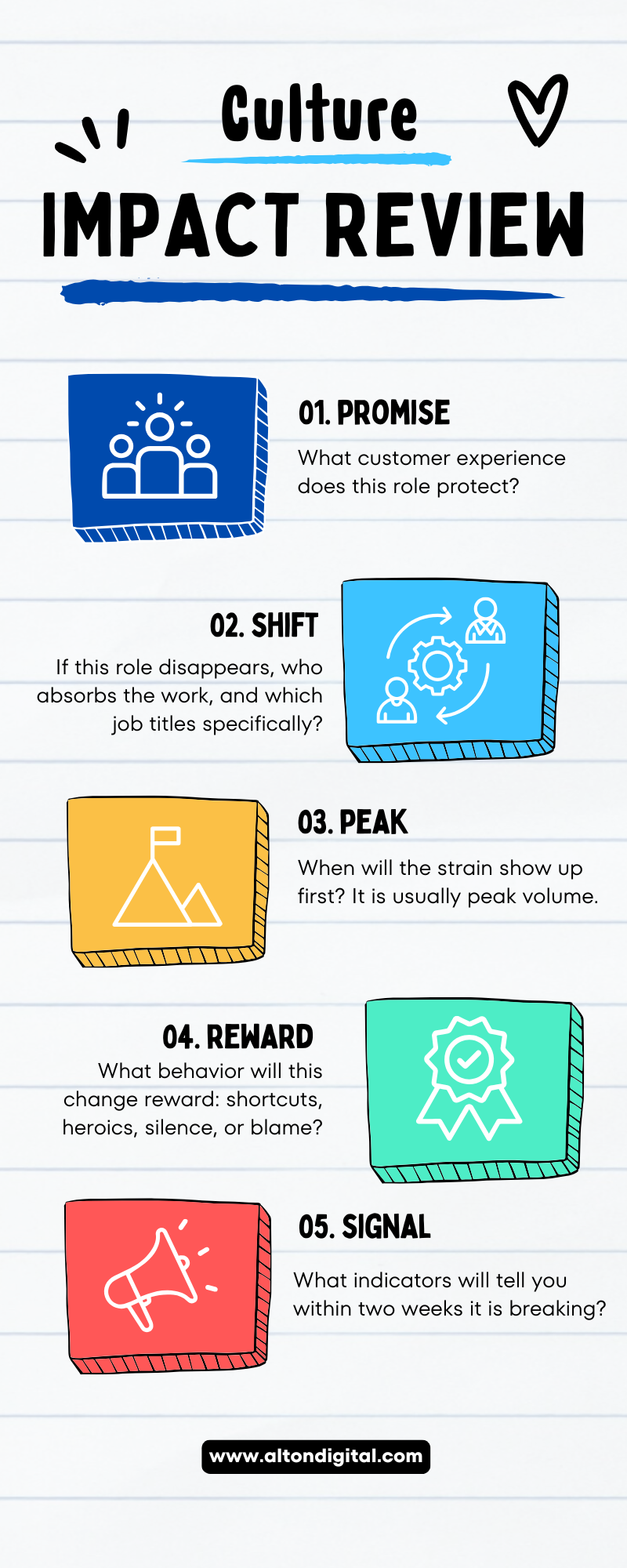
Before you eliminate a role, consider running a a Culture Impact Review. Simply ask these five questions.
Before you eliminate a role, consider running a a Culture Impact Review. Simply ask these five questions.
- What customer promise does this role protect, whether that is speed, cleanliness, warmth, accuracy, or safety?
- If this role disappears, who absorbs the work, and which job titles specifically?
- When will the strain show up first? Be honest. It is usually peak volume.
- What behavior will this change reward: shortcuts, heroics, silence, or blame?
- What leading indicators, wait times, walkaways, complaints, callout patterns, turnover signals, will tell you within two weeks that something is breaking?
If your answers keep landing on "the frontline will figure it out," that is not a strategy. That is a balance transfer.
What are the bussers in your organization?
Every organization has roles that are easy to cut and slow to replace. They do not always touch revenue directly. They protect the customer promise. They keep the machine workable.
Start there. Not as a slogan. As a design principle.
Because the customer meets your culture through the people closest to them. When you protect that group, you are not just being generous. You are being smart.
Stay Curious!
Colt
Stay Curious!
Colt