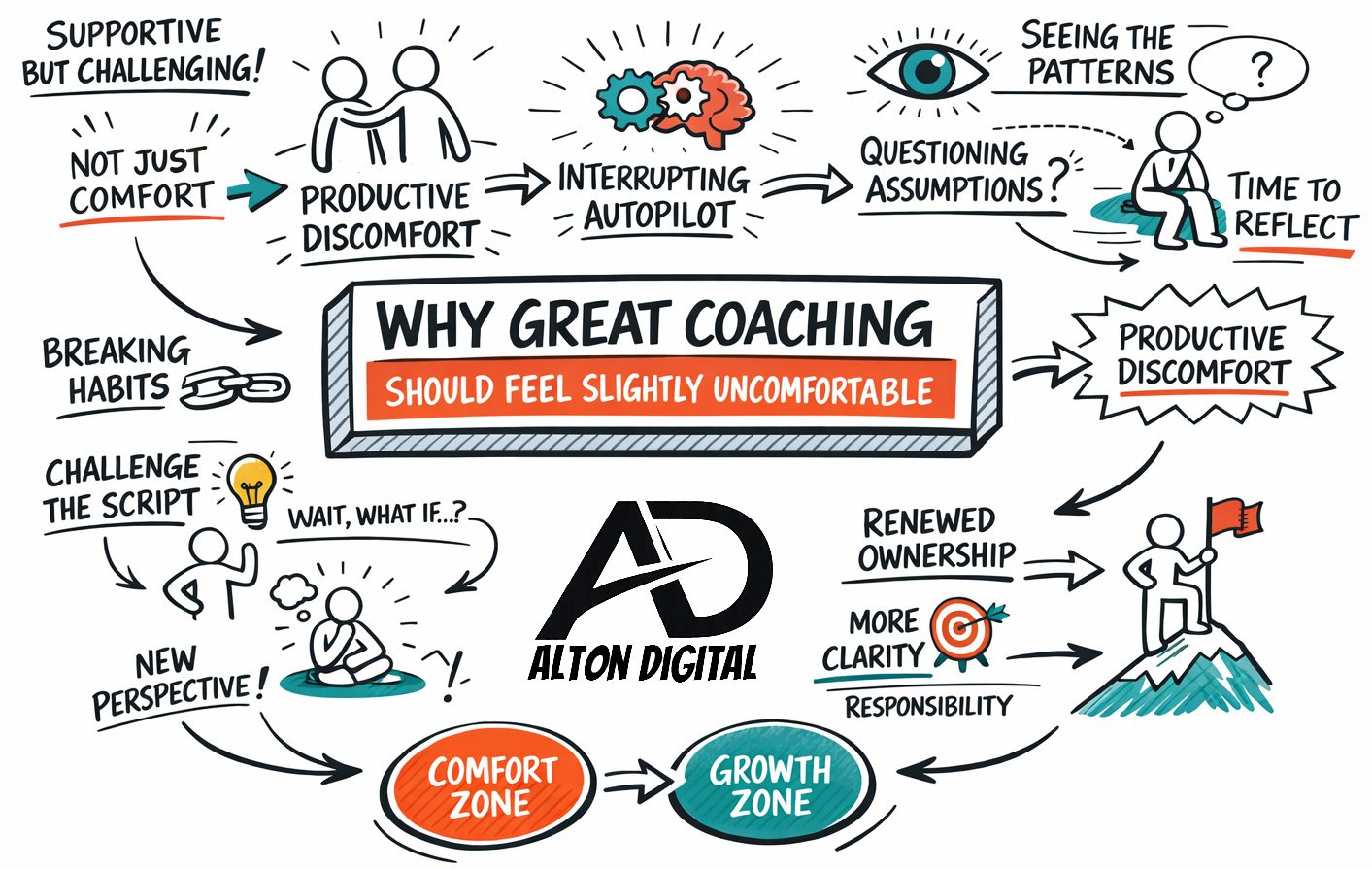
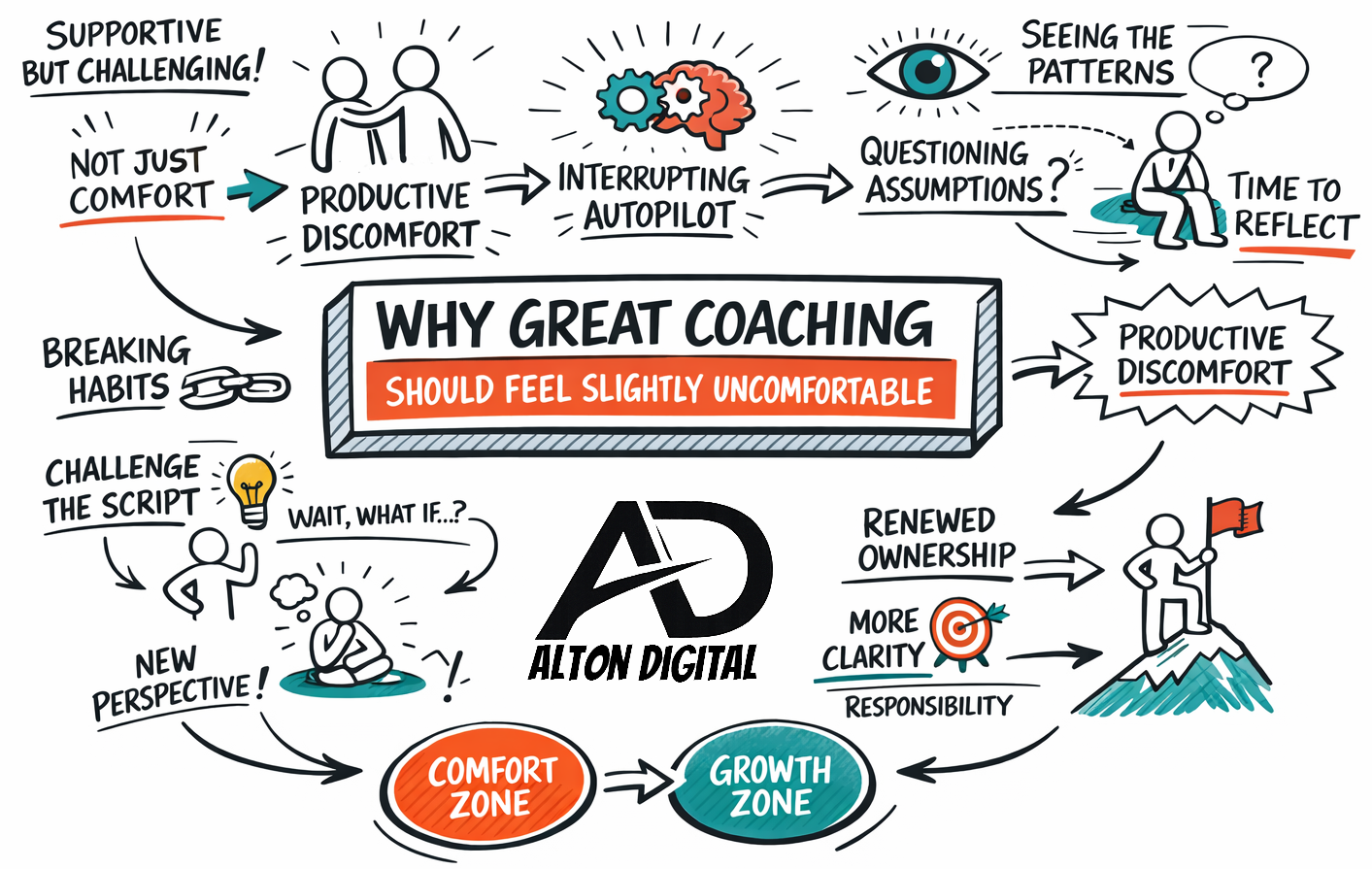
Why Great Coaching Should Feel Slightly Uncomfortable
Most people think coaching should feel supportive. That is true, but incomplete.
Good coaching should feel supportive in the same way physical therapy is supportive. There is care in it. There is skill in it. But there is also pressure on the part that is not working the way it should. That tension is not a flaw in the process. It is often where the real work begins.
Because most of us do not need one more encouraging sentence floating across a Teams chat. We need help seeing the pattern we are stuck in while we are still inside it.
That is where coaching earns its keep.
Most people think coaching is support
When people hear the word coaching, they often picture encouragement. A thoughtful question. A reassuring nod. Someone who helps another person feel seen.
Don’t get me wrong…all of that matters. None of it is wrong.
But if coaching never moves beyond comfort, it starts to lose its value. It becomes affirmation with nicer branding. It helps people feel heard, but not necessarily changed.
The best coaching conversations do something more demanding than that. They create a moment where a person has to stop and really examine what they are doing, what assumption they are carrying, or what story they have been repeating without ever testing it.
That moment is not always dramatic. Sometimes it looks like silence. Sometimes it sounds like, “I had not thought about it that way.”
But that pause matters.
Not because the coach said something brilliant. Not because the conversation suddenly became profound. It matters because the person has stepped, even briefly, out of the script they were about to run again.
That is the work.
Autopilot is the real obstacle
One of the reasons coaching matters so much is that human beings are built for efficiency. We rely on shortcuts. We make fast judgments. We repeat familiar interpretations because they save time and energy.
The brilliant Daniel Kahneman’s work is useful here. In Thinking, Fast and Slow, he describes the difference between fast, automatic thinking and slower, more deliberate thinking. His broader body of work reshaped how we understand judgment and decision-making, and his Nobel biography offers a good window into why that work matters so much.
This shows up in coaching all the time. A lot of what looks like conviction at work is really autopilot.
I already know how this conversation will go.
That person never takes ownership.
This is just how I am.
This is the only realistic option.
Sometimes those statements are true. Often they are just familiar.
A coach is not there to shame someone for having those mental grooves. We all have them. A coach is there to slow the moment down enough for a person to notice the groove before they fall into it again.
That is why great coaching can feel slightly uncomfortable. It asks someone to leave the speed of instinct and enter the effort of reflection. It asks them to question a familiar interpretation before turning it into a conclusion.
That is not always pleasant. But it is often the beginning of better thinking.
Great coaching creates productive discomfort
Of course, not all discomfort is useful. Some pressure shuts people down. That type of pressure is not productive and should be avoided.
But productive discomfort is different.
It happens when someone is gently, skillfully confronted with a pattern they can no longer ignore.
The manager who says they want accountability, but solves every problem before the employee has a chance to think. The team member who says they want growth, but avoids every conversation that might expose a weakness. The leader who says they value trust, but still reaches for control at every meaningful decision.
A good coach does not attack the person. A good coach makes the pattern visible.
That is a big difference.
Sometimes the most useful moment in a coaching conversation is not the answer. It is the pause right before the answer, when someone realizes the script they were about to repeat is no longer fully convincing.
That is not a polished moment. It is not efficient. It is rarely comfortable.
It is just honest. And honesty is often where movement begins.
The goal is not dependence. It is renewed ownership
This is where coaching gets especially important.
A lot of leaders think good coaching means being consistently helpful. Always available. Always ready with insight. Always able to guide the conversation to a productive next step.
There is generosity in that instinct, but there is also risk. Because the moment coaching turns into dependence, it stops being coaching.
The real aim is not to become someone’s favorite source of answers. It is to help them reclaim responsibility for their own thinking. A strong coaching conversation should leave a person with more ownership, not more reliance. More clarity about what matters. More awareness of the story they have been telling. More willingness to sit with a hard truth instead of rushing past it. More capacity to choose with intention instead of reacting from habit.
That is why I do not think the best coaching always feels comfortable. Sometimes comfort is a sign that nothing essential has been touched. Sometimes the better sign is a pause, a longer silence than usual, or the moment someone realizes they may have been seeing the situation through too narrow a lens.
That is not failure. That is the conversation reaching something real.
Because great coaching is not about making people feel better as quickly as possible. It is about helping them see clearly enough to move forward with purpose. And clarity, at least the kind that actually changes us, usually arrives with a little friction.
Stay curious!
Colt
About Colt Alton
Hey! I'm Colt. By trade and training, I help develop people and organizations. Subscribe below to follow my thinking on building impactful learning experiences, learning technology and product development, and whatever else is on my mind. Thanks for visiting, thanks for reading.