The longer you wait, the longer you should expect to wait
Taleb's qualitative mechanism
Taleb explains the mechanism qualitatively in his book "The Black Swan".
People think:
It has already lasted so long. Surely it should end soon.
But for some events, the fact that the event is still ongoing is not evidence that it is close to ending.
It is evidence that the event may belong to a different class.
In his stories about war and exile, people keep treating a state as temporary even after "temporary" has survived for years. The failed update is the important part.
The question is not only:
How long do these things usually last?
The better question is:
Given that this thing has already lasted this long, how much longer should I expect?
Mathematical formulation
Let total duration be Pareto as durations involving human systems with 'unknown unknowns' (scope creep, political instability, hidden dependencies) often follow power-law tails:
X ~ Pareto(s, alpha)
where:
s = minimum possible duration
alpha = tail parameter
lower alpha = fatter tail
The object we are interested is:
E[X - t | X > t]
where:
t = how long we have already waited
X > t = the event is still ongoing
X - t = remaining wait
This is conditional expected remaining duration.
It is the mathematical version of Taleb's qualitative mechanism.
Conditional survival
For this Pareto distribution, the survival function is:
S(x) = P(X > x) = (s / x)^alpha
This gives the unconditional probability that the total duration is longer than x. Suppose we observe the event still ongoing after elapsed time t. In notation, this observation is:
X > t
If we ask whether it lasts x more, the total duration must be greater than:
t + x
So the first object is:
S(t + x) = P(X > t + x)
And now we can condition on the observation:
X > t
The conditional survival for the remaining wait is:
P(X > t + x | X > t)
By conditional probability, since X > t + x implies X > t (looks straight-forward but it takes some effort to prove memoryless property rigorously):
P(X > t + x | X > t)
  = P(X > t + x) / P(X > t)
  = S(t + x) / S(t)
Plug in the Pareto survival function:
P(X > t + x | X > t)
  = (s / (t + x))^alpha / (s / t)^alpha
  = (t / (t + x))^alpha
This has the same shape as the original Pareto survival function, but with t as the new scale.
So:
X | X > t ~ Pareto(t, alpha)
Expected remaining duration
For Pareto, when alpha > 1 and given s:
E[X] = alpha / (alpha - 1) * s
Therefore the expected remaining wait is:
E[X | X > t] = alpha / (alpha - 1) * t
E[X - t | X > t]
  = E[X | X > t] - t
  = alpha / (alpha - 1) * t - t
  = t / (alpha - 1)
Note that this grows linearly with t. The longer you've waited, the longer you should expect to keep waiting — in absolute time. This is the opposite of the regression-to-the-mean intuition most people have.
This gives a rigorous form to the qualitative claim:
The longer you have already waited, the longer you should expect to keep waiting.
Not because of pessimism but because conditioning on survival changes the distribution you are looking at.
Emigration
Taleb's exile examples fit this structure. People leave because the situation is expected to be temporary. They wait in hotels, temporary apartments, or with relatives. At first the question is:
When do we go back?
But after years, the more useful question becomes:
Given that exile has already lasted this long, what kind of duration process are we in?
The fact that return has not happened is not neutral information. It should update the forecast.
Example:
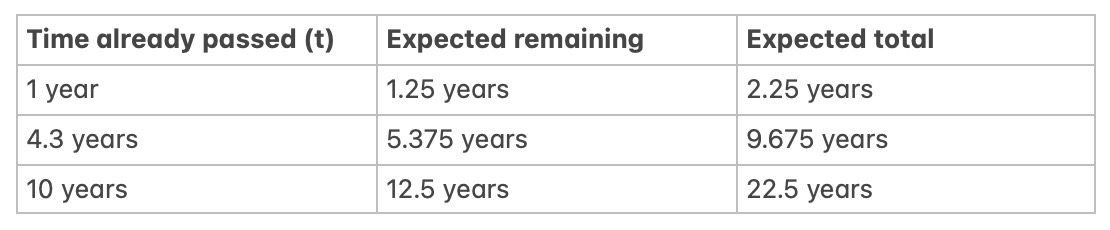
alpha = 1.8
s = 0.5
t = 4.3
Then:
E[X - t | X > t] = t / (alpha - 1)
                 = 4.3 / 0.8
                 = 5.375
So after 4.3 years in exile, the expected remaining wait is about 5.4 more years.
The expected total duration becomes:
E[X | X > t] = t + E[X - t | X > t]
             = 4.3 + 5.375
             = 9.675
About 9.7 years total.
Example with α = 1.8
Project delay
The same mechanism appears in ordinary project work. A project is estimated at 2 weeks. After 2 months it is still "almost done." The naive update is:
It is already late, so surely it must finish soon.
The conditional-expectation update is:
This project has already survived far beyond the original estimate.
Maybe it belongs to the class of projects with hidden scope, bad dependencies, or unknown unknowns.
The delay is not just bad news about the schedule. It is information about the process.
Closing
Taleb gives us the mechanism qualitatively. The math shows it’s not pessimism — it’s correct Bayesian updating under fat tails. The next time you hear 'this is only temporary,' ask yourself: how long has this temporary situation already survived? The answer might tell you more than any original forecast."