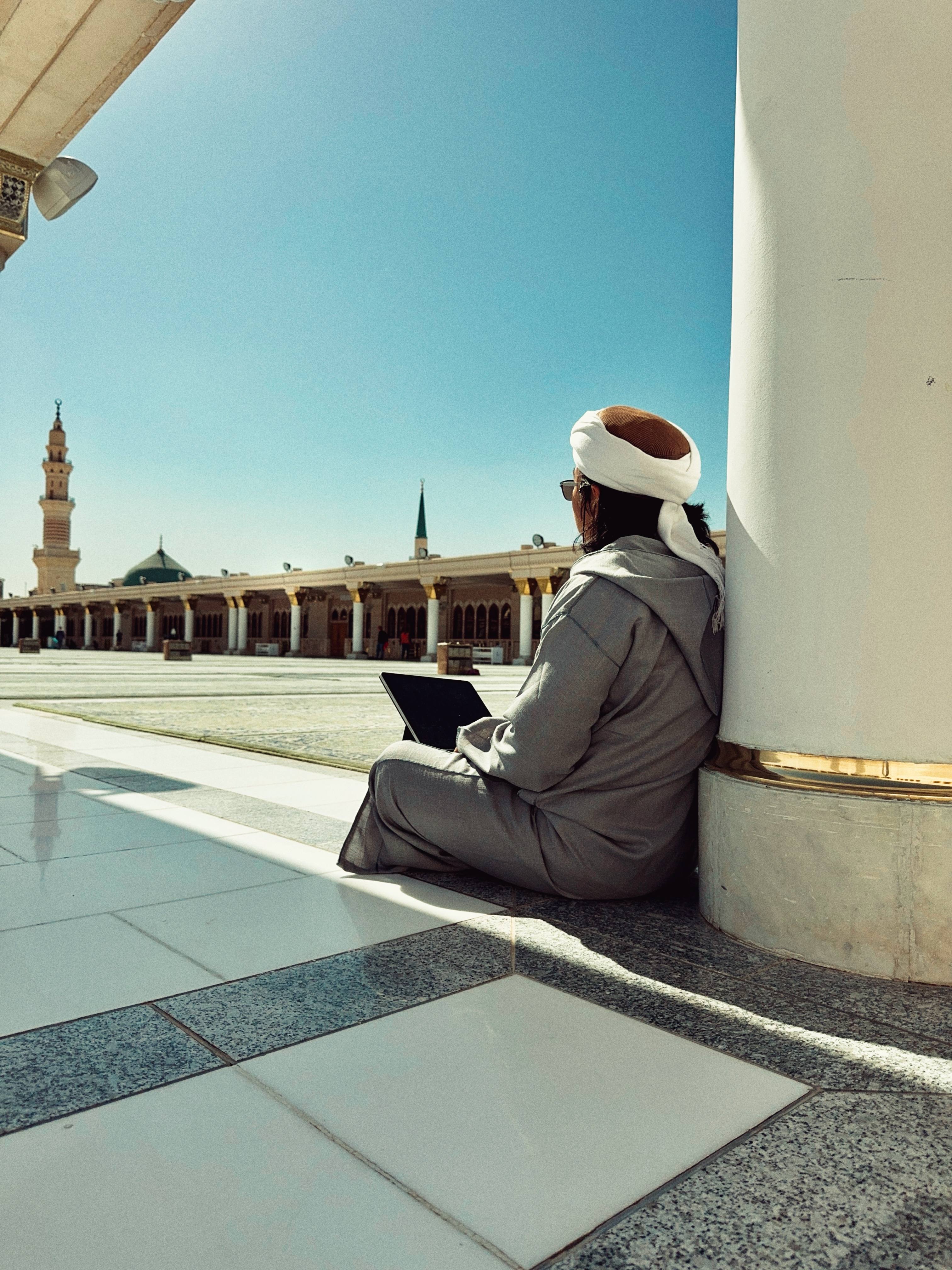
The author embarking on his writing journey in Madinah
Introduction
Grounded {Daily}
A Practical Guide to Living the Day with God
______________________________________
______________________________________
Why This Book Was Written
This book did not begin as a project.
It grew slowly, over years, through teaching, listening, and concern.
Three motivations, unfolding at different times, eventually came together and gave this book its shape.
⸻
1. What Teaching Revealed
For more than a decade, I have been involved in running a weekend madrasah in Perth. Working closely with children, teenagers, and young adults has been a privilege — but it has also been deeply instructive.
Over time, a pattern became difficult to ignore.
For many Muslims, Islam had been narrowed to questions of halal and haram. These are important questions, and necessary ones. But they are not sufficient on their own.
Many young Muslims were learning what is permitted and what is forbidden, yet struggling inwardly. Anxiety, restlessness, emotional fragility, and a quiet sense of dissatisfaction were increasingly common — even among those who were practising.
When they searched for calm, meaning, or emotional resilience, many turned elsewhere: to self-help figures, motivational speakers, or modern wellness movements.
Not because Islam lacked answers,
but because those answers were no longer being presented as a living, integrated way of life.
Our tradition does not only teach us rules.
It teaches us how to stand, how to endure, how to remain inwardly steady, and how to live with God at the centre of the day.
This book is, in part, an attempt to recover that balance.
⸻
2. A Repeated Question
Alongside this, a simpler and more personal request kept recurring.
Friends and students would ask:
“Where do I begin — simply?”
They were not looking for advanced texts, philosophical discussions, or technical detail. They wanted a clear starting point.
Something:
• written in accessible English
• with Arabic fully transliterated and translated
• practical enough to live by
• simple enough to sustain
They were not asking how to become scholars or ascetics.
They were asking how to start a spiritual journey without becoming overwhelmed — and how to keep going.
This book is written with them in mind.
⸻
3. Conversations That Gave the Book Its Shape
The final push for this book came through two separate conversations, at different times, with two of my teachers:
Habib Kadhim as-Saqqaf and Shaykh Ahmed Mamdouh Saad.
Each comes from a different scholarly and spiritual tradition — the Ba ʿAlawī and the Azhari — yet both traditions are known for a balanced approach to religion, where sound reason, outward practice, and inner spirituality are held together rather than separated. Both teachers are also deeply aware of the realities of the modern world and the pressures faced by Muslims living within it.
In each conversation, the question I asked was essentially the same.
We spoke about the speed at which the world is changing.
Some changes bring benefit.
Many bring pressure, instability, and quiet harm.
I asked:
“What can we do to protect ourselves?”
In both conversations, the answer was strikingly similar.
Dhikrullāh.
Not as a retreat from life,
but as a way of remaining connected to Allah while fully engaged with the world.
In both discussions, the conversation then turned naturally to how remembrance should begin. Not everything can be carried at once. Many people today are already burdened — spiritually, emotionally, physically, and materially.
Both teachers emphasised that the Prophetic way of remembrance is meant to be approached gradually:
• beginning with what is most essential
• establishing consistency before expansion
• and deepening only as capacity grows
They also reminded me that spiritual practices are not limited to addressing inner unease or psychological strain. Connection to Allah strengthens a person in material difficulty, physical hardship, and the pressures of everyday responsibility as well. Dhikr does not replace effort, treatment, or planning — but without it, effort becomes anxious, hardship heavier, and material concerns quickly overwhelm the heart.
From these two conversations — separate in time, yet closely aligned in insight — the structure of this book became clear.
My role here has not been to invent a new method, but to compile and organise this shared guidance into a clear, step-by-step approach to living with God in a distracted world: one that begins simply, remains sustainable, and grows naturally with consistency — a Grounded life.
This book follows that path.
⸻
What This Book Is — and Is Not
This book is not about doing more.
It is about doing what already fills your day — with presence.
It is not meant to overwhelm.
It is meant to ground.
It does not promise transformation overnight.
It offers a way to walk steadily, day after day, with God in mind.
That is what Grounded {Daily} is for.
⸻
A Personal Word
I do not write this book as a spiritual authority, nor as someone who has arrived. I write it as someone still seeking clarity, steadiness, and balance — for myself first, and then for those closest to me.
This book is part of my own effort to live more deliberately with God in mind, to resist drift, and to remain grounded amid the pressures of modern life. It is written for my own soul before it is offered to anyone else.
It is my hope — and my duʿāʾ — that I live up to the practices outlined in these pages, and that they become a source of steadiness and blessing for my wife and our daughters. If this book helps us order our days better, remain more present in prayer, and stay connected to Allah through remembrance, then it has fulfilled its purpose.
Any good found here is from Allah.
Any shortcomings are my own.