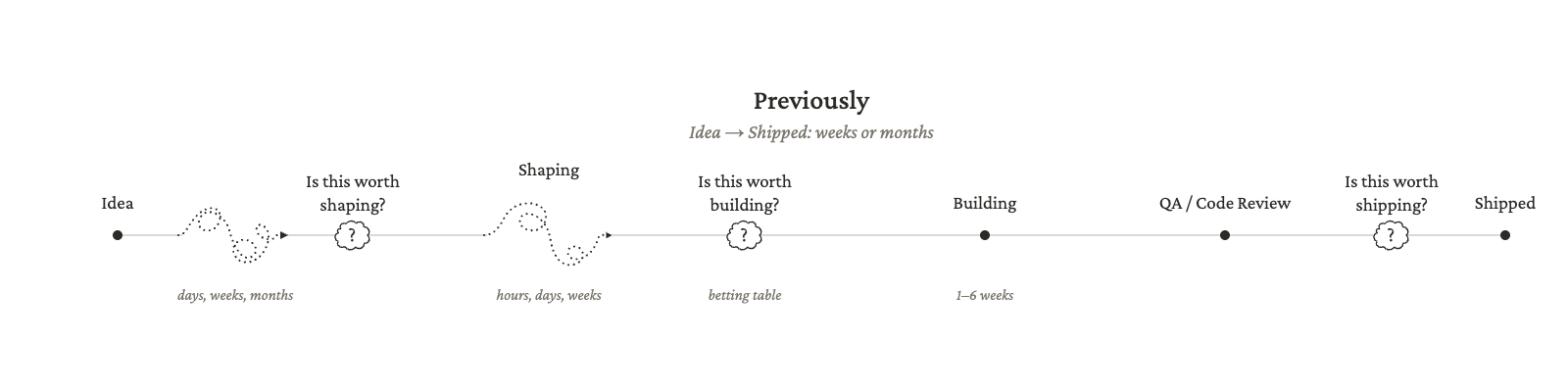
Let‘s start with two images. The first shows the typical journey of a feature from idea to reality in Shape Up before agent-driven development.
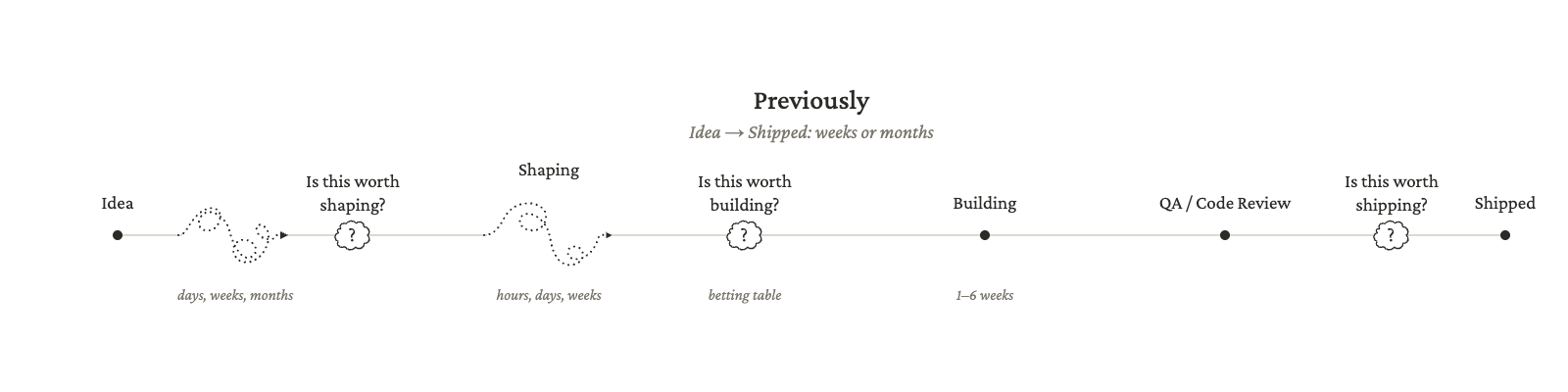
The second shows what‘s possible today.
The speed and effortlessness are magical. We‘ve shipped more features, improvements, and fixes faster than ever before. Things that have lingered on the someday list are live. Increasingly, a single person can build almost anything, including me. And this pace is just the beginning. We‘re still learning and optimizing this new way of working. There‘s no going back.
The previous timeline is excruciatingly slow in comparison. And it‘s true — so many steps, so many hurdles to clear! But every step refined and sharpened the idea.
Hundreds of ideas come up each week. Most are ephemeral, but a few take root, and a handful of those are worth shaping. In a typical cycle, we might shape a dozen or more ideas. Many of those never make it past the betting table.
As an idea is shaped, discussed, and debated, you peel the onion until you find the core of the problem and solution. You hit dead ends and start over. You set it aside because it‘s going nowhere and pick it back up when inspiration strikes weeks later.
Along the way, the idea bounces between different people. Each person brings their own expertise, experience, and perspective to it, first during shaping and betting, then as it‘s built. A programmer gives technical feedback during shaping, a designer and programmer team up to build it for the web, mobile programmers and designers build it for native apps, the QA team tests it, senior programmers review the code. Meanwhile, we’re living with it, trying it out, revisiting assumptions, and letting the whole thing simmer. Is this the right solution? Does it genuinely make the product better?
Now, every idea can come with a working PR attached to it. Building and shipping it might involve one or two people over the course of hours or a day.
Progress, absolutely, but it has a cost. It‘s incredible that I can build and ship an idea on my own, but I can‘t think of any idea I‘ve had that wasn‘t improved by people interacting with it, challenging it, pushing me to make it better. Jason and David share feedback on pitches. Designers and programmers bring judos that simplify everything or an idea that didn‘t seem essential until the feature was real. QA and coworkers call out things that suddenly seem obvious.
Agents accept the premise. Agents aim to please. Agents don't use the product every day. Agents don’t know that the last time we touched this feature we learned about unique ways customers use it.
Building software has always been collaborative, messy, and slower than we think it should be. It’s not a straight line from idea to a live feature. The twists and turns, the friction, and the constraints improve ideas and ensure that only the best survive.
With agents, everything is a straight line.
I don't have the answer yet. The question I'm thinking about every day is: How do we combine the magic with the messy?