Here's an interesting question for you: how can you remotely detect a fire in an era before modern smoke alarms existed?
Well, if you live in the early 1900s you can refer to your copy of The Boy Mechanic**, which was "one of many compliations [sic] of short how-to articles from Popular Mechanics, a monthly magazine of the late 19th century," (h/t retrotechnology.com) and look at the entry for "A Cheap Fire Alarm".
Well, if you live in the early 1900s you can refer to your copy of The Boy Mechanic**, which was "one of many compliations [sic] of short how-to articles from Popular Mechanics, a monthly magazine of the late 19th century," (h/t retrotechnology.com) and look at the entry for "A Cheap Fire Alarm".
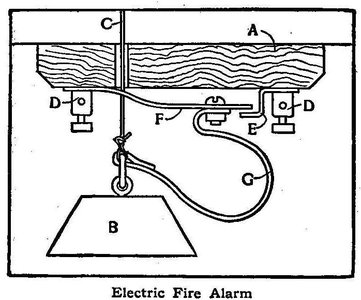
Electric Fire Alarm
An electrical device for the barn that will give an alarm in case of fire is shown in the accompanying diagram. A is a wooden block, which is fastened under the loft at a gable end of the barn; B is an iron weight attached to the string C, and this string passes up through the barn to the roof, then over a hook or pulley and across the barn, under the gable, and is fastened to the opposite end of the barn.
D D are binding posts for electric wires. They have screw ends, as shown, by which means they are fastened to the wooden block A. They also hold the brass piece E and the strip of spring brass F in place against the wooden block. G is a leather strap fastened to the weight B and the spring F connected to the latter by a small sink bolt.
{48}
At the house an electric bell is placed wherever convenient. Several battery cells, of course, are also needed. Dry batteries are most convenient. The battery cells and bell are connected in the usual manner, and one wire from the bell and one from the battery are strung to the barn and connected to the binding posts D D.
If a fire occurs in the hay-mow the blaze will generally shoot toward the gable soon after it starts, and will then burn the string C, which allows the weight B to fall and pull the brass spring against the iron piece E, which closes the circuit and rings the bell in the house.
If desired, the string may be stretched back and forth under the roof several times or drawn through any place that is in danger of fire.
Contributed by Geo. B. Wrenn, Ashland, Ohio.
Constraint compounds creativity. Although the fire codes of the 20th century probably mean that your barn would already be too far gone to save, I admire the ingenuity of a fire-detection system made of 10 items or fewer. Complexity is the default, which makes it amazing to me to find people who go against the grain that way.
* The Wikipedia entry for "Smoke detector" surprised me -- apparently the underlying technology was developed in the late 1930s, but didn't hit the consumer market till the 1950s.
** I first read the book when I was 10 or 11. Can't remember if it was from the library or a birthday present. I hadn't thought about it in years, but remembered it before bed last night when I was thinking absentmindedly about how gosh-darn creative people can be. I searched for it this morning and was pleasantly surprised to find it on Project Gutenberg.