Palladium 《王沪宁的胜利与恐惧》
Governance Futurism
The Triumph and Terror of Wang Huning
王沪宁的胜利与恐怖
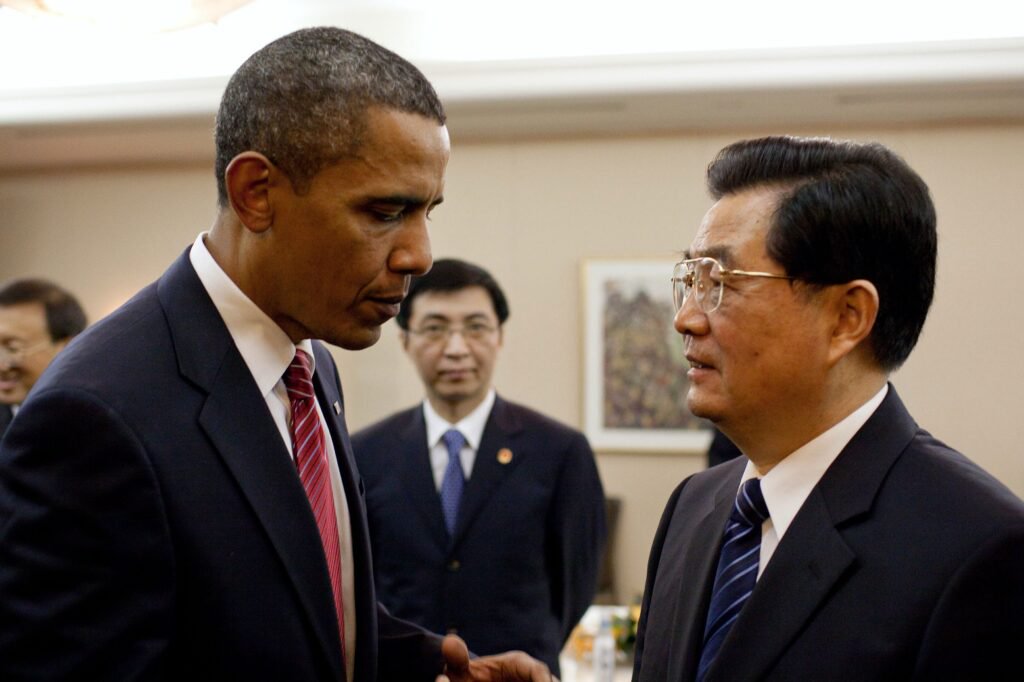 Official White House Photo/Wang Huning observes as Chinese President Hu Jintao speaks with U.S. President Barack Obama, Toronto
白宫官方照片/王沪宁注视中国国家主席胡锦涛与美国总统奥巴马在多伦多交谈
One day in August 2021, Zhao Wei disappeared. For one of China’s best-known actresses to physically vanish from public view would have been enough to cause a stir on its own. But Zhao’s disappearing act was far more thorough: overnight, she was erased from the internet. Her Weibo social media page, with its 86 million followers, went offline, as did fan sites dedicated to her. Searches for her many films and television shows returned no results on streaming sites. Zhao’s name was scrubbed from the credits of projects she had appeared in or directed, replaced with a blank space. Online discussions uttering her name were censored. Suddenly, little trace remained that the 45-year-old celebrity had ever existed.
2021 年 8 月的一天,赵薇突然消失了。作为中国最著名的女演员之一,仅仅从公众视野中物理消失就足以引发轰动。但赵薇的消失要彻底得多:一夜之间,她被从互联网上抹去。拥有 8600 万粉丝的微博账号下线,她的粉丝网站也随之关闭。在流媒体平台上搜索她参演的众多影视作品均无结果。赵薇的名字从她出演或执导作品的演职员表中被删除,代之以空白。提及她名字的在线讨论遭到审查。转眼间,这位 45 岁明星存在过的痕迹几乎荡然无存。
She wasn’t alone. Other Chinese entertainers also began to vanish as Chinese government regulators announced a “heightened crackdown” intended to dispense with “vulgar internet celebrities” promoting lascivious lifestyles and to “resolve the problem of chaos” created by online fandom culture. Those imitating the effeminate or androgynous aesthetics of Korean boyband stars—colorfully referred to as “xiao xian rou,” or “little fresh meat”—were next to go, with the government vowing to “resolutely put an end to sissy men” appearing on the screens of China’s impressionable youth.
她并非孤例。随着中国政府监管部门宣布"加强整治",旨在清除宣扬低俗生活方式的"低俗网红"并"解决饭圈文化乱象",其他艺人也开始从公众视野消失。那些模仿韩国男团明星阴柔或中性审美风格的艺人——被戏称为"小鲜肉"——成为下一批整顿对象,政府誓言要"坚决杜绝娘炮形象"出现在中国易受影响的青少年屏幕上。
Zhao and her unfortunate compatriots in the entertainment industry were caught up in something far larger than themselves: a sudden wave of new government policies that are currently upending Chinese life in what state media has characterized as a “profound transformation” of the country. Officially referred to as Chinese President Xi Jinping’s “Common Prosperity” campaign, this transformation is proceeding along two parallel lines: a vast regulatory crackdown roiling the private sector economy and a broader moralistic effort to reengineer Chinese culture from the top down.
赵薇及其娱乐界同行的遭遇,实则卷入了远比个人命运更宏大的时代浪潮:一系列突如其来的新政正在颠覆中国人的生活,官方媒体将其称为国家的"深刻变革"。这场被正式命名为习近平主席"共同富裕"倡议的变革,正沿着两条并行轨道推进:一方面是席卷私营经济领域的全面监管整顿,另一方面则是自上而下重塑中国文化的道德教化工程。
But why is this “profound transformation” happening? And why now? Most analysis has focused on one man: Xi and his seemingly endless personal obsession with political control. The overlooked answer, however, is that this is indeed the culmination of decades of thinking and planning by a very powerful man—but that man is not Xi Jinping.
但为何会发生这种"深刻变革"?又为何是现在?多数分析聚焦于一个人:习近平及其对政治控制看似无止境的个人执念。然而被忽视的答案是,这实际上是一位极具权势者数十年思考与谋划的必然结果——但此人并非习近平。
The Grey Eminence 《王沪宁的胜利与恐惧》
Wang Huning much prefers the shadows to the limelight. An insomniac and workaholic, former friends and colleagues describe the bespectacled, soft-spoken political theorist as introverted and obsessively discreet. It took former Chinese leader Jiang Zemin’s repeated entreaties to convince the brilliant then-young academic—who spoke wistfully of following the traditional path of a Confucian scholar, aloof from politics—to give up academia in the early 1990s and join the Chinese Communist Party regime instead. When he finally did so, Wang cut off nearly all contact with his former connections, stopped publishing and speaking publicly, and implemented a strict policy of never speaking to foreigners at all. Behind this veil of carefully cultivated opacity, it’s unsurprising that so few people in the West know of Wang, let alone know him personally.
王沪宁更偏爱阴影而非聚光灯。这位失眠的工作狂、戴眼镜且轻声细语的政治理论家,被昔日友人和同事描述为内向且极度谨慎。上世纪 90 年代初,时任中国领导人江泽民多次恳请这位才华横溢的年轻学者放弃学术道路——他曾满怀憧憬地谈及追随传统儒家学者超然政坛的路径——转而加入中国共产党体制。当王沪宁最终应允时,他几乎切断了与过去所有社会关系的联系,停止公开出版和演讲,并严格执行绝不与外国人交谈的准则。在这层精心营造的朦胧面纱背后,西方世界鲜少有人知晓王沪宁的存在,更遑论与他私交甚笃,也就不足为奇了。
Yet Wang Huning is arguably the single most influential “public intellectual” alive today.
然而,王沪宁堪称当今在世最具影响力的"公共知识分子"。
A member of the CCP’s seven-man Politburo Standing Committee, he is China’s top ideological theorist, quietly credited as being the “ideas man” behind each of Xi’s signature political concepts, including the “China Dream,” the anti-corruption campaign, the Belt and Road Initiative, a more assertive foreign policy, and even “Xi Jinping Thought.” Scrutinize any photograph of Xi on an important trip or at a key meeting and one is likely to spot Wang there in the background, never far from the leader’s side.
作为中共中央政治局七名常委之一,他是中国最高意识形态理论家,被外界视为习近平所有标志性政治理念背后的"智囊"——从"中国梦"到反腐败运动,从"一带一路"倡议到更具进取性的外交政策,乃至"习近平新时代中国特色社会主义思想"。仔细观察习近平任何一次重要出访或关键会议的照片,几乎都能在领导人身后不远处发现王沪宁的身影。
Wang has thus earned comparisons to famous figures of Chinese history like Zhuge Liang and Han Fei (historians dub the latter “China’s Machiavelli”) who similarly served behind the throne as powerful strategic advisers and consiglieres—a position referred to in Chinese literature as dishi: “Emperor’s Teacher.” Such a figure is just as readily recognizable in the West as an éminence grise (“grey eminence”), in the tradition of Tremblay, Talleyrand, Metternich, Kissinger, or Vladimir Putin adviser Vladislav Surkov.
王沪宁因此常被比作中国历史上的著名人物,如诸葛亮和韩非子(历史学家称后者为"中国的马基雅维利"),他们同样作为强大的战略顾问和谋士隐身幕后——这种角色在中国典籍中被称为"帝师"。这类人物在西方同样广为人知,即所谓"灰衣主教"(éminence grise)传统,如特伦布莱、塔列朗、梅特涅、基辛格,或普京顾问弗拉季斯拉夫·苏尔科夫。
But what is singularly remarkable about Wang is that he’s managed to serve in this role of court philosopher to not just one, but all three of China’s previous top leaders, including as the pen behind Jiang Zemin’s signature “Three Represents” policy and Hu Jintao’s “Harmonious Society.”
但王沪宁真正令人称奇之处在于,他不仅担任过一位中国最高领导人的智囊,而是连续辅佐了前三任领导人——从江泽民标志性的"三个代表"理论,到胡锦涛提出的"和谐社会"构想,背后都有他的笔触。
In the brutally cutthroat world of CCP factional politics, this is an unprecedented feat. Wang was recruited into the party by Jiang’s “Shanghai Gang,” a rival faction that Xi worked to ruthlessly purge after coming to power in 2012; many prominent members, like former security chief Zhou Yongkang and former vice security minister Sun Lijun, have ended up in prison. Meanwhile, Hu Jintao’s Communist Youth League Faction has also been heavily marginalized as Xi’s faction has consolidated control. Yet Wang Huning remains. More than any other, it is this fact that reveals the depth of his impeccable political cunning.
在中共派系斗争这个刀光剑影的残酷世界里,这堪称空前绝后的政治奇迹。王沪宁当年是由江泽民的"上海帮"引入政坛,而这个派系在 2012 年习近平上台后遭到无情清洗:前政法委书记周永康、前公安部副部长孙力军等要员纷纷锒铛入狱。与此同时,随着习近平派系全面掌权,胡锦涛的团派势力也被大幅边缘化。唯有王沪宁始终屹立不倒。这一点,比任何事都更能彰显他登峰造极的政治智慧。
And the fingerprints of China’s Grey Eminence on the Common Prosperity campaign are unmistakable. While it’s hard to be certain what Wang really believes today inside his black box, he was once an immensely prolific author, publishing nearly 20 books along with numerous essays. And the obvious continuity between the thought in those works and what’s happening in China today says something fascinating about how Beijing has come to perceive the world through the eyes of Wang Huning.
中国"灰衣主教"在共同富裕运动中的影响力清晰可辨。虽然难以确知王沪宁如今在其思想黑箱中的真实想法,但他曾是一位著作等身的学者,出版近 20 本专著及大量文章。这些著作中的思想与当今中国现状之间明显的延续性,揭示了北京如何通过王沪宁的视角认知世界这一耐人寻味的现象。
Cultural Competence 文化素养
While other Chinese teenagers spent the tumultuous years of the Cultural Revolution (1966-76) “sent down to the countryside” to dig ditches and work on farms, Wang Huning studied French at an elite foreign-language training school near his hometown of Shanghai, spending his days reading banned foreign literary classics secured for him by his teachers. Born in 1955 to a revolutionary family from Shandong, he was a sickly, bookish youth; this, along with his family’s connections, seems to have secured him a pass from hard labor.
当其他中国青少年在文化大革命(1966-76 年)的动荡岁月里"上山下乡"挖沟渠、干农活时,王沪宁却在家乡上海附近的一所精英外语培训学校学习法语,整日阅读由老师为他获取的禁书——外国文学经典。这位 1955 年出生于山东革命家庭的体弱书生,似乎凭借病弱体质与家庭关系,得以免除繁重体力劳动。
When China’s shuttered universities reopened in 1978, following the commencement of “reform and opening” by Mao’s successor Deng Xiaoping, Wang was among the first to take the restored national university entrance exam, competing with millions for a chance to return to higher learning. He passed so spectacularly that Shanghai’s Fudan University, one of China’s top institutions, admitted him into its prestigious international politics master’s program despite having never completed a bachelor’s degree.
1978 年,随着毛泽东的继任者邓小平开启"改革开放",中国关闭多年的大学重新开放。王沪宁成为首批参加恢复高考的考生之一,与数百万学子竞争重返高等教育的机会。他以惊人成绩考入中国顶尖学府上海复旦大学,被破格录取为国际政治学硕士研究生——尽管他从未获得过本科学位。
The thesis work he completed at Fudan, which would become his first book, traced the development of the Western concept of national sovereignty from antiquity to the present day—including from Gilgamesh through Socrates, Aristotle, Augustine, Machiavelli, Hobbes, Rousseau, Montesquieu, Hegel, and Marx—and contrasted it with Chinese conceptions of the idea. The work would become the foundation for many of his future theories of the nation-state and international relations.
他在复旦完成的硕士论文成为其首部专著,该书追溯了从远古至今西方主权概念的发展历程——涵盖从《吉尔伽美什史诗》到苏格拉底、亚里士多德、奥古斯丁、马基雅维利、霍布斯、卢梭、孟德斯鸠、黑格尔直至马克思的思想脉络——并与中国的国家观念进行对比。这部著作为他日后关于民族国家与国际关系的诸多理论奠定了基石。
But Wang was also beginning to pick up the strands of what would become another core thread of his life’s work: the necessary centrality of culture, tradition, and value structures to political stability.
但王沪宁此时已开始编织其学术生涯的另一条核心脉络:文化、传统和价值体系对政治稳定的根本性作用。
Wang elaborated on these ideas in a 1988 essay, “The Structure of China’s Changing Political Culture,” which would become one of his most cited works. In it, he argued that the CCP must urgently consider how society’s “software” (culture, values, attitudes) shapes political destiny as much as its “hardware” (economics, systems, institutions). While seemingly a straightforward idea, this was notably a daring break from the materialism of orthodox Marxism.
王沪宁在 1988 年发表的《中国政治文化结构变迁》一文中详细阐述了这些观点,该文后来成为他被引用最多的著作之一。他在文中提出,中共必须迫切考虑社会的"软件"(文化、价值观、态度)如何与"硬件"(经济、制度、机构)同样深刻地塑造政治命运。这个看似直白的观点,实则是对正统马克思主义唯物论的大胆突破。
Examining China in the midst of Deng’s rapid opening to the world, Wang perceived a country “in a state of transformation” from “an economy of production to an economy of consumption,” while evolving “from a spiritually oriented culture to a materially oriented culture,” and “from a collectivist culture to an individualistic culture.”
在考察邓小平时代急速对外开放中的中国时,王沪宁洞察到一个"处于转型状态"的国家——正"从生产型经济转向消费型经济",同时"从精神导向文化演变为物质导向文化",并"从集体主义文化转向个人主义文化"。
Meanwhile, he believed that the modernization of “Socialism with Chinese characteristics” was effectively leaving China without any real cultural direction at all. “There are no core values in China’s most recent structure,” he warned. This could serve only to dissolve societal and political cohesion.
与此同时,他认为"中国特色社会主义"的现代化进程实际上使中国陷入了文化方向的真空。"中国最新结构中缺乏核心价值体系,"他警告道。这种状况只会瓦解社会与政治的凝聚力。
That, he said, was untenable. Warning that “the components of the political culture shaped by the Cultural Revolution came to be divorced from the source that gave birth to this culture, as well as from social demands, social values, and social relations”—and thus “the results of the adoption of Marxism were not always positive”—he argued that, “Since 1949, we have criticized the core values of the classical and modern structures, but have not paid enough attention to shaping our own core values.” Therefore: “we must create core values.” Ideally, he concluded, “We must combine the flexibility of [China’s] traditional values with the modern spirit [both Western and Marxist].”
他表示,这种状况是不可持续的。他警告称,"文化大革命塑造的政治文化要素逐渐脱离了孕育这种文化的源头,也与社会需求、社会价值和社会关系相脱节"——因此"马克思主义中国化的成果并不总是积极的"。他认为,"1949 年以来,我们批判了古典和现代结构的核心价值观,却没有足够重视塑造我们自己的核心价值观。"因此:"我们必须创造核心价值观。"他总结道,理想情况下,"我们必须将[中国]传统价值观的灵活性与[西方和马克思主义的]现代精神相结合。"
But at this point, like many during those heady years of reform and opening, he remained hopeful that liberalism could play a positive role in China, writing that his recommendations could allow “the components of the modern structure that embody the spirit of modern democracy and humanism [to] find the support they need to take root and grow.”
但在当时,与改革开放初期许多热血青年一样,他仍对自由主义能在中国发挥积极作用抱有希望,并写道他的建议可以让"体现现代民主和人文主义精神的现代结构要素找到扎根生长所需的支持"。
That would soon change. 这种想法很快就将改变。
A Dark Vision 黑暗的愿景
Also in 1988, Wang—having risen with unprecedented speed to become Fudan’s youngest full professor at age 30—won a coveted scholarship (facilitated by the American Political Science Association) to spend six months in the United States as a visiting scholar. Profoundly curious about America, Wang took full advantage, wandering about the country like a sort of latter-day Chinese Alexis de Tocqueville, visiting more than 30 cities and nearly 20 universities.
同样在 1988 年,年仅 30 岁便以空前速度晋升为复旦大学最年轻正教授的王沪宁,获得了由美国政治学会促成的珍贵奖学金,得以作为访问学者在美国进修六个月。怀着对美国的强烈好奇,王沪宁充分利用这次机会,像一位现代中国版的托克维尔般游历全美,走访了 30 多座城市和近 20 所大学。
What he found deeply disturbed him, permanently shifting his view of the West and the consequences of its ideas.
他的所见所闻令他深感不安,彻底改变了他对西方及其思想后果的认知。
Wang recorded his observations in a memoir that would become his most famous work: the 1991 book America Against America. In it, he marvels at homeless encampments in the streets of Washington DC, out-of-control drug crime in poor black neighborhoods in New York and San Francisco, and corporations that seemed to have fused themselves to and taken over responsibilities of government. Eventually, he concludes that America faces an “unstoppable undercurrent of crisis” produced by its societal contradictions, including between rich and poor, white and black, democratic and oligarchic power, egalitarianism and class privilege, individual rights and collective responsibilities, cultural traditions and the solvent of liquid modernity.
王沪宁在回忆录中记录了他的观察,这部著作后来成为他最知名的作品——1991 年出版的《美国反对美国》。书中,他对华盛顿特区街头的无家可归者营地、纽约和旧金山贫困黑人社区失控的毒品犯罪、以及似乎与政府融合并接管政府职能的企业感到震惊。最终,他得出结论:美国面临着由其社会矛盾产生的"不可阻挡的危机暗流",这些矛盾包括贫富之间、白人与黑人之间、民主与寡头权力之间、平等主义与阶级特权之间、个人权利与集体责任之间、文化传统与流动现代性的消解力量之间的对立。
But while Americans can, he says, perceive that they are faced with “intricate social and cultural problems,” they “tend to think of them as scientific and technological problems” to be solved separately. This gets them nowhere, he argues, because their problems are in fact all inextricably interlinked and have the same root cause: a radical, nihilistic individualism at the heart of modern American liberalism.
但他指出,尽管美国人能够意识到自己面临着"错综复杂的社会文化问题",却"倾向于将其视为可以单独解决的科学与技术问题"。他认为这种做法徒劳无功,因为这些问题实际上都相互交织,且有着相同的根源——现代美国自由主义核心中那种激进的、虚无主义的个人主义。
“The real cell of society in the United States is the individual,” he finds. This is so because the cell most foundational (per Aristotle) to society, “the family, has disintegrated.” Meanwhile, in the American system, “everything has a dual nature, and the glamour of high commodification abounds. Human flesh, sex, knowledge, politics, power, and law can all become the target of commodification.” This “commodification, in many ways, corrupts society and leads to a number of serious social problems.” In the end, “the American economic system has created human loneliness” as its foremost product, along with spectacular inequality. As a result, “nihilism has become the American way, which is a fatal shock to cultural development and the American spirit.”
"美国社会真正的细胞是个人,"他发现。之所以如此,是因为对社会最基础(根据亚里士多德的观点)的细胞——"家庭已经解体"。与此同时,在美国体制中,"一切事物都具有双重性,高度商品化的魅力无处不在。人的肉体、性、知识、政治、权力和法律都可能成为商品化的对象"。这种"商品化从多方面腐蚀社会,导致诸多严重社会问题"。最终,"美国经济制度将人类孤独感"作为首要产物,连同惊人的不平等一起制造出来。其结果是"虚无主义已成为美国方式,这对文化发展和美国精神造成了致命冲击。"
Moreover, he says that the “American spirit is facing serious challenges” from new ideational competitors. Reflecting on the universities he visited and quoting approvingly from Allan Bloom’s The Closing of the American Mind, he notes a growing tension between Enlightenment liberal rationalism and a “younger generation [that] is ignorant of traditional Western values” and actively rejects its cultural inheritance. “If the value system collapses,” he wonders, “how can the social system be sustained?”
此外,他表示"美国精神正面临来自新意识形态竞争者的严峻挑战"。回顾走访大学的经历并援引艾伦·布鲁姆《美国精神的封闭》中的观点,他指出启蒙运动自由主义理性主义与"对西方传统价值一无所知且积极抗拒文化传承的年轻一代"之间日益加剧的紧张关系。"如果价值体系崩塌",他质疑道,"社会制度又如何维系?"
Ultimately, he argues, when faced with critical social issues like drug addiction, America’s atomized, deracinated, and dispirited society has found itself with “an insurmountable problem” because it no longer has any coherent conceptual grounds from which to mount any resistance.
他最终论证道,当面对毒品泛滥等重大社会问题时,美国这个原子化、无根化且萎靡不振的社会已陷入"无法克服的困境",因为它丧失了组织抵抗所需的任何连贯思想基础。
Once idealistic about America, at the start of 1989 the young Wang returned to China and, promoted to Dean of Fudan’s International Politics Department, became a leading opponent of liberalization.
曾对美国充满理想主义的年轻王沪宁,在 1989 年初回到中国后,升任复旦大学国际政治系主任,成为自由化的主要反对者。
He began to argue that China had to resist global liberal influence and become a culturally unified and self-confident nation governed by a strong, centralized party-state. He would develop these ideas into what has become known as China’s “Neo-Authoritarian” movement—though Wang never used the term, identifying himself with China’s “Neo-Conservatives.” This reflected his desire to blend Marxist socialism with traditional Chinese Confucian values and Legalist political thought, maximalist Western ideas of state sovereignty and power, and nationalism in order to synthesize a new basis for long-term stability and growth immune to Western liberalism.
他开始主张中国必须抵制全球自由主义的影响,成为一个文化统一、自信的国家,并由一个强大的中央集权政党国家治理。他将这些思想发展成为后来被称为中国"新权威主义"的运动——尽管王从未使用过这个术语,而是自视为中国"新保守主义者"。这反映了他希望将马克思主义社会主义与中国传统儒家价值观、法家政治思想、西方关于国家主权和权力的极端观念以及民族主义相结合,从而综合出一种能够抵御西方自由主义、实现长期稳定与增长的新基础。
“He was most concerned with the question of how to manage China,” one former Fudan student recalls. “He was suggesting that a strong, centralized state is necessary to hold this society together. He spent every night in his office and didn’t do anything else.”
"他最关心的是如何治理中国这个问题,"一位前复旦学生回忆道。"他认为需要一个强大的中央集权国家来维系这个社会。他每晚都待在办公室,几乎不做其他任何事情。"
Wang’s timing couldn’t have been more auspicious. Only months after his return, China’s own emerging contradictions exploded into view in the form of student protests in Tiananmen Square. After PLA tanks crushed the dreams of liberal democracy sprouting in China, CCP leadership began searching desperately for a new political model on which to secure the regime. They soon turned to Wang Huning.
王沪宁的时机把握得恰到好处。回国仅数月后,中国自身日益凸显的矛盾就以天安门广场学生抗议的形式爆发。在解放军坦克碾碎中国萌芽的自由民主梦想后,中共领导层开始急切寻找能够巩固政权的新政治模式,很快便将目光投向了王沪宁。
When Wang won national acclaim by leading a university debate team to victory in an international competition in Singapore in 1993, he caught the attention of Jiang Zemin, who had become party leader after Tiananmen. Wang, having defeated National Taiwan University by arguing that human nature is inherently evil, foreshadowed that, “While Western modern civilization can bring material prosperity, it doesn’t necessarily lead to improvement in character.” Jiang plucked him from the university and, at the age of 40, he was granted a leadership position in the CCP’s secretive Central Policy Research Office, putting him on an inside track into the highest echelons of power.
1993 年,当王沪宁率领大学辩论队在新加坡国际赛事中夺冠并赢得全国赞誉时,他引起了天安门事件后上台的党领袖江泽民的注意。王沪宁在击败台湾大学队的比赛中以"人性本恶"为辩题,并预言性指出:"西方现代文明虽能带来物质繁荣,却未必能促进品德提升"。江泽民将其从高校破格提拔,40 岁时便进入中共神秘的中央政策研究室担任领导职务,由此踏入了通往权力巅峰的快车道。
Wang Huning’s Nightmare 王沪宁的梦魇
From the smug point of view of millions who now inhabit the Chinese internet, Wang’s dark vision of American dissolution was nothing less than prophetic. When they look to the U.S., they no longer see a beacon of liberal democracy standing as an admired symbol of a better future. That was the impression of those who created the famous “Goddess of Democracy,” with her paper-mâché torch held aloft before the Gate of Heavenly Peace.
在如今中国互联网上数以百万计网民自鸣得意的视角中,王沪宁对美国衰落的阴暗预言堪称先知先觉。当他们望向美国时,再也看不到那个作为美好未来象征、备受推崇的自由民主灯塔。当年在天安门前高举纸糊火炬的"民主女神"创造者们,心中怀揣的正是这般印象。
Instead, they see Wang’s America: deindustrialization, rural decay, over-financialization, out of control asset prices, and the emergence of a self-perpetuating rentier elite; powerful tech monopolies able to crush any upstart competitors operating effectively beyond the scope of government; immense economic inequality, chronic unemployment, addiction, homelessness, and crime; cultural chaos, historical nihilism, family breakdown, and plunging fertility rates; societal despair, spiritual malaise, social isolation, and skyrocketing rates of mental health issues; a loss of national unity and purpose in the face of decadence and barely concealed self-loathing; vast internal divisions, racial tensions, riots, political violence, and a country that increasingly seems close to coming apart.
相反,他们看到的是王沪宁笔下的美国:产业空心化、乡村衰败、金融过度膨胀、资产价格失控、食利阶层自我繁衍形成;科技巨头垄断横行,能够碾压任何新兴竞争者,其势力范围甚至超越政府管控;经济不平等加剧,长期失业、药物成瘾、无家可归与犯罪率攀升;文化混乱、历史虚无主义盛行、家庭解体与生育率断崖式下跌;社会陷入绝望,精神萎靡,人际疏离,心理健康问题激增;面对颓废风气与近乎不加掩饰的自我憎恶,国家凝聚力与共同目标丧失殆尽;内部严重分裂,种族冲突、骚乱、政治暴力频发,整个国家日益呈现分崩离析之态。
As a tumultuous 2020 roiled American politics, Chinese people began turning to Wang’s America Against America for answers. And when a mob stormed the U.S. Capitol building on January 6, 2021, the book flew off the shelves. Out-of-print copies began selling for as much as $2,500 on Chinese e-commerce sites.
当 2020 年的动荡席卷美国政坛时,中国人开始从王沪宁的《美国反对美国》中寻找答案。2021 年 1 月 6 日暴民冲击国会大厦事件发生后,该书迅速脱销。绝版书在中国电商平台上的价格一度飙升至 2500 美元。
But Wang is unlikely to be savoring the acclaim, because his worst fear has become reality: the “unstoppable undercurrent of crisis” he identified in America seems to have successfully jumped the Pacific. Despite all his and Xi’s success in draconian suppression of political liberalism, many of the same problems Wang observed in America have nonetheless emerged to ravage China over the last decade as the country progressively embraced a more neoliberal capitalist economic model.
但王沪宁恐怕无暇享受这些赞誉,因为他最担忧的噩梦已成现实:他在美国观察到的"不可阻挡的危机暗流"似乎已成功跨越太平洋。尽管他和习近平在压制政治自由主义方面取得了铁腕成功,但随着中国逐步拥抱更偏向新自由主义的资本主义经济模式,过去十年间王沪宁在美国看到的诸多问题同样开始肆虐中国。
“Socialism with Chinese Characteristics” has rapidly transformed China into one of the most economically unequal societies on earth. It now boasts a Gini Coefficient of, officially, around 0.47, worse than the U.S.’s 0.41. The wealthiest 1% of the population now holds around 31% of the country’s wealth (not far behind the 35% in the U.S.). But most people in China remain relatively poor: some 600 million still subsist on a monthly income of less than 1,000 yuan ($155) a month.
"中国特色社会主义"已迅速将中国转变为全球经济最不平等的社会之一。官方公布的基尼系数已达 0.47,比美国的 0.41 更为严峻。最富有的 1%人口掌握了全国约 31%的财富(与美国 35%的占比相去不远)。但绝大多数中国人仍处于相对贫困状态:约 6 亿民众每月可支配收入不足 1000 元(约合 155 美元)。
Meanwhile, Chinese tech giants have established monopoly positions even more robust than their U.S. counterparts, often with market shares nearing 90%. Corporate employment frequently features an exhausting “996” (9am to 9pm, 6 days a week) schedule. Others labor among struggling legions trapped by up-front debts in the vast system of modern-day indentured servitude that is the Chinese “gig economy.” Up to 400 million Chinese are forecast to enjoy the liberation of such “self-employment” by 2036, according to Alibaba.
与此同时,中国科技巨头建立的垄断地位比美国同行更为稳固,市场份额常逼近 90%。企业用工普遍存在令人精疲力竭的"996"工作制(早 9 点至晚 9 点,每周 6 天)。更多人则深陷中国"零工经济"这一现代契约奴役体系的庞大网络中,被预付债务所困。阿里巴巴预测,到 2036 年中国将有高达 4 亿人享受这种"灵活就业"的"自由"。
The job market for China’s ever-expanding pool of university graduates is so competitive that “graduation equals unemployment” is a societal meme (the two words share a common Chinese character). And as young people have flocked to urban metropoles to search for employment, rural regions have been drained and left to decay, while centuries of communal extended family life have been upended in a generation, leaving the elderly to rely on the state for marginal care. In the cities, young people have been priced out of the property market by a red-hot asset bubble.
中国不断扩大的高校毕业生群体面临空前激烈的就业竞争,"毕业即失业"成为社会流行语(两词在汉语中共享"业"字)。随着年轻人涌入大城市求职,农村地区人口流失、日渐凋敝,延续数百年的家族聚居生活在一代人间土崩瓦解,留守老人只能依靠国家提供的基本养老保障。在城市,疯狂的资产泡沫让年轻人被彻底挤出房地产市场。
Meanwhile, contrary to trite Western assumptions of an inherently communal Chinese culture, the sense of atomization and low social trust in China has become so acute that it’s led to periodic bouts of anguished societal soul-searching after oddly regular instances in which injured individuals have been left to die on the street by passers-by habitually distrustful of being scammed.
与此同时,与西方陈词滥调中关于中国文化天生崇尚集体主义的假设相反,中国社会的原子化与低信任度已严重到引发周期性社会痛苦反思——每当出现伤者因路人惯常性担心受骗而遭遗弃街头的离奇事件后,这种反思便会爆发。
Feeling alone and unable to get ahead in a ruthlessly consumerist society, Chinese youth increasingly describe existing in a state of nihilistic despair encapsulated by the online slang term neijuan (“involution”), which describes a “turning inward” by individuals and society due to a prevalent sense of being stuck in a draining rat race where everyone inevitably loses. This despair has manifested itself in a movement known as tangping, or “lying flat,” in which people attempt to escape that rat race by doing the absolute bare minimum amount of work required to live, becoming modern ascetics.
在残酷的消费主义社会中感到孤独且前途无望,中国年轻人越来越多地用网络俚语"内卷"来描述自身存在的虚无绝望状态——这个词刻画了因深陷"所有人注定失败"的消耗性竞争而产生的个人与社会"向内蜷缩"。这种绝望催生了名为"躺平"的运动,参与者试图通过仅维持生存所需的最低限度工作来逃离恶性竞争,成为现代苦行僧。
In this environment, China’s fertility rate has collapsed to 1.3 children per woman as of 2020—below Japan and above only South Korea as the lowest in the world—plunging its economic future into crisis. Ending family size limits and government attempts to persuade families to have more children have been met with incredulity and ridicule by Chinese young people as being “totally out of touch” with economic and social reality. “Do they not yet know that most young people are exhausted just supporting themselves?” asked one typically viral post on social media. It’s true that, given China’s cut-throat education system, raising even one child costs a huge sum: estimates range between $30,000 (about seven times the annual salary of the average citizen) and $115,000, depending on location.
在这种环境下,中国的生育率已跌至 2020 年的每名妇女生育 1.3 个孩子——低于日本,仅高于韩国,成为全球最低水平——使其经济前景陷入危机。取消家庭规模限制和政府鼓励生育的举措,被中国年轻人讥讽为"完全脱离"经济社会现实。社交媒体上一篇典型的热门帖子质问:"他们难道不知道大多数年轻人光是养活自己就已经精疲力尽了吗?"确实,考虑到中国残酷的教育体系,即使养育一个孩子也需要巨额花费:根据地区不同,估算成本在 3 万美元(约为普通公民年收入的 7 倍)至 11.5 万美元之间。
But even those Chinese youth who could afford to have kids have found they enjoy a new lifestyle: the coveted DINK (“Double Income, No Kids”) life, in which well-educated young couples (married or not) spend all that extra cash on themselves. As one thoroughly liberated 27-year-old man with a vasectomy once explained to The New York Times: “For our generation, children aren’t a necessity…Now we can live without any burdens. So why not invest our spiritual and economic resources on our own lives?”
但即便是那些经济条件允许生育的中国年轻人,也发现自己更青睐一种新生活方式:令人艳羡的"丁克"(双收入无子女)生活。在这种模式下,受过良好教育的年轻伴侣(无论婚否)将所有可支配收入用于自我享受。一位 27 岁就接受输精管结扎术的彻底解放派男性曾向《纽约时报》这样诠释:"对我们这代人来说,孩子不再是必需品...现在我们可以毫无负担地生活。何不把精神和经济资源都投资在自己的人生上?"
So while Americans have today given up the old dream of liberalizing China, they should maybe look a little closer. It’s true that China never remotely liberalized—if you consider liberalism to be all about democratic elections, a free press, and respect for human rights. But many political thinkers would argue there is more to a comprehensive definition of modern liberalism than that. Instead, they would identify liberalism’s essential telos as being the liberation of the individual from all limiting ties of place, tradition, religion, associations, and relationships, along with all the material limits of nature, in pursuit of the radical autonomy of the modern “consumer.”
因此,当美国人如今放弃"自由化中国"的旧梦时,或许应该更细致地观察现状。如果仅将自由主义定义为民主选举、新闻自由和人权保障,中国确实从未有过任何自由化迹象。但许多政治思想家认为,现代自由主义的完整定义远不止于此。在他们看来,自由主义的根本目的,在于将个体从地域、传统、宗教、社群及人际关系的所有束缚中解放出来,同时突破自然界的物质限制,以实现现代"消费主体"的绝对自主。
From this perspective, China has been thoroughly liberalized, and the picture of what’s happening to Chinese society begins to look far more like Wang’s nightmare of a liberal culture consumed by nihilistic individualism and commodification.
从这个角度看,中国已彻底自由化,而当下中国社会的图景,正愈发接近王沪宁所担忧的那种被虚无主义个人主义和商品化吞噬的自由文化噩梦。
The Grand Experiment 伟大实验
It is in this context that Wang Huning appears to have won a long-running debate within the Chinese system about what’s now required for the People’s Republic of China to endure. The era of tolerance for unfettered economic and cultural liberalism in China is over.
正是在这一背景下,王沪宁似乎赢得了中国体制内部一场关于"中华人民共和国要长久存续需要什么"的长期论辩。中国对经济文化自由主义放任包容的时代已经终结。
According to a leaked account by one of his old friends, Xi has found himself, like Wang, “repulsed by the all-encompassing commercialization of Chinese society, with its attendant nouveaux riches, official corruption, loss of values, dignity, and self-respect, and such ‘moral evils’ as drugs and prostitution.” Wang has now seemingly convinced Xi that they have no choice but to take drastic action to head off existential threats to social order being generated by Western-style economic and cultural liberal-capitalism—threats nearly identical to those that scourge the U.S.
据他的一位老友透露,习近平与王沪宁一样,"对中国社会全面商业化的现象感到厌恶,随之而来的暴发户、官员腐败、价值观沦丧、尊严与自尊的缺失,以及毒品卖淫等'道德罪恶'"。如今王沪宁似乎已说服习近平:面对西方自由资本主义经济文化模式对社会秩序构成的生存威胁——这些威胁与美国所遭受的如出一辙——他们别无选择,必须采取果断行动加以遏制。
This intervention has taken the form of the Common Prosperity campaign, with Xi declaring in January that “We absolutely must not allow the gap between rich and poor to get wider,” and warning that “achieving common prosperity is not only an economic issue, but also a major political issue related to the party’s governing foundations.”
这一干预以共同富裕运动的形式展开,习近平在一月份宣称"我们决不能允许贫富差距进一步扩大",并警告"实现共同富裕不仅是经济问题,更是关系党的执政根基的重大政治问题"。
This is why anti-monopoly investigations have hit China’s top technology firms with billions of dollars in fines and forced restructurings and strict new data rules have curtailed China’s internet and social media companies. It’s why record-breaking IPOs have been put on hold and corporations ordered to improve labor conditions, with “996” overtime requirements made illegal and pay raised for gig workers. It’s why the government killed off the private tutoring sector overnight and capped property rental price increases. It’s why the government has announced “excessively high incomes” are to be “adjusted.”
正因如此,反垄断调查对中国顶级科技企业处以数十亿美元罚款并强制重组,严格的新数据规定限制了中国的互联网和社交媒体公司。正因如此,创纪录的 IPO 被叫停,企业被要求改善劳动条件,"996"加班制度被定为非法,零工经济从业者薪资得到提升。正因如此,政府一夜之间叫停教培行业并对房屋租金涨幅设限。正因如此,政府宣布将对"过高收入"进行"调节"。
And it’s why celebrities like Zhao Wei have been disappearing, why Chinese minors have been banned from playing the “spiritual opium” of video games for more than three hours per week, why LGBT groups have been scrubbed from the internet, and why abortion restrictions have been significantly tightened. As one nationalist article promoted across state media explained, if the liberal West’s “tittytainment strategy” is allowed to succeed in causing China’s “young generation lose their toughness and virility then we will fall…just like the Soviet Union did.” The purpose of Xi’s “profound transformation” is to ensure that “the cultural market will no longer be a paradise for sissy stars, and news and public opinion will no longer be in a position of worshipping Western culture.”
正因如此,赵薇等明星接连销声匿迹,未成年人每周玩"精神鸦片"电子游戏被限制在三小时以内,LGBT 群体相关内容遭全网清理,堕胎限制也大幅收紧。正如一篇获官媒集体转载的民族主义文章所言,若放任西方自由主义"奶头乐战略"得逞,导致中国"年轻一代丧失血性与阳刚之气,我们就会重蹈苏联覆辙"。习近平推动这场"深刻变革"的目的,就是要确保"文化市场不再成为娘炮明星的乐园,新闻舆论不再陷入崇洋媚外的境地"。
In the end, the campaign represents Wang Huning’s triumph and his terror. It’s thirty years of his thought on culture made manifest in policy.
这场运动最终体现了王沪宁的胜利与可怖之处——这是他三十年来文化思想在政策层面的具现化。
On one hand, it is worth viewing honestly the level of economic, technological, cultural, and political upheaval the West is currently experiencing and considering whether he may have accurately diagnosed a common undercurrent spreading through our globalized world. On the other, the odds that his gambit to engineer new societal values can succeed seems doubtful, considering the many failures of history’s other would-be “engineers of the soul.”
一方面,值得坦诚审视西方当前在经济、科技、文化和政治领域经历的动荡程度,并思考他是否准确诊断出了全球化世界中蔓延的共同暗流。另一方面,考虑到历史上其他自诩"灵魂工程师"的诸多失败先例,他试图塑造新社会价值观的豪赌能否成功,似乎仍存疑问。
The best simple proxy to measure this effort in coming years is likely to be demographics. For reasons not entirely clear, many countries around the world now face the same challenge: fertility rates that have fallen below the replacement rate as they’ve developed into advanced economies. This has occurred across a diverse array of political systems, and shows little sign of moderating. Besides immigration, a wide range of policies have now been tried in attempts to raise birth rates, from increased public funding of childcare services to “pro-natal” tax credits for families with children. None have been consistently successful, sparking anguished debate in some quarters on whether losing the will to survive and reproduce is simply a fundamental factor of modernity. But if any country can succeed in reversing this trend, no matter the brute-force effort required, it is likely to be China.
衡量这一努力在未来几年成效的最佳简单指标很可能是人口统计数据。出于尚不完全明确的原因,全球许多国家如今都面临相同挑战:随着发展成为发达经济体,生育率已降至更替水平以下。这种现象出现在各种不同的政治制度中,且几乎没有缓和迹象。除移民政策外,各国已尝试从增加儿童保育公共服务投入到实施"鼓励生育"的家庭税收抵免等广泛政策来提高生育率,但均未取得持续成功,这引发部分领域关于"丧失生存繁衍意志是否已成为现代性根本特征"的痛苦辩论。但如果有国家能逆转这一趋势——无论需要付出多大代价——这个国家很可能就是中国。
Either way, our world is witnessing a grand experiment that’s now underway: China and the West, facing very similar societal problems, have now, thanks to Wang Huning, embarked on radically different approaches to addressing them. And with China increasingly challenging the United States for a position of global geopolitical and ideological leadership, the conclusion of this experiment could very well shape the global future of governance for the century ahead.
无论如何,我们正目睹一场宏大实验的展开:面对极为相似的社会问题,由于王沪宁的推动,中国与西方如今采取了截然不同的解决路径。随着中国日益挑战美国在全球地缘政治和意识形态领导权上的地位,这场实验的结论很可能将塑造未来一个世纪的全球治理格局。
N.S. Lyons is an analyst and writer living and working in Washington, D.C. He is the author of The Upheaval.
N.S. Lyons 是一位生活和工作在华盛顿特区的分析师兼作家,他是《剧变》一书的作者。
© 2025 American Governance Foundation Inc.
© 2025 美国治理基金会公司
© 2025 美国治理基金会公司