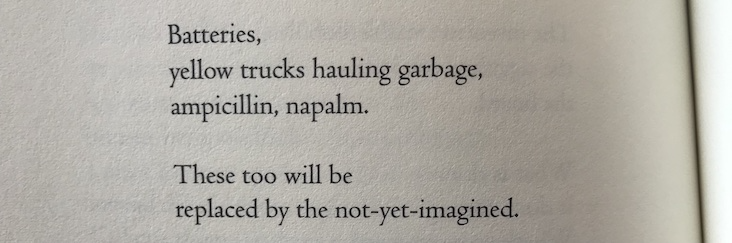
– Jane Hirshfield, Come, Thief
Hello friends! I hope you're doing alright.
Welcome to my new hey.com blog... thing. I am excited about it because it is extremely bare bones: this page will not track you or help the dark forces of the internet sell you 3D-printed foam slippers (just me?); this page is just words.
I want to talk about the catastrophic decline in local news in America, why it's a deeply fraught situation, and where I see the possibilities for change. People have been talking about this issue for decades, but I wanted to consolidate some of my current understanding here, and also just because it's a good idea to write things down now and then.
I also just recently published a new study (open access!) related to this topic, and while I was inspired by many of the people I spoke to over the course of the research, the end result, unfortunately, did not fill me up with hope—and this post is not very hopeful. All the same, I like what F. Scott Fitzgerald said about hope: it's good practice to hold two opposed ideas in the head at the same time; you should be able to see things are hopeless, and still be determined to make them otherwise.
Here is where things currently stand (you can skip if you know it):
- In the span of two decades, one quarter of all local newsrooms in the U.S. have disappeared.
- Over 65 million Americans already live in “news deserts,” places with just one local paper or none at all.
- Newspapers in general have lost over half of their newsroom employees since 2008.
- Beyond the thousands of newsrooms that have straight up closed, “countless others have become shells—or ‘ghosts’—of themselves,” according to the leading research initiative on news deserts at UNC.
Ok, that was just the scenic ride up to the top. Now the screaming-downward part.
The death of local news is bad because:
- Declining local news leads to (big surprise) less politically informed voters, but also less engaged politicians, declines in voting and in civic engagement overall.
- When no one is around to do real investigative journalism, or even just show up to public meetings and hearings, there is increased government waste, less government innovation, worse environmental conditions, and the loss of countless (in the truest, largest sense of the word) other economic benefits regular news coverage brings to a community.
- The disappearance of local news outlets erodes social cohesion and leads to increased political polarization and the loss of communal common ground.
- Local news has also been an essential service throughout the pandemic to keep local communities informed and leaders accountable. (Let's play a game where we do the whole pandemic again, but this time there are no local journalists. Sounds fun.)
I've been thinking about this a lot, because it seems to me that if we don't fix this problem, well, democracy in America is going to get even more fun than it has already been lately. More on that in a minute.
In broad strokes, the things causing local news to go extinct include (and, again, skip it if you know it):
(1) The overwhelming capture of the advertising market by giant tech companies like Facebook and Google, which have stripped news publishers of their income, hitting particularly hard in rural and poor communities. These companies have simultaneously polluted our news environment with disinformation and racial hatred and *checks notes* occasional genocide.
(2) The public's shift toward increasingly getting "news" (broadly defined) via social media platforms, which are not in any way designed to do this (civic) job, and have repeatedly failed to do it well. As a result, audiences are becoming less connected to professional, salt-of-the-earth local news organizations, which then causes declining subscriptions, erodes public trust in the local paper, etc.
(3) The sell-off of local newspapers to hedge funds and the broader trend of aggressive roll-ups/consolidation/asset stripping for short-term financial gain, with the accompanying "Troncification."
(4) And, more recently, the pandemic. ... Oh, that.
In fairness to the tech companies, they do, in theory, care about local news—much in the way an amateur lepidopterist cares about the pretty pretty butterflies they have impaled and hung up on the wall.
I'll also say, if we’re looking at the health of our media as a whole, let’s not forget the commercial TV networks, particularly on the conservative side, that have spent decades selling outrage, useless punditry, and false objectivity (though I won't get started on the objectivity rabbit hole here). None of this has helped foster anything good for professional local news, or its future prospects, either.
So here we are.
This issue has even struck close to home for me in a perfectly literal sense. The four local papers in Southern Maryland (where I grew up and currently live) ended their daily prints and were merged into a single jumbled website last year, and the long-time editor for the oldest paper (est. 1883) seems to have gotten fired unexpectedly to save costs in the merge. It is quite hard to figure out who all is actually working for each "paper" now. If it wasn't literal reality, it would seem utterly cliché. I feel disconnected from this place, from the people around me, from any kind of "community" beyond my neighborhood. But then, I guess we've been bowling alone for a while.
Now, I am not a journalist, and fixing this problem is not, strictly speaking, my job. I'm not really saying anything new here, either. The FCC actually commissioned a fantastic report on the problem in 2011, which was indeed *inhales sharply* ten years ago. Many a think tank, philanthropy, and even a few elected officials have, in turn, also released studies and reports and firmly worded statements observing the trend as it inexorably spiraled downward. The spiraling continues.
I've been thinking about all of this because I think ignoring this problem has caused untold amounts of damage to American society already. Every issue, every community, every election, every vote, depends on a healthy public sphere—to enable dialogue, understanding, accountability, empathy, truth. Years and decades of progress can slip away when the lights go out. But it's not all about the grand sweep of history stuff. At a basic level, if you want to live in a place with strong social ties—a community that cares for its members—you need a healthy public sphere.
Abstractly, Americans know this. We love to talk about the first amendment and our sacred free press. But we get fuzzy on the details, and we don't pay attention because "the media" perennially "sucks" anyway. And then twenty or so years go by and things are, as your grandma might say, super fucked.
So here were are, still.
...
Now, the last thing I'll say before I get to "solutions" is this: the great big truth is that we are in this situation because we do not treat local news as a genuine public good.
A public good is something a society depends on, but which requires our collective public investment to maintain (e.g. libraries, fire departments, sanitation). We have spent a lot of time, it seems, trying to be "innovative" about the future of local news, with efforts like the American Journalism Project and innovation challenges by the Knight Foundation to support local newsrooms. These are worthy efforts, and more is good. But, as several decades of decline have shown us (and Elizabeth Hansen has helpfully argued here) in many or perhaps most communities, no amount of commercial business model innovation will save local news. Much less the millions wasted on trying to solve the problem with cryptocurrency. Or any other lipstick-on-a-tronc strategy. News is a public good. We have to treat it like a public good to save it.
If we cannot treat local news as a public good, I think the evidence is overwhelming that local news will continue to spiral downward, and, well, maybe that's simply the choice we're making.
Or maybe all of this is just fait accomplis already. I don't know.
Due to the sheer scale of the problem, I am pretty sure there are only a few specific things that could actually stop the bleeding and secure a prosperous future for local news. At this point, I don't think any of them are very likely. But still, here they are:
☞ Thing 1 —Tax targeted advertising to fund local news
It's not an original idea, but it is a good one. I interviewed Craig Aaron, the CEO of Free Press, and his colleague Tim Karr about this idea before, discussing a white paper where they proposed a big tech tax to save local news. It is a good idea because it is relatively simple, and it could actually meet the scale of the problem.
In Tim Karr's words:
"We compare the online-ad tax to a carbon tax, an excise tax on emissions that falls most heavily on energy-intensive industries. Policymakers then use the resulting revenue to offset the negative impacts of the polluters, investing in clean-energy programs and other efforts to combat climate change. In our case, the tax offsets the negatives of targeted advertising to fund another public good: independent, noncommercial journalism."
If we were to enact an online-ad tax for local news, the new fund could (relatively) easily be set up as a publicly accountable, independently managed entity. In fact, we already do exactly this for federal funding that is appropriated to public media (CPB, PBS, NPR, etc). Figuring out the design and governance of such a fund is still a crucial problem to address, especially to ensure that we don't only invest in legacy institutions and thinking (which are often, frankly, very white at the leadership levels and slow to change), but to prioritize equity, under-served communities, and supporting the real boundary-pushers.
Unfortunately, I know many folks, friends among them, who do not think it is the role of government to intervene (in the way most public goods require) to save local news. These people are, you know, completely fucking wrong (as Martha Minow argues here, and Victor Pickard wrote a very good book on here). But still, this is a very common belief. It is also a uniquely American attitude—most other liberal democracies spend massively more government money to fund news services. And it is a depressing attitude, because whether people recognize it or not, saying "the government can't help" is, at this point, tantamount to saying "I'd rather let local news die."
☞ Thing 2 — Pass a new Public Media Act in Congress
You may be noticing a trend.
Some history: when the original Public Broadcasting Act was signed into law in 1967, a new era of noncommercial radio and TV programming was ushered forth to inform and educate the public and ensure the airwaves would not become vast commercialized wastelands. The Act asserted that public media would empower citizens and communities to “address national concerns and solve local problems,” and provide for “the needs of unserved and underserved audiences, particularly children and minorities.” Millions of Americans grew up with “Sesame Street” and “Mr. Rogers’ Neighborhood,” and have benefited from investigative news such as “Frontline” and “PBS NewsHour,” freely available to all. It was an investment in the public sphere as a public good.
Unfortunately, the 1967 act hasn’t been meaningfully updated for half a century, and our public media system is still designed for the TV and radio era, and largely constrained by statute to those mediums.
A new Public Media Act could, in theory, drastically change what is possible (as I've argued before here). By reforming public media’s structure and funding, we could ensure professional reporting exists in every town and city in America, invest in a new generation of noncommercial digital-first media organizations, build a new ecosystem of digital public service media, and upgrade legacy newspapers and stations. The talent needed to achieve this transformation is also an opportunity—public media’s executives, producers, journalists and software developers should reflect the demographics of the American public (and demonstrate a meaningful contrast to Silicon Valley).
But to do this right, the public media system will also need to open itself up to a thorough reckoning on race in all aspects of its work. The last time the U.S. public broadcasting system saw this kind of "audit" was in the late 70’s when the CPB commissioned a report titled “A Formula for Change,” which asserted that “the public broadcast system is asleep at the transmitter” regarding the needs and interests of Black, Asian, Latino and indigenous Americans. There's been progress, but just last week, 140 filmmakers sent a letter to PBS’s leadership challenging PBS to do better on racial representation in who they hire and pay to create programming. That's just the start of what still needs to be addressed.
And all of this is to say nothing of the systemic racial harm that has been done in our broader media system for centuries. Arguably, public media's most important task today is doing its part to fight this accumulated and ongoing harm. If you want to understand this better, certainly don't take it from me—the Media 2070 Reparations project launch essay is a good place to start.
If we can take our public media system's failures to heart, and if those in the system are willing to be ambitious about the future (in the same way it took crazy ambition to build the whole system in the first place), I believe such a future could save local news and would go a long way to foster a more democratic nation.
☞ Thing 3 — End the reign of Facebook and Google and the rest
Jane Hirshfield already said it at the top of this piece, but Facebook and Google and the rest will not last forever. Intuitively we know this, but for some reason it is not considered a very "serious" thing to talk about. For some reason these entities have achieved a fearful grip on our imagination. They have become simply the way things are, the way modern life is. Saying these companies will not last forever sometimes sounds like you're saying America will not last forever (incidentally, also true).
Today's big tech companies own many of the railways on which the rest of the media runs. They set the terms, they define the incentives. The most likely outcome is that they will continue to do so.
But, eventually, things will change; things will end.
If we want to imagine a world where local news can thrive, and where democracy can thrive, I think we have to get serious about imagining alternative, "pro-social" digital platforms that could replace those that are currently in power.
I don't want a new monolithic entity—I don't think world domination is a very pro-social behavior. I want a diversity of alternatives. Isn't that what most of us really want in life? Are we taking that desire seriously?
And actually, I think it is possible we are already running late. Of all the "tech-lash" activity that's been happening in Congress and in Washington generally, the most promising area has been a progressive lurch on antitrust regulation. The FTC should soon have new leadership that intends to create a more competitive and accountable tech sector; the NEC at the White House as well.
Even so, new antitrust regulation will not, on its own, create social media platforms that are designed to serve democracy over profit (I'm looking at you TikTok). The landscape might become "more competitive", but there is no guarantee that new competitors will serve the interests of democracy better than the incumbents. No, if we want a better digital future, a more ethical digital future, a less racist digital future, a more communal digital future—we have to build it.
New Public is an effort that is trying to help improve the design of our digital public spaces generally, and they've released some incredibly helpful research to that effect. There are other efforts as well, such as the work done by the team at Pol.is to create a digital platform that helps polarized groups find areas of consensus. NPR is also experimenting with their flagship digital audio platform NPR One, as I discuss in my recent study. NPR One elevates local news, prioritizes giving users contrasting or surprising viewpoints, and lets people donate directly to local stations. They want you to be engaged with their content, but for pro-democratic objectives, rather than commercial ones.
I really appreciated this piece in the Atlantic a few weeks back on this general topic as well, and you might also.
And we need more, so much more.
...
So where does all of this leave us? If we're talking about what is most likely to happen, I think the most honest, sober answer is that we in America will fail to save local news from its continued collapse. The reason for this, essentially, is that we will fail to rally around the kinds of solutions that would actually meet the scale of the problem—and by we, I mean government, philanthropy, commercial media, public media, the public itself.
Probably it will just be a choice by omission; few will notice we could have even tried. Yes, there will continue to be a lot of work to try and improve the situation—I'll certainly do my small part of that, too. But everyone knows that that is not the same as doing what is necessary to solve the problem. In short, because the damage is so vast, at this point saving local news in a large and equitable sense would require billions of dollars every year from now into forever, be it via a new tax or something else. I don’t think we will make that larger choice, or perhaps we are not currently capable of choosing it.
And that foreshadows nothing good for democracy in America, because the void will be filled. Inaction does not mean nothing happens; it means something else happens.*
And so, I'll end with the start. Jane Hirshfield's poem (full poem here) is not really a hopeful one, just a true one. The last line is taken from Beowulf: "Heaven swallows the smoke." All technology is devoured by something else, and yet it all lives on in our words and feelings about the endless change. Anyway, that's how I took it. In all likelihood, newspapers don't make it out alive. That might just be a footnote of the history we're in. Well... I guess I'm just saying it with feeling.
And yet, because I also like to say yet with feeling, too, despite all of this, despite the overwhelming sense of collapse, none of this is set in the physical laws of the universe. There is not a known outcome. We aren't talking about the inescapable pull of gravity, but rather the trajectory of historical path dependency. Maybe we can still jump the tracks. We should keep trying, anyway. Why not?
If you're interested in any of these things, do reach out! After all, my thinking isn't set in stone, so I'm eager to chat.
—Erik
*This phrase feels familiar to me but I couldn't find the source.