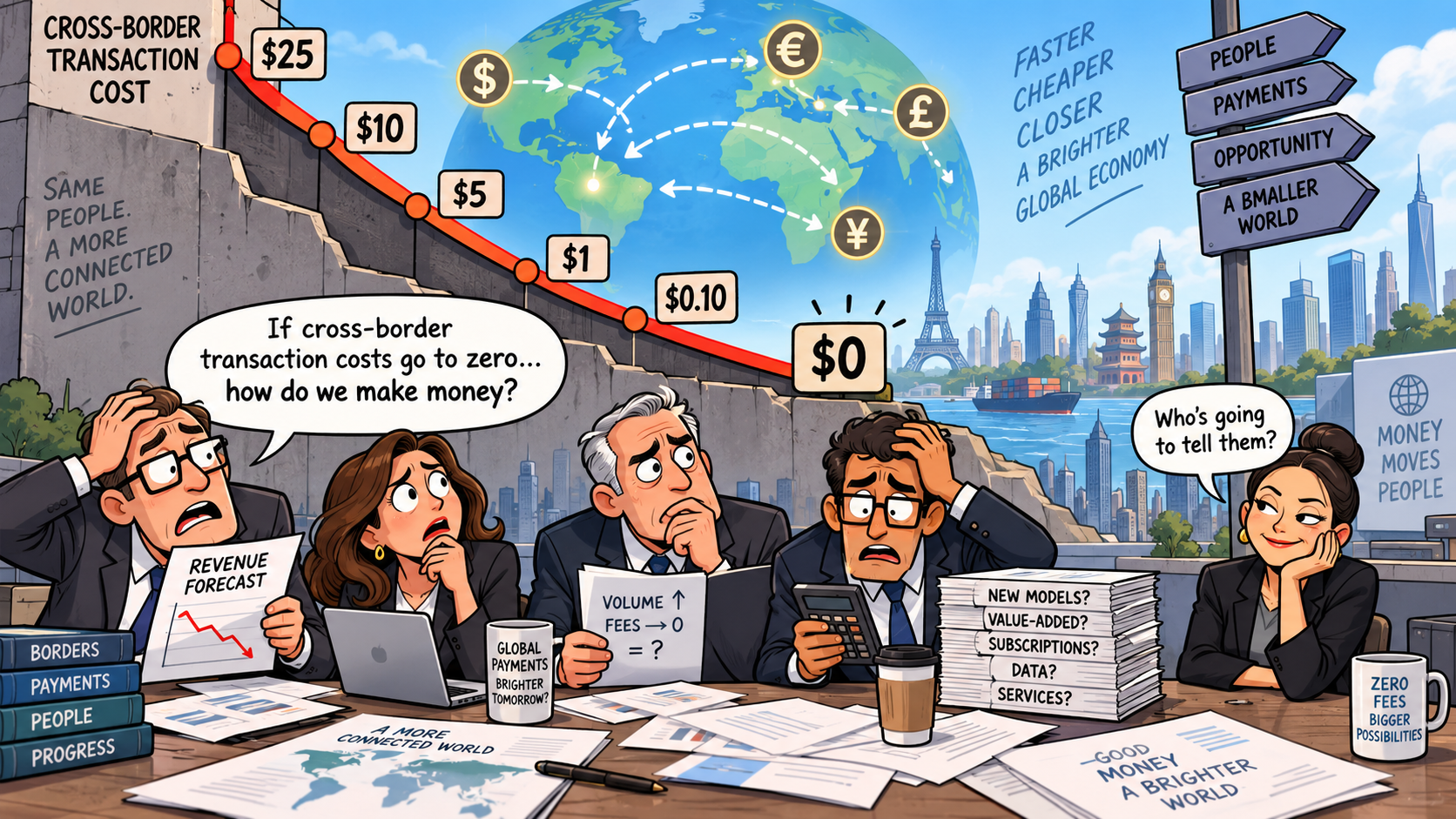
If you look at the cost of money transfers worldwide, they are going down. Extremely competitive markets are charging about 0.5% to transfer money from one country to another. If you're looking at the top super-competitive corridors, they're between 0.5% and 1.5%. Emerging markets are between 2% and 3%, and some difficult, non-liquid markets are between 4% and 5%.
For example, if you wanted to send money from India to Pakistan, that's an illiquid market. That would be very, very difficult, and the numbers would be very high. If you were to ship from Bangladesh to Guatemala, that would be an illiquid market, and yes, the cost would be high. If you were to do USA to India or UAE to Pakistan, etc., the markets are extremely competitive.
Now that we have ascertained that everyone wants to keep things like the U.S. dollar and that too, unstable coins, the cost of cross-border money transmission is actually going very, very low. If you look at crypto, it's said that it's literally 1/18th or 1/15th of the cost of sending money. If the cost of sending money is $15, $1 would be the cost of the crypto part, if not less. Sometimes it's even 1/20th or 1/50th of the cost, depending on the gas fees and so forth. It's really, really cheap now to do this thing.
The question is: in a couple of years, if not faster, because of AI and everything else, people are going to make better apps, more efficient models, more efficient roads, highways, networks, payment rails, and delivery rails to transfer money in the most efficient and cost-effective manner. Then the question is: how do money transfer operators stay in business?
It was a very interesting thing that recently Coin Circle acquired TazaPay, so what does that mean? and a lot of the fintechs are going the route of getting a banking license. Banks are not in the business of moving money. Banks really don't care. The part where they make money is lending, deposits, and essentially commercial credit. That's where the money is. Movement of money is not going to be so much. It's going to be where you park your money, how you use your money, and how you spend your money that is going to become more important.
The thing that still needs to be broken is the dominance of Visa and Mastercard. That oligopoly has to go. Until and unless the world sort of agrees on a payment network where QR codes or such crypto-based wallets and related stablecoins can be used to make payments without realizing or utilizing the Visa and Mastercard payment rails, I think even the spending part will go away. Then the money will still have to be made using deposit interest rates, treasury yields, bond yields, and commercial credit lending.
Essentially, an interesting time. Let's see where it goes.
For example, if you wanted to send money from India to Pakistan, that's an illiquid market. That would be very, very difficult, and the numbers would be very high. If you were to ship from Bangladesh to Guatemala, that would be an illiquid market, and yes, the cost would be high. If you were to do USA to India or UAE to Pakistan, etc., the markets are extremely competitive.
Now that we have ascertained that everyone wants to keep things like the U.S. dollar and that too, unstable coins, the cost of cross-border money transmission is actually going very, very low. If you look at crypto, it's said that it's literally 1/18th or 1/15th of the cost of sending money. If the cost of sending money is $15, $1 would be the cost of the crypto part, if not less. Sometimes it's even 1/20th or 1/50th of the cost, depending on the gas fees and so forth. It's really, really cheap now to do this thing.
The question is: in a couple of years, if not faster, because of AI and everything else, people are going to make better apps, more efficient models, more efficient roads, highways, networks, payment rails, and delivery rails to transfer money in the most efficient and cost-effective manner. Then the question is: how do money transfer operators stay in business?
It was a very interesting thing that recently Coin Circle acquired TazaPay, so what does that mean? and a lot of the fintechs are going the route of getting a banking license. Banks are not in the business of moving money. Banks really don't care. The part where they make money is lending, deposits, and essentially commercial credit. That's where the money is. Movement of money is not going to be so much. It's going to be where you park your money, how you use your money, and how you spend your money that is going to become more important.
The thing that still needs to be broken is the dominance of Visa and Mastercard. That oligopoly has to go. Until and unless the world sort of agrees on a payment network where QR codes or such crypto-based wallets and related stablecoins can be used to make payments without realizing or utilizing the Visa and Mastercard payment rails, I think even the spending part will go away. Then the money will still have to be made using deposit interest rates, treasury yields, bond yields, and commercial credit lending.
Essentially, an interesting time. Let's see where it goes.