A homily on Luke 7:11-17 given on the Feast of All Souls (Year C), a day dedicated to praying for all the faithful departed believed to be in purgatory. It emphasizes the importance of interceding for those who have died, helping them on their journey to heaven. This homily draws on John Caputo's notion of the event of God.
Jesus went to a town called Nain, and his disciples and a large crowd went with him. As he approached the gate of the town, a man who had died was being carried out. He was his mother’s only son, and she was a widow; and with her was a large crowd from the town. When the Lord saw her, he had compassion for her and said to her, “Do not weep.”
Then he came forward and touched the pallet, and the bearers stood still. And Jesus said, “Young man, I say to you, rise!” The dead man sat up and began to speak, and Jesus gave him to his mother. Fear seized all of them; and they glorified God, saying, “A great Prophet has risen among us!” and “God has looked favourably on his people!” This word about Jesus spread throughout Judea and all the surrounding country. ― Luke 7:11-17
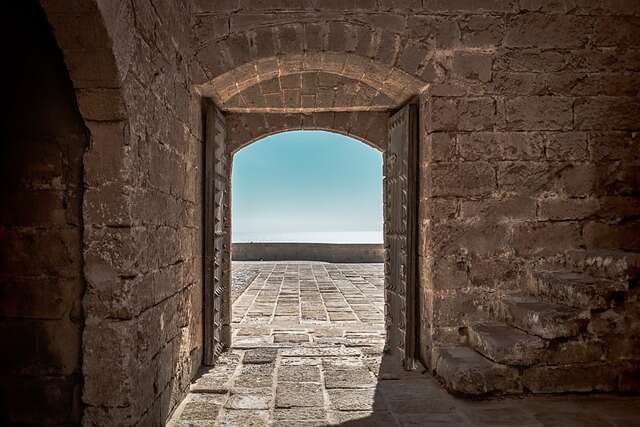
There is a gate outside a small Galilean town called Nain. It is the place where two processions meet — one coming from life, one coming from death. One is led by a widow and her tears; the other, by the Lord of Life and his compassion.
Every one of us, sooner or later, stands at that gate. And on this All Souls’ Day, the whole Church stands there together — at the threshold where life and death meet, where grief and hope come face to face.
We come remembering those who have gone before us — the ones whose names we whisper in prayer, whose love and presence are still with us, though in different ways. We walk, like the widow of Nain, with love that has learned to ache.
Luke’s Gospel begins quietly: “Soon afterward, Jesus went to a town called Nain.” Nain means “pleasant” or “beautiful.” But that day, beauty had turned bitter. A mother walked behind the body of her only son. She had already buried her husband — now she buried her last hope.
The widow of Nain walks for all of us who have lost: a person, a dream, a part of ourselves. Her grief is humanity’s grief. And at the gate of Nain, that grief meets God.
Luke says simply: “When the Lord saw her, he had compassion on her.” He saw her — before he spoke, before he touched, before he healed. He saw. And still, even now, the Lord sees.
He sees the tears we hide on All Souls’ Day. He sees the longing that brings us to the altar, with the names of our beloved dead written in the book of remembrance, held in prayer. Before we can even speak their names, Christ has already seen them — and us — with eyes of mercy that never forget.
That word compassion that Saint Luke the Evangelist uses means more than pity. In Greek it describes a stirring in the very depths, a trembling in the heart of God himself. This is no distant sympathy, but love that enters our sorrow from within. The Creator looks upon creation in its grief — and his own heart breaks open. This is the power of God: not the power to control, but the power to be moved.
This, my friends, is the mystery of the Incarnation. As St. Cyril of Alexandria writes, “Christ’s compassion is not an emotion added to God, but the manifestation of divine love itself in human flesh.”
When Jesus reaches out to the bier, he is not just halting a funeral — he is crossing the line between the living and the dead, between what we have lost and what love can still restore.
That touch changes everything. In Christ, death itself becomes a place of meeting. So today, when we remember our dead, we do not remember them as gone, but as waiting — as those who still walk with us in the mystery of the Communion of Saints.
All Souls’ Day is not only about grief. It is about the compassion that crosses even the grave. For if Christ has touched death, then death has been touched by God.
“Young man, I say to you, arise.” This is more than resuscitation — it is revelation. The Word who once called light from darkness now calls life from death. And when life returns, it always finds words — for life and word are forever bound together in the heart of God.
Then Christ gives the young man back to his mother. Notice that — he gives him back. The resurrection restores relationship. It knits together what grief has torn apart. This is what divine compassion does: it gives us back to one another.
But there is more. The Fathers of the Church saw in every story of Scripture not only history, but mystery — a mirror of the soul.
So what if the widow of Nain is not only that woman long ago, but the soul itself? And what if her dead son is the life within us that has grown cold — the hope we carried to burial, wrapped in the linen of despair?
How many times have we walked behind our own losses, believing they would never rise again? And then, unexpectedly, Christ meets us there — not in the temple, not in our certainties, but at the gate where life and death meet, the gate of endings and of tears.
He sees us. He touches what we thought untouchable. He speaks into the silence we thought was final: “Young man, young woman, beloved soul, I say to you, arise.”
And something stirs — faintly at first, then stronger — the pulse of a new beginning. For God does not dwell apart from our pain, waiting to be found. God happens wherever love breaks through despair. Wherever compassion dares to cross the line of death, resurrection has already begun.
This is not only the story of Nain. It is the story of the human heart. For every resurrection begins at a gate like this.
And so today, when the body of Christ touches you in the Eucharist, know that it is the same touch that halted death in Nain. The same compassion flows; the same life is given. Wherever the Lord’s body meets the world’s sorrow, resurrection begins.
The people at Nain cried out, “A great prophet has arisen among us, and God has visited his people!” And that visitation has never stopped. God still visits his people — not as a stranger at the door, but as Life itself entering our dead places. Whenever love interrupts despair, whenever compassion halts the march of sorrow, whenever faith dares to whisper “Arise” into the silence — Nain happens again.
Christ still walks the roads of the world. He still meets widows and widowers at their gates. He still speaks life where we have learned only to bury.
And one day, when the great procession of all creation reaches its final gate, the same voice will say to every tomb, to every sorrow, to every soul: “I say to you, arise.”
My brothers and sisters, this is our hope on All Souls’ Day: that the Lord who once raised the widow’s son will raise those we love — and, in time, raise us too.
Until that day, we walk in faith, carrying both our loss and our longing, trusting that wherever compassion meets grief, resurrection has already begun.
About Fr. Graham Hill C.Ss.R.
Redemptorist priest living and working in Toronto, Ontario. Who proudly practices eccentric activities with strings under tension — from musical instruments to recurve bows.