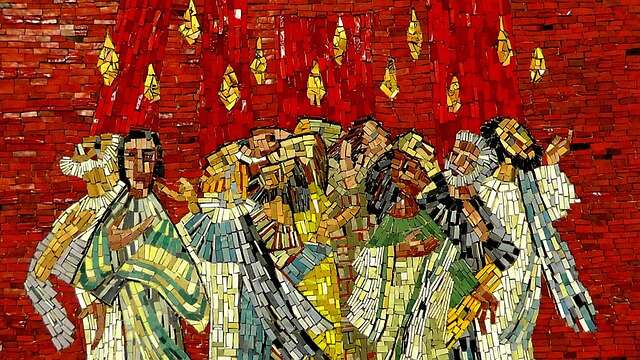
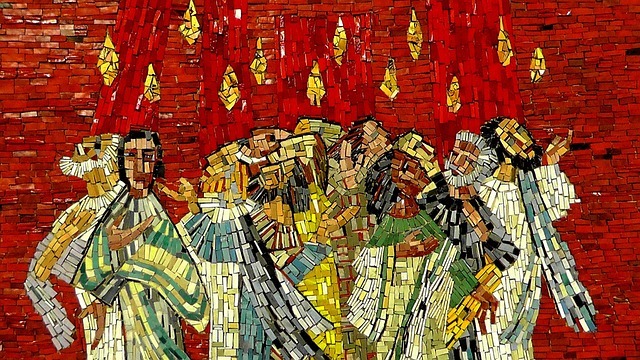
Pentecost is not the arrival of a distant God, but awakening to a presence already sustaining everything. Through breath, peace, and shared understanding, locked rooms become permeable, fear loosens, and ordinary life opens toward communion, healing, and love already moving quietly within and among us. A homily for the Solemnity of Pentecost on Acts 2:1–11 and John 20:19–23.
Pentecost is often called the birthday of the Church, and that is true enough, but it can also be misleading if we imagine birthdays as beginnings from nothing—as if there was a moment when God was absent, and then suddenly present, as if the Spirit had to travel a long distance to arrive.
The Scriptures are more subtle than that.
In John’s Gospel, the disciples are behind locked doors. In Acts, they are gathered in one place, afraid, uncertain, still trying to make sense of a story they thought had collapsed. But notice what is already there: life is still there, breath is still there, memory is still there, longing is still there. Even fear itself is still a kind of attention—misdirected perhaps, but alive.
And into that situation comes the word: peace.
Not as an interruption from a distant place, but as something that meets them where they already are.
“Peace be with you.”
It is almost disarmingly ordinary. No thunder. No announcement of arrival. Just a presence that reorders what is already happening inside the room.
Then he shows them his wounds.
Which means the place of fear is not erased. It is included. The story is not undone; it is held differently. The risen Christ is not separated from what has been suffered. He carries it, and in carrying it, transforms how it is encountered.
And then he breathes.
Not as spectacle, but as closeness. Breath is the most shared reality we have—what is exchanged constantly without notice, what sustains life without argument or permission. To breathe is to participate in a world that is already giving itself.
So what is happening here is not the arrival of something foreign into a sealed room. It is the unveiling of a depth that was never absent, only unrecognized.
“As the Father sent me, so I send you.”
But even that sending does not begin as pressure from outside. It arises from within the same shared life that is already sustaining them. The movement outward is not imposed upon them; it is what becomes possible when fear no longer has the final word about what reality is.
Acts tells the same truth in a different way.
The room is filled with wind and fire, yes—but more striking is what happens to perception itself. What was closed becomes open. What was fragmented begins to be heard as one speech in many languages. Not because people become identical, but because something deeper than separation is being recognized.
They are understood.
And that is always the quiet miracle: not spectacle, but communion.
Not everyone speaking the same language, but each one hearing in their own.
It is the kind of moment that suggests something has been true all along, even if it has not yet been noticed. As if the world has always been more relational than we realized, more connected than our fear allowed us to see.
Which is why Pentecost is less about God breaking into a world that was previously Godless, and more about a world finally becoming aware of the life that has been sustaining it all along.
The Spirit does not begin by replacing what is there. The Spirit awakens what is already alive but unrecognized—what has been quietly moving beneath fear, beneath confusion, beneath the locked doors we build around ourselves.
And we know those doors.
They are not always dramatic. Sometimes they are simply the habits of living without expectation. Sometimes they are the slow narrowing of desire. Sometimes they are the way we learn to function without risking too much hope. Sometimes they are the places where we assume, without quite saying it, that nothing new will happen here.
But even there, something is still being given. Even there, life continues. Even there, breath is still being shared.
And the Gospel’s claim is not that those places are invaded from the outside, but that they are not abandoned from within.
So when Jesus says, “Peace be with you,” it is not the introduction of peace into a place where it was absent. It is the naming of a reality that fear has been covering over.
And when he breathes, it is not the beginning of life, but the recognition of a life that is deeper than fear has been able to notice.
This is why sending comes last.
Because mission is not the pressure placed on people who have finally become good enough. It is what emerges when people realize that life is already being given in them, and that this life tends toward communion.
“As the Father sent me, so I send you.”
Not as burden, but as participation.
Not as escape from the world, but as deeper engagement with it.
Because once you begin to see that life itself is already oriented toward healing, toward reconciliation, toward understanding, then even ordinary places begin to open differently.
The locked room is not always a place we leave.
Sometimes it is a place that slowly becomes permeable.
Sometimes it is a place where peace begins to be noticed.
Sometimes it is a place where breath is finally trusted again.
And Pentecost is the quiet insistence that this is how transformation actually happens: not by force, not by rupture, but by a gradual awakening to what has been true from the beginning—that we are already held in a life that is moving toward love, and that our freedom is learning to move with it.
So perhaps the question is not whether the Spirit will come.
It is whether we will begin to recognize what has been gently sustaining us all along.
And if we do, we may discover that the door we thought needed to be broken down was never as closed as we feared.
It was simply waiting for us to notice the breath already moving through it.
About Fr. Graham Hill C.Ss.R.
A Redemptorist priest living and working in Toronto, Ontario, with a fondness for eccentric pursuits involving strings under tension—from musical instruments to recurve bows.