A homily for the Feast of the Baptism of the Lord, on Matthew 3.13-17.
Jesus came from Galilee to John at the Jordan, to be baptized by him. John would have prevented him, saying, “I need to be baptized by you, and do you come to me?” But Jesus answered him, “Let it be so for now; for it is proper for us in this way to fulfill all righteousness.” Then John consented.
And when Jesus had been baptized, just as he came up from the water, suddenly the heavens were opened to him and he saw the Spirit of God descending like a dove and alighting on him. And a voice from heaven said, “This is my Son, the Beloved, with whom I am well pleased.” ― Matthew 3.13-17.
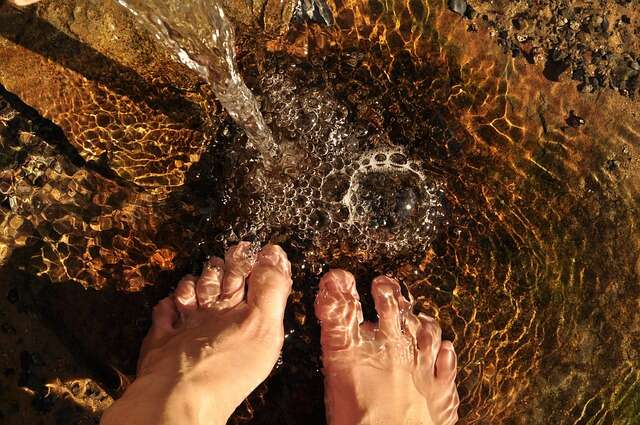
On the feast of the Baptism of the Lord we are given a scene that is almost stubbornly physical. There is a river. Mud between toes. The sharp smell of water and reeds. A crowd pressed close, breath on breath, each body carrying its own history—regret, hope, weariness, longing. And into that press of humanity steps Jesus.
Not hovering. Not descending in light from a safe distance. He comes from Galilee to the Jordan, walking the road like everyone else, dust on his hem, muscles tired from travel. He waits his turn. He stands in line with sinners.
Already the gospel is saying something about God.
Because if we are honest, many of us have learned to look for God somewhere else. In the abstract. In the cleaned-up version of ourselves. In moments when we have finally gotten it together. We imagine God at a distance from bodies that ache, emotions that overwhelm, grief that sits heavy in the chest, routines that feel small and repetitive. We imagine holiness as escape—out of history, out of flesh, out of the mess.
But Matthew will not let us do that. God shows up at a river where people are confessing their sins out loud. God shows up where water runs over skin and into hair, where clothes cling heavy and cold afterward. God shows up where repentance is not an idea but a bodily turning, a wading in, a willingness to be seen.
And Jesus insists on being there too.
John protests, as any sensible religious person might. “I need to be baptized by you.” In other words: this isn’t how it’s supposed to work. The holy one should stay dry. The righteous should remain separate. God should be above all this.
But Jesus answers with words that are as earthy as the river itself: “Let it be so now; for it is proper for us in this way to fulfill all righteousness.” Righteousness here is not moral perfection. It is right relationship. It is God refusing to be God without us.
So Jesus steps into the water.
The baptism of Jesus is not a detour on the way to the real work. It is the revelation of how God chooses to be with the world. God does not save from a distance. God saves by entering fully into the waters that already hold us—waters of fear and failure, of grief and joy, of ordinary days that blur together.
Notice what happens next. The heavens are opened—not because Jesus escapes the water, but while he is standing in it. The Spirit descends not in abstraction, but embodied, visible, like a dove. And a voice speaks not to remove Jesus from humanity, but to name him within it: “This is my Son, the Beloved, with whom I am well pleased.”
Before Jesus heals anyone. Before he teaches, suffers, or dies. Before he does anything to earn it. He is named beloved.
That matters for us, because baptism works the same way.
Most of us were baptized long before we could choose it, long before we could understand it. Which is precisely the point. Baptism is not about our decision to be faithful. It is about God’s decision to be faithful to us. It is God’s stubborn insistence on entering our lives as they actually are—not as we wish they were.
Baptism does not lift us out of our bodies. It marks them. Water on skin. Oil on forehead. A name spoken aloud. God claims us not as souls trapped in flesh, but as whole people—breathing, bleeding, aging, loving.
And that means God meets us not just in mountaintop moments, but in the thick of ordinary routines. In the sink full of dishes. In the commute. In the ache of caring for someone who cannot give back. In the quiet grief that resurfaces at odd hours. In the joy that surprises us with its intensity. In the weariness that settles in our bones.
The baptism of Jesus tells us that none of that is outside the life of God.
The Christian life is not about climbing up to God but about discovering that God has already climbed down to us. The Jordan is proof. God wades into human water—murky, unpredictable, shared. God takes on the vulnerability of being touched, named, misunderstood. God binds God’s own life to ours.
Which also means that baptism does not make life easier in the way we might hope. Jesus rises from the water and is immediately driven into the wilderness. Belovedness does not exempt him from hunger, loneliness, temptation. And our baptism does not spare us either—from loss, from doubt, from the long work of forgiveness.
But it does mean we never face those things alone.
To be baptized into Christ is to be accompanied—by a God who knows what it is to have a body that gets tired, emotions that swell, a heart that breaks. A God who knows what it is to stand in a line of imperfect people and choose solidarity over separation.
This is why Christian spirituality is not about escaping history but inhabiting it more deeply. Not floating above the pain of the world, but entering it with courage and compassion. Not denying our humanity, but trusting that God has already claimed it.
Every time we remember our baptism—every time water touches us in any form—we are reminded that God is nearer than we think. In the shower at the end of a long day. In tears that come unbidden. In the steady rhythm of breath when prayer feels impossible. In the ordinary miracle of being alive in a body that God has called good.
At the Jordan, God says to Jesus, “You are my beloved.” And in Christ, God says the same to us—not once, but again and again, in the middle of lives that are unfinished and fragile and real.
So on this feast of the Baptism of the Lord, we do not look for God elsewhere. We look here. In water and word. In flesh and feeling. In the daily practice of showing up to our own lives, trusting that God has already shown up first.
The heavens are still open. The Spirit is still moving. And the voice still speaks—over us, through us, within us—naming us beloved, and sending us back into the world, wet-haired and human, to live as signs of the God who meets the world from the inside out.
About Fr. Graham Hill C.Ss.R.
Redemptorist priest living and working in Toronto, Ontario. Who proudly practices eccentric activities with strings under tension — from musical instruments to recurve bows.