A homily for the second Sunday of Advent in year A on Matthew 3.1-12 and Isaiah 11.1-10. This homily was prepared but never delivered.
On that day: A shoot shall come out from the stump of Jesse, and a branch shall grow out of his roots. The spirit of the Lord shall rest on him, the spirit of wisdom and understanding, the spirit of counsel and might, the spirit of knowledge and the fear of the Lord. His delight shall be in the fear of the Lord.
He shall not judge by what his eyes see, or decide by what his ears hear; but with righteousness he shall judge the poor, and decide with equity for the meek of the earth; he shall strike the earth with the rod of his mouth, and with the breath of his lips he shall kill the wicked. Righteousness shall be the belt around his waist, and faithfulness the belt around his loins.
The wolf shall live with the lamb, the leopard shall lie down with the kid, the calf and the lion and the fatling together, and a little child shall lead them. The cow and the bear shall graze, their young shall lie down together; and the lion shall eat straw like the ox. The nursing child shall play over the hole of the asp, and the weaned child shall put its hand on the adder’s den. They will not hurt or destroy on all my holy mountain; for the earth will be full of the knowledge of the Lord as the waters cover the sea.
On that day the root of Jesse shall stand as a signal to the peoples; the nations shall inquire of him, and his dwelling shall be glorious. — Isaiah 11.1-10.
In those days John the Baptist appeared in the wilderness of Judea, proclaiming, “Repent, for the kingdom of heaven has come near.” This is the one of whom the Prophet Isaiah spoke when he said, “The voice of one crying out in the wilderness: ‘Prepare the way of the Lord, make his paths straight.’”
Now John wore clothing of camel’s hair with a leather belt around his waist, and his food was locusts and wild honey. Then the people of Jerusalem and all Judea were going out to him, and all the region along the Jordan, and they were baptized by him in the river Jordan, confessing their sins.
But when he saw many Pharisees and Sadducees coming for baptism, John said to them, “You brood of vipers! Who warned you to flee from the wrath to come? Bear fruit worthy of repentance. Do not presume to say to yourselves, ‘We have Abraham as our father’; for I tell you, God is able from these stones to raise up children to Abraham. Even now the axe is lying at the root of the trees; every tree therefore that does not bear good fruit is cut down and thrown into the fire.
“I baptize you with water for repentance, but one who is more powerful than I is coming after me; I am not worthy to carry his sandals. He will baptize you with the Holy Spirit and fire. His winnowing fork is in his hand, and he will clear his threshing floor and will gather his wheat into the granary; but the chaff he will burn with unquenchable fire.” — Matthew 3.1-12
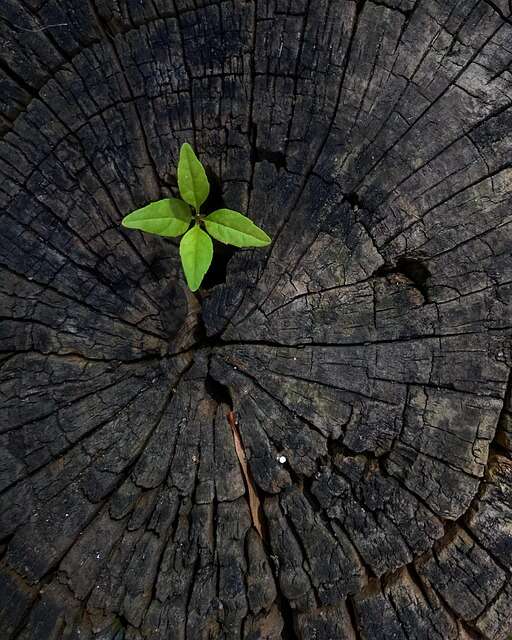
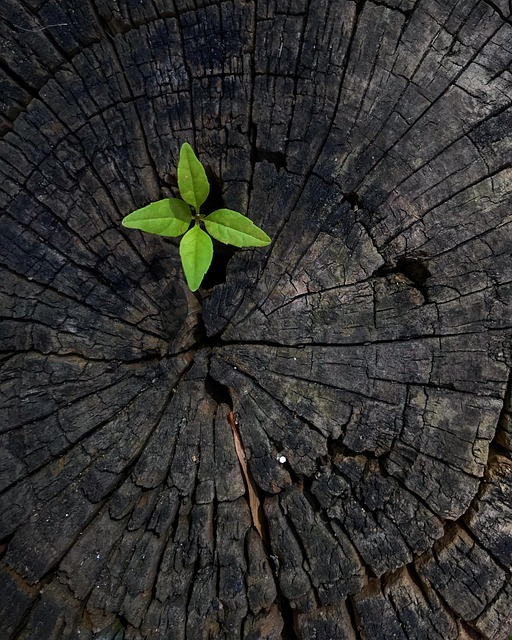
A few winters ago, I stood before a tree stump behind a barn at a friend’s farm in Prince Albert, SK. Snow had settled into its cracks like a blessing whispered into old wounds. The stump was cold… grey… rough… just a remnant of what once reached for the sky. And yet, right at the centre of that stump, a seedling, impossibly small and stubbornly alive, a green shoot pressed upward. It was nothing spectacular, nothing anyone would notice unless they lingered. But it moved me in a way I still can’t completely explain. It was as if the earth itself were saying, “Life is coming. Even here. Even now.” And something in me softened under that promise, the way soil softens under thawing snow.
Standing before that stump, I realized that new life rarely announces itself with fanfare. It often begins quietly, hidden, easily overlooked. And that realization became the doorway into the Scriptures we hear today. If Isaiah gives us the image of new life taking root, John gives us the sound of it — a voice clearing growth. John the Baptist, with his wild eyes and bare feet, crying out in the wilderness that God is on the way. Because so often, when God comes, it looks like that shoot — small, vulnerable, born in the cold, tender enough to break your heart.
That stump behind the barn, that day, felt like a doorway into Advent itself — an invitation to trust that God chooses the low places, the cut-down places, the places that feel finished and forgotten.
I suspect you know some of those places too. You see we all carry those stumps within us — the remnants of something we hoped would keep growing but didn’t. A relationship that withered. A dream that was felled by life’s storms. A confidence that was cut down by disappointment. A faith that once stood tall but now feels reduced to bare roots and weathered wood. We look at these stumps and say what people have always said: Nothing good can come from this. Nothing holy can take root here. But this is exactly where this season of Advent speaks its fiercest hope. Advent dares to suggest that God is not afraid of what “looks” dead. Advent insists that heaven is found in the most unlikely landscapes — stumps, wildernesses, mangers. And so we gather here, as people who know both longing and loss, to listen again for the old voices that still speak new things:
Isaiah whispering hope through the sawdust, John crying out in the wind. Isaiah looks at the stump of Jesse — the broken, humbled house of David — and instead of seeing death, he sees possibility. Not because Israel has its act together. Not because the world is ready for holiness. But because God is.
“A shoot shall come out from the stump of Jesse,” he says, “and a branch shall grow out of his roots.” It’s as if Isaiah kneels down, puts his ear to the silent stump, and hears the Creator’s breath swelling with life inside the stillness.
And this new life is not abstract. It is embodied. Rooted. Physical. It grows. It stretches. It bears fruit. It brings justice to the poor, equity to the meek, faithfulness to creation. Wolves lie down with lambs. Leopards with goats. Children play near serpents and come to no harm. Isaiah is describing nothing less than the incarnation of peace — peace made flesh, peace with skin and breath and weight.
And then, rising from another landscape, another prophet bends this time toward the river’s breath — John the Baptist, standing knee-deep in the Jordan, hair tangled, face weathered, listening for God’s stirring in the current. And what he hears is not vague. It is urgent. Resonant. Alive. It rises. It resounds. It shakes the sleepers. It calls for hearts to turn, for valleys to lift, for paths to clear for the coming One. He is the sound of Advent shaking us awake. “Prepare the way of the Lord,” he cries. “Make his paths straight.”
Don’t make the mistake of confusing John’s urgency with anger. He’s announcing that God is stepping into our world not as an idea, not as a rule, not as a judgment — but as a presence, a person, a life that roots itself in our own. His fire is not the fire of destruction but of clearing — like sunlight breaking through thickets, like warmth returning to cold fingers, like love melting what has grown hard.
And here the two voices meet. John and Isaiah together tell the same truth: God enters the world like a shoot — vulnerable, persistent, alive — growing exactly where we thought life impossible. These ancient voices — Isaiah in the sawdust, John in the wind — speak into our world too, if we’re willing to listen. So what does this mean for us, here, in this moment?
It means we no longer dismiss our stumps as hopeless. It means we stop pretending our wounds have no place in God’s story. It means we recognize the holy not only in sanctuaries in liturgies and hymns, but also in the rugged, splintered, half-lit places of our lives.
For the incarnation — God made flesh — does not begin in a palace. It begins in a womb. In a manger. Among animals and straw and shepherds. It begins in the kind of place you’d walk past without noticing — unless you linger.
Maybe that’s the invitation of Advent: to linger with God in the places we’d rather hurry past. To look at our stumps long enough to notice the tender green pushing upward. To protect the space where new life is trying to break through.
And the hope God plants in us is never meant to stay with us alone — it grows outward. And as a community, it calls us to be people who see shoots in others — who don’t judge by appearances or write anyone off as a lost cause. People who cradle the fragile beginnings of hope in one another’s lives. People who embody the peace Isaiah imagines — a peace that takes root in our words, our choices, our presence.
So let me ask you: Where is the stump in your life this Advent? What part of you feels cut down or cut off? What ending have you quietly accepted as final? Bring that place into the light. Let Isaiah speak over it. Let John call to it. Let Christ draw near to it. Because the God who loved us enough to take on flesh has not stopped entering our world. He still comes to the rough places, the hollow places, the unpromising places. He still grows where no one expects growth. He still chooses the stumps. So as we enter this Advent, hear the invitation one more time. Make room. Clear the ground. Protect the shoot.
Look again at what you thought was finished. Because the incarnate God is already there — breathing, rooting, rising — turning the cut-down places of your life into the ground of new creation. And if you have eyes to see, you may discover that the stump you mourn is the very place where Christ is being born in you.
About Fr. Graham Hill C.Ss.R.
Redemptorist priest living and working in Toronto, Ontario. Who proudly practices eccentric activities with strings under tension — from musical instruments to recurve bows.