My wife and I attended a comedy show west of St. Louis on Friday night. It featured Heather McMahan, and she was much funnier than in her recently trending Netflix special, which focuses on bawdy and feminist but rather shallow humor. On second thought, maybe it's just a halo effect from her point-by-point explanation to all women in the audience four steps to how to give a spectacular blowjob (spoiler: the final step was to blurt out, "what do you want from Taco Bellllll?").
Anyway, at one point, Heather asked everyone, "Missouri is part of the South, right?" It was the only point in ~90 minutes that she noticeably stumbled in her act. Murmurs and dissent broke out in the crowd. Heather--who hails from Atlanta--diffused it expertly, picking up on the banter and circling back to her routine after declaring "South of the Mason-Dixon amiright?" But the moment to the fore an interesting question--exactly what region does Missouri belong to culturally? What economy? What history and politics even?
By almost any measure, Missouri comprises a unique juncture.
According to the 2020 census, Hartville, Missouri is the population center of the United States. That is, if every person weighed the same amount and stood where they lived on a full-size replica of the United States (balanced on Atlas' finger, perhaps, like a Harlem Globetrotter basketball), the center of gravity would be a few miles east of Springfield, smack dab in the middle of Missouri.
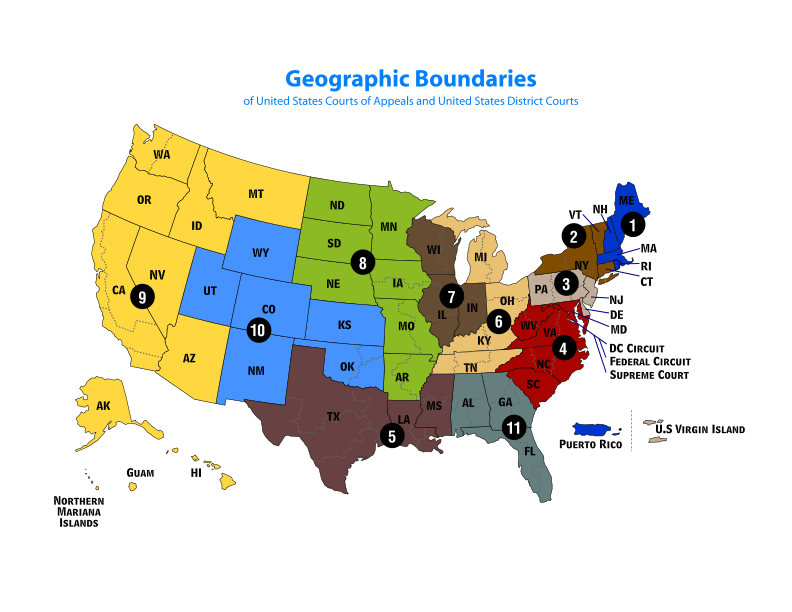
Legally, Circuit Court of Appeals have at least as much impact on the nation's legal culture and society as does the Supreme Court. St. Louis' place on the Mississippi River places it on the precipice of the Eighth Circuit and a bridge apart from the Seventh. The Sixth Circuit is downriver a few miles but borders Cape Girardeau. And Kansas City is a city split between the Eighth and Tenth Circuits. See the map below. u.s._federal_courts_circuit_map_1.pdf
114 KB
There's a remarkable diversity of legal precedents available to area lawyers, depending on where their clients are sued. Many lawyers and judges even commute from St. Louis or Kansas City into other jurisdictions to go to work.
Historically, important influences have arisen from this crossroads. Put to use by the French and Spanish for decades, Missouri did not join the union until the Louisiana Purchase in 1803. It is named after a French king and contains one of the most concentrated Catholic populations in the United States. Infamously, Dred Scott was decided here. But also, International Shoe. There was not insignificant dispute over which side Missouri fought on in the Civil War, since Missouri sent tens of thousands of men to both the Union and Confederate causes. Currently, the state is a battleground for progressive prosecutors, mask mandates, home schooling, transgender care, and abortion.
Economically, Missouri has seen better days. (Unless you live in a few crime-riddled blocks, the crime rate is not so bad as statistics make it seem, though.) Through the Gilded Age, St. Louis possessed a clout that put it in the same class as New York and Washington D.C. But the discovery of fossil fuels in the early part of the 20th century dealt the Mississippi and Missouri River economies a death blow from which they have yet to recover. That said, the boom period was a long one, and old money abounds. When catastrophic blight very nearly eradicated French Vineyards in the late nineteenth century, in fact, it was Missouri horticulturists who rescued them. Charles Shaw and other well-to-do botanists devised a means to graft European grape vines onto Missouri roots and sent boatloads to France in the nick of time.
In St. Louis, at least, I also observe charming and quite impressive local entrepreneurship. Something about the city layout and robust transportation infrastructure lends itself to holes in the wall trying out new things. Though you can't possibly know without visiting, the restaurants are far better than they have any right to be, many rivaling all but the most elite New York or Los Angeles institutions. Similarly, when Dutch Conglomerate Inbev purchased national brewer Anheuser-Busch and laid off hundreds of workers, St. Louis became the sudden beneficiary of dozens of craft brewing companies producing high-quality lagers, IPA, and ciders. Indeed, the breweries here are family affairs that encourage diners to bring children and pets to indoor and outdoor pavilions to drink and dine. There is enough space and strong-bones industrial buildings to try almost anything, whether that be converting an unused church to a skatepark, re-igniting nostalgia for board games, or putting fine dining in a greenhouse.
Culturally, the "Show Me State" is difficult to pigeonhole. It's not part of the Rust Belt. It's not part of the South. It's not part of Appalachia. It's not on the Great Plains. It's not Coastal, but because of its rivers and the 1150-mile coastline of the Lake of the Ozarks, it's not exactly landlocked either. It's not part of the Mountain States, the Bible Belt, or the Sun Belt. By car, St. Louis is four hours from Chicago, four hours from Nashville, four hours from Indianapolis, four hours from Louisville, and four hours from Kansas City. Missouri was the site of the American frontier for most of the nineteenth century and the point of departure for the Oregon Trail. Later Missouri was a hub of manufacturing and transit (by rail and river) for World War II supply. Everything heading north, west, south, or east had to pass through Missouri at some point or another. And not a little rubbed off.
I was surprised on my first drive into St. Louis, not only by the gleaming arch and massive stadiums, but to see farmers in overalls and pop-up whisky boutiques. Mark Twain famously penned social commentary and the great American novel from Hannibal before donning his white linen and moving to California. Both more academic voices, such as T.S. Eliot, and more pragmatic voices--George Washington Carver and a surprising cadre of famous generals--hail from Missouri. Outlaws have always had a place in state lore, from Bloody Bill and Jesse James to William Munny and Marty and Wendy Byrde. The "Father of Rock & Roll" Chuck Berry played at local bar Blueberry Hill--incidentally on Delmar, the street that has historically separated St. Louis' white and black population--weekly until his death in 2017. To even greater fanfare, Pop icon Taylor Swift recently attended a Kansas City Chiefs game to cheer on her boyfriend Travis Kelce. Missouri went blue for Clinton (who hailed from Arkansas on the southern border) but has gone red since. Washington University School of Medicine publishes the go-to manual for med school training while the larger university's economists expanded the Chicago School's freewheeling gestalt to include the catalytic incentives that institutions provide. Both Jon Hamm, star of the 60's biopic "Mad Men," and William S. Burroughs, inveterate Beat, hail from St. Louis. There's city, there's farm. There's car and train. There's black, white, and every race in between. There's corruption, there's religiosity. There's radicalism and an unspoken mandate to be moderate and decent to others. Sometimes it seems like people's features are just bigger, as if allowed to stretch out of their scrunched, East Coast archetypes without being blunted and mellowed by West Coast indulgence. And there's an ineffable sense that there's plenty of space to live between the Atlantic Old World and the Pacific new one.
Yet the unique standing of Missouri is not really appreciated, if it is even guessed at. Most of the country readily conflates the postal abbreviation (MO) with Montana and the culture with Mississippi. While elementary school children can rattle off the "Four corners" states, New England states, or West Coast states, many geographers have a hard time visualizing what states border Missouri to the north, south, east, and west.
So far as I can tell, the rivers flow on to the east and south, bereft of cargo now. Cars stream west to the mountains or the coast, or north to Chicago, or lately, south to Austin. Planes and helicopters pass overhead. And that's just fine. There's plenty here.