A little over 3 years ago, I decided to get serious about learning to code. I had tried a few times in the past, but had given up when I got stuck or didn’t understand something. But this time I was determined to stick with it. Now after 3 years, I have built over 30 projects, several with 100s of real users, and even contributed code at work as a PM.
My process began by taking Replit’s 100 days of code course. This was a great option for me because from day one they had you writing code that ran. That also had detailed videos with explanations of why it worked. This was different than other courses I had tried where you learned a lot of concepts at a high-level. And then when you finally got into code, you had no clue how those concepts worked in practice or how to combine them. By 50 or so days in I felt like I had learned enough to start building things on my own. So I continued with the course and started hacking in parallel. By the end of that course I was hungry to build things and to learn more. I dove right into a Python for Business course. And I was also building things on the side, it was a great way to take what I learning and put it right into practice. And from there I kept building stuff. I had an Apple Note full of ideas that I never thought would become real. But now I had the skills to make them reality. Lots were flops, some never got off the ground, but a few got real users. It felt great. And then recently I realized that even though I was building things that “worked” there was lots I still didn’t know. So I took a refresher in Python and another course to learn how to better use Django. I learned a lot of new things and realized there will always be more to know and I’m still at the start of my own journey. If you want more on how I started and progressed you can check out this recent episode of the Tech Threads podcast (Huge thanks to Max for having me on!).
I’ve learned a lot over the last 3 years, and wanted to share what worked in case it would help others. So let’s get right into it.
Stick With It
Let’s be honest off the top, learning to code is not easy. It’s like stepping into another universe with its own language, culture, and customs. It can be easy to get discouraged and feel like giving up. But you have to push through and put in the time to learn. You aren’t going to learn know everything right away, and that’s okay. The most important thing you can do is keep trying, learn something new each day. Put something into practice. Write some code that runs, and make sure you understand how it works. Then move onto something more challenging. While I thought the Replit course was great, learning to code is not easy. Paul Graham illustrated this well when he tweeted about the course.
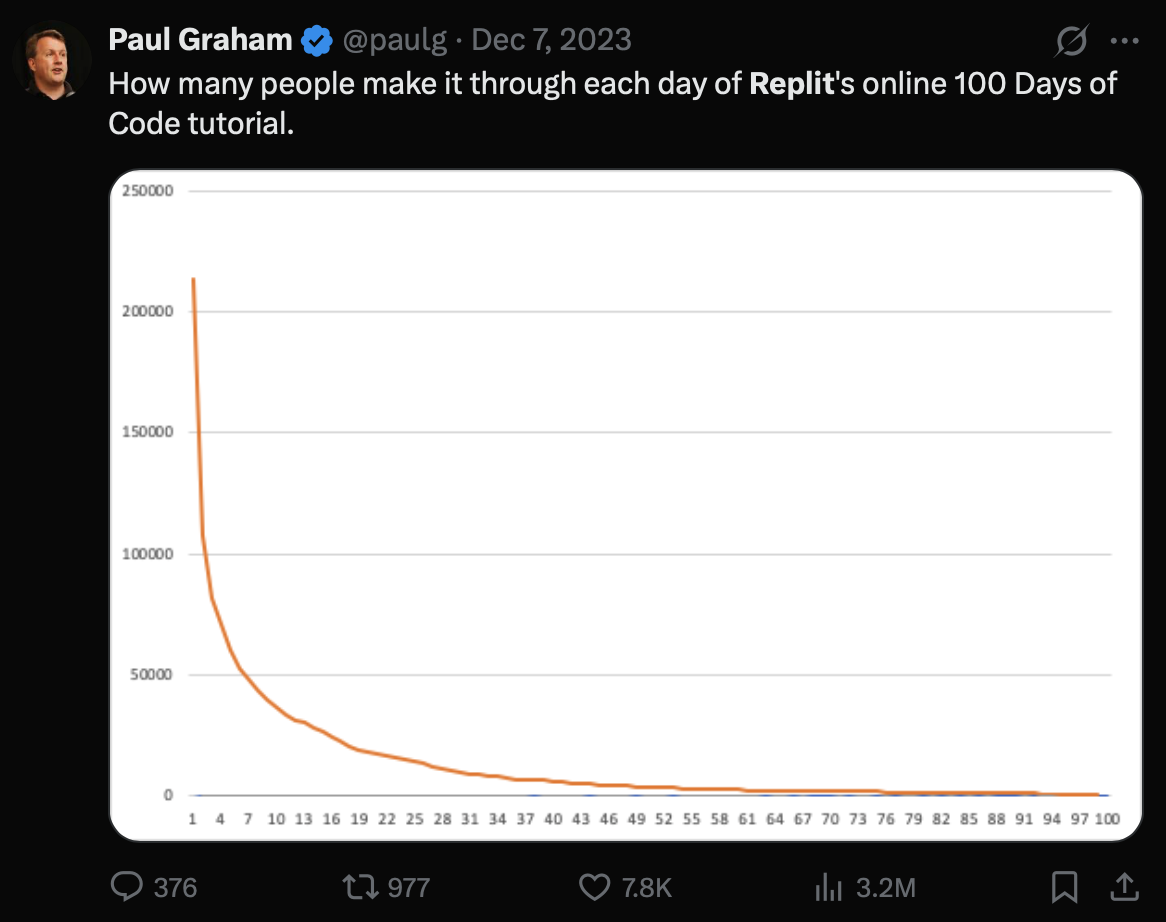
This chart is a pretty eye opening view into how many people don’t stick with learning. But it is also a good roadmap for how to be successful, just stick with it.
Make It a Competition with Yourself
Starting with a 100 days course was great for me, because it meant I ended the course with a 100 day streak of coding. If you know me, I am super competitive and hate losing (especially to myself). So there was no way I was gonna let that streak end at 100 days, I wanted to see how high I could push that number. I obsessed every day with making sure that number ticked up by 1. When I felt bored or tired, I would think about losing that streak, and would get my butt to my computer. Eventually, that streak got to 411 days. It only ended when I was so sick that I couldn’t get out of bed. So I missed a day. But then the next day I was back at it. I haven’t been as aggressive at pushing that number lately, but as of today I am at a one hour of coding a day for 146 days. And tomorrow it will be 147. Nothing has been more motivating for me in learning, than competing against myself.
Find Great Mentors
I have been very fortunate to have great mentors. They’re a mix of friends, people I know online, and people I have never met. One thing that became clear to me when I started, was that people are very willing to help if you ask. Every person that I told I was learning to code offered me help. But no one is going to offer if they do not know you are interested. My formula for finding mentors followed 3 patterns. I started with friends and engineers who I knew from work who I admired. I asked them how they would get started if they were me. They gave me lots of resources and project ideas. They helped me debug my local setup and pair programmed with me. These are people who will be as invested in your success as you are, if they see you are willing to put in the work. Next, I started connecting with people online who were posting interesting projects. We would chat through DMs, Slack, and Discord. They were always willing to jam on an idea or rubber duck things when I was stuck. And lastly, I found great teachers on YouTube. I would find one of their videos on a specific topic I was stuck on. And after they helped me figure it out, I would keep watching their videos. The amount of people who are willing to help will greatly outnumber the amount of things you need help with. You just gotta ask!
Use AI the Right Way
I count myself as lucky that I started learning right before ChatGPT came out. I got the chance to learn on my own, before AI was good enough to write code for me. If I was stuck on a problem I couldn’t ask AI. Even if I had wanted to, the models weren’t good enough yet, and frankly, I didn’t even know what to ask. As my skills have progressed so has AI. Now with a few sentence prompt you can have a working prototype, without ever writing code (or even looking at it). I would caution you to avoid this. I have used AI a ton both as a feature in my projects, and as a partner in building. But I have still not given up on learning, or turned all the building over to AI. Instead I use it as a tutor. When I am stuck I will ask it for advice, or when I see many solutions to a problem, I will use it as a rubber duck. But, I am still not ready to let it do all the work for me. And I make sure to learn something new each day, on my own or with AI’s help. Some people have asked, “Is it even worth learning to code in this AI age?” My answer is resoundingly “yes”. The code an AI tool writes for you is only as valuable as your ability to understand what it has done. Amjad Masad, the founder of Replit said that the return on learning to code is doubling every 6 months. Coding is not a skill that AI is removing the need for, instead it is making those who code more capable and useful.
To sum all this up, anyone can learn to code; and the only real secret is to just start. No matter where your skill or knowledge level is today, you have total control on whether you know more tomorrow. So jump in and get going, there’s an endless world out there if you are willing to put in the world.