At long last, we have an answer: what ARE the nine best Ylvis songs?
In late 2013, you might recall, the world was taken by storm by a bizarre song about foxes. For reasons nobody fully understands, it became a genuine phenomenon: as of today, it has 1.2 billion views on YouTube, which is about 50% more than both versions of Taylor Swift's "Love Story" combined. It was part of a cultural era in which brief fascination with strange music from faraway cultures was a bit of a stateside trend: "What Does the Fox Say?" debuted less than a year after Psy's megahit "Gangnam Style." But while Psy's success presaged the coming dominance of K-pop in global pop culture, Ylvis and "The Fox" came and went, a curious but insignificant moment in a mostly-forgotten era.
Ylvis, for their part, mostly went out of their way to avoid capitalizing on their success. They released several songs after "The Fox," but not many; their next big musical project was a documentary series about quirky moments in Norwegian history (including but not limited to "Biebermania" and "that time a diving tower cost way too much to build"). At the time of their unexpected worldwide hit, they were already the hosts of a successful talk show, and had happily found their niche. Unlike, say, The Lonely Island, whose music was the cause of their success (and of Andy Samberg's subsequent SNL casting), Ylvis's sudden musical fame was a pleasant addition to an already-accomplished career. They could afford to make the music they wanted for as long as they wanted to make it, and they could afford to stop making it when they felt it was time.
Consequently, Ylvis's English-language songs are few and far between. That, combined with their general disinterest in pursuing virality at the cost of everything else, has left them relatively niche—at least, as niche as any group whose "duds" all have millions of views apiece. But "The Fox" became a hit for a reason: namely, that Ylvis are master craftsmen of comedy songwriting, among the best and funniest to ever do it. I love me some Lonely Island, some Tom Lehrer, some Als both Weird and Sherman, but gun to my head, if you asked me who my favorite comic songwriters are, I'd say Ylvis and I wouldn't hesitate.
This'll sound funny to you if "The Fox" is all you ever heard of them, but a huge part of their brilliance is that Ylvis is tremendously subtle with their comedy: as broad and obvious as their jokes can get, they're just as comfortable with humor that's funny for reasons that aren't immediately clear, conceptual comedy that doesn't underline its own concept, and jokes that take a long time to build without obvious payoff. Even their broader humor tends to come from strange and unexpected places: rather than building on their jokes, Ylvis usually prefers to swerve, throwing things at you from left field, letting side jokes grow and grow until they take over the song altogether. (They're one of the rare comedy groups whose songs tend to get better on repeated listen—there are details and nuances and some sheer meticulous comedy craft that they're content to keep out of the foreground.)
You and I are both busy people, so for your edification: here are a few of Ylvis's best songs, sure to enrich your life and consternate your good friends. Enjoy!
#9: The Cabin
If you want a great case study on what sets Ylvis apart from other, similar groups, this might be the place to start. A lot of comedy songwriters treat their music as a springboard for jokes: they make their punchline clear, then riff and riff until they have a song's worth of song. Their music is delivered from the POV of a singer who is, first and foremost, a comedian who wants to tell a bunch of jokes about a thing they want to joke about. Ylvis, on the other hand, focuses on the sincerity of the singer: the jokes lie, not in how bad his cabin is, but in how hard he's trying to make all of its worst traits sound like sexy little surprises.
Two bits particularly stand out here. First, there's the weirdly-long aside—not a standalone verse so much as an extended conceit—where Vegard Ylvisåker briefly becomes convinced that his father is trapped in the cabin walls because he's seemingly forgotten what photographs are. It's a weird joke! It's not connected to anything else in the song; tonally, it's quite different from everything around it. Leaving aside the broad, silly, obvious (weird!) joke, the main humor of it comes from how it fits, breaks from, and finally rejoins the R+B cadence of the songwriting structure: its sonic punchline is how Vegard's strangled "aaaAAAAhh!" is almost an R+B-style belt, followed by the genuine belt of "It's a picture!" (Ylvis's willingness and ability to make musical jokes—jokes about composition and arrangement and delivery—groups them with a lineage of loftier, more sophisticated comic songwriters; some of their jokes could've come straight from a PDQ Bach composition.)
Then you have the song's big reveal, near the end, that this attempted cabin-based seduction isn't just being emailed to a coworker, as the opening of the video implies—it's addressed to his wife of ten year. Aha! This isn't a pickup attempt from a wannabe lover boy: it's a story of a husband who's also a Weird Cabin Guy, and whose wife wants absolutely nothing to do with his bizarre fixation. The shots we get of Vegard recording this in-studio, with a session musician on saxophone, becomes a part of this joke: this music (and this music video) has all been diegetic, something that this man went out of the way to write and record and pester his wife with. It's a marital sales brochure, a portrait of a guy doing one of the most Guy Things imaginable. And on second listen, when you know the song is this man trying to share his fantasy of his wife with his wife, every line reads differently, more pathetic and more weirdly melancholic all at once.
#8: Yoghurt
This is one of the most quintessentially-Ylvis songs—it's hard to imagine another group doing anything like this. Where to begin? Lyrically, there's the sheer banality of Bård rhyming "yoghurt" with "yoghurt" again and again, without saying much of anything at all. There's the simple-to-the-point-of-idiocy breakdown where he just names various flavors of yoghurt without any further commentary—a longform setup to the punchline, in the second half of the song, where he becomes a salesperson for a savory yoghurt brand and replaces "vanilla" and "banana" with "wasabi" and "carpaccio." But the central joke, perhaps, is the bit that sounds almost like every generic pop song about love or sex, where a man sells himself as some kind of unforgettable sexual demigod...
It's so amazing, yes— this thing is gonna blow your mind It is the sweetest, softest, purest thing you'll ever find You think you've tried it, but remember: it's a special kind
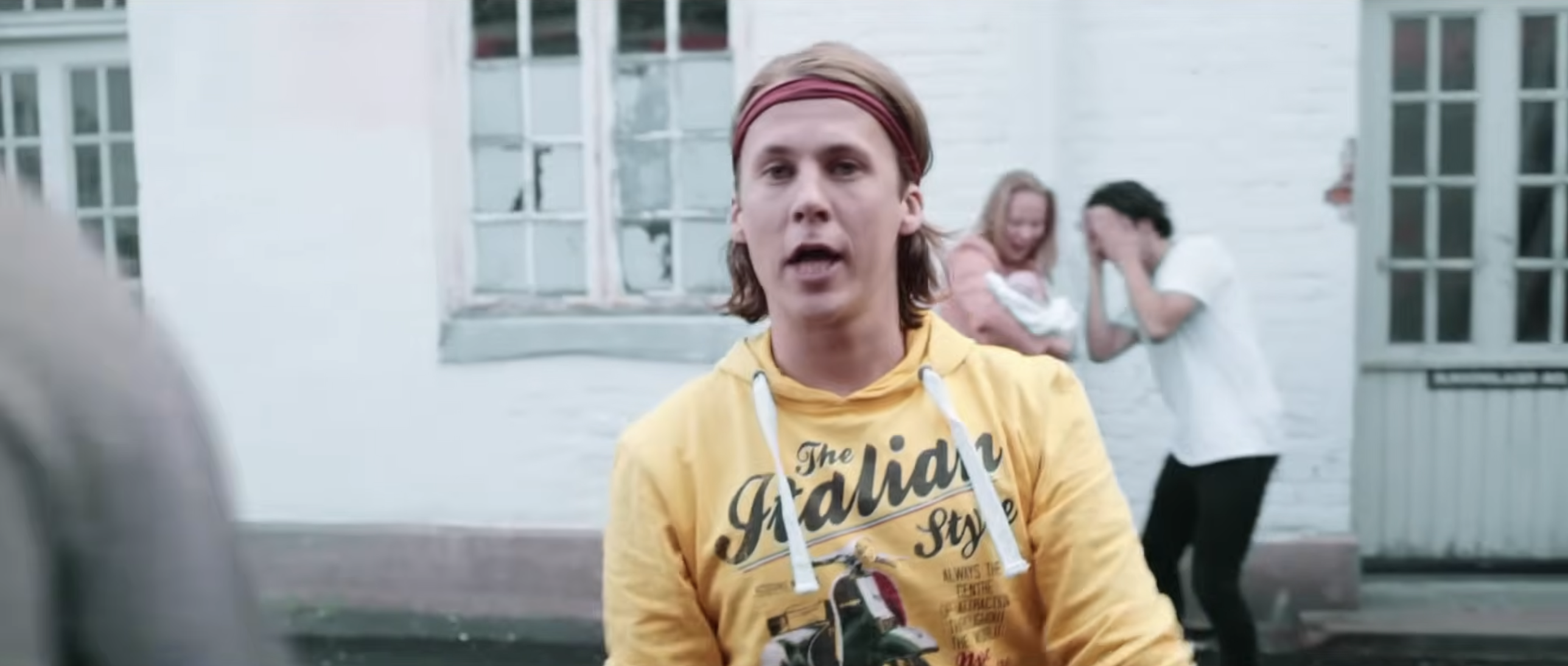
These are the sorts of jokes that are only funny, musically, because they're not underlined. There are a lot of them, and they interlock with one another, each of them happening in syncopation with the others, their humor coming from their structure more than from a more overtly articulated joke structure. And there's further enjambment in the form of the music video itself, which is shot in a single take (with one jump cut). As Bård sings, Vegard silently plays out a completely unrelated story in the background, mostly out-of-focus, in which he meets a woman, has a child with her, gets left for another man, and winds up passed out, homeless, on the street. What does this have to do with the topic of the song itself? Nothing! It's just another funny thing, happening simultaneously with (and in juxtaposition to) the main goings-on. It's funny in ways, and for reasons, that are unlike most funny music written by most funny people. Because Ylvis is something special.
#7: A capella
There's something insufferable about a cappella groups, even the good ones. It's not that they're fundamentally gimmicky, or that they have more than a whiff of Annoying Theatre Kid to them. It's that they're so damn wholesome: so determined to play around with the melodies of proven-to-be-popular songs in such inherently toothless ways. Choral music doesn't need to be this way! Roomful of Teeth is melodic, boppy, and catchy when they want to be, but they're also powerful, strange and challenging and emotionally stirring and even dangerous, at times. A cappella performers typically have no interest in that sort of thing; their audience is not the kind of person who typically thinks of "emotional profundity" beyond whatever The Lion King made them feel when they were five. But they simultaneously tend to want to be Uplifting with a capital U: you're supposed to go "wow" and think, for a few passing seconds, about how amazing and inspiring human beings can be, until the barista at Starbucks comes back with your order.
This is the closest Ylvis gets to a Crazy Ex-Girlfriend-style parody of a musical trend—it's them at their broadest and most straightforward. But it's their narrative framing absolutely sells this: specifically, that this is the story of a young boy being physically and aggressively bullied, a boy who runs into five grown adults who are willing to step in and lend a hand... by singing a cappella at him, and insisting that he's learned a cappella himself when he clearly hasn't, then getting on a tour bus and driving away, deeply impressed with themselves even when nobody else is listening.
It's gentle and warm-spirited, because Ylvis is not a particularly nasty group. Its funniest joke, in typical Ylvis fashion, has nothing to do with the overall conceit of the song. ("Boodelooap!") But as a satire of a certain kind of self-absorbed "do-gooder," it's mean as hell and it's all the better for it. The subtext is there, whether or not you're personally the sort of cold-hearted grudge-holding crank who will find it cathartic. If you're not, then just take it from me: this song is balm for a spiteful soul.
#6: Trucker's Hitch
First things first: with all due respect to "The Fox," this is hands-down Ylvis's catchiest song. Something you may be picking up on is that Ylvis are a genuinely impressive musical duo: not only do they have pipes for days, but they can write the shit out of a song. It's a beautiful gift, and one that they pervert endlessly by funneling it towards the silliest ends they can imagine. The fact that this song's hooks are catchy and its beats are bangers only drives the silliness home.
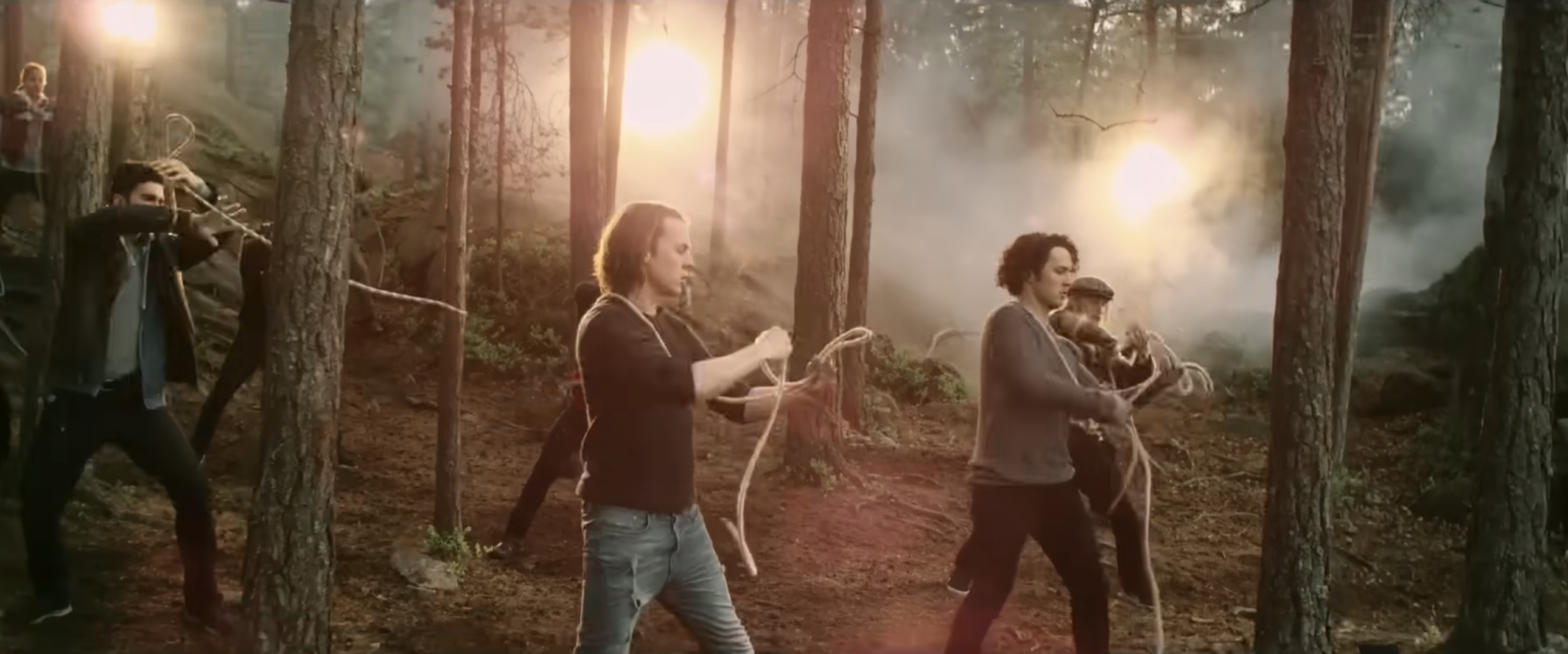
But the real star of "Trucker's Hitch" is the drop. Specifically, that the drop is a set of detailed instructions for how to tie a trucker's hitch. After two verses' worth of build-up about just how tricky a knot this is to tie, they just up and... tell you how to do it, with the same cadence that the Cha-Cha Slide uses to tell you how to move on the dance floor. There's something very funny about them replacing the relative simplicity of an instructional dance song with the instructions for a notoriously difficult knot; there's something even funnier about them repurposing a drop for this. And it's not a parody of EDM: it's a genuine banger that happens to be about tying ropes. The sincerity—as is often the case with them—itself becomes the joke.
A special nod, here, for the instructional video that both brothers independently discover while trying to learn how to tie the knot. Why is it so funny that the video—which is real, by the way—is presented as a Romanian folk dance, complete with eight men in traditional garb and an old woman at a spinning wheel? Why is it so funny that it's a polka? (A polka whose dance steps sync up perfectly, of course, with the EDM of the actual song.) Perhaps it's the implication that tying a trucker's hitch is historically done as part of a coordinated group dance, and that the tradition spans nations and cultures and generations. Or maybe it's just always funny when a group commits so hard to the bit that even the video-within-a-video has nearly a million views all its own.
#5: The Language of Love
"Surely I can't put this song this high," I told myself. "There's no way a song this dumb, this obvious, makes it this far up the list, even if it is a completely spurious and bullshit list." But there was no way I could put it any lower. Ylvis takes the same stupid joke and somehow makes me cry-laugh watching it four times in a row, because I am a four-year-old at heart and so are they.
This is a prime example of how willing Ylvis is to completely ditch one joke in favor of another, the moment it's time to replace it. I've got to believe that the first verse was the real "concept" that led to the rest of the song: a bilingual K-pop duet, as was trendy at the time, about a monolingual man. "How would they manage to overcome their language barrier?" they surely asked themselves, and then they came to the only logical answer. At which point, the second verse was the only logical follow-up, even though it abandons any semblance of connection to the original joke—the right move, clearly. After which, they only had to work out an ending, which they logically concluded would involve a singing moon, for no goddamn reason whatsoever.
One touch that stands out to me, every time I rewatch this, is that "the language of love's" subtitles are all genuinely handwritten. They didn't throw in a handwriting-esque font and call it a day: that wouldn't be as funny as the childish scrawl they came up with, so they did that little bit of extra work, and it paid off. And the childish scrawl really is inexplicably funny, and a handwriting font wouldn't have been funny at all, and perhaps the sublime genius of Ylvis in a nutshell is that they knew the one would be hysterical and the other would've been forgettable, and when you're doing something very very stupid, you've got to nail those details or you don't have a joke at all.
#4: I Will Never Be a Star
Ylvis is comprised of two brothers, Bård and Vegard. Ylvis also has a kid brother, Bjarte. And when "The Fox" became an unexpected phenomenon, Bård and Vegard made the only reasonable decision they could make: namely, to write a song for their kid brother about how pissed off he was that they didn't let him join their little band.
On the one hand, this is as classic of a "bullying the youngest child" move as you can possibly get: everything about this song is the musical equivalent of playing why-are-you-hitting-yourself with a kid who's too young to fight back. Taking your astonishing success and making your brother sing a whole song about how famous the two of you are? Classic. On the other hand, it's an unbelievably sweet and loving act: at the moment when the world's eyes were on them, Ylvis took the opportunity to shine the spotlight on their brother, centering their family history at the least personal and intimate moment of their careers. (The contrast between their Fox-adjacent publicity pictures and the ones taken directly out of family photo albums is more than a little moving: it wordlessly says a lot about the duo, and about why they seemingly had no interest in capitalizing on their moment in the zeitgeist.)
And Bjarte just kills it. Knocks it out of the park. Sure, they autotune him a bit, but whatever: the kid can clearly fuckin' sing. His comic timing is killer, his dance moves are delightful, and that pen trick? Man.
It's rare for a comedy group to put out anything this personal, this touching. It's a little less tight than most of Ylvis's oeuvre, but that's because the real joke, the real humor, comes from us knowing that the three brothers did this together: it's the sense of glee that the song conveys, that feeling that we're witnessing a shared inside joke. It's funny, sure, but it's also joyous: a love letter from and between brothers. The affection could not be more palpable.
#3: The Fox
(Sorry, Bjarte.)
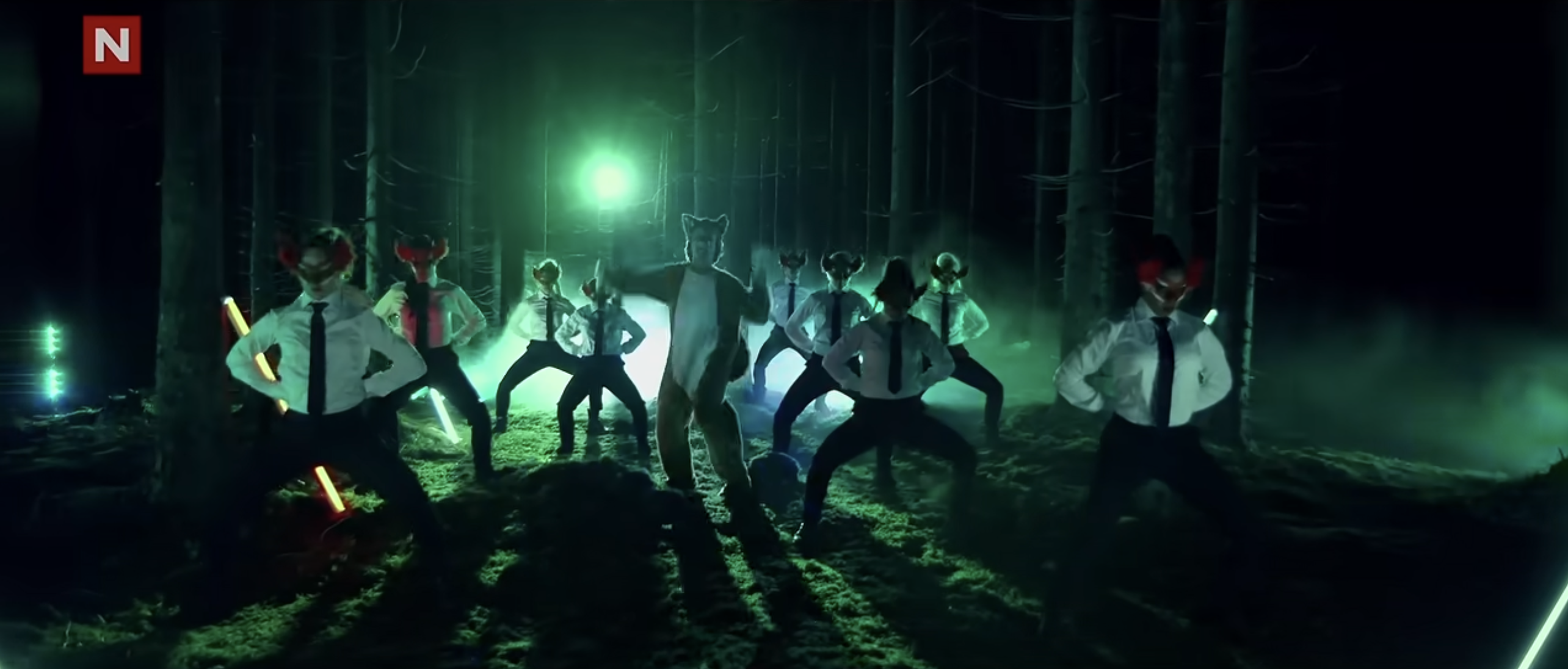
As weird as this is to say about a song with 1.2 billion views on YouTube, we really don't talk enough about how superb "The Fox" really is. Even in the context of their other songs, it's something special. You have that same love of meticulously-structured banality that you find in "Yoghurt," the same appreciation of weird onomatopoeic howling that "The Language of Love" builds itself around, the same impish genre-lampooning that you get with "A cappella," and the same unearned emotionality—backed with music that, hilariously, tugs on those heartstrings anyway—that makes all three of those songs work. But once you've heard their other music, once you have some genuine appreciation for their craft, you notice how terrifically structured this song is, how they managed to write a hit comedy song that never once makes a straightforward joke. (The closest they get is the musical joke they make with the word "morse," and the way they repeat the joke, less sensibly, with "horse," but even that is stretching the definition of "joke" quite a bit.)
You'll be shocked to hear this, if you've read this far, but I was obsessed with "The Fox" when it first came out. It's the kind of song that doesn't work if every one of its elements isn't calibrated to the point of literal perfection. They pick the exact right moment to throw "the elephant goes toot" into their first verse—just a nonsensical enough sound effect, thrown in at the tail end of the second repetition of the verse's rhythmic substructure, that it keeps the bit from getting stale. The microhook of "ow ow ow," building to the first chorus. The transition to the elaborate choreography of the chorus, and the way they slowly reveal that, on some level, this is framed as a children's book being read aloud by a grandfather to his grandchild. The absurdity of the bridge, where Bård and Vegard start to abruptly levitate, or of the repeated declaration that this fox is, for never explained, their guardian angel. And, of course, the fox itself, appearing at the end with some sublime scatting. (Why, exactly, does it work so well? You and I may never know.)
Speaking of scatting, we really do have to talk about that chorus. I fancy myself a connoisseur of stupid mouth noises, and I'm not sure there's a better set of eight nonsense sounds in recorded-music history than the two sets of four across "The Fox's" chorus. I'm aware that that's a ridiculous thing to say, but I'm not wrong. I mean, those noises are compelling, both in and of themselves and as a progression of sounds that build off one another. It's the same kind of masterful comic work as Key and Peele's famous East/West College Bowl sketch: it is genuinely hard to make good comedy out of a series of funny noises, particularly when the funny noises make up the entirety of the bit. And Ylvis legitimately knocks it out of the park.
And what's fascinating here is that, for once, that's a quantifiably true statement. "The Fox" doesn't hit a billion views if all of these elements don't work precisely this well. You can get to fifty million views with a funny enough joke, even if you're sloppy with the details; there's no fucking way you crack a billion. (To compare Ylvis to The Lonely Island one last time, "The Fox" has as many views as "I Just Had Sex" and "Jack Sparrow" and "Jizz in My Pants" and "Threw It On the Ground" and "I'm On a Boat" and "Motherlover" combined. This one song singlehandedly eclipsed the collective online popularity of the single most famous comedy group of the last two decades, despite that comedy group in turn coming from the single most famous comedy establishment in the Western world. And they somehow did it without writing a single memeable lyric.)
If you want to understand my fixation on this group, you first need to understand that that kind of success is objectively insane. These guys pulled Lady Gaga-mid-Bad Romance numbers, despite being complete unknowns outside of Norway, and despite their seeming disinterest in making a huge hit at all. And whether or not the millions of people who briefly got "The Fox" stuck in their head ever realized it, Ylvis had that megahit because their craft is genuinely that good. These breakdowns of their songs are my shorthand analyses: you could easily write an essay about any one of them, although I'm not sure that you should. I first heard "The Fox" in its early days—it might not have cracked a million views—and even so, it was clearly, conspicuously, brilliant. I wasn't obsessed with it because it was a success. But it became a success for all the reasons that I became obsessed with it. And you don't have to take my word for it: you can hear it for yourself.
#2: Old Friends
I'll be honest with you: if it wasn't for this one song, I wouldn't have bothered writing about any of this. But "Old Friends" is genuinely a comic masterpiece. I have to keep myself from breaking this one down, line by line, to get into just how well-constructed it is, and just how perfectly it builds its funny bits. Suffice it to say, if you want to learn the real nitty-gritty technical details of how to time a joke, or how to write musical comedy, or how to construct a comedy sketch in general, I think you could pick up pretty much all of it by listening to this song on repeat until your brain starts to fry.
The underlying joke, of course, is that this is a surprisingly moving song, even though it has no right to be. Some of that comes down to how—as Ylvis exploits time after time—music moves us even when its lyrics try to completely undercut the emotionality. But what makes "Old Friends" so fantastic is how much of its lyrics are played straight, and how long it takes to get to a funny place to begin with. Its early jokes aren't really "jokes" at all—they're more bathos than anything, like the way that "You had a hat / and I had a hat" pings our funny bones because they're almost-but-not-quite the kinds of words that fit the lyrical build of the song up to that point. (To paraphrase a line by Red Letter Media: you might not consciously pick up on structural details like this, but your brain does.) And the song dips back to earnest places, or couches its humor with enough phonetic poeticism that it sounds earnest even when it's not, time and again, staggering its jokes out enough that, even when you know something funny is coming, you're not certain of exactly where it's going to rear its head.
And past a point, Ylvis stops making jokes at all, giving the song a long enough runway that it manages to end on a genuinely touching note—well past the point where that shouldn't be possible in the first place. From the bridge on, we get something deceptively earnest:
Oh Margaret! Oh Margaret! Don't you worry 'bout me now: I'm doing just fine on my own. There are other things to life than your soft skin against mine, and Francis is helping me move on... I'm moving on.
"Life's a bitch," a wise man said. "No matter what, you end up dead, and all that you can wish for is a friend." So pour another glass of wine, with Francis' shoulder touching mine. I'll stay right here until the bitter end.
And you have a hat, And I have a hat... Mmm, we both have hats.
And your wife is dead, And my wife is dead... "Here's to life," Francis said. "Here's to life," Francis said.
Apart from the one repetition of the "we both have hats" bit from earlier in the song—whose humor is itself blunted because we've heard it before—this whole long passage is played completely earnestly. Even that "Life's a bitch" line is just a repurposing of a line that Francis is given earlier: it's the original punchline to the "your wife is dead / and my wife is dead" chorus, and it subtly sets up the way Ylvis subverts that chorus here, with the (again, weirdly touching) "here's to life" refrain with which the song ends.
Of course, the "Oh Margaret!" bridge is undercut by the song's video, where it's juxtaposed with two old men throwing Molotov cocktails and punching the shit out of a man for reasons never explained. Even there, though, those images are contrasted with a shot of one of those men standing at his wife's grave, a look of weary grief in his eyes. And past the bridge, the video too stays more-or-less earnest, even solemn, with only two quick brief shots of anything crazier (which are themselves fairly muted). The final leg of the song is purely a work of sustained irony: it's funny, not because of anything we're seeing or hearing—there isn't a single wink to the audience in the vocal delivery, even—but because it follows everything else we've seen and heard.
And while the song in general is as restrained as Ylvis ever gets, there's one perfect out-of-left-field comedic swerve, which is even better for following immediately after the song's single longest-delayed punchline. Because, yes, it's terrific that they build up the image of
We snuck down to the local farm, and there we opened up the barn to set the horses free and watch them run. The moon was extra bright that night, the horses in the pale moonlight...
and follow it up with
"Watch this," Francis said, and pulled his gun.
But even that's a misdirect. Because while you're busy laughing at them landing that joke, repeating the banal-repetition structure of every chorus to date...
He shot a horse, so I shot a horse.
...they hit you with the blindside, out of nowhere:
Francis choked a chicken with his hands.
And then, just for good measure, they do one last hairpin twist from emotional to deranged.
But watching them die, he started to cry. "I'm bored," Francis said. "Let's steal a car."
(Does any songwriting duo have a better sense of when to establish a rhyme scheme and when to drop it? In a word: no.)
#1: Massachusetts
If I have my timeline right—and I believe I do—this was Ylvis's first new song after the titanic success of "The Fox." Was it written because of that success, as a response to their sudden fans overseas? I'm not sure, but it plays like it: not a victory lap, exactly, so much as the duo taking an opportunity and running with it, and running, and running, and then running a little bit more.
Jesus, where to start with this one? Past the first thirty seconds or so, "Massachusetts" doesn't sit still: it changes its idea of what the joke is, or what the joke ought to be, with seemingly every other line. And this is another Ylvis production where the joke, more often than not, lies in the idea of what's being said, rather than in the actual lines themselves—only the lines are deliciously funny too.
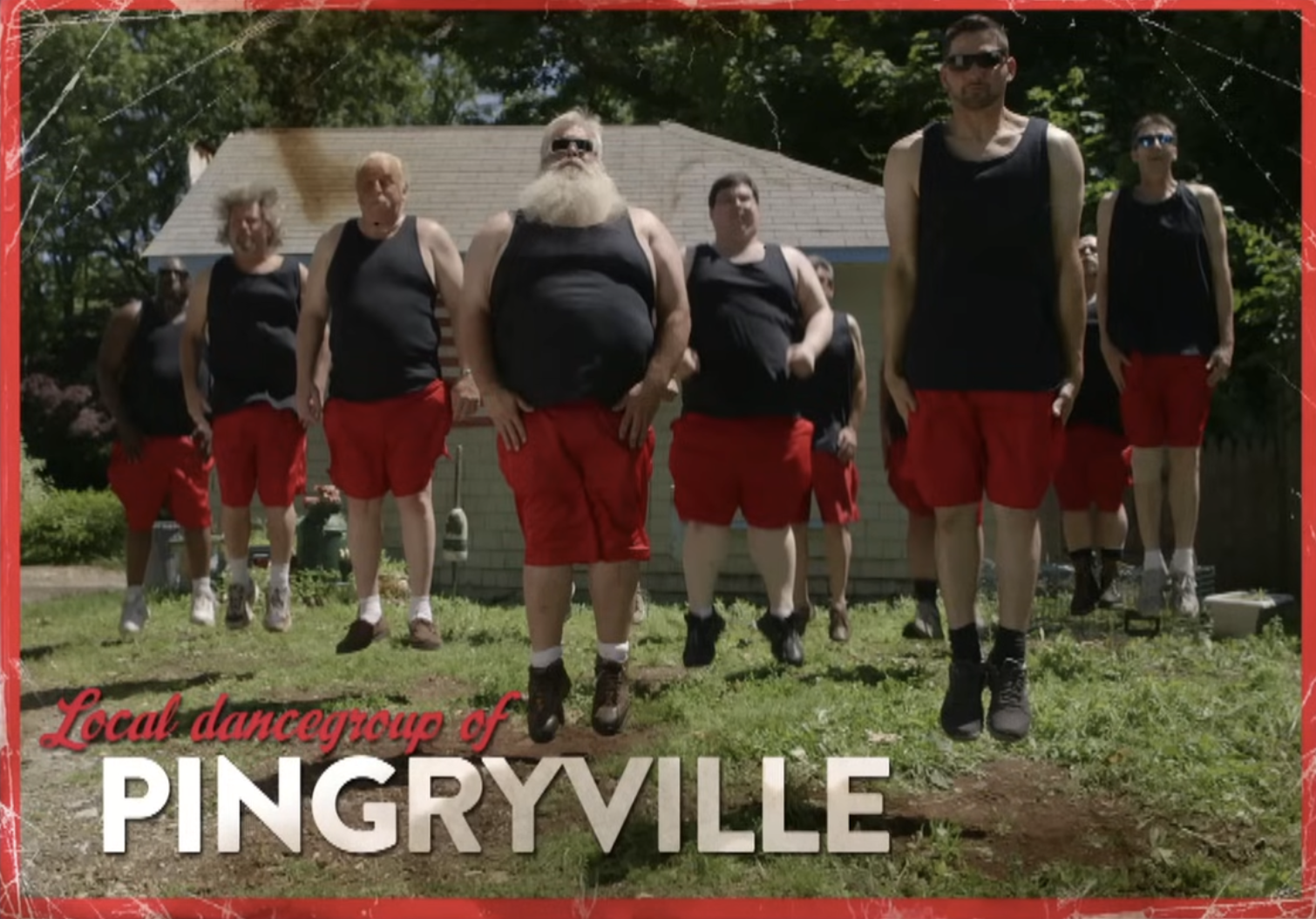
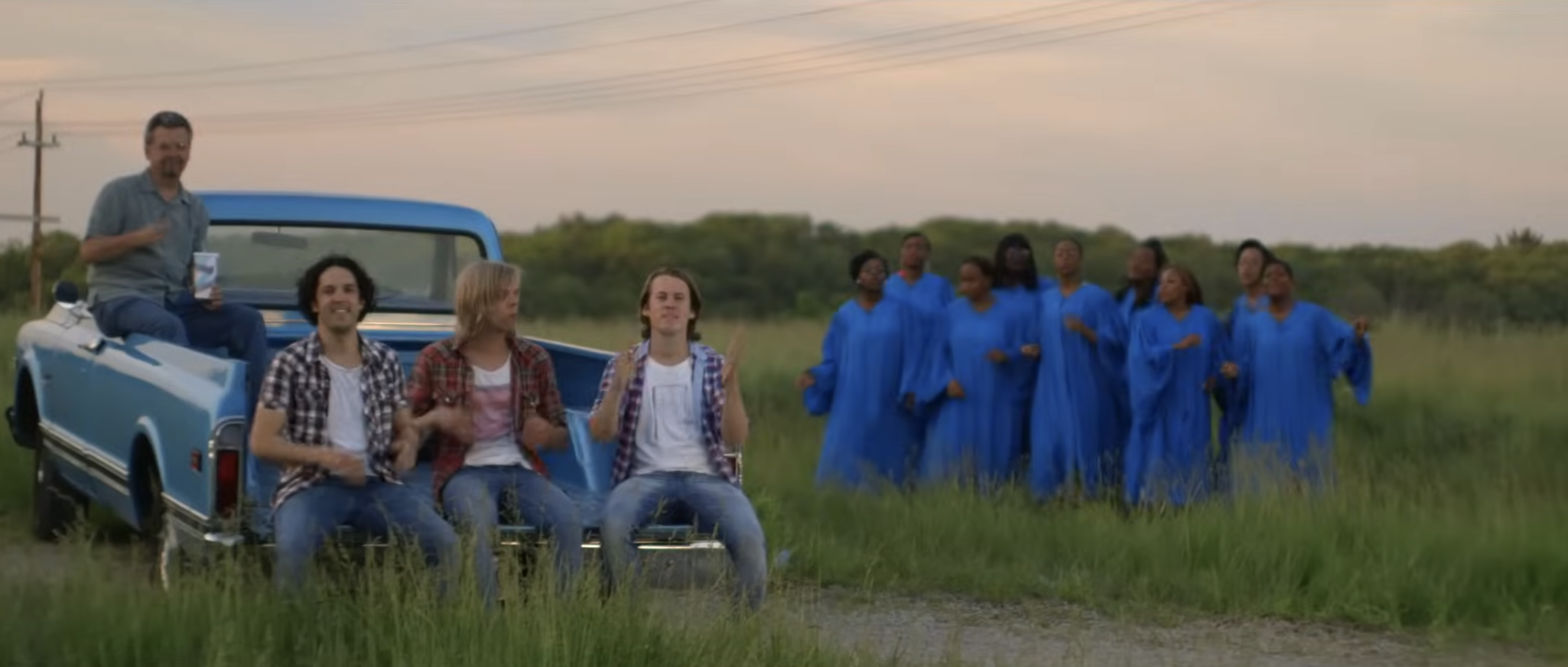
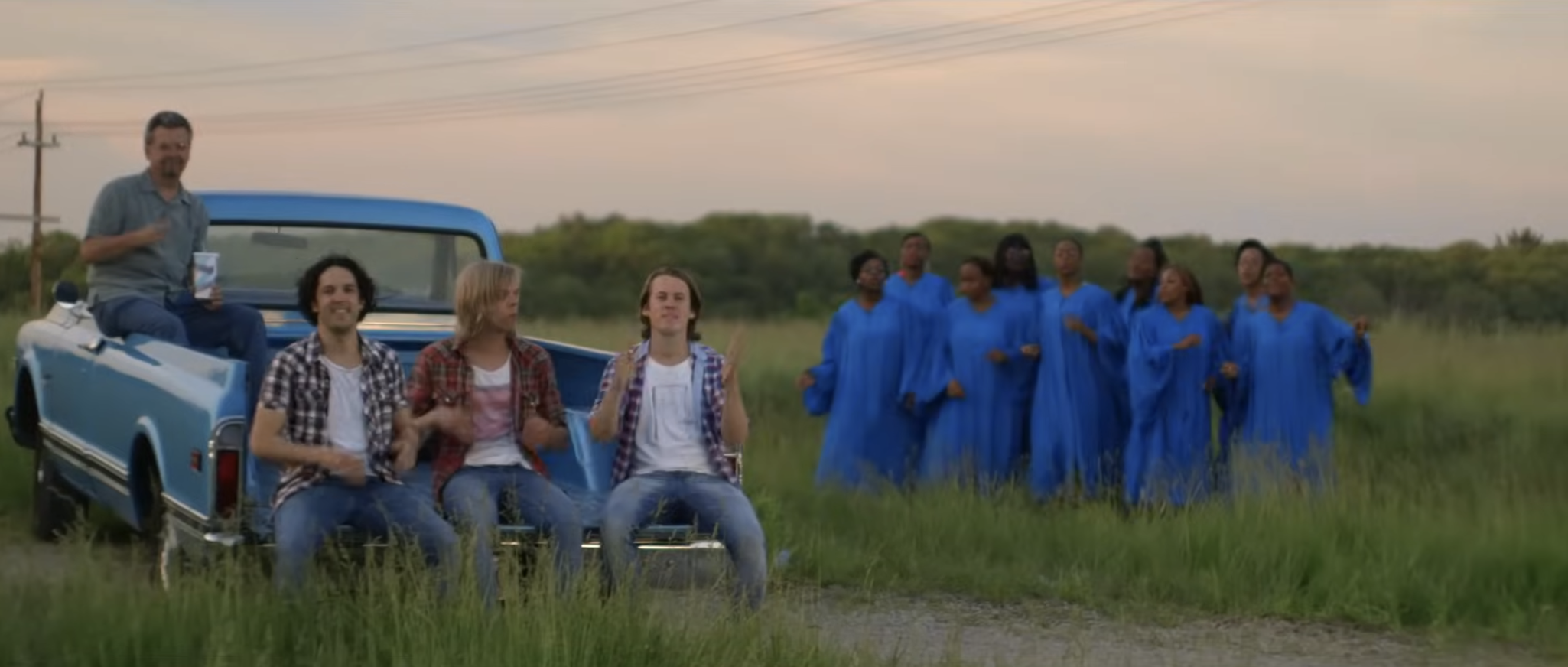
To pick just one quick cross-section: the thematic conceit of Massachusetts as a stand-in for America as a melting pot pivots (complete with genre shift!) to the claim that the state was Nelson Mandela's birthplace and the place where the fight against apartheid took place... only the conceit of that joke immediately shifts to being one of the band introducing us to all the other "tribes" of Massachusetts, each of which is more inexplicable than the last: the "boys of Attleboro," the "Catholic priests of Haverhill" (seemingly a drinking group), "staring dogs of the Suffolk county," and finally—in maybe my single favorite visual of the whole song—the "local dance group of Pingryville," of whom we only get to see a single dance move:
Start-to-finish—from Nelson Mandela to Pingryville—that whole sequence lasts twenty seconds. The next three minutes continue at about the same clip, throwing out new bits more-or-less nonstop, often with the visuals throwing out different jokes in different directions all the while. (How does this song somehow become a story about a closeted gay man at the same time it's also somehow about misspelling "Massachusetts" in a bunch of silly ways?)
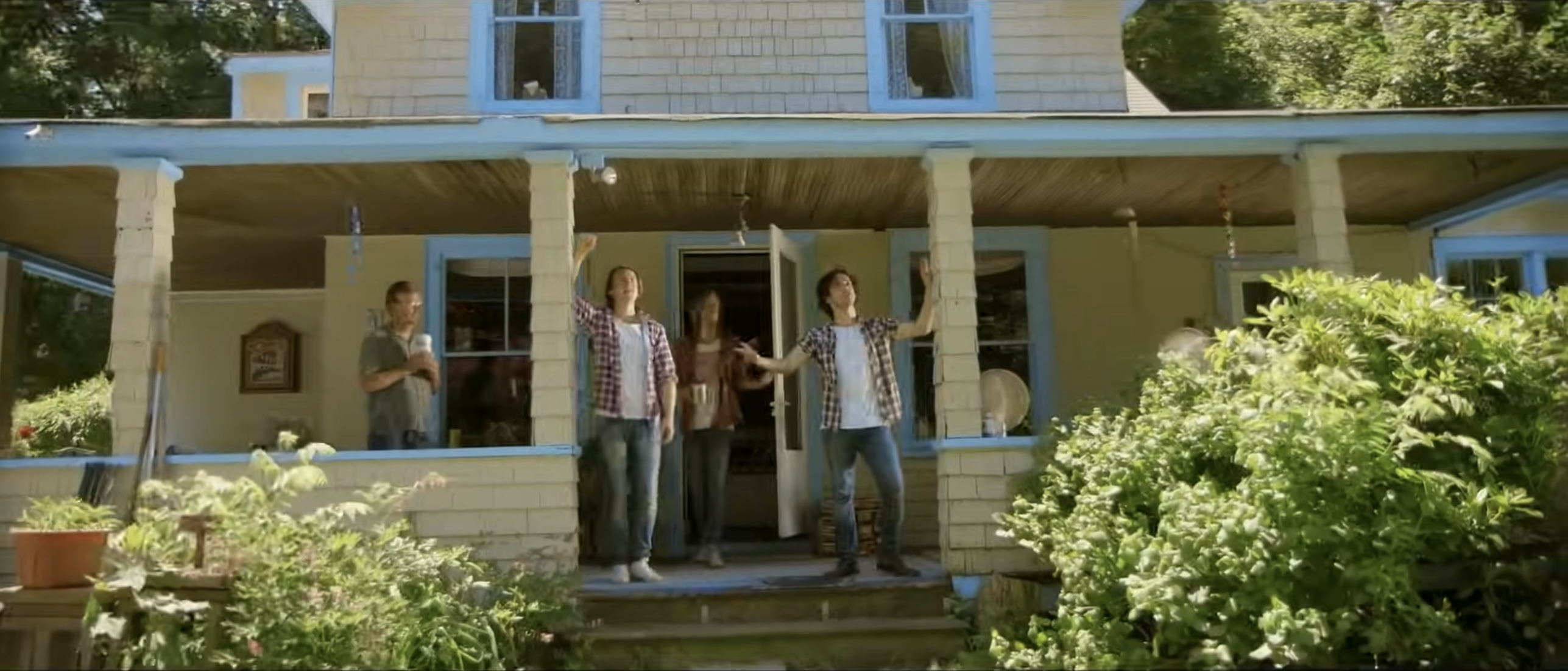
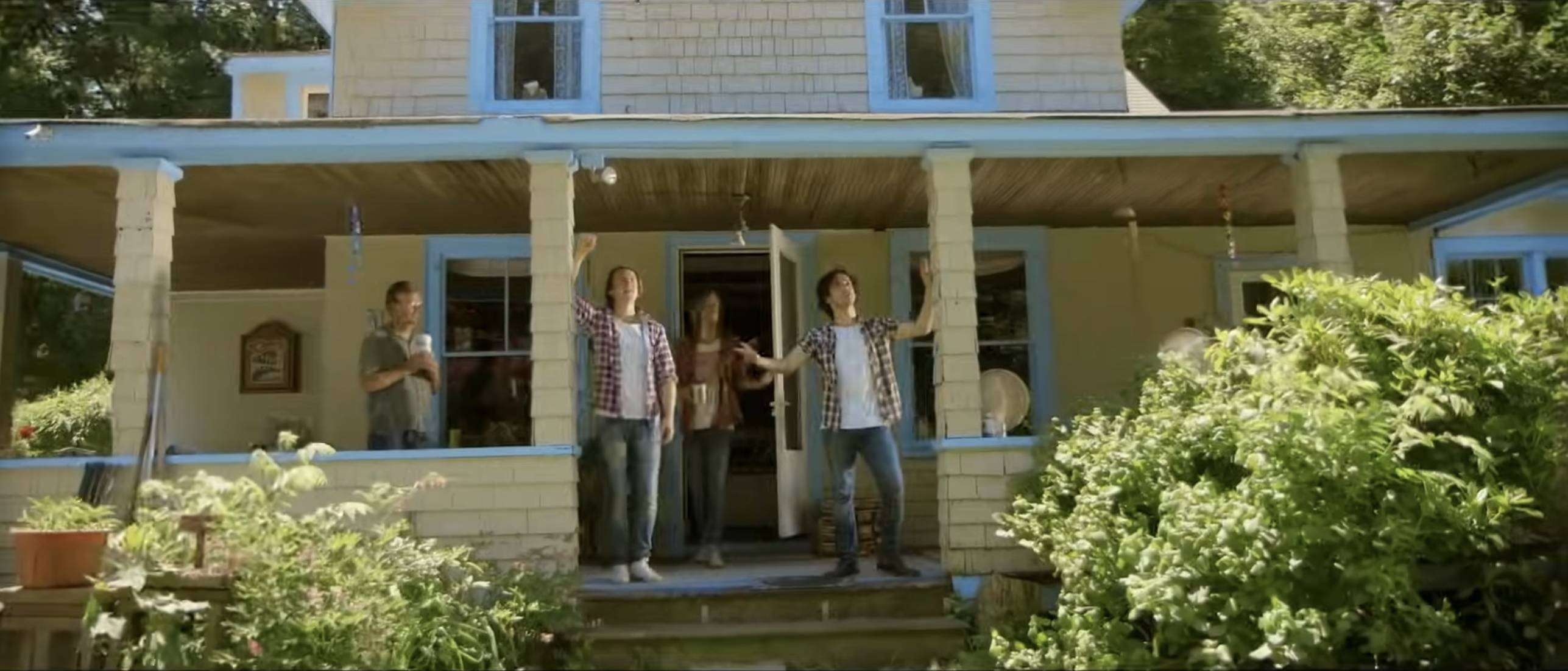
Speaking of visual gags, there's a great quiet one just before the band returns to the closeted-gay-man narrative to close out the song. The man who we've seen them having confusing sexual feelings about starts showing up in the background of every shot, including the ones he wasn't in previously:
That includes this quickie, where he isn't even fully visible—you only know it's him from the drink and his shirt:
In every subsequent shot of that particular porch—and they make a point to include more shots of it than of any other location, including half a dozen new ones in the last ten seconds of the video alone—the angle conspicuously cuts him out. You get every angle of that porch but the one where he'd be in it. But in the shot that ends the video, Bård is staring right at him, off-camera; you can tell by that hint of cup just visible on the left:
You can, on the other hand, see him in the establishing shot of that porch, much earlier, just before the passage whose joke is Ylvis naming every single one of that house's many, many residents—all of them, pointedly, except for that man, and keep in mind that all of this happens well before the gay "subplot" (can you even call it that?) comes up to begin with:
So, to sum up: they show the man at this house; they run through the all the residents at this house except for this man; they introduce the bit about having closeted feelings for this man; they leave the closeted stuff behind for a minute, but start trickling him into the backgrounds of a bunch of shots; then they return to the closeted stuff and end the song on that note, all while going out of their way to shoot the porch without letting the man into the shot, even though the song ends with Bård looking into his eyes, and...
Who is this for, exactly?
No, really: who did they make this visual gag for? They don't call attention to it—in fact, they do the exact opposite, intentionally obscuring it even after you take into account that this all occurs in brief fraction-of-a-second shots. But it's there, waiting to be noticed, an elaborate sleight-of-hand of a joke in the middle of an already-packed video attached to an also-already-packed song that you pretty much can't spot unless, for some reason, you decide to go through the video frame-by-frame. And if you do... there it is. A completely wordless, completely non-linear joke whose punchline, by and large, entirely revolves around absence. A joke that's seemingly there to be missed.
Who is this for? There's only one possible answer: they did it for nobody. They did it because they thought of it, and they realized that, if they did this, nobody would notice it, and then they did it anyway. Maybe the joke, for them, was specifically that no one would ever notice. Because nobody was expecting the fox guys to put a weird multifaceted joke that's maybe supposed to be a visual gag about a guy being in denial about his sexuality into the video of a silly song that, elsewhere, claims "Massachusetts" ought to be spelled "Massocheichei."
They did it, in other words, because this is how their minds work. This kind of pointlessness. This kind of unfathomable attention to detail. Fitting a strange joke into a strange place in a strange way, not because anyone would notice it, but because they realized they could put a joke there. It's the sort of unpredictable ingenuity, the sort of sense of humor, that sometimes gets you a ten-digit view count and sometimes gets you this, a joke buried in a video with a respectable sixteen million views itself, which I'd bet money that you and I are the first people to discover—because, after thirteen years of loving this song and watching this video repeatedly, I only just noticed this detail today.
Either that amazes you or it doesn't. Either you find this sort of thing hilarious or you don't. Personally, I think it's extraordinary: extraordinary that they do this sort of thing; extraordinary that they work this way; extraordinary that they come up with jokes this unusual, ranging from the bizarre big-picture concepts that they form each of their songs around to the tiniest subtleties of lyrical pacing and musical joke and visual edit. They work as broad comedy, and they work as stunning examples of craft; they're funny if you don't know how comedy works, and they're a marvel if you do.
I wouldn't have been shocked if they became titans of the industry, after "The Fox." Certainly they had the chops to be. I'm not surprised that they've remained steadily popular in Norway, where they continue to launch show after show, some musical and some not. (Watching their newer songs and videos, it's clear that they're still very good at doing whatever they're doing—I'm just not sure exactly what that is.) But there's something more incredible, if anything, about the fact that they could have made it big internationally, and just... chose not to. They wanted to make documentaries about minor civic incidents, and fanboy about Taskmaster, and do wonderful things right where they were. And the rest of us get to savor what we have of them, and delight that there's a group like them out there, somewhere, waiting for us to become fluent in Norwegian so we can be dazed by them all over again.