Not for the first time, I find myself marveling at the design of John Gruber's blog Daring Fireball.
The design has remained virtually unchanged since Gruber began writing it in 2002. The site briefly used a different font for its header; its logo was slightly more elaborate than it is now. Within a couple of years, the design was finalized, and then it never changed. Gruber never bothered creating a mobile layout, because the site is perfectly readable on mobile: you double-tap to select the body column, and from there it reads beautifully.
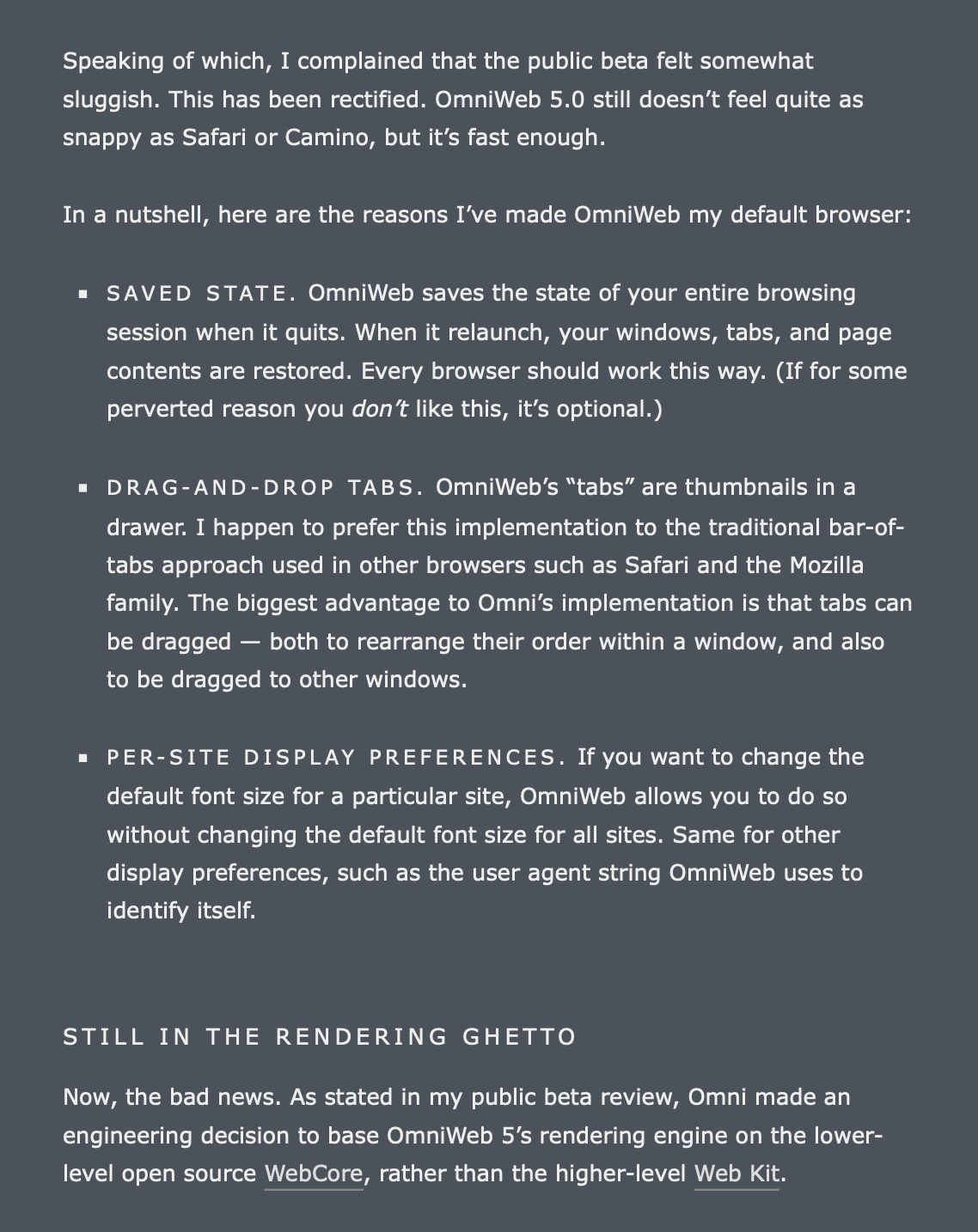
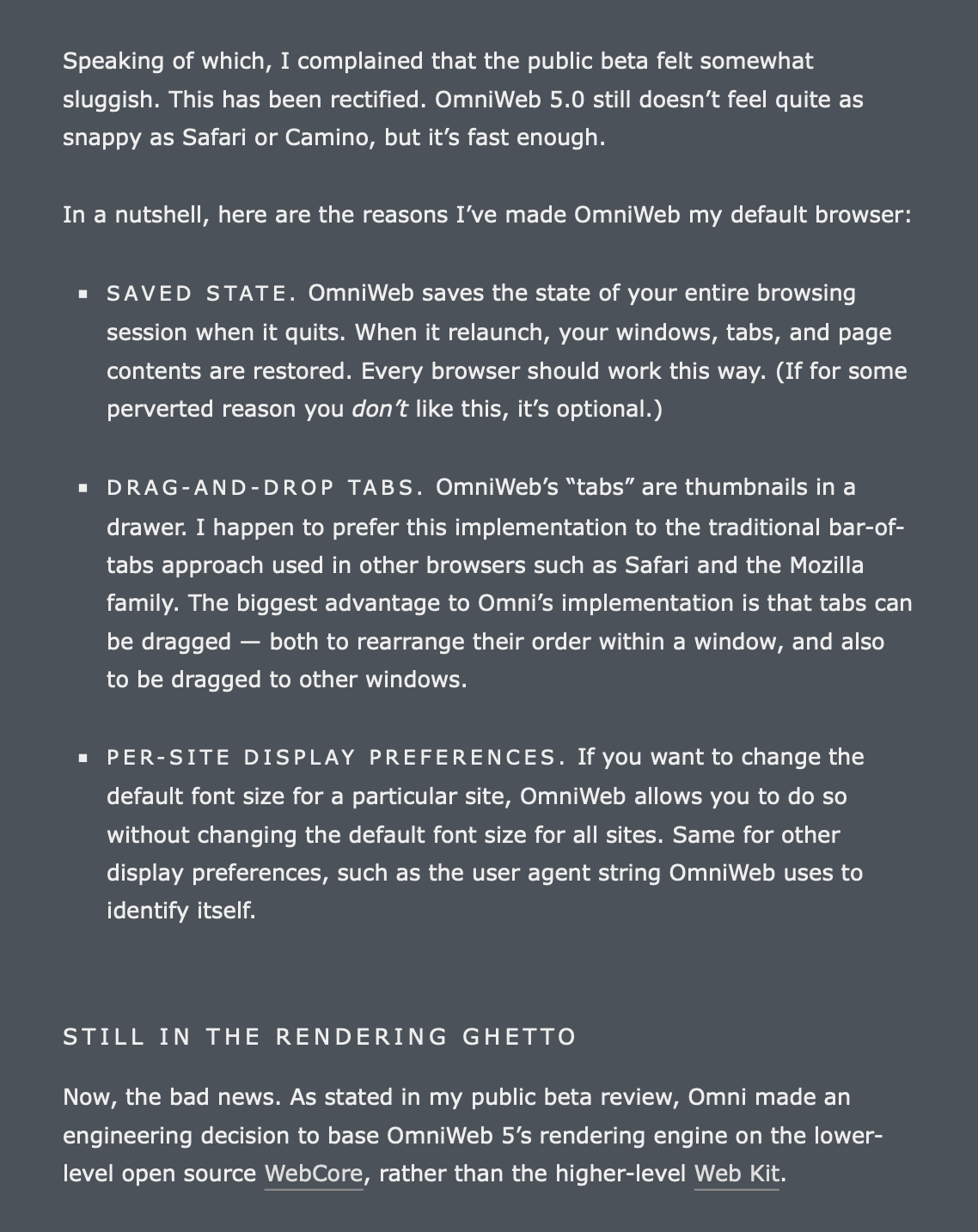
Among other things, it's one of the only blog designs I've ever seen that makes links both obvious and unobtrusive:
The hyperlinks don't interfere with Gruber's prose whatsoever. At the same time, they're obvious links, formally declared, treated like a meaningful part of the blog's content.
The formal structure of Daring Fireball is its genius. Gruber anticipated the importance of inline quotations for his blogging style; his design incorporates quotes as part of his posts' structure, using a design language that echoes and reinforces the design of his hyperlinks:
Notable too is how consistently the text size of Daring Fireball's various elements remain. Items from his Linked List—as pictured above—are presented in an upper-case style that adds only slight emphasis beyond what inline hyperlinks offer. Posts are differentiated from one another with the slightest of margins, which works because Gruber's line height is so consistent that even small breaks leap out:
These techniques are echoed in the design of Daring Fireball posts' subtitles, which replicate the gentle margins and the uppercase text of the Linked List titles, with a little extra character spacing for emphasis:
Even there, Gruber doesn't make the text size the slightest bit larger. He doesn't need to. Consistency creates ease and comfort. It makes Gruber's prose some of the most readable text online.
(These stylization choices also repeat themselves in how Daring Fireball handles bulleted lists, and emphasized text within bulleted lists. The same techniques pop up again and again, giving different types of text different treatments with quiet-but-distinct variations.)
John Gruber knows a thing or two about timeless design: he's the inventor of Markdown, the formatting language that virtually every application on the planet supports. Have you ever italicized text like _this_ or made text bold like **this?** You have Gruber to thank for that. And while various companies have introduced slight variations to Gruber's original design, nothing they've attempted has become as commonly accepted as Gruber's original designs—because Markdown was carefully thought-out from the start, enough that additions and modifications generally make it more complicated and confusing than it was to begin with.
If you want to make readable publications online, there's still no better design to study than Daring Fireball. And if you think that its techniques are simple or crude, you've never tried to create a similarly straightforward design before; give it a try, and you quickly see how difficult it is to create this versatile and readable of a design system without resorting to Gruber's exact techniques.
Good design lasts, not because it is flashy, but because it is sturdy. There's an integrity to it. It stays usable no matter what you throw at it. It's not threatened by novelty, because its goal isn't to be exciting: it's to last.
When Steve Jobs introduced the iPhone, he compared its interface to the desktop's mouse-and-cursor system. His point was that the multitouch interface that the iPhone debuted would prove to be as timeless as cursors are. And he was right on both counts: many of the basic gestures introduced with the original iPhone remain in use today, but also—while we don't think of it very often—the cursor is a strange and peculiar user interface that's so good at being what it is that we barely think about it today. The last time someone added a legitimate innovation to the cursor may have been the scroll wheel, which solved a problem that early mice did not. Past that, while there have been a number of gimmicky attempts to improve the experience of using a desktop interface, nothing really lasted—just as nothing replaced the cursor, not even touchscreen technology itself.
We don't think of truly well-designed technology as technology. It starts to feel natural to us. Because it is natural. Good design wants to be obvious, unintrusive, useful, and quiet. When something works, we stop noticing it. We often only notice good design when it disappears, and when we no longer have access to it whatsoever.
Social media feeds? Brilliantly designed (for all I criticize their usage endlessly). Notification systems? Fantastically-designed in theory, but in practice, our sheer exhaustion with digital notifications suggests flaws in their implementation that we have yet to solve. "Pull-to-refresh" wasn't a thing in the original iPhone, but the designer Loren Brichter—a Philadelphian, like John Gruber—created it for a third-party app, and now it's accepted as the way to implement interface refreshes. (Brichter also pioneered the per-cell swipe, AKA the thing where you swipe a text message to reveal actions you can take on it, and the vertical list icon, AKA the thing Discord uses to show you different servers you've joined. So much of how you use modern technology was pioneered by a single man, whose name you didn't know because his designs are so good they feel inevitable in some way.)
Tech is a deeply immature industry in many ways. Rather, modern tech is deeply immature, to the extent that it forgets how much of its roots go back to work from the 70s and 80s that continue to underpin much of what drives it forward—invisibly, both because that work isn't novel enough to excite people chasing highs, and because that work did what it needed to. The things we discuss the most loudly are rarely the things that matter the most. And that's a shame, because it teaches us to pursue the wrong things, and makes us value the worst possible kinds of technology.
But you can tell when someone values the right kind of technology, and strives to emulate it. You can tell, because the things they make are simultaneously quiet and startling; they solve real problems in unusual ways, and for a moment you feel the astonished joy of experiencing a problem solved in ways you didn't think it could be, and then you feel very little; their work becomes a part of your life, so deeply and considerately that you forget it exists at all.
__________
It's worth pointing out that this was written and published in HEY, a marvelous emailing platform developed by a company that's spent two decades carefully designing a few things well. If you've ever tried using a kanban app before, their new product Fizzy might make you cry with relief and delight.