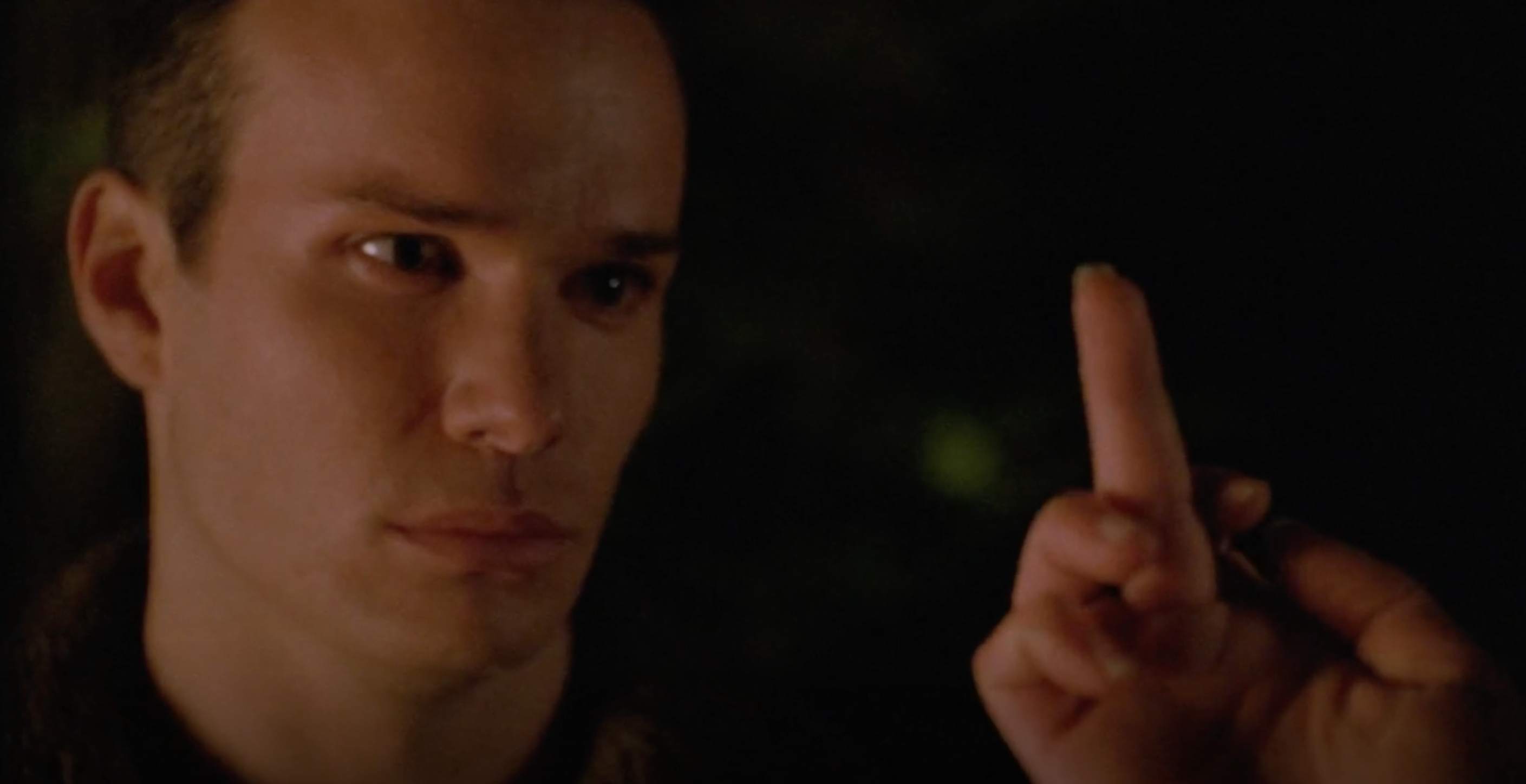
My hottest Twin Peaks take might just be: I think that James Hurley is a terrific character, but only in episodes that David Lynch directs himself. In everybody else's hands, he's awful; in Lynch's, he's brilliant. And the difference between the two gets at what exactly made Lynch such a profound artist.
Because James is infamously hatable—so much so that The Return opens with a character more-or-less staring directly at the camera to say "James was always cool." The single worst plot arc in Twin Peaks is a James Hurley solo adventure, and it goes so horribly that James is more-or-less written off the show altogether after that. And one James moment that I will adore forever—the impromptu recording of his syrupy ballad Just You and I—is reviled by a good chunk of the show's fandom. He might be more disliked than Donna Hayward, and the "worse than Donna" bar is set high.
But that's not James' fault. He was just misunderstood. And not just by the audience: it was clear that most of Twin Peaks' writers and directors had no clue why James Hurley was so compelling in David Lynch's hands. Ironically, they made the same mistake that Bobby makes, over the course of his one-sided rivalry with James: they assume that James is a charismatic heartthrob, a bad boy with a heart of gold. And James is no heartthrob. He doesn't really have charisma. James is a sweet, sad, dumb boy, which nobody understands because they're too busy ogling his cheekbones. That's the joke, and that's the appeal, and that's the secret that occasionally makes him so magnetic.
Viewed one way, the story of Twin Peaks' high schoolers plays out as a pointed satire of its more adult dramas. The grown-ups of Twin Peaks aren't exactly grown up: their sexual hang-ups are juvenile and adolescent, their emotional maturity is virtually non-existent, and they occasionally throw flat-out temper tantrums, stomping their feet and going red in the face and shouting "NO!" like they've just been denied a cookie. They're preoccupied with reputation, too—with the joke there often being that this is a podunk town whose bigwigs look shabby and unimpressive.
Meanwhile, at the start of the series, nearly every teenager is actively cheating on their partner, a daisy chain of infidelity that sometimes plays out as farce. Their personas are even more juvenile, an exaggerated pastiche of movie archetypes and tropes. They're all playacting at being adults, down to their investigations of Laura's murder playing out like Nancy Drew paperbacks. And in Laura's wake, these teens are forced to examine who they are, and come to the unsettling conclusion that they know less about themselves than they pretend.
Perhaps the most dramatic example of this—and arguably the most complex character arc of the entire series—is Bobby Briggs, who starts out as a run-of-the-mill jerk, briefly evolves into something more menacing, then gradually starts, in fits and jerks, to accept the responsibilities of genuine adulthood. He handles these poorly at first, then more gracefully over time, until by the end of the original series he almost seems like a well-formed human being. One of the most satisfying reveals in The Return is the way that Bobby's grace and maturity doesn't even have to be explained: we fully believe that he grew up alright, and the hints of more turbulent episodes in his past seem to be ones he is contending with decently, albeit sorrowfully.
Early Bobby, though, is consumed with jealousy over James Hurley. Because Bobby wants, more than anything, to be cool. He tries so hard to have style, machismo, wit, and sex appeal. He treats his girlfriend like a status symbol; he's crazy about the woman he's cheating with because she treats him like he really is all that. And Bobby can't stand that James, with his cheekbones and his motorcycle and his sunglasses and his worn leather jacket, seems to effortlessly possess what Bobby tries and fails so hard to acquire.
And James doesn't try hard at all. In fact, that's his appeal—just not in any of the ways Bobby suspects. James' appeal is that he's vulnerable, emotionally available, and too guileless to play games. (As Laura correctly pegs, James is just too dumb to be clever or showy: what you see is pretty much what you get, because he's too thick to imagine being anything but himself.)
In a world of emotionally repressed dipshits, James stands out because he feels openly and honestly. It's his appeal to Laura, who needs someone who can love her in uncomplicated ways. And it's his appeal to Donna, too, whose notions of romance are shallow and more than a little dim.
This is the duality of James: that he looks like a loner and a rebel, but has the emotional complexity of an abandoned puppy dog. In Lynch's hands, James is thrust into situations that make people perceive him as a man of action, a budding protagonist of sorts, when he's really just pushed about by forces beyond his control; he's a good makeshift hero because his heart is pure and his intentions are true, but he's sympathetic rather than genuinely magnetic. His conflict with Bobby is entirely Bobby-driven, because Bobby resents the man of action he wrongly thinks James must be; meanwhile, James spends most of his time being thrown about and feeling sad about it, which is as likable as James was ever going to be.
Other writers mistakenly saw James as a leading man, and tried to write leading parts for him. These fell through like wet cardboard, because James was simply never cut out to lead. Viewers resented him for this, particularly when his arc revolved around Donna (another character whose appeal the other writers largely misunderstood). Because James and Donna were a lampoon of high school heartthrobs, never the genuine article: their appeal was that they were as dumb and ignorant and self-centered and overconfident as teenagers genuinely are, and that they saw themselves as the romantic protagonists in a story that largely had nothing to do with them at all.
Hence the Vertigo-esque brilliance of the Maddy Ferguson love triangle, which presaged a career of Lynch repeatedly pulling the same move he first developed here. James is "in love" with Maddy because she's a mirror image of the girl he loved and lost. Significantly, he's drawn to her for the same reason that Cooper is drawn to Laura: he feels a deep, futile need to save her. But Maddy's appeal is also that she's not Laura: she's simpler, more straightforward, less challenging, and all this draws James to her too. He doesn't see her as a whole person, but then, nobody does: everyone looks at Maddy the way they used to look at Laura, including Maddy herself, who dearly wants some of the mystery and magnetism of her late cousin. And it leads to the sublime, simple scene where James records "Just You and I," and enlists both of the women he's in love with as backup singers. (Both the words "together" and "forever" have ironic double-meanings in that song: he can't choose between women, because he's pining after a woman he will never see again.) It's an Archie Comics gag played as tragicomedy.
This aspect of James deepens in Fire Walk With Me, where we at last meet Laura herself, and understand the complex relationships she had with both James and Bobby. In the context of Laura's final week on Earth—her last days before she's raped, murdered, and thrown in the river—it's obvious how deep and how sweet James' love for her is, and just as obvious how little his love suffices. He really does think that love alone can save her; he can't possibly comprehend how terrible Laura's troubles are, until that heartbreaking final moment when she screams she loves him and runs off into the woods. He will spend the rest of his life haunted by her: not by their love, and not by her death, but by that realization that he never understood what she was going through until it was too late.
By contrast, Bobby—who was both just as much a little shit as he was in the series and a victim of Laura's emotional abuse—is clearly clever enough, and perceptive enough, to recognize that Laura is involved in something incomprehensibly terrible. He understands that Laura doesn't love him, and that she's using him; on some level, he also understands that letting her do this is somehow the only act of grace he can possibly offer her. There's not much he can do for her, and he knows it, and he accepts it; he gives what little he can give, and understands that he may never fully know what he meant to her, or who she was. James rages in vain against Laura's circumstances; Bobby quietly makes peace with it. And Bobby gets over Laura, in his way; I'm not sure that James ever does.
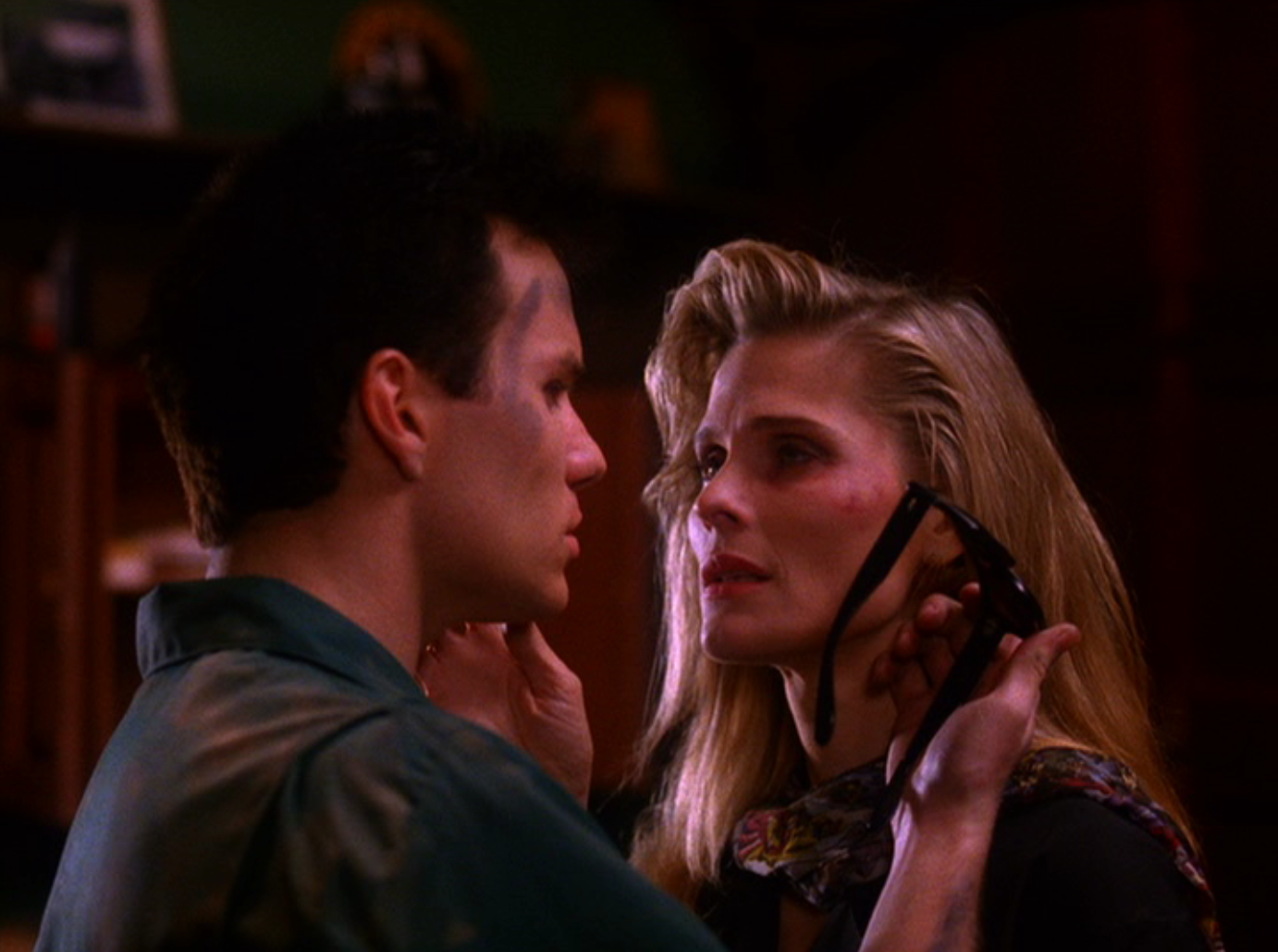
I'm not sure that there's much to say about James' arc with Evelyn Marsh. It's a horrible misfire, a complete misread of who James is and why he (sometimes) works. Writing a straightforward noir story with a conventional femme fatale misunderstands James completely: a noir protagonist either needs to be a wily idealist or a greedy and morally-compromised man, and James is neither. Evelyn Marsh could have worked if it was played out as a farce: two terrible, blackhearted rogues playing a transparently manipulative game with a total dummy, failing to recognize just what a dope they were dealing with. But Evelyn couldn't possibly work as a foil to James: her purported complexity is wasted on him, because James is not a complicated man. Laura's complications worked because they put James in a position to fail her; Donna's simplicity worked with James because James is simple too. Evelyn was a swing and a miss, and it's everybody's fault but James': that boy wanted to live a modest, humble life, and a bunch of writers who were cleverer and worse than David Lynch thought they'd try and make him get up to more.
In The Return, we get Lynch's idea of a perfect James plot, and it's telling how simple it is by comparison. James lives a quiet, working-class life; he talks to his coworker, because that's the guy he sees every day. He plays his simple, sad love song at the Roadhouse, and it sounds more like a ghost story than ever, because he's singing it to two women who've both been dead for 25 years. And he pines after a woman who seems to harbor a bit of a thing for him, despite her husband, and when push comes to shove, horrific violence ensues—violence that all happens because of James, even though he doesn't lift a finger. He's simply too dim and too straightforward not to look at a pretty woman until her husband causes trouble for them both.
It's not a big, central story, but James was never bound for big things. He's a small, quiet man, and that was always his appeal, in this loud, violent world. He's a good guy, and I'd like to believe he finds love, but the only dramatic question about him was whether he'd ever choose to love a real person over a ghost. Maybe he does; maybe he spends his life pining and forlorn. In the meantime, the world will continue to swirl around him now and again, waylaid as ever by that jacket and those cheekbones, convinced briefly and wrongly that maybe he really is a leading man.