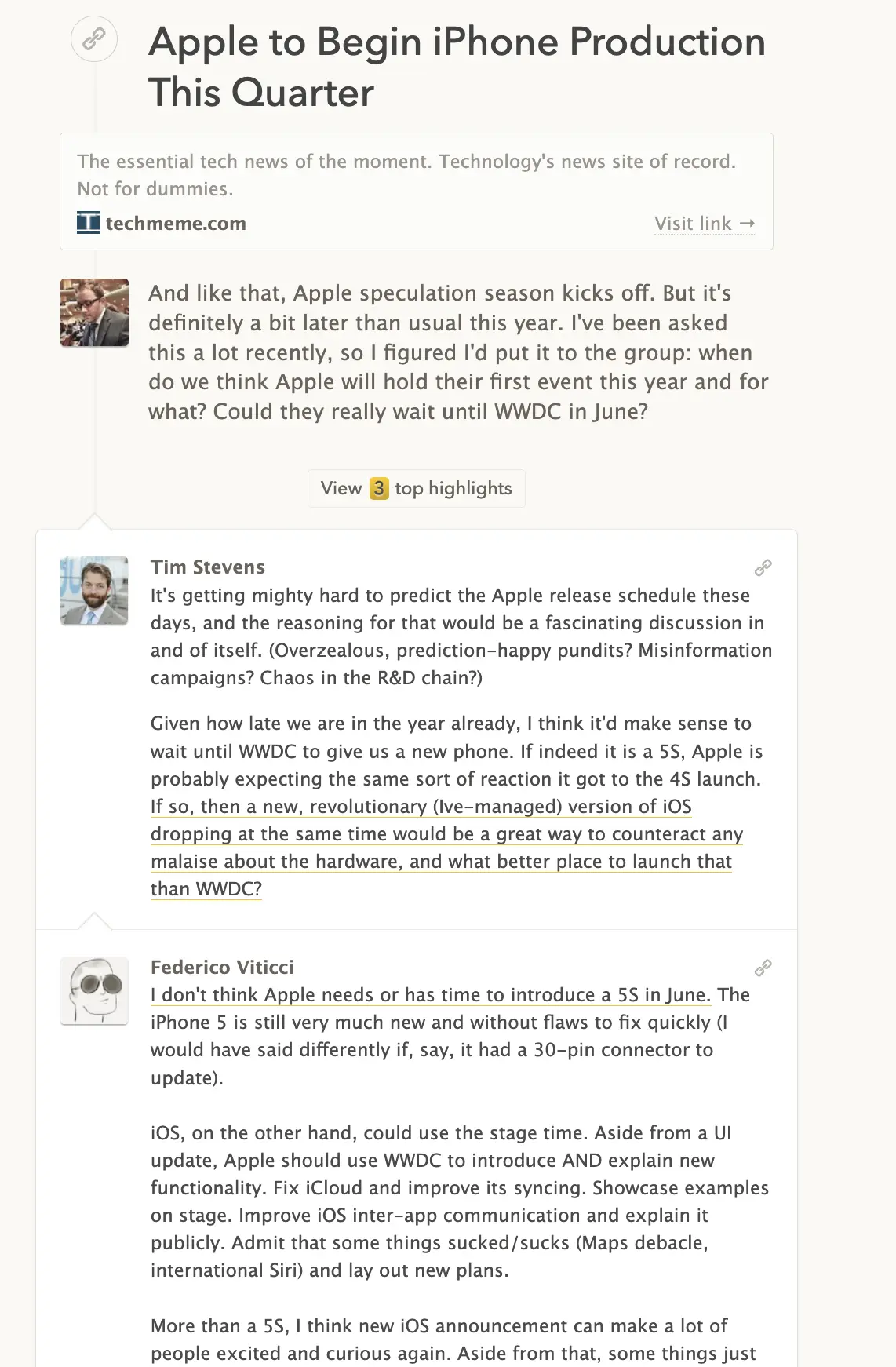
Does anybody remember the app Branch? Ha ha, just kidding. Of course you don't.
Twelve years ago, one of my favorite bloggers posted a link to a conversation happening somewhere else. The participants were all names that I knew, but the medium was unfamiliar to me. It was halfway between a comment section and a roundtable blog post: conversational, but curated. And while the conversation itself was public, the participant list was limited: not to the site itself, but to that one conversation.
Branch didn't look particularly innovative. The innovations lay in how it worked. Specifically:
Each conversation revolved around a link to something else, creating a focal point (and turning said focal point into grounds for discussion).
Each conversation was invite-only. Anyone could use the app, but the act of starting a conversation involved choosing its participants.
New threads could be started within a conversation by quoting other participants' texts. Rather than starting new discussions, these threads operated as tangents that helped focus the central conversation.
I remember Branch as one of the last real innovations in text-based conversation. At the time, nothing interested me more: it seemed clear that the mechanics of the medium we talked to one another in had a direct impact on the relationships we formed with each other, and that creating new modes for conversation was the quickest way to create entire new cultures.
I was desperately envious of the people who'd come up with Branch at the time. In retrospect, I shouldn't have been. They were purchased, along with other innovative companies, by Facebook, which was interested not in apps but in developers. Every company that Facebook purchased was destroyed; their innovations were rarely added to Facebook's products.
(Among Facebook's acquisitions of the time: Push Pop Press, which had developed a new ultrafluid style of ebooks and text-based posts that put every other kind of digital reading material to shame; FriendFeed, which allowed you to consolidate all of your social media posts and feeds and interactions into one place; and DayTum, an incredibly innovative and gorgeous tool for collecting and visualizing various kinds of personal data. They all felt like the future, and they all vanished into the ether.)
At around the time of Branch's acquisition, Twitter had mostly finalized its form factor, which remains in use to this day (and has been copied verbatim by Bluesky and Threads and Mastodon). There has been virtually no innovation in the field ever since. When was the last time a genuinely novel text-based medium became popular online? It makes me wince to count sites like Quora and Stack Overflow, but even those sites are 15 years old. That's not because there's no innovation left to be had: it's because companies stopped trying.
Crucial to this timing: the iPhone debuted in 2007. This sent two separate shockwaves through tech culture. First, it quickly became clear that images and videos made for lower-friction mediums than text, since keyboards and screens shrank and cameras became synonymous with computing devices. Second, and more insidiously, the iPhone's runaway success gave rise to a new generation of "tech bro," who was far less concerned with finicky little innovations than with potential billion-dollar payouts. Facebook set the archetype for digital success story, and Instagram set the archetype for breakthrough mobile app, and then Facebook bought Instagram, and the rest is history.
Yet people insist on communicating with one another just the same. Text remains important. Sure, the medium of choice has switched to chat apps and group texts and Discord, with a healthy side portion of Twitter-esques. But even on photo and video platforms, text commenting is still the most efficient way—the only efficient way—for conversations to happen. Sure, comments are terrible on YouTube, and on Instagram, and on TikTok... but they exist, because they have to exist. Sure, Reddit botched its redesign so terribly that most users still use the nearly-decade-old design to read comment threads... but the old design still exists, and Reddit remains as popular as ever. People still read, even if the mediums they're reading on are more decentralized than ever. People still talk.
So it's insane how little we think about the mediums we use to talk to one another on. Case in point: Bluesky, which is mostly a pretty solid app, introduced a Discover feed, so users could see which posts were most popular at any given point. Great idea, maybe... but in practice, this results in people stumbling upon other users' posts without any context, understanding of tone, or recognition of what things ought to be taken as humorous. Any mildly successful joke is immediately flooded by the worst sorts of cranks, scolds, and general dumbassery, not because any one individual is a dumbass, but because in aggregate, this kind of basic confusion leads people to act in less-than-flattering ways. Their confused responses are met with irritation or hostility; they grow defensive; they see other people behaving the same ways that they do, and form a collective sense of self-righteous grievance. Now an air of default hostility exists between people using the app in slightly different ways, because the app gave them a tool that let them piss each other off.
Medium matters. I don't care how smart you think you are, how self-aware or above it all you believe yourself to be. You are still shaped by the platforms that you use. They will change how you think. They will change how you perceive others. They will ultimately change how you think about the world, in ways that the apps' designers rarely bother to think about and are mostly not bright enough to understand. If we want to form better communities, if we want to make a better world, we have to do better than this.
And the state of the art, weirdly enough, remains grounded in 2013. It takes the form of apps that no longer exist—apps that have so soundly vanished from the world, because nobody valued them or cared to document them, that you have to go digging through web archives just to take screenshots of what they used to be.
I'm not saying that Branch is the end-all be-all of digital interaction. In fact, I've spent the last ten years thinking non-stop about the ways in which things could be drastically better. But Branch is something new, something different, and it's worth looking at, if only so we can start to learn how to think and talk about systems like this.
What matters about a design like Branch's? What kinds of tendency does it encourage?
For one thing, it's inherently group-oriented. It promotes, not private conversations, but discussions between groups.
For another, it's both intentional and ephemeral. Branch requires you to choose who you'd like to talk with; anyone you invite to a discussion knows that you specifically would love to talk with them. At the same time, each set of people matters only for the length of a single conversation. The next conversation might have a slightly different set of participants, or it might be a different group entirely.
As I emphasized up top, it encourages focused discussion. It's not the same as posting a link in a chat room, or even sharing a link on Facebook or Twitter. You are intentionally, deliberately, sharing something so it can be talked about. The point is to dwell on something worth dwelling on—increasingly a rarity in this era of social media.
Another curious aspect of Branch's design is that it explicitly values listening. Users of Branch could follow other people's discussions, and would get notifications when those discussions got updated... but those notifications were read-only. Branch was designed for watching as much as anything. It discouraged the notion that, everywhere and at all times, your opinion matters and is welcome. Instead, it suggested—wild—that sometimes you could devote your time and energy to thinking about what other people said.
Branch didn't survive long enough to generate a culture. We can only speculate about the habits, both good and bad, that it might have promoted. On the one hand, Branch was almost certainly en route to becoming a less irritating site, seeing as it largely consisted of conversations between people who were actively welcoming one another to speak. Perhaps that intentionality would have helped people feel more seen, more directly reached out to, than a feed full of people who are exclusively talking about themselves, never about you. On the other hand, perhaps that might have led to people feeling excluded, uninvited, lonely. Perhaps it would have been annoying when people asked you to participate. Would we start to treat it like a faux pas when people invited us to discussions we didn't want to have? Or when people left conversations without participating?
And is it always a good thing that we can carefully control who gets to participate in a conversation? That people get to determine who the in-group is? That people could potentially silence, or just not think about, contrary voices, different voices, potentially important voices? What happens when different sets of users begin casually excluding entire demographics from their conversations? And would a culture of resentment have formed, with quote-tweets replaced by people forming Branches around other people's Branches, one group chat publicly shit-talking another public group chat?
Like I said, we'll never know. But these are interesting questions. Questions that, had Branch survived, wouldn't have remained hypothetical for very long. It's almost guaranteed that Branch would have spawned a new kind of Internet culture, created new possibilities for community, opened up new blind spots, attracted new kinds of critique. And that's neat! It's neat because we get to imagine what could have been, and it's neat because it reminds us how easy it would be to create a completely new kind of Internet. It's neat because we all need to remember, again and again and again, that we aren't limited to the options that giant conglomerates have placed before us. Here more than anywhere, we have more choices, and more possibility, and more room to discover new ways that things can be.
What's fascinating to me is how drastically different Branch was as an experience than anything like it, despite its mechanics being nearly identical to a bunch of things that already exist. Branch was a comments section plus an invite list. It was a notifications system minus the part where you always get to post. It was link-sharing, but done in a slightly different way. That's all it took to create something new—that, and the time it took to think of a different system.
We should be thinking about these things. We should be asking ourselves how the systems we use could be different, and how those changes might affect us and our friends and our society. We should be building those systems, and seeing what happens. Building digital systems hasn't gotten any harder than it was twelve years ago. In many ways, it's gotten easier, more accessible, more doable. And look: have you seen the sorts of dipshits launching tech companies? You are almost certainly smarter than most of these people. They act like it's hard because they're vainglorious imbeciles, but if it was actually difficult, they wouldn't have bothered.
This is a conversation we need to have, because this is a world we need to build. These are things I've been thinking about for two decades now; they will remain important things to think about two decades from now. It gets tricky to talk about when all you've experienced are the shit products they foist upon us nowadays, but we're not limited to the garbage they're pushing. If the present feels like a dead end, perhaps we need to take a detour to the still-quite-recent past.