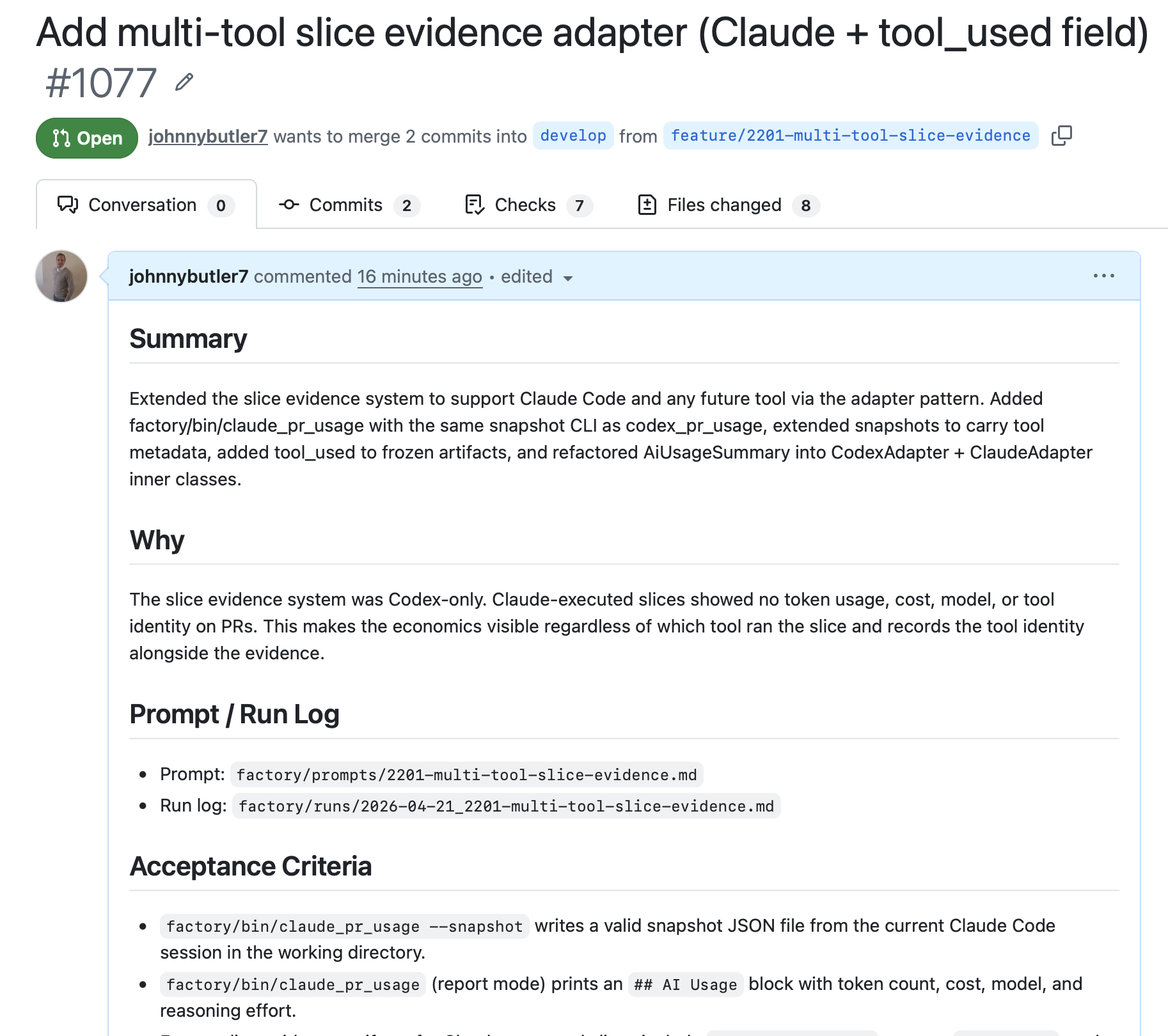
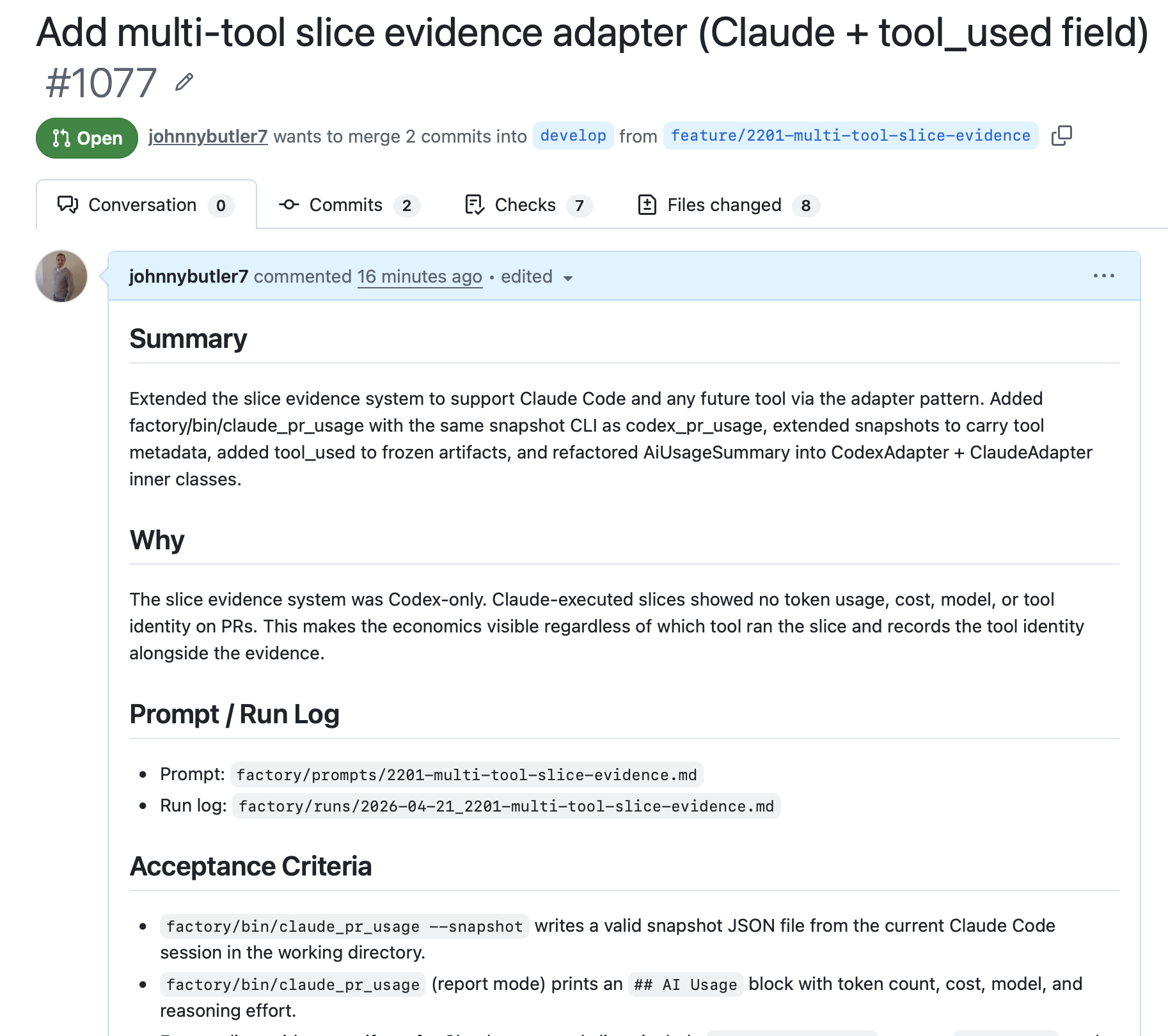
A diff tells you what changed. A governed PR should tell you why it exists. That is why PR summaries in the factory now include a Why section near the top.
This sounds like a small template change, but it fixes a real review problem. Without it, the reviewer has to reconstruct intent from implementation detail. They read the code, infer the problem, guess the constraint, and only then decide whether the slice actually makes sense. That is bad enough in ordinary software review. It gets worse when agents are involved.
The PR that pushed this over the line for me was a multi-tool evidence change. The implementation was real enough: adapters, usage snapshots, frozen artifacts, and a tool_used field so Claude-executed slices could show up properly alongside Codex. Useful plumbing, but still not the first thing a reviewer should have to decode.
The real point was simpler. Governance cannot care which tool happened to do the work. If agents are going to operate inside a real delivery system, the review surface has to stay stable either way. Same model visibility. Same token usage. Same cost visibility. Same tool identity. Same evidence shape. Otherwise multi-tool support is mostly theatre. You can say multiple tools work, but you cannot review them in the same way.
That is why the Why section belongs near the top. The reviewer should be able to see immediately what the slice is for. Not after reading the plumbing. Not after decoding the artifact changes. Right at the start. Once the intent is obvious, the rest of the PR reads differently. It stops looking like miscellaneous internal wiring and starts looking like what it actually is: a direct fix for a governance gap.
That is what a governed PR summary should do. Not narrate the diff. Remove reconstruction work. Review gets slower and shakier when intent is buried. It gets faster and sharper when intent is stated early and the implementation can be judged against it.
That matters for humans, and it matters even more if the surrounding system is supposed to support multiple agent tools honestly. The contract has to hold every time: what changed, why it changed, which tool ran it, what model was used, what it cost, and what evidence backs it up. That is not presentation polish. It is part of the governance surface.
Small template change. Better governance. Stronger base for multi-agent delivery.