Everyone has superpowers.
I don't mean anyone can fly or shoot lasers from their eyes. I mean you (and everyone you know) has some combination of abilities, interests, and ways of seeing the world that no one else on Earth possesses. This isn’t aspirational. It’s true, because math (I’ll prove it later).
Once you get past wondering if you have superpowers (because you do), the real question is: will you figure out and accept what they are?
An internalized paradox
We’ve all heard phrases like JFK’s famous “we do these things not because they are easy, but because they are hard” and we learn from school, relationships, work, and movies/tv/books that valuable things come from effort.
Like any deeply rooted myth, it grows from a kernel of truth. It's true that valuable things (diamonds, Ferraris, soulmates) are valuable because they are rare. Reversing that construction implies that that common things are not valuable. Things that are easy tend to be common.
So the heuristic becomes “if something is difficult/effortful, it must be valuable.”
These is how the myth forms. First, notice the jump from “common” to “easy.” These are often, but not always, the same.
Also notice how context matters. Diamonds are actually quite common, but through lots of marketing and a cartel, they are made to be rare. A Ferrari is intentionally rare as well (although not if you’re a billionaire car collector).
This myth is reinforced by our cognitive biases. We imbue more value into things that we’ve put time and energy into over things that we don’t. In social psychology this is called effort justification. One of the more common instances of this bias is known as the IKEA effect (where people value things more if they construct them themselves).
As a side note, this cultural myth is one of the reasons Marcel Duchamp’s work Fountain was so controversial when it premiered in 1917 (and still is).

A mass produced urinal turned on its side and signed “R. Mutt.” That’s art??? Why not?
Our cognitive biases plus a constantly reinforced myth create a blind spot that hides the truth:
Our superpowers are what is easy, not what is hard
A way to understand this is to remember that context matters. When thinking about your superpowers, remember that you are on the inside.
To someone viewing someone with incredible abilities from the outside, they seem incredibly difficult or impossible to achieve and involve a lot of effort. They could never do that!
But to the person with the superpower, these abilities feel normal. LeBron at basketball, Serena at tennis, Warren Buffett at investing, Jony Ive at design. They will never say it comes easily. They’ve probably worked very hard at what they do for a long time. And they’re smart enough to respond to the question of “how did you become successful?” with anything other than “I was born with the ability.”
But if you listen carefully, the honest ones (who aren’t selling something) will likely say something like “it was a gift” or “I don’t know.” The truth of the matter is they can’t NOT do what they do.
Heres another way to think about it. Let’s look at this classic cover from the first Superman comic:
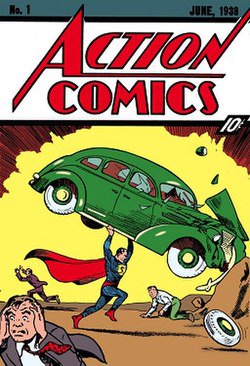
He’s lifting a car (a 1938 Chevy weighed around 3,000 lbs) the way you and I might lift an empty cardboard box and put it on a shelf. To everyone else (terrified faces, running away) it’s an insane feat of strength. To Superman, he’s lifting a cardboard box.
Superheroes like Superman, Batman, Spiderman, the X-Men are the most common way we think about superpowers. Beings with incredible abilities. Demigods (or in some cases actual gods) who are completely unlike the rest of us mortals.
Taking these stories literally, it can lead to the conclusion that those fictional heroes are the ones that have superpowers while the rest of us do not. But that’s a superficial way of thinking about it. Stopping at “I’m normal and they’re super” leads to an incorrect conclusion. The thing that makes flying, shooting lasers from your eyes, or reading minds a superpower isn’t that they’re fantastical. What makes them superpowers is that no one else but that person can do those things.
There are things that every single real-life, living human being can do that no one else can do. Everyone has skills, interests, ways of seeing the world, ways of thinking, life experiences, that they are in unique possession of. Everyone is the best in the world at something(s).
Everyone has superpowers.
Don’t believe me? Let’s do the math
Here comes the math I was talking about. If math scares you (or isn’t one of your superpowers), at least the logic of it will make sense.
Let’s imagine there are 1000 skills in the world. That means there are 1000 people who are the best in the world at each skill. That makes 1000 who are differentiated enough that you could say it’s their superpower.
But no one has just one skill. They have several. Start combining skills and you quickly wind up with trillions of possible combinations. So you don’t even have to be the best in the world at any single skill to be “the best in the world.” You could be in the top 25% for skill A, the top 40% for skill B, and above average for skill C and be the best in the world at that particular combination of skills.
Let’s do some quick math to prove it.
The formula for “number of combinations of a thing” is:
C(n,k) = n! / (k!(n-k)!)
Where:
- n = 1000 (total skills)
- k = 3 (skills in each combination)
- ! 👈 if you forgot this part of high school math, this is called a factorial. It just means "multiply this number by every number below it down to 1" (so 3! = 3 × 2 × 1 = 6).
So:
C(1000, 3) = 1000! / (3! × 997!)
The factorials cancel out, leaving:
= (1000 × 999 × 998) / (3 × 2 × 1)
= 997,002,000 / 6
= 166,167,000
That is 166 MILLION combinations!
Which means in our mythical world of 8 billion people, 1 in 8 million are the best in any one of the 1000 available skills.
But if you look at combinations of 3 out of 1000 skills, 1 in 48 is the best in the world at a given combination.
To quickly do the math on 4 or 5 skills as well:
- 4 skills: ~41 billion combinations (this is little more than 5 earth’s worth of people)
- 5 skills: ~8 trillion combinations (this is around 70x the number of people who have ever lived)
<math over>
Remember that this assumes there are only 1000 skills that matter. Of course there are more than 1000 skills, interests, ways of seeing the world, natural abilities, etc. And your superpowers could be a combo of 2 or 3 or 10 or 20 of them. We’re well into grains of sand on the beach or stars in the known universe territory now.
Everyone has superpowers
So you see, it’s not about “do I have a superpower or do I not.” Everyone has them. Everyone has some thing (or rather some combination of things) that they do better than anyone else in the world (likely better than anyone else that has ever lived in the world).
The real question is whether each person accepts their superpowers. This is what just about every comic book superhero origin story arc is about.
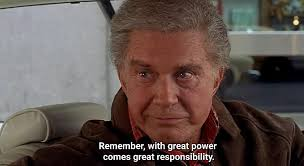
thanks uncle ben (RIP)
To accept your superpowers, you have to first figure out what they are.
You could say that being able to figure out your superpowers is the quintessential superpower.
Time to figure them out
Good news and bad news.
The bad news: I can’t tell you how to figure out your superpowers. Because there is no “how.”
I know, I know. It’s the title of this post and probably what got you to read it in the first place, but think about it for a second. By definition, your superpowers are what makes you unique. So if some random writer you found on the internet could tell you a surefire way that worked to find your superpowers, then anyone could read how to do it. And that thing wouldn’t be unique. And it wouldn’t be a superpower.
Good news 1: There’s some silver lining in that bad news though. If someone does come along claiming to tell you how to figure out your superpowers. You can comfortably ignore them. They are either:
- Trying to con you (for money, attention, whatever)
- Trying to help you, but their help won’t work because they’re telling you how they figured out their superpowers. By definition, this won’t work for you to figure out your superpowers. After all they are different than you.
Good news 2: The one who will figure out your superpowers is you. So there’s no one else you need to find. No secret scroll you have to discover. No secret technique you need to learn. You’ve got everything you already need.
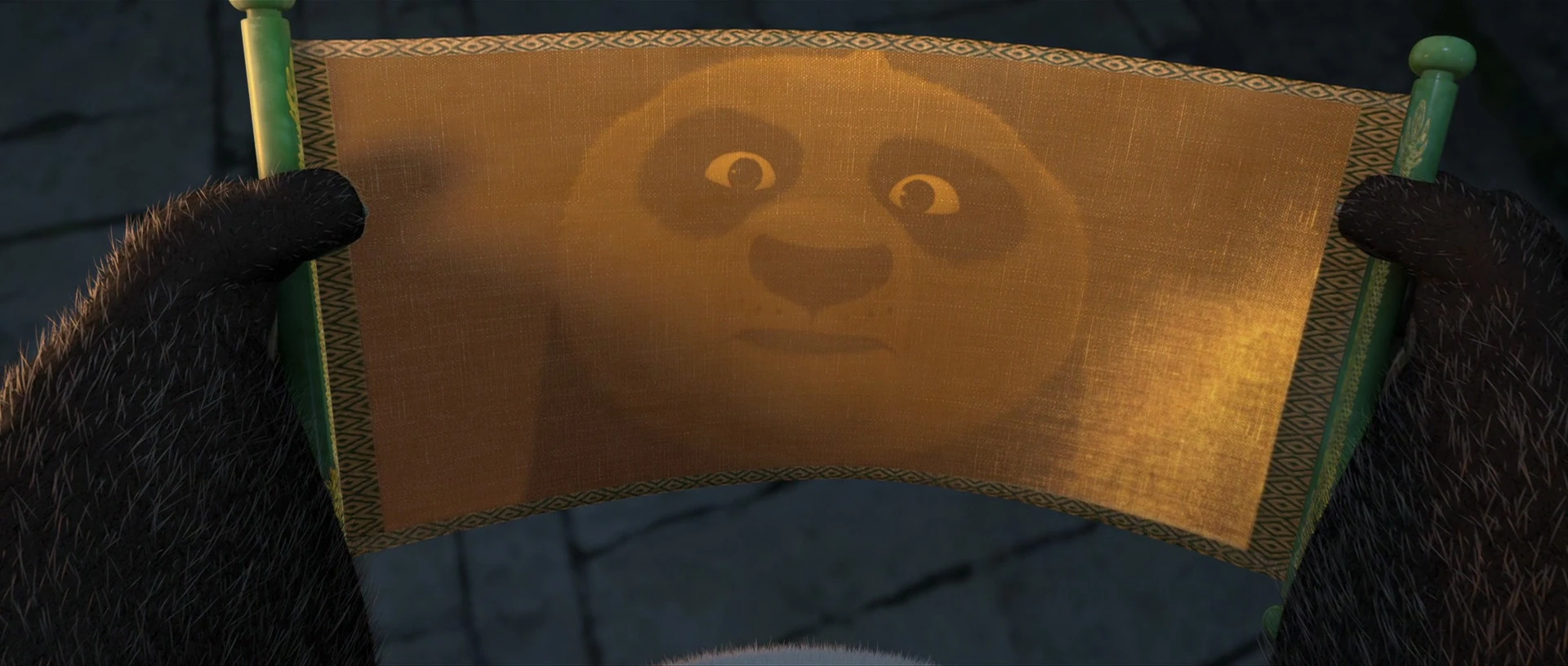
Kung Fu Panda is one of the best movies about superpowers
I’d even go so far to say that you already know what your superpowers are.
I’d even go so far to say that you already know what your superpowers are.
Although not in the way you think I mean “know.”
Thinking vs. Feeling
I’ll give you a clue. Or maybe it’s just a big sign that says “Dead End.”
A trap to be aware of.
Much of what I’ve written here are questions, ideas, frameworks. This is all the stuff of rationality. Thinking.
But thinking is not the way to find your superpowers. Maybe at some point you’ll be able to articulate what your superpowers are to yourself and others, but that’s a translation of what you discover.
But’s not how you discover it.
You discover it through feeling.
It’s pre-verbal, pre-thought.
It’s a full body experience. Your conscious, rational mind may not know. But you are more than just your conscious rational mind (sorry, Descartes). Your body, your unconscious mind are all part of you as well and they often know things well before your conscious rational mind.
Here’s an analogy: when you tap a tuning fork, it vibrates at specific frequency. That vibration is transferred to the air around the tuning fork, causing pressure waves to travel through the air. That pressure is picked up by our eardrums and turned into a tone.
Objects have specific frequencies that they “like” to vibrate at (known as resonant frequencies). If you hold a tuning fork next to a glass and the fork’s frequency matches the glass’s resonant frequency, the glass will start to vibrate. When the tuning fork (or speaker or whatever is generating the frequency) is strong enough, it can vibrate so hard it shatters the glass.
That’s what the feeling feels like. Resonance.
The compass that points the way to your superpower is a resonance you feel, not a thought you think.
A word of warning
As everything does, uncovering and embracing your superpowers comes with downsides. Remember, your superpowers are unique. They’re what makes you different from everyone else. And being different means separating yourself from others. It can be a lonely experience.
You will be able to connect with fewer people about your superpowers, because by definition there are fewer people who understand them at your level.
Think back to all those superheroes. Another thing they all have in common is how alone they all are:
- Superman is literally the last of his kind stranded on a planet of aliens. He has adopted them as his new home, but he must hide who he really is in order to be accepted.
- Spiderman seems to put people close to him in mortal danger, which pushes him to keep everyone he loves at arms length.
- Batman lives a double life as a rich playboy who lives alone in a massive house and a vigilante (constantly on the wrong side of the law), whose home base is in a cave.
- Even the X-Men, who have found connection in each other despite being shunned by the wider world, all have different powers which present unique problems that none of their teammates can truly relate to (and often creates conflict between them).
A word of reassurance
I like this resonance analogy for another reason. It points to something fundamentally different than that feeling, but is analogous:
Human connection.
Resonating with something is kind of like “being seen” by that thing. It’s similar to the way “being seen” by another person feels. Call it love or empathy or whatever you want (again, whatever it is, it’s pre-verbal). But the two feelings “rhyme.”
As I said at the top, rare things are valuable. And people who can relate to your superpowers are rare. But rare doesn’t mean they don’t exist.
Just as when you line up two sound waves the right way, they can amplify or harmonize. It’s no surprise that when you find those rare individuals who both resonate with you and what you’re interested in, the experience is greater than simply “I like this person” and/or “this person likes what I like.”
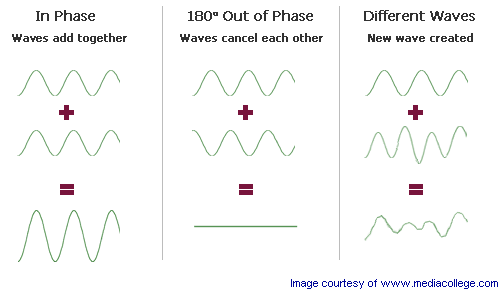
Put simply, your tuning fork gets stronger in the presence of others who share your frequency. And when you know your frequency, you can actively engage with things at that frequency. Doing so makes it easier for people on that same wavelength to find you.
Seeing the invisible
So now, let’s figure them out. It will be difficult.
They are the water that you’ve always been swimming in, so you don’t see them.
It’s impossible to see your own eyes. And yet that is where the truth lies.
But others can see your eyes. To them, your eyes are the most obvious thing. They are the “windows to your soul.”
In the same way, we can use others to help use understand our superpowers.
I don’t mean “ask them.” You might get lucky, but they’re likely tell you things to flatter you or that fits in what they want you to be, rather than who you really are.
Instead observe how they react to you. Look for the things that others find difficult, effortful, or impossible that to you seem normal, effortless, natural.
Give yourself time. You probably just did it quickly and came up empty, but that’s to be expected.
It comes with time and patience. It’s like standing in a forest and listening and suddenly noticing everything anew. Or looking at a flower. Really looking at it.
Remember this is your water. These are things that seem utterly normal and banal and obvious to you. They’ve been invisible to you your whole life. You’re not going to suddenly see it.
Until you do.
Here’s a clue: have you ever heard someone ask you “wow, how did you do that?” and you genuinely answered, “I don’t know, I just did it.”
Here’s another clue: context matters. What makes something normal in one context becomes a superpower in a different context.
One piece of Superman lore: he’s only Superman on Earth because we have a yellow sun. When he’s near a red sun (or kryptonite) he’s not Superman anymore.
Once you start noticing your unique superpowers, you can starting noticing contexts that you uniquely apply them to.
You already know what your superpowers are
If you’re still stuck, maybe it’s because they’re not “what you want them to be.”
A common trap to fall into is looking at what others do well and telling yourself “I want to be like them.” When you do that, you’re comparing yourself to someone else’s superpowers.
You’re not valuing your own. You’re wishing for someone else’s.
Your superpowers may not be what you want, but they are what you have.
There’s another commonality in all the superhero stories: their powers are almost always thrust on them. Through an accident, through fate, through genetic lottery. Each superhero’s journey is in some way about accepting and embracing what fate has given them.
It’s the same with your superpowers. They were given to you. You were born with them. It’s entirely up to you to embrace or not embrace them.
You don’t have to. It’s not your destiny or anything. There’s no moral imperative. No cosmic or real mother/father figure who will be disappointed if you don’t accept them.
But they are yours whether you accept them or not.
Here are some questions. The answers may help your rational mind realize what your body already knows.
What do you do in your spare time?
For fun.
When you don’t have to do anything, what do you choose to do?
What excites you, draws you in like gravity?
What do you keep coming back to time and time again?
What do you pay others to let you do?
The one scarce resource we have in our lives is time.
We all run out of it eventually. And most of us exchange our time for money. So money is like a compressed form of our time, that we can spend on whatever we want. So what do you use your valuable compressed time to spend more (actual) time doing?
Games, sports, recreation. We diminish them by categorizing them as silly or frivolous (unlike “serious work” lol).
When you spend your limited time on this earth in exchange for $100, what do you spend that $100 on?
What were the things that the world tried to beat out of you?
School, work, community is all about conformity. Being like everyone else in the group.
In those situations, different = threatening.
What were you teased about as a kid? What obsession were you peer pressured into giving up?
What interest did family and friends talk you out of because “it’s not a real career”?
When does failure feel like success?
The more you do something the better you get at it. But when you’re starting out you fail a lot.
Failing doesn’t feel good. And it causes most people to quit. When people quit, they stop doing something and they stop getting better at it.
But for some people, failing actually feels good. Success means the game is over. Failure means the fun continues. As it continues, it deepens. Success/failure isn’t the point for these people. Doing the thing is the point.
So when others quit, some people keep going. And because they keep going, they get better and better while others don’t. Eventually, they reach rarified air that no one else has reached. Textbook definition of a superpower.
What’s that thing for you?
What have you always been this way about?
The 10,000 hour rule is a myth. It’s a misreading of 1993 study about violinists and probably only got popular because it’s a nice round number in a pop social science book.
But it does point to the obvious truth that that the more you do something, the better you get at it. So look to the things you’ve been doing for a long time. That you can’t help but do.
Since I was a kid I’ve been…
When I’m bored, my mind always seems to start thinking about…
At parties I worry that I’ll go on a 45 minute rant if someone mentions…
You know this meme?

For you, what goes after “me:“?
The Meta-Superpowers
This can all feel like a lot and it can be difficult to know where to begin. Here’s a pointer:
You could say that being able to figure out your superpowers is the quintessential superpower.
Remember this?
If you’re feeling stuck, start there. There are a few skills that you can develop to help strengthen your ability to figure out your superpowers. You can call it resonance or sensitivity or intuition or whatever you want. The names don’t matter, none of them are “it” anyway.
- Openness: the willingness to receive what comes (experiences, ideas, feelings) without immediately filtering them through what you expect or want them to be.
- Curiosity: The willingness to follow what interests you without knowing where it leads. A focus on the process or the experience rather than the goal.
- Self-directedness or autonomy: The capacity to steer your own path based on internal signals rather than external expectations.
Together these skills are often summarized as “a love of learning” or a “growth mindset” or a “beginner’s mind” or “inner-directedness.” Whatever the cluster is (remember the name doesn’t matter), it’s driven by you and in the direction of the truth.
The sculptor Giuseppe Penone created a work called Cedro di Versailles where he spent years carefully carving away the outer layers of a tree to reveal the young tree hidden inside. The tree was always there. It just needed someone patient and curious enough to find it.
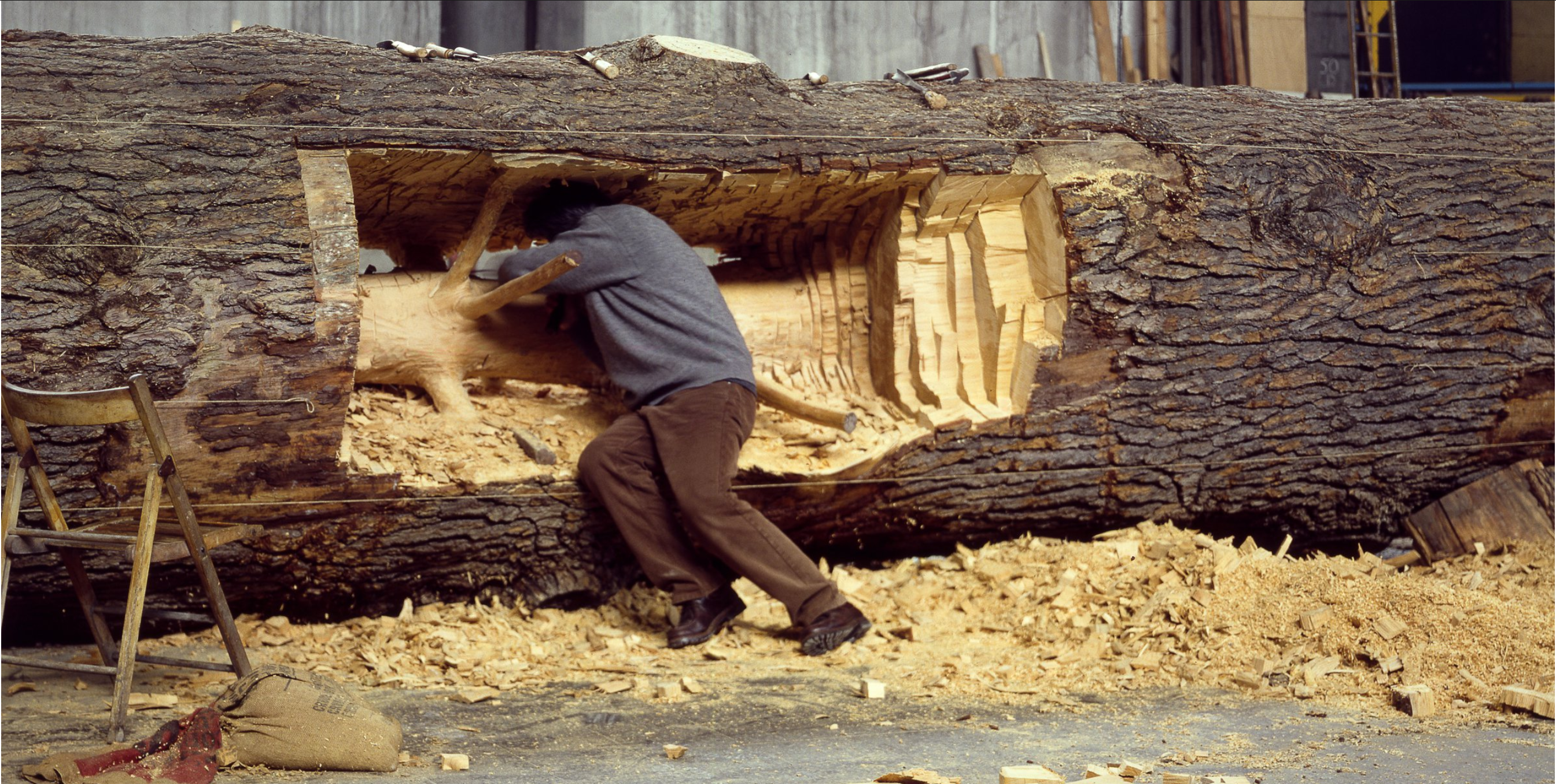

Your superpowers are like that. They've been there all along. Only there is no sculptor who will uncover them.
Or rather, there is a sculptor. The sculptor is you. Also the tree is you.
Or whatever. It’s just a metaphor.
You are given the gift of life in order to discover what your gift in life is. You will complete your mission when you figure out what your mission is. This is not a paradox. This is the way.
I said at the start that the key is to finding your superpowers is to look for what is easy, not what is hard.
The irony is that one of the hardest things you can do is find and accept what comes easy.