For edition #8 of the Acosta Dispatch, I'm taking a break from book #2 and working on another historical story. More details within. Reviews: Marked for Life: One Man's Fight for Justice from the Inside by Isaac Wright Jr.; and The New York Trilogy by Paul Auster
About Me
I'm a British 40-something speculative fiction writer, professional designer and creative director based near London. Over the last five years, I worked on drafting my debut novel, Dark Century. The Acosta Dispatch is my occasional roundup; with news, short reviews and more, published erratically.
Format
Topics are broken down into:
Cable – News & Events; Minutes – On Writing & Publishing; Vetting – The Month's Reviews; Postings – Elsewhere, On/Off-line; Intercept –Quote of the Month
Cable – News & Events
Iron Maiden, June 28, 2025, London Stadium
Some impressive backdrops like this one, for Fear of the Dark
Despite the heat, I met with old friends to watch Iron Maiden play their local (by local, I mean ‘local stadium’, rather than ‘local pub’) – not quite capacity, but Bruce Dickinson, the lead singer, assures us 70+ thousand people turned up for a galloping two hour set from Maiden’s back catalogue.
Despite the average age of each band member hovering in the late 60s, they can clearly still play note perfect. Overall, great show and I’ll be spinning my favourite album Somewhere In Time (1986), all week.
Minutes – On Writing & Publishing
Short Story Writing
Confession: I put my ambition to get through the next chapter of the new novel aside for the time being.
Writing the historical fiction has taught me just how much research will be needed to write something that’s authentic to the period. I found myself bogged down and a little dejected with the (perceived) weight of the details, and the sheer thought of writing a whole other manuscript, which will take a very long time.
The best advice — oft-given with writers on editor submission — is to write the next thing, but what next thing? Clearly, the historical novel needs a little more time to settle, but other points of consideration emerged:
Finding a great community of writers and readers;
The realisation that beyond my debut on said submission (which I can’t share at the moment), I don’t have much in the way of creative writing online;
Shrugging off the pressure of writing a whole other manuscript
What I desired was to write a palate cleanser: a short story that which I could sink my teeth into with a view to publication later this year (either with an existing publication or right here).
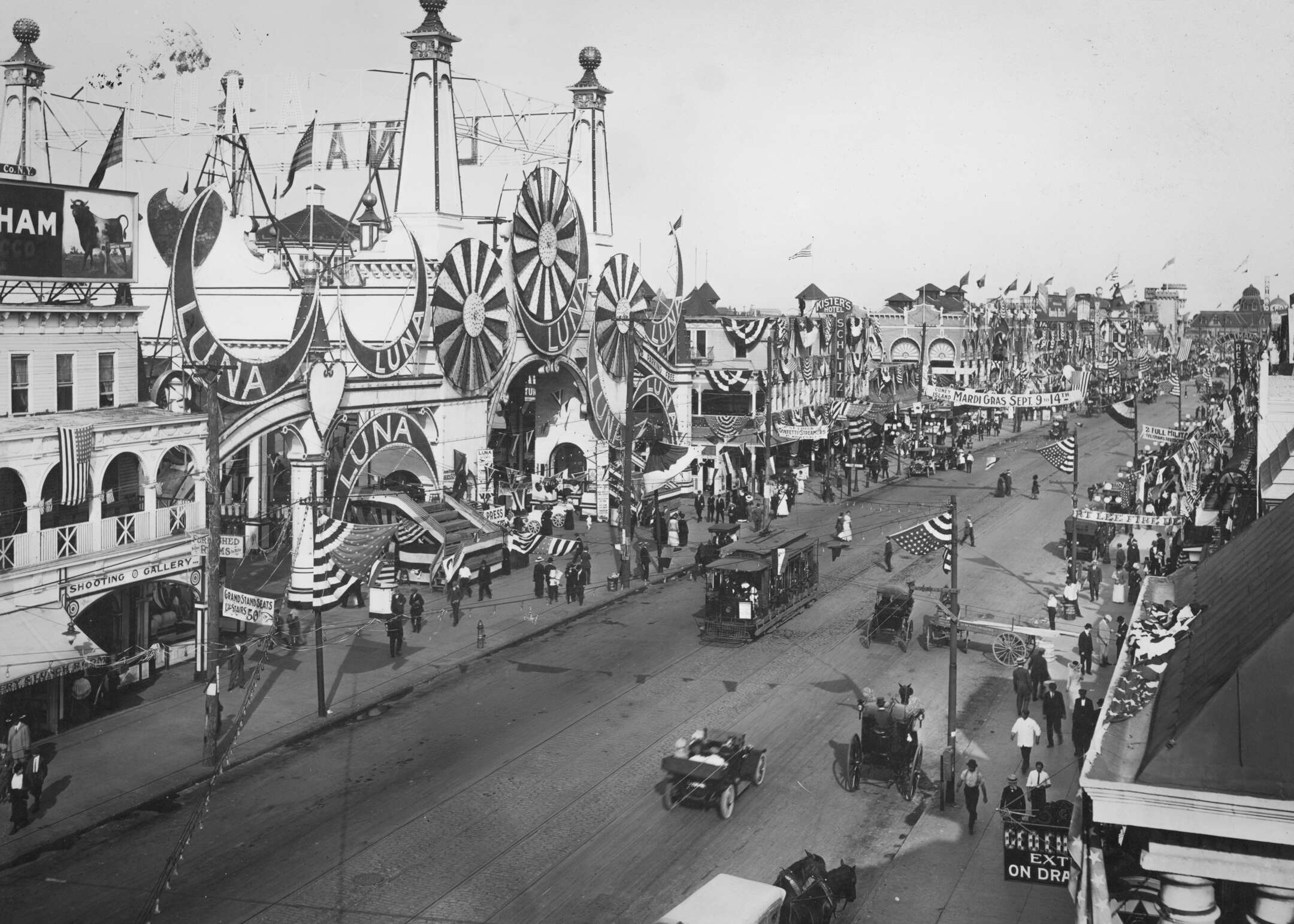
I decided I would write a speculative story based on Robert Chambers’ 1895 anthology, The King in Yellow, now considered a seminal text which has influenced everything from HP Lovecraft’s now widely celebrated cosmic horror stories to HBO’s True Detective. I had a blast re-reading The Repairer of Reputationsand The Yellow Sign, set in Chambers’ imagined version of 1920s Manhattan, and found myself penning a prequel set on Coney Island, tangentially linking threads and characters from the original anthology. I’m about a third of the way in now from my initial outline, and the story has truly taken a life of its own.
Surf Avenue on Coney Island in the early 1900s (Library of Congress) Photograph Irving Underhill, 1912.
Here’s a snippet:
We strolled along Surf Avenue, chatting idly about the weather and the show, before she regaled how her da wound up on Ellis Island. It was an unhappy tale. I recalled she’d just started at the Coronet, so I took to pointing out Coney’s more exotic attractions and their sordid operators. The gesture gave me ample pause to mark anyone following us. Next to the Bowery, Feltman’s Pavilion was doing a fine Friday trade, and we took seats at the edge of the Deutscher Garten, treating Maggie to a Red Hot and a glass of beer.
“Oh, you’ve spoiled me rotten!” she enthused, slumping into her chair after we’d eaten. “I saw a nickelodeon on the way here. Let me pay for a show as a thank you for lunch.”
Despite her interruption to my work, Maggie was a welcome presence. Besides, neither of us were due back at the theater before five. We had not walked long before I saw it: the Yellow Sign had been hastily daubed over an advertisement for a Kinetoscope parlor nearby. The strange glyph was immediately recognizable, and yet utterly indescribable; it seemed to stretch and swirl, even as I tried to fixate on it.
Its instruction was urgent.
“Is everything alright, Eugene?” Concern was writ upon Maggie’s face, but how could I possibly explain the Yellow Sign? She’d have no notion, nor appreciation of my persistent study of The King in Yellow; nor comprehend the Occluded Metropolis on the shore of Lake Hali, lit by the black stars of the Hyades.
“How about we try the Kinetoscopes, instead?” I proposed, pointing at the long-faded poster.
She squinted and shrugged, before looping her arm around mine. “Lead on, then, Mr. Bardin.”
I hope to finish the story before the end of August.
Stay tuned.
Vetting – The Month's Reviews
Another month was spent beta reading (I can’t review books that aren’t published!), but I have my annual holiday happening at the end of July and intend to get round to a fair few books when I don’t have to think about anything else...
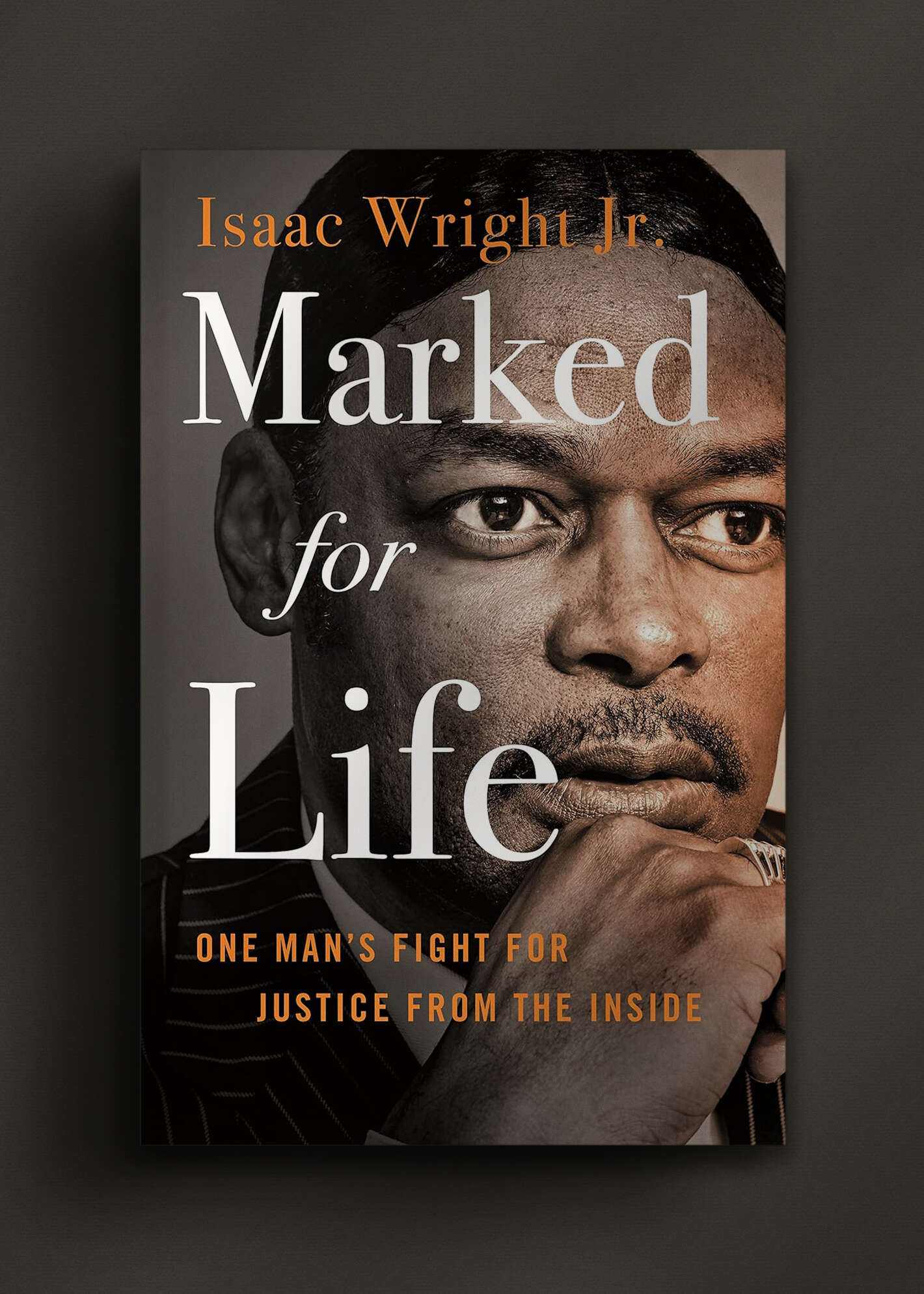
Marked for Life: One Man's Fight for Justice from the Inside by Isaac Wright Jr. (St Martin's Press, 2022)
Everything you were and ever will be is squashed in prison. That’s what they don’t tell you, what the public doesn’t understand, and what the movies don’t show. Prison doesn’t just take away your present, swallowing up your days, hours, and minutes. It also takes away your past too—drowns out your memories until they’re wisps of ideas, unrecognizable, like something from a dream or a story someone once told you. And it takes away your future, until all you can see in front of you is a blank space, so dark and empty that you can’t even imagine what would fill it.
I had one clear advantage over the detectives and prosecutor who set me up, the witnesses who lied about me to save themselves, and the judge who perverted justice to seal my fate: I had thought about nothing else for over 2,600 days.
My case was my lifeblood — it pumped my heart, circulated the blood in my body, and ran through my veins. Everyone else had lives to live, schedules and plans and all the things that come with being free. But in prison, those things fall away; you have nothing to do but make it through the day. Over and over and over again. It’s always right now and it’s always forever.
So around the clock, from when I opened my eyes in the morning to when I put my head down at night, I thought about them: Prosecutor Bissell, Chief Detective Thornburg, Judge Imbriani, Detectives Dugan, Racz, and Buckman. Seven-plus years after my arrest, I knew them better than they knew themselves.
I’m not entirely sure how I came across Wright Jr.’s remarkable story, I think someone on Substack may have linked his Wikipedia article, but I was so astonished by his story, I immediately picked up his memoir, Marked for Life at 9pm, and read it in a single sitting before going to bed near 4am.
To summarise, Wright Jr., a music producer in New Jersey in the early 1990s is handed a life sentence plus 72 years, accused of being a drug lord under a newly enshrined ‘Kingpin’ statute. Refusing to take a plea deal, Wright Jr. decides to represent himself and trains himself in law using the prisons’ libraries. The resulting cross examination by Wright Jr. of one of the original detectives in 1996 later unravels a carefully planned conspiracy by a corrupt system. I don’t think I’m spoiling anything, it is on Wikipedia after all, but what Wright Jr. has achieved in Marked for Life reveals some profound and unpalatable insights into the American justice system.
This is not just a book about the legal system and one man’s fight for innocence; this is a revenge story, served ice cold, and one I haven’t stopped raving about to anyone who’ll listen. Fact is far more devious than fiction in Wright Jr.’s stunning memoir.
Essential reading.
The New York Trilogy by Paul Auster (Faber, 2011)
The old man would wander through the streets of the neighbourhood, advancing slowly, sometimes by the merest of increments, pausing, moving on again, pausing once more, as though each step had to be weighed and measured before it could take its place among the sum total of steps. Moving in this manner was difficult for Quinn. He was used to walking briskly, and all this starting and stopping and shuffling began to be a strain, as though the rhythm of his body was being disrupted. He was the hare in pursuit of the tortoise, and again and again he had to remind himself to hold back.
What Stillman did on these walks remained something of a mystery to Quinn. He could, of course, see with his own eyes what happened, and all these things he dutifully recorded in his red notebook. But the meaning of these things continued to elude him. Stillman never seemed to be going anywhere in particular, nor did he seem to know where he was. And yet, as if by conscious design, he kept to a narrowly circumscribed area, bounded on the north by 110th Street, on the south by 72nd Street, on the west by Riverside Park, and on the east by Amsterdam Avenue. No matter how haphazard his journeys seemed to be – and each day his itinerary was different – Stillman never crossed these borders. Such precision baffled Quinn, for in all other respects Stillman seemed to be aimless.
As he walked, Stillman did not look up. His eyes were permanently fixed on the pavement, as though he were searching for something. Indeed, every now and then he would stoop down, pick some object off the ground, and examine it closely, turning it over and over in his hand. It made Quinn think of an archaeologist inspecting a shard at some prehistoric ruin. Occasionally, after poring over an object in this way, Stillman would toss it back onto the sidewalk. But more often than not he would open his bag and lay the object gently inside it.
Prior to reading The Deadly Percheron by John Franklin, I hadn’t got round to reading Paul Auster, though I had The New York Trilogy sitting on my shelf; the two books felt quite similar in tone, and they were set in the same city. The trilogy, is as the name suggests, but it was originally published as three separate books – City of Glass (1985), Ghosts (1986) and The Locked Room (1986) – which technically makes The New York Trilogy an omnibus edition, but I suppose The New York Omnibus doesn’t quite have the same ring to it.
The plots feel eerily similar in scope. In City of Glass, a thriller writer who writes under a pseudonym assumes the identity of a third persona, a detective named Paul Auster, who is paid to monitor a man around the city. In Ghosts, a private eye, Blue, is paid to monitor a man, Black, around the city, spying on him from the apartment across the street and submitting weekly reports. The Locked Room, by contrast, involves a failed writer whose estranged childhood friend disappears; leaving him in the unusual position of literary executor.
All result in the protagonists’ descent into madness.
Layers of identity shift or cloak themselves many times over, and the stories loop and entwine in both theme and cast of characters, creating a disconcerting read where you never quite know where you are, or where you’re going, but will certainly make you think about it for a long time after you finish the last page.
Postings – Elsewhere, On/Off-line
""We know that many household items were coloured with arsenic-based green pigments. It was even used in confectionery."
The trouble is, the combination of elements used is toxic and that's still a problem more than a century later. And it's a particular problem when it comes to old books.
Victorian bookbinders used arsenic as well as mercury and chrome to create striking covers. And unlike domestic items, books have survived in archives around the world, creating a 21st Century problem from 19th Century fashion.
Prolonged exposure to multiple green books can cause low level arsenic poisoning.
Long-term exposure can cause changes to the skin, harm to the liver and kidneys and a reduction in red and white blood cells, which can lead to anaemia and an increased risk of infections."
"The neighbors we never knew we had, the first 17 years of a cicada’s life are spent underground as a colorless nymph, suckling nutrients from the roots of trees. These vampires (since they live on sap, vampires is what they are, at least to plants) are among the longest living insects. Luckily, they do not bite or sting, and carry no communicable diseases. It’s all sheer biomass. In a fit of paradoxical vitality, they’ve dug up from underneath, like sappers invading a castle, leaving behind coin-sized holes in the ground. If you put a stick in one of these coin slots, it will be swallowed, and its disappearance is accompanied by a dizzying sense that even a humble yard can contain foreign worlds untouched by human hands."
"Reading, too, has become an area for optimization. Why not? Reading makes us good, so we should be doing as much of it as possible, is what some influencer somewhere is probably saying. You may have seen articles like “How to read 100 books a year” or “Tips for speed reading to read more books than ever.” Speed reading is fine if you’re cramming for an exam, but speed reading so you can optimize your hobby? Feels dark."
When he came to the end and read the signature of Mr. Wilde, he folded the paper carefully and returned it to me. I handed him the notes, and he settled back, pushing his fatigue cap up to his forehead, with a boyish gesture, which I remembered so well in school. I watched his face as he read, and when he finished I took the notes with the manuscript, and placed them in my pocket. Then I unfolded a scroll marked with the Yellow Sign. He saw the sign, but he did not seem to recognize it, and I called his attention to it somewhat sharply.
“Well,” he said, “I see it. What is it?”
“It is the Yellow Sign,” I said, angrily.
”Oh, that's it, is it?” said Louis, in that flattering voice, which Doctor Archer used to employ with me, and would probably have employed again, had I not settled his affair for him.
From The Repairer of Reputations by Robert W. Chambers (F. Tennyson Neely, 1895)
Many thanks for reading. The Acosta Dispatch is an occasional roundup by me, Jordan Acosta; a British speculative fiction writer. News, short reviews and more, published erratically.

You can subscribe at jordanacosta.co, and read previous editions, here. You can unsubscribe at any time, and I won't share your email address with anyone.

This edition was originally published July 3, 2025.
About Jordan Acosta
British-Filipino speculative fiction writer, represented by John Baker.