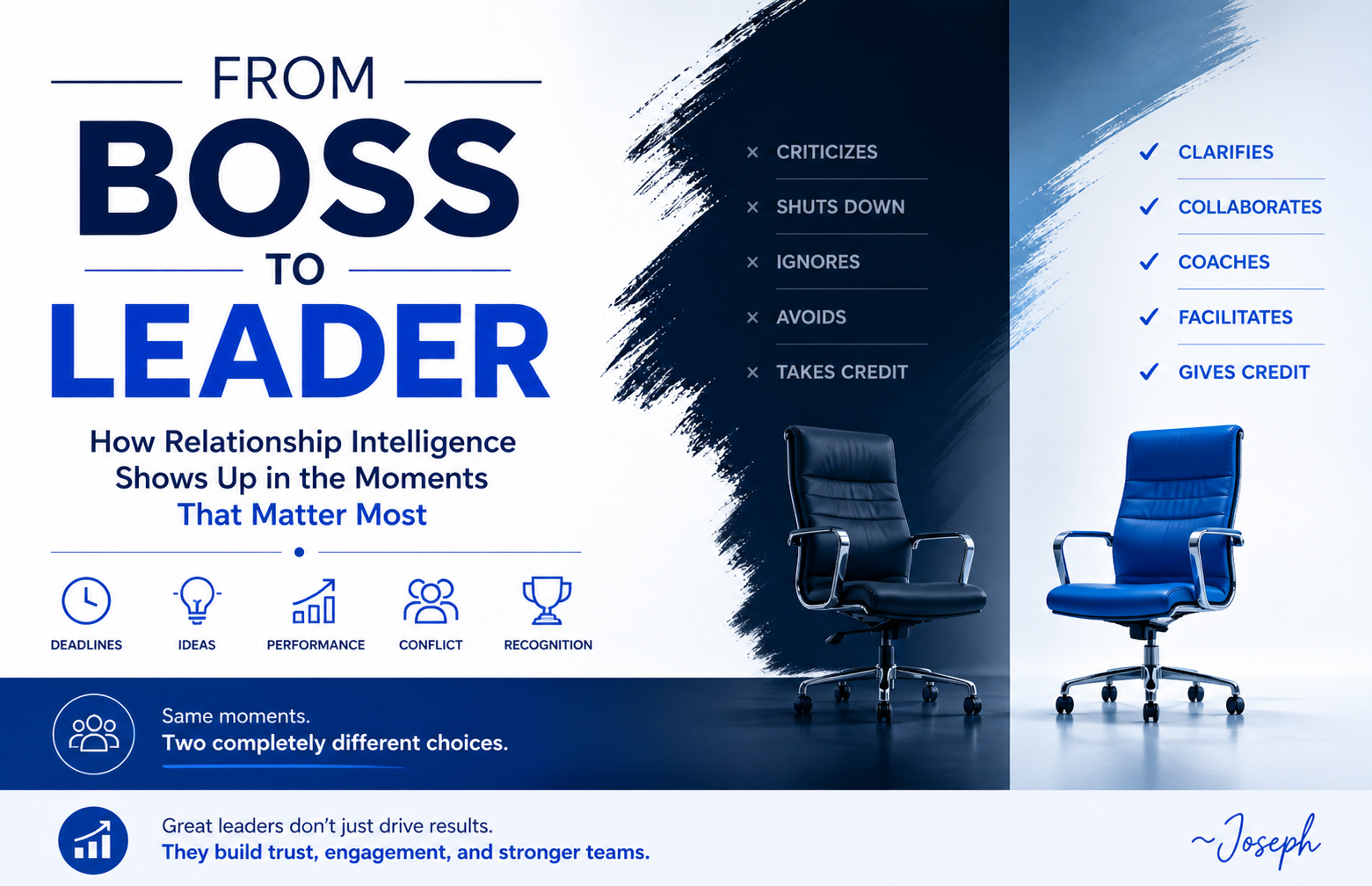
Relationship Intelligence at Work: How Leaders Manage Differently Than Bosses
Most leadership isn’t tested in big moments.
It’s revealed in the small ones.
Every business problem is ultimately a relationship problem in disguise—especially the relationship between managers and their teams.
Bosses lean on authority, policy, and pressure.
Leaders rely on relationship intelligence, trust, and real conversation.
In a world where talent has options, how you manage people is either your greatest risk—or your greatest advantage.
---
Boss vs. Leader: Same Role, Different Relationship
On paper, a boss and a leader can hold the exact same title.
What separates them isn’t authority—it’s relationship intelligence:
the ability to connect, build trust, and adapt to the people in front of you.
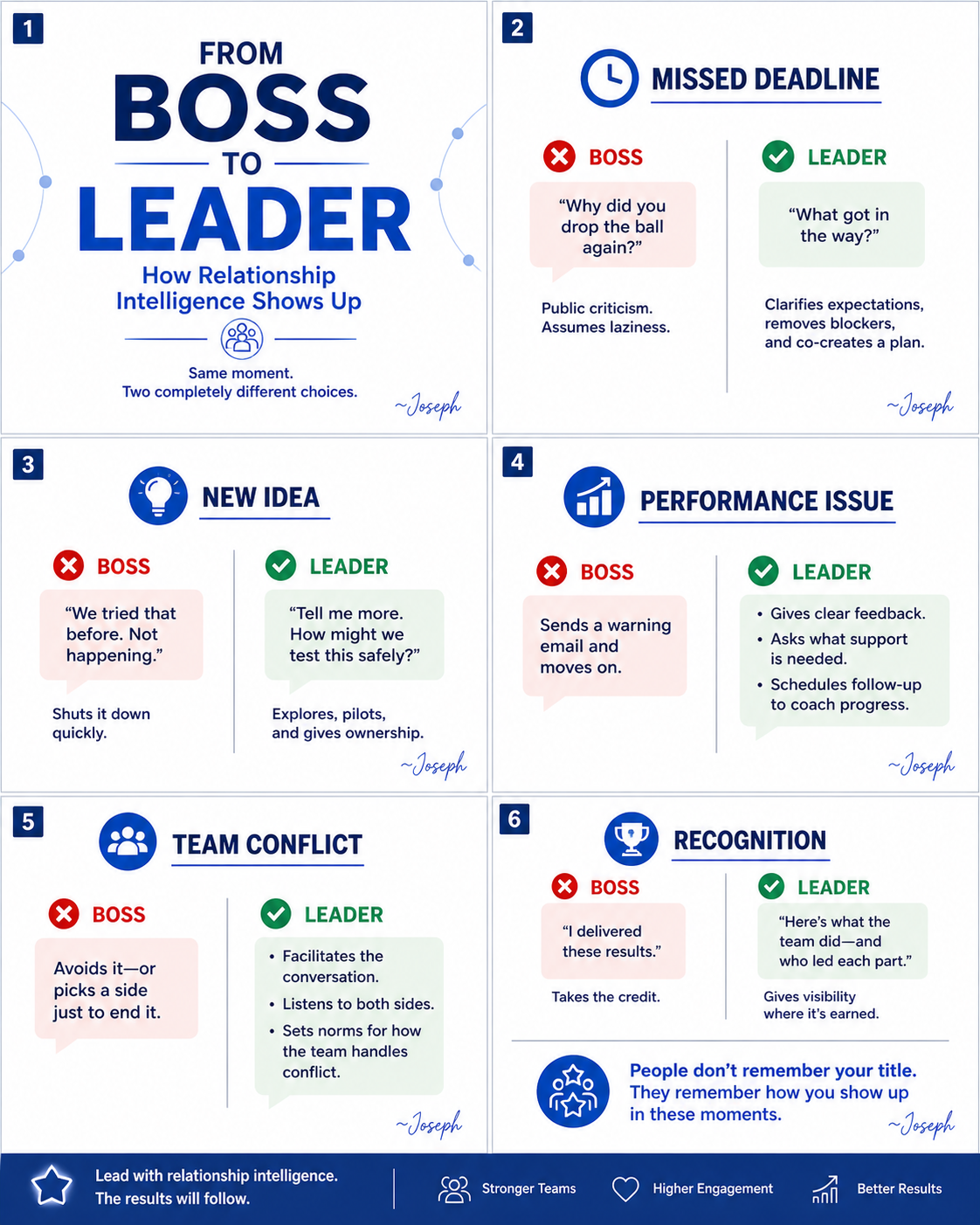
Here’s how that difference shows up in real life:
- A boss drives employees. A leader coaches them.
- A boss depends on authority. A leader earns goodwill.
- A boss inspires fear. A leader creates enthusiasm.
- A boss says “I.” A leader says “we.”
- A boss assigns blame. A leader solves problems.
- A boss uses people. A leader develops people.
- A boss says “Go.” A leader says “Let’s go.”
The title may be the same.
The experience for the team is completely different.
---
## What Relationship Intelligence Looks Like Day-to-Day
“Relationship intelligence” can sound abstract—until you see it in action.
It shows up in how leaders respond in everyday moments:

- When something goes wrong → Do you blame or get curious?
- When someone brings an idea → Do you shut it down or explore it?
- When performance slips → Do you correct once or coach consistently?
- When conflict appears → Do you avoid it or facilitate it?
- When success happens → Do you take credit or give it?
These moments seem small.
But repeated over time, they define culture, trust, and performance.
---
## Three Shifts to Move From Boss to Leader
If you recognize some “boss” tendencies in your own leadership—you’re not alone.
Most managers were promoted for performance, not taught how to lead people.
The good news? Relationship intelligence is learnable.
---
### 1. Replace Control with Clarity and Coaching
Control feels efficient—but it’s expensive.
It creates compliance, not commitment.
Instead:
- Get clear on outcomes and priorities
- Ask: “What support do you need?”
- Use 1:1s to remove blockers, not just review status
Leaders don’t just monitor work.
They enable progress.
---
### 2. Shift From “One Size Fits All” to “Know Your People”
Great leaders don’t manage everyone the same.
They pay attention.
- What motivates each person?
- How do they prefer to communicate?
- What does success look like for them?
When people feel understood, they show up differently.
---
### 3. Turn Feedback Into a Two-Way Conversation
Bosses deliver feedback.
Leaders build feedback loops.
Instead of:
“Here’s what you did wrong.”
Try:
“Here’s what I observed—how did it look from your side?”
Then ask:
“What am I missing?”
That one question changes everything.
---
## Why This Matters Now
Today’s workplace has changed.
Remote work.
Hybrid teams.
Higher expectations.
People don’t just leave jobs anymore.
They disengage quietly—or leave faster than ever.
Relationship intelligence gives leaders an edge because it:
- Builds trust quickly
- Increases engagement and retention
- Improves performance through psychological safety
This isn’t about being “nice.”
It’s about creating an environment where people actually do their best work.
---
## One Question for Every Manager
Your team doesn’t experience your title.
They experience your behavior.
So the real question is:
Are you showing up as a boss who manages tasks—
or a leader who manages relationships?
The answer shows up in the small moments.
And over time, those moments define everything.
---
~Joseph