Hello, well first, this article is a follow-up to this one.
We need to talk about the end of my August.
Agents and native code on proprietary platforms
In August, people do nothing, they're at the beach... that's not my thing, I prefer tinkering with stuff in my own little corner.
First experiment, I had an idea for an iOS app that could be useful to me, but nothing more than a vague idea.
I just wanted to try something, the idea was simple, a camera with extra features... in Swift.
For that, I put together my plan, then handed the execution over to several agents running Codex-5.6-Sol, basically the high-end stuff.
Whether it's Opus Fable or Sol, I'm used to working with them on all sorts of things, I know their capabilities well.
But here, even getting to the first draft was already much more of a struggle than on my other projects (Rails, Symfony, Django and Next.js).
The final result was "very AI", the user experience was a disaster despite my instructions... anyway, I tried iterating a bit, but I quickly understood that GPT just wasn't in the mood.
The idea was to be able to send screenshots to Dropbox, yes Dropbox already has that feature, but Capso (and what I originally use, CleanShot X) lets you edit the image before uploading it, very handy when I need to explain things to clients, nothing beats screen recording.
Anyway, same story, I manage to add the feature (you can see it on GitHub, actually), but I don't know, I don't like the feeling, the experience doesn't feel as smooth as what I'm used to. Usually I have 5 or 6 agents running in parallel, it's smooth, no long stretches of "cogitating", the tests go well... here I can feel it struggling, this time it was a mix of Claude Fable and Opus 5.
I don't like the final result either, there's no getting around it, it was just a little hobby project, but getting to a user experience I actually liked would take a huge amount of time... and I didn't particularly feel like it at that point.
I've been using macOS and iOS for years, but I've never really built anything for the platform. I'm not a huge fan of how closed it is and how completely Apple controls it, and I can't see myself building a business on it, the open web is just fine.
The post that stuck in my head
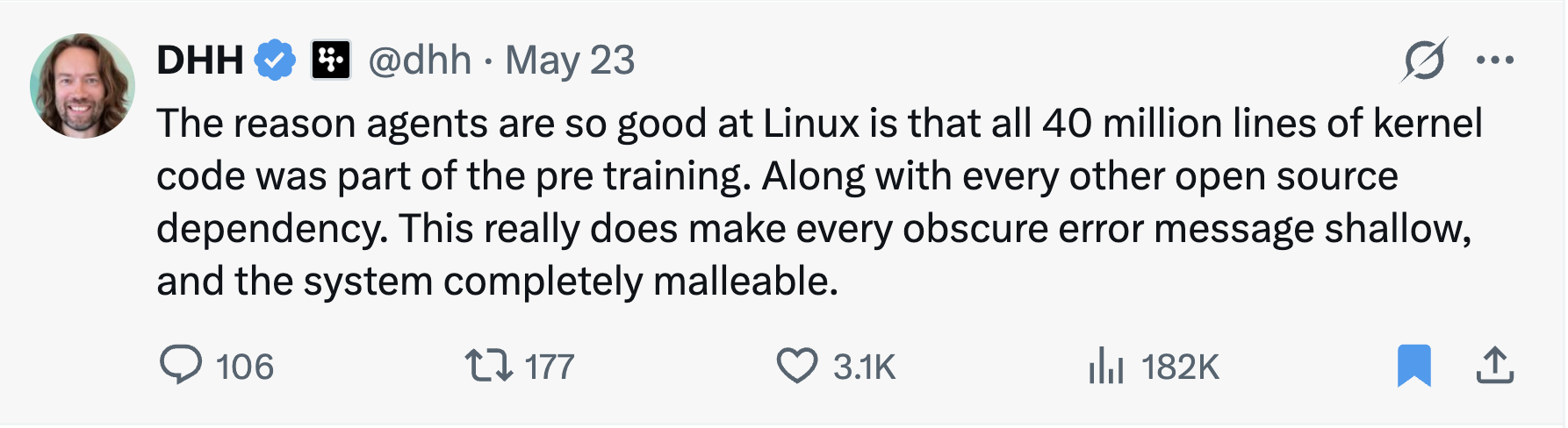
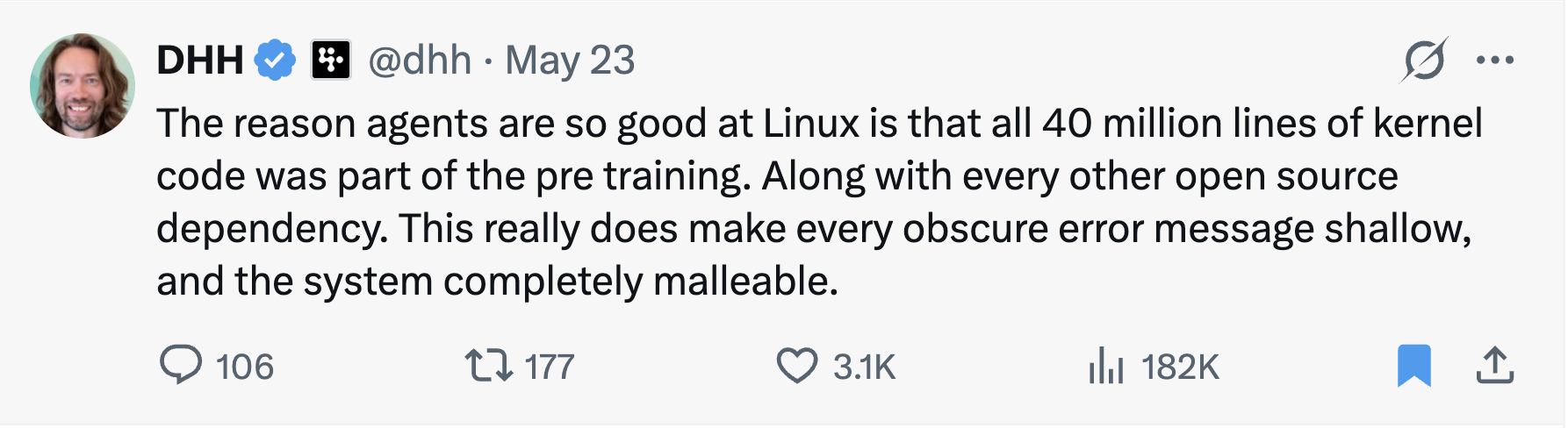
Yes, that post on X from DHH, talking about agents and the Linux kernel source code. When you think about it, it's pretty obvious... of course they have all that code in their training data...
So... when they work in that environment, they're more "at home".
The Omarchy hype
At the end of August, DHH releases his "Omarchy Quattro" distribution, and saying "the hype was intense" wouldn't even do justice to what happened next...
For the first few days, I watched from a distance, my Mac works for me for now, and switching operating systems isn't happening just yet. I have too many workflows on my machine that I'd need to adapt, and I'd also need to get into new habits.
Then a few days later, I download the ISO and put it on my machine, because well... I have to see for myself. Why all the noise?
What can I say? The work is excellent, DHH picked the right tools and added his own to create a coherent whole, but as I say in my post about Omaport, that consistency stops once you start using software that wasn't "designed for Omarchy".
And that gives me ideas...
My Omatstuff
So, for Omaport, we've already written an article about it, we're not going over it again. Building it was a breeze. Linux, based on rclone, with the windows drawn using Qt 6, a completely open source stack. Opus was completely at home, without the slightest stress... the final result was almost right on the first try, just a few turns of the screwdriver and I had an experience I really liked, one I actually started using myself every day, perfect.
But the thing is, Omaport is simple, that's the point, shall we turn up the complexity a little?
Omatable
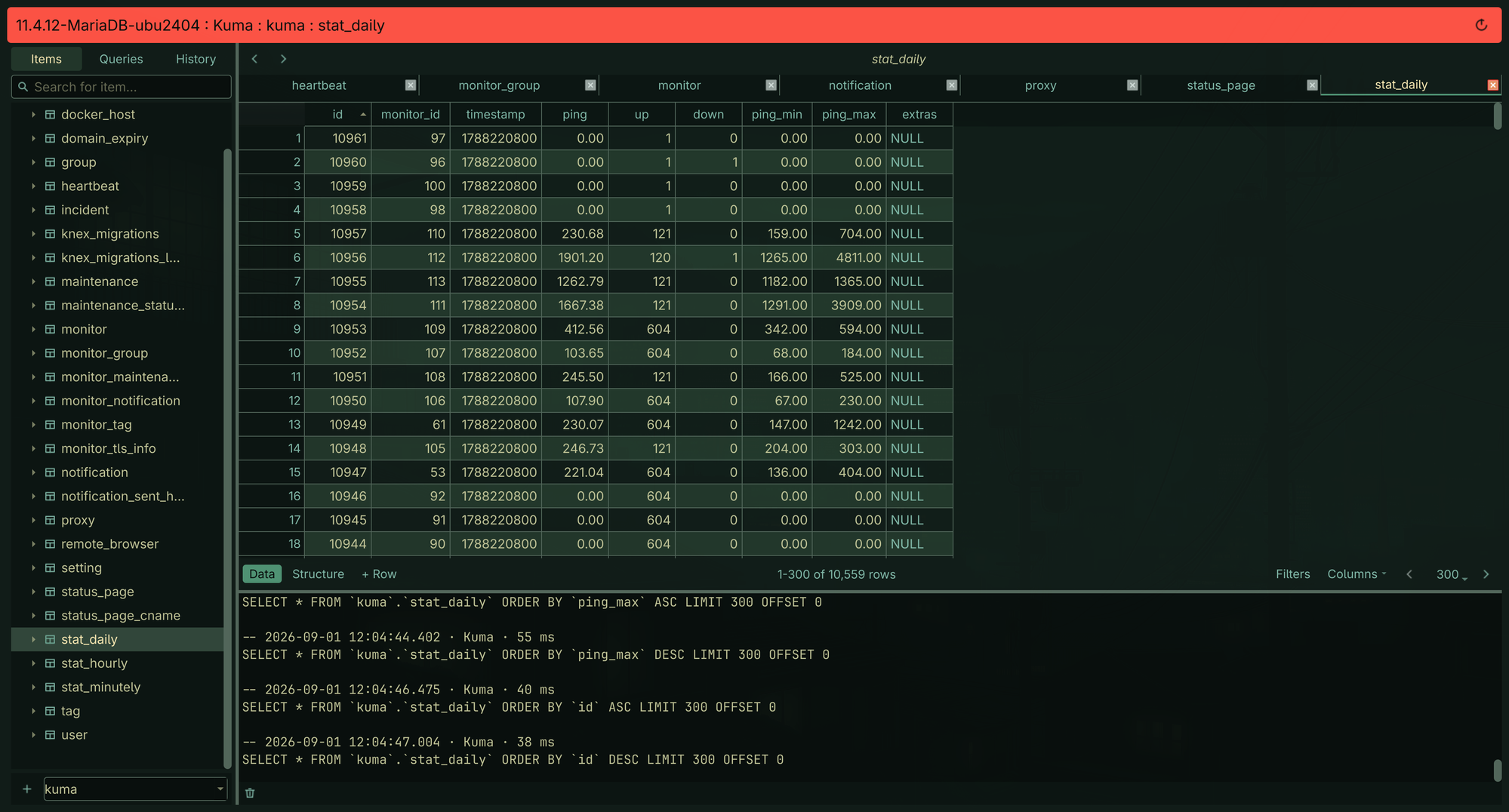
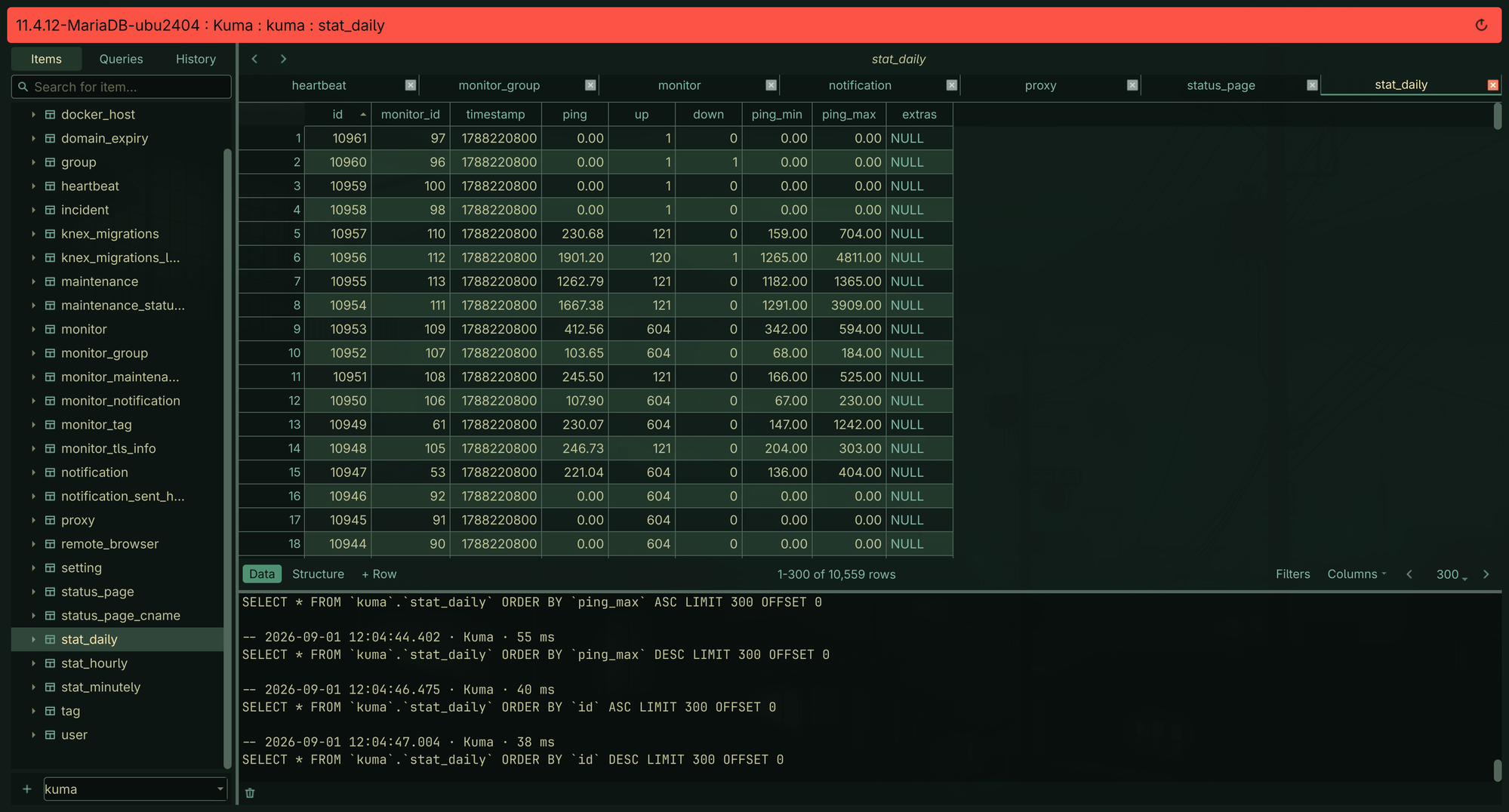
I don't like phpMyAdmin, I haven't used it in years, I like looking at my databases in a nice interface, clear, fast, native.
On macOS, I used Sequel Ace, then TablePlus.
On Linux, there's DBeaver, but I don't like it, it's ugly. There's also a completely abandoned version of TablePlus, probably because they don't have any users.
The thing is, Omaport was the easiest one to make... what interests me with Omatable is that we're a small step up.
First, compatibility, I mainly work with MySQL, PostgreSQL and Redis, so Omatable needs to be comfortable with those three.
Then, it needs to be usable mostly from the keyboard, to fit in with everything Omarchy does...
Once again, development went smoothly, after 24 to 48 hours I had something nice. Obviously, I didn't test it on production databases at first (by the end I did... because it was working like a charm).
Anyway, what can I say? I have everything I need in 48 hours, compatible with the engines I want (obviously we use system libraries to move faster, we didn't reimplement the protocol, you know, open source...).
I've got connections "over SSH", compatibility with 1Password, which handles my private SSH key (we have that in Omaport too, by the way).
A much bigger step up, still unfinished, Omapixel
Well, for the third project (and the last one for now, because I need to move on to other things), I decided to go big, Omapixel. The idea is simple, there's no good, simple image editor on Linux. There are things out there... but I'm not a graphic designer, I make a few small edits from time to time, it needs to be simple, fast and effective, like Pixelmator Pro on my Mac.
Now, telling you this went as well as the other two would clearly be pushing it...
First, the backend is mostly GEGL, which is available under the GPLv3 license. That's actually why Omapixel uses that license too, some GEGL features only unlock if you also have a GPLv3 license. It's not a commercial project, it's a toy, so well, I don't really care what kind of license it is.
Anyway, back to our agents.
At first it was pretty rough, I had some insane performance issues, it was unusable, I had to bring Fable in to help me understand why it was so slow.
After a few iterations, we end up with something much nicer to use... but sitting all alone in its own little corner.
In the first version, there's a file format specific to Omapixel, but the problem is that I have 10 years' worth of Photoshop / Pixelmator Pro files...
It would be COMPLETELY crazy to be able to open them in Omapixel, right?
Well... we can.
And no, I haven't done anything illegal for any of the three projects, no copying code, no reverse engineering proprietary software, nada, absolutely nothing.
I simply used my saved files, which I've been accumulating for years.
To make Omapixel compatible with the PSD and PXD formats, I simply gave an agent files I'd accumulated over time, all entirely my own (for example, all the illustrations for my blog, ads I've made... etc.).
And I asked it to figure out the format using that big dataset, it figured it out very quickly... and PSD was easier because the format is well documented and there are already open source projects (in Python) that handle it well (not completely, of course).
There were a few hiccups, opacity that didn't look right, text in the wrong place. For that, I kept it simple, I opened the file in the original software (Photoshop and Pixelmator) and took screenshots that I gave to Fable, asking it to dig into why we were getting those differences.
After a few hours, the files looked the same in Omapixel as they did in the original software...
That's pretty incredible.
So, agents on Linux?
Well, they're clearly at home...
The result speaks for itself, and Omarchy Quattro is built around that, actually. The agent is at the heart of the system and can modify everything, because on Linux, all the settings are easily accessible in text files...
It's funny, because Linux was overlooked on the desktop for a long time precisely because of that, because you had to go digging through files to change things on your computer.
And now, that's its greatest strength (that and the fact that everything is based on code anyone can read, including agents...).
For the record, I've also tried agents on .NET in the past, well, it works, but it's not as mind-blowing. When you're on Linux, with open source, I think it's on another level.

.png)

.png?disposition=attachment)