Omarchy made me try Linux again. Then I needed Cyberduck.
I have always watched the Linux desktop from a distance.
Not because Linux lacks power. In fact, its foundations and command-line tools are often far more powerful than their equivalents elsewhere.
What kept me away was the experience around them.
Install GNOME, open an application built with Qt, and suddenly the illusion falls apart. Different visual language, different spacing, different controls. The application works, but it no longer feels like it belongs to the same computer.
That might sound superficial, but it matters to me.
On macOS, applications tend to share a common language. They do not all look identical, but they feel as though they belong together. On Linux, I have often felt like I was moving between several operating systems living inside the same screen.
Then came the Omarchy hype
Like many people lately, I got caught up in it.
I installed Omarchy on my machine just to see what it was all about. It came from DHH, so I figured it had to be at least somewhat good 😁
And it is.
As long as you stay within applications designed for Omarchy, the experience is genuinely pleasant. The system has a strong visual identity. The keyboard-first workflow makes sense. Things feel deliberate and, most importantly, coherent.
Then you open LibreOffice.
And there it is again: the Linux desktop I remembered.
That does not invalidate Omarchy. Quite the opposite. The foundation is so good that the applications which do not belong become much more noticeable.
After a while, I started remembering all the other reasons behind my old “not Linux” position.
One of them was file transfer.
Where is the great Linux SFTP client?
On Windows, there is WinSCP.
On macOS, there is Cyberduck.
On Linux, there are ways to transfer files, of course. Many of them. But I could not find a native client that gave me the same simple experience: save a few bookmarks, open one, quickly look at some files, move something around and leave.
This is the strange contradiction of Linux.
The underlying tools are exceptionally powerful. rclone, for example, speaks SFTP, FTP, WebDAV, S3, Backblaze B2 and dozens of other storage systems.
But the experiences built around those tools are often fragmented or visually disconnected from the rest of the desktop.
There is an understandable reason for this. Imagine building an application for Windows and macOS, then being told that “Linux support” means targeting a collection of distributions, desktop environments, packaging systems and visual conventions.
It is a nightmare.
But Omarchy is malleable
This is where Omarchy changes the equation for me.
Omarchy is agent-first. Claude, Grok, GPT or whichever agent you prefer sits close to the centre of the operating system. The machine becomes unusually malleable.
When something is missing, you are no longer limited to searching for an approximation and learning to live with it.
You can build the missing piece.
I use Cyberduck regularly on macOS—not for elaborate workflows, but simply to look at little things here and there. Connect to a server, inspect a directory, upload or download a file, and move on.
So I started wondering:
What if I recreated that feeling specifically for Omarchy?
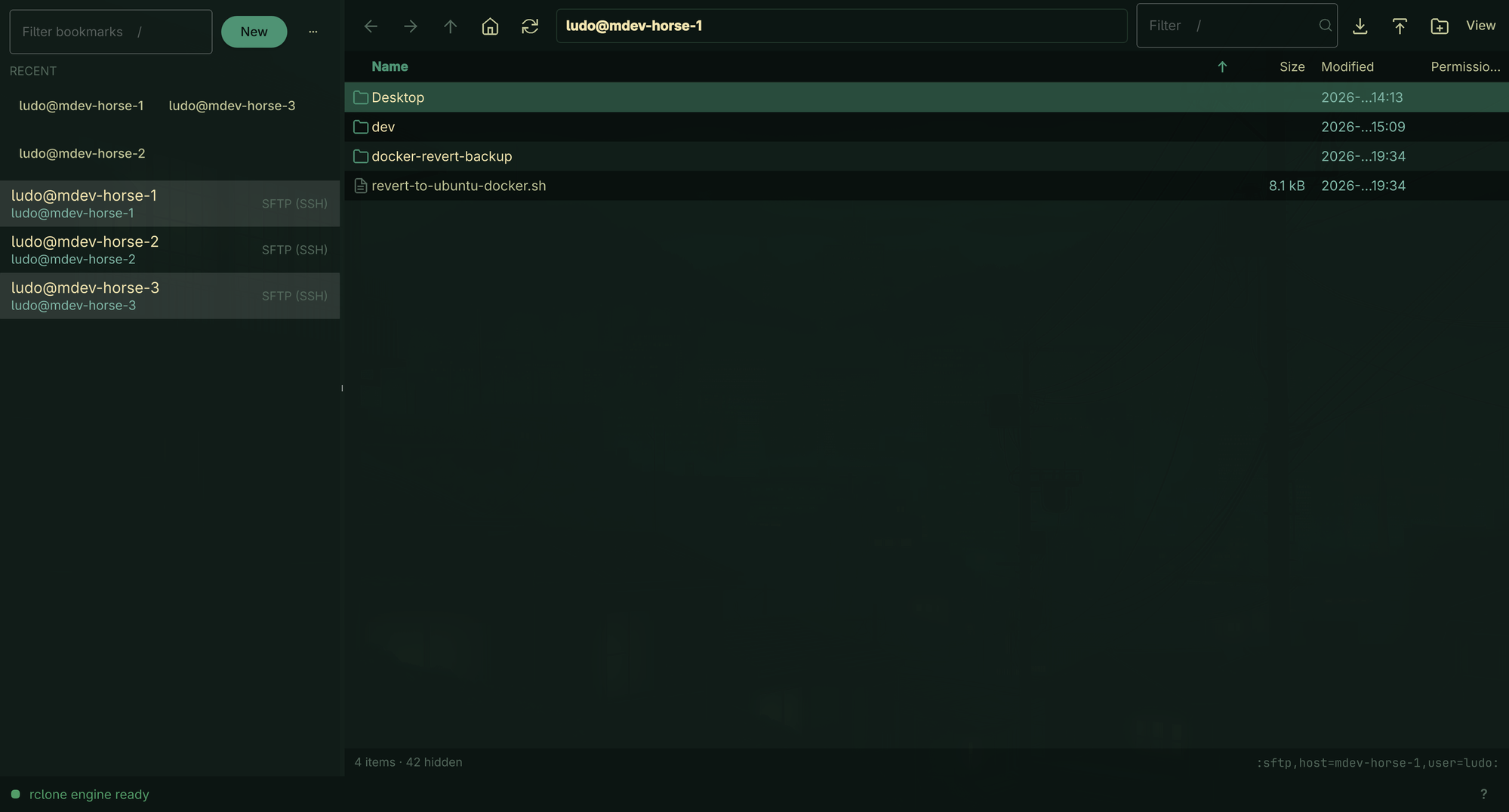
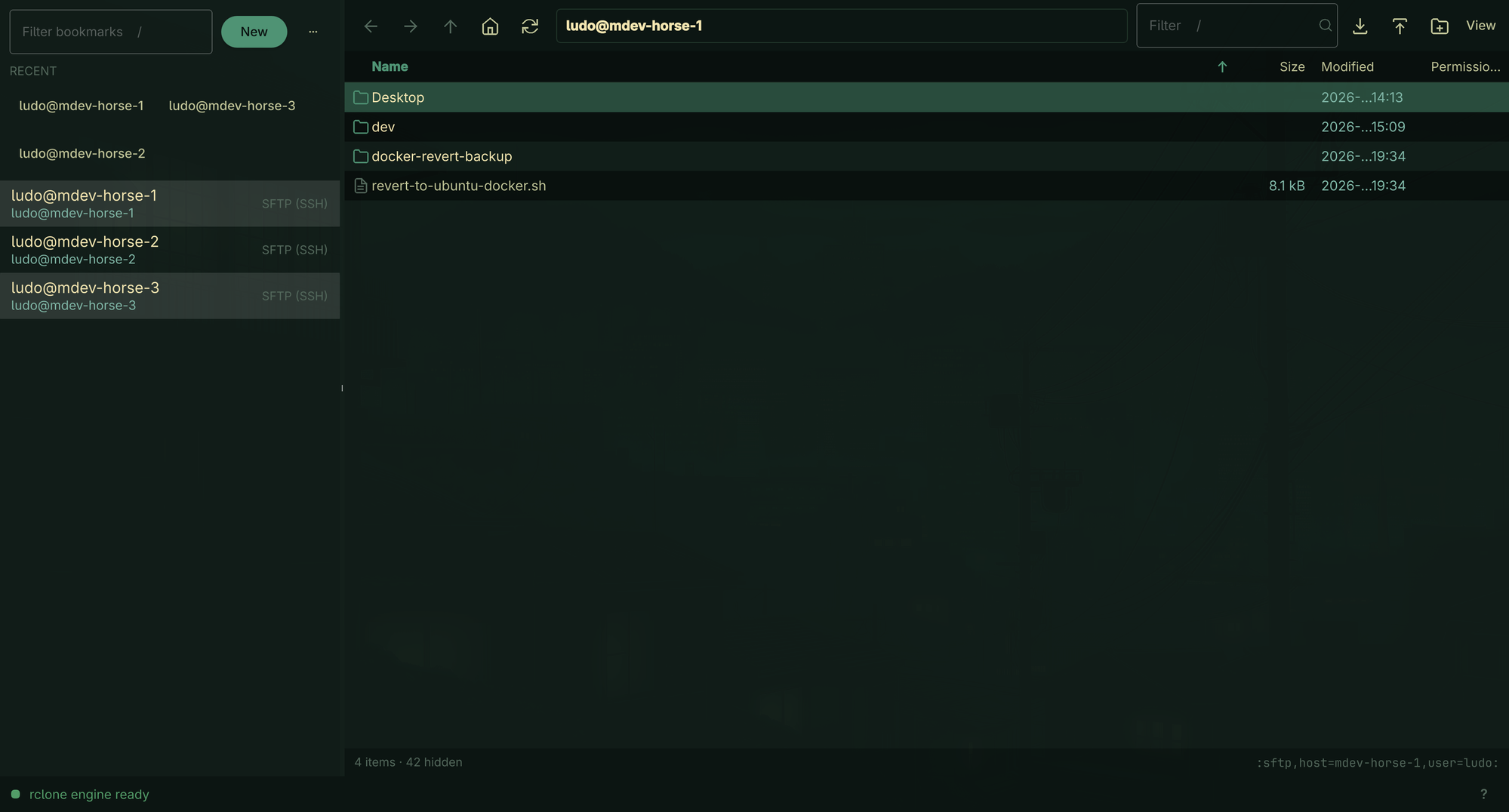
Not a Cyberduck port. Not an attempt to copy its code. Just the same product shape: bookmarks, a remote file browser and a transfer queue—rebuilt around the Omarchy experience.
Meet Omaduck
It now exists, and it is called Omaduck.
Omaduck is a native Qt 6 application that follows the active Omarchy theme and text size. It uses rclone as its engine instead of reimplementing all the protocols rclone already understands.
It supports SFTP, FTP, WebDAV, S3, B2 and around 60 other backends. It has bookmarks, queued transfers, drag and drop, keyboard navigation, SSH-agent authentication and remote editing through your usual editor.
It is one binary. No Electron. No Java.
I also paid particular attention to credentials. Passwords stay in the system keyring, never appear in command-line arguments and are never written to the shared rclone configuration. Even bookmark exports are encrypted.
This is the part of Linux I find exciting: the foundations were already there. rclone already contained the difficult machinery. Omarchy provided a coherent environment. Agents made that environment malleable enough for me to create the missing experience.