A social media post tried to tell people if they were smart 30 years ago, they should have invested $100/mo in Birkshire Hathaway. It showed a video steadily Maybe it's a dig on Warren or a poke in the eyes of the wealthy? Who knows.
When I was in my Technology Management Masters, we had a class in business valuation. The guy who taught it was Stanford educated. He worked as a day trader through his 20s. And when he taught us, his day job was valuating startups for a large venture capital firm. (One of the things I loved about the George Mason University Techman degree was its use of practicioners instead of professors.)
Some of the younger guys were day trading, so they thought they'd hit him up for a stock tip.
When I was in my Technology Management Masters, we had a class in business valuation. The guy who taught it was Stanford educated. He worked as a day trader through his 20s. And when he taught us, his day job was valuating startups for a large venture capital firm. (One of the things I loved about the George Mason University Techman degree was its use of practicioners instead of professors.)
Some of the younger guys were day trading, so they thought they'd hit him up for a stock tip.
When I stopped day trading, I put it all in the S&P 500. If you're not doing it professionally, buying individual stocks is a sucker's game.
That's what he said. S&P and let-it-ride. For his class, we were taught "the no-risk investment was a 30-year T-Bill." That is, if your investment returns less than a T-bill, it's not worth the risk. The "should I invest in this or not" as a business was compared to the S&P 500. My cohort's hypothetical was:
You are a regional big-box hardware store chain. Do you upgrade the lights from halogen to LED or do you put RFID chips on all the merchandice to stop theft. If the investment doesn't beat the S&P 500, then you're better off as a company investing the money.
Our assessment was the LED upgrade because it was guaranteed to beat the S&P. RFIDs weren't a guarantee. As it turned out, the regional chain went with the RFID and found that their employees were giving their friends a "buy-on, take-one free" option at the register by invalidating the RFID. Didn't beat the T-Bill.
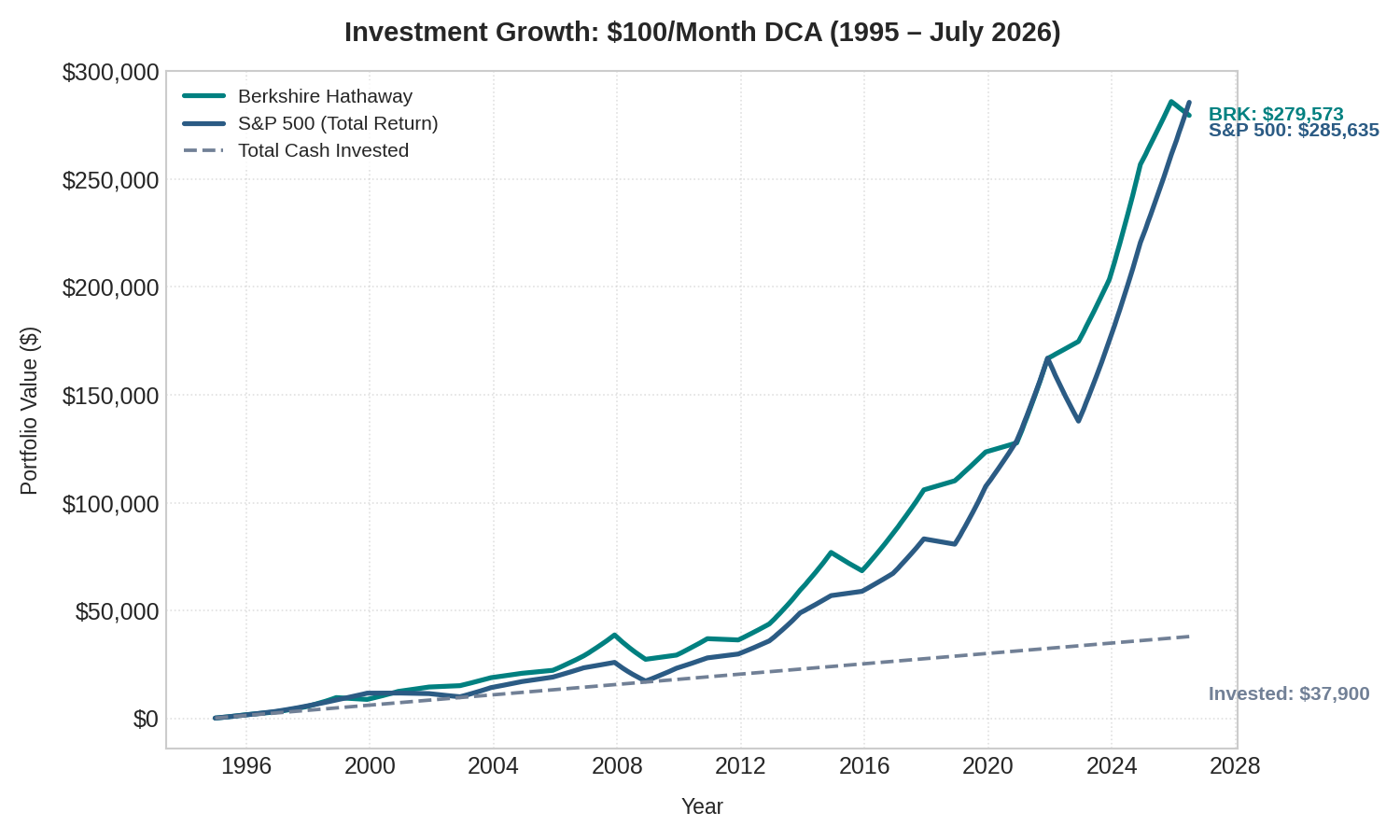
In response to the social media post, I whipped up this graph. Bottom line, Birkshire Hathaway, which has a high entrance threshhold, marginally out-performed the S&P over the past thirty years. Since most of us could not invest in BRK, S&P was the best option. It wasn't the safest, but if you have the event horizon, it's the best performer.
A bet on the US economy is still the right bet.
--
Ben
iu, kiun vi fidas, estas unu el ni