Why Raising Wake Teacher Pay Won't Fix Wake Schools
The May Day teacher rallies became a bit of a topic here in North Carolina. Teachers here in Wake county specifically complained about not being paid enough. A politician highlighted Wake's "supplies" budget and equated it to classroom spending.
I went to law school because I was tired of having people tell me what the law meant. I wanted the tools to figure it out myself. While I never became an attorney (I couldn't live up to their ethical standards), I earned an expert understanding. I later got a masters degree in technical management and spent more time in statistics than I care to. I would consider myself in duffer territory here.
I wanted to summarize my findings here for future reference.
North Carolina spends in the Second Quartile
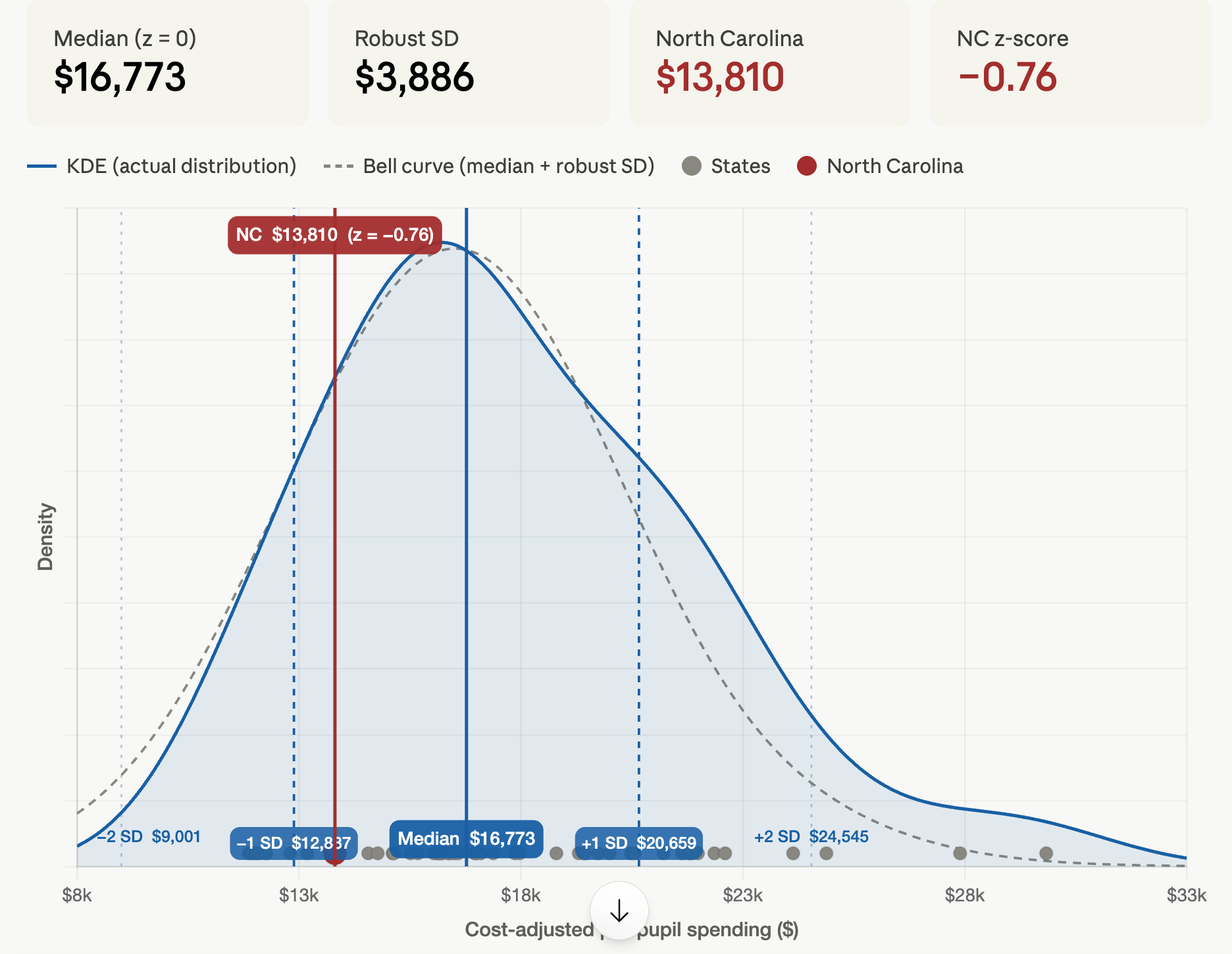
I started with an easy question. How does North Carolina spend relative to other states. Given that different states have different costs of living, I adjusted to "real dollars," which put all 51 jurisdiction on the same plane. That produced the first graph, which showed that NC was in the second quartile ranked 42nd in real spending. Boring.
But North Carolina is 28th in outcome, outperforming 18 states who outspend us.
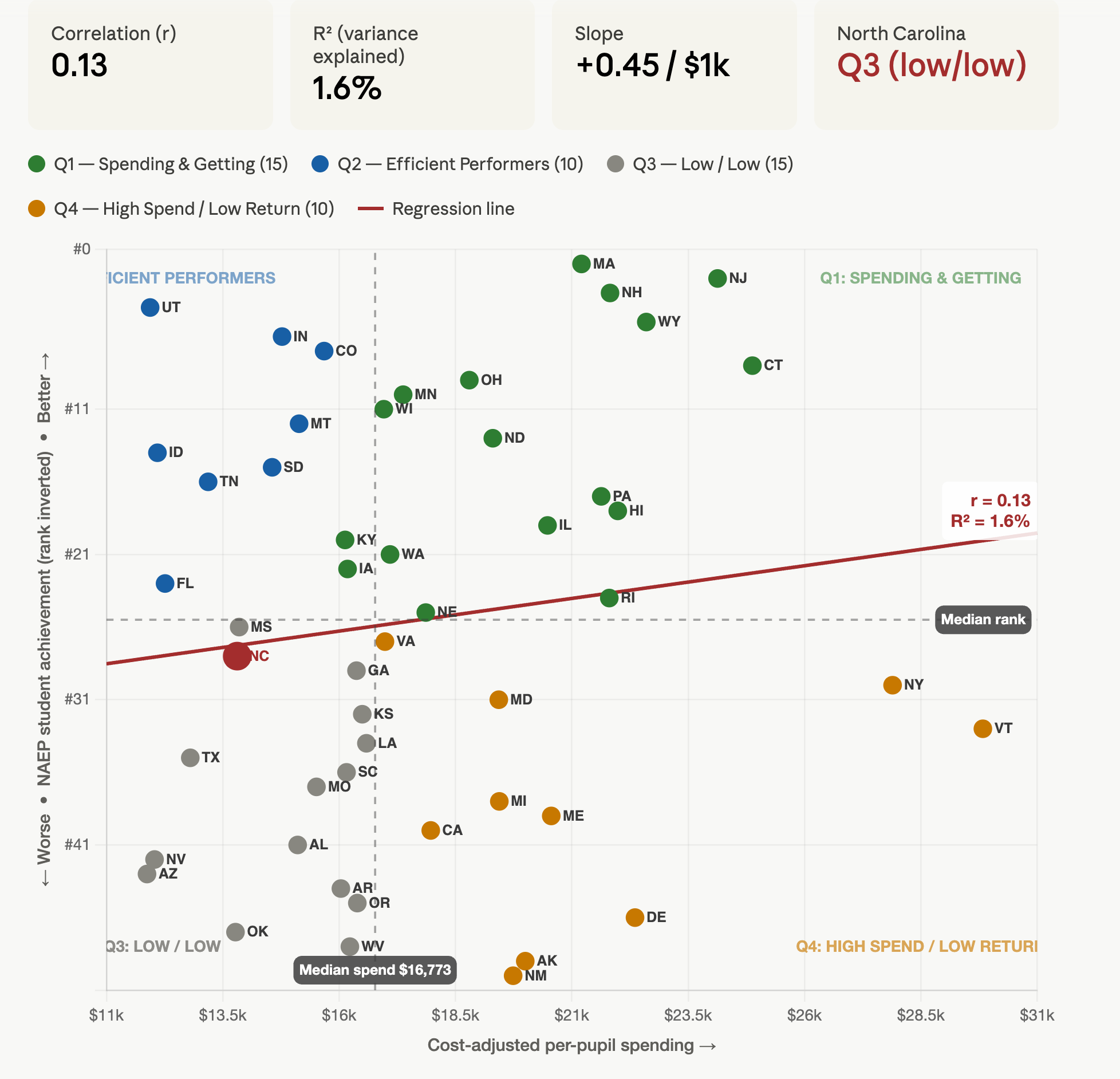
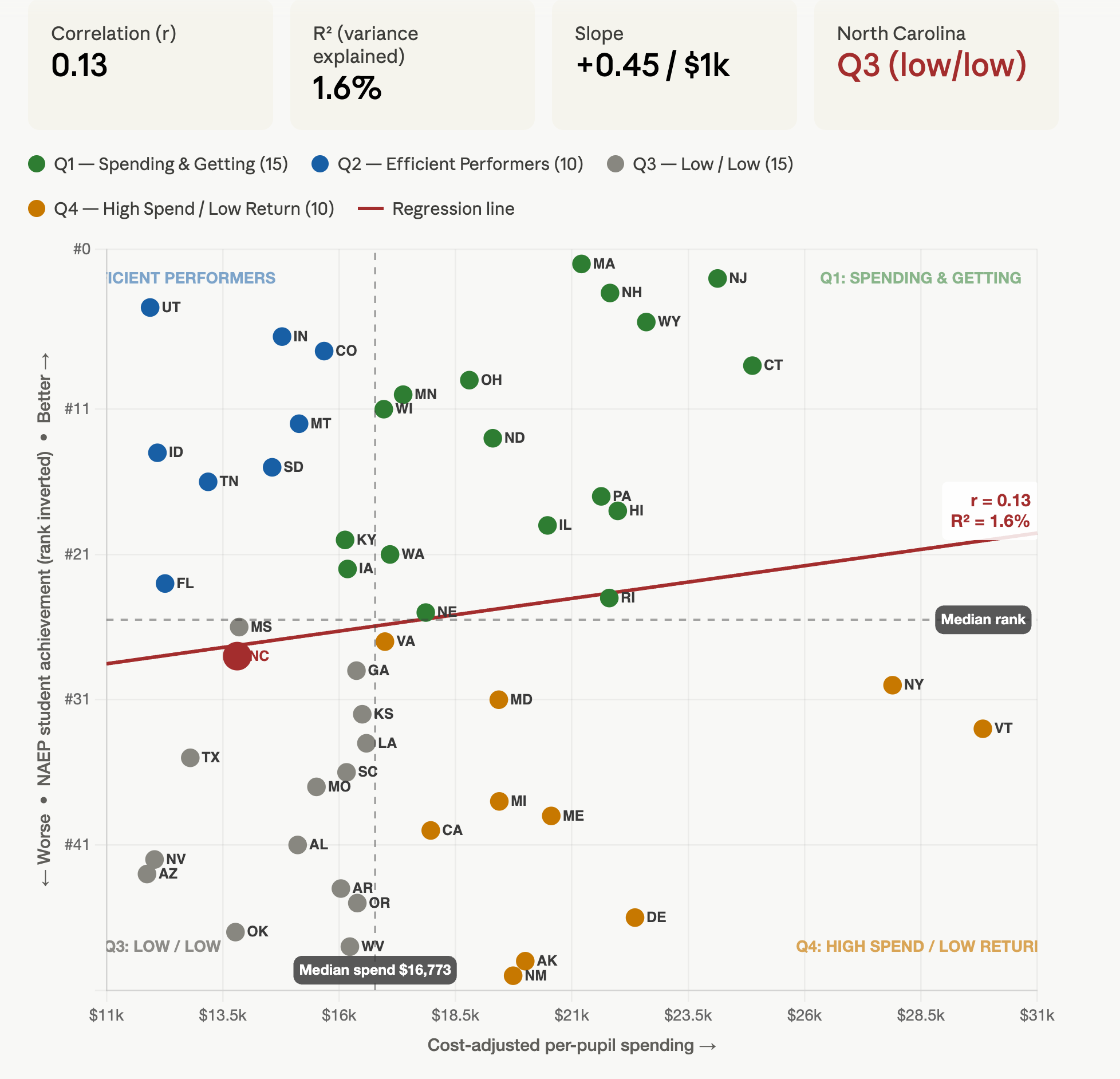
Then I compared this to the NAEP's student achievement rank. North Carolina still showed in the lower quadrant. Lower investment with average outcome. North Carolina was 28th in outcome despite being 42nd in spending. However, the correlation here (0.13) shows no relationship between spending and outcome. It also showed 18 states that spent more than North Carolina for a lower outcome, and a few who spent less and out performed.
Wake County teachers are wage competitive, but not enough to single-handled raise a family.
This led to a discussion of whether Wake county teachers earned a "living wage." The average base salary for a Wake Teacher is $55-58K (when removing temporary and support staff). This compares to other white collar jobs. Wake is a tech and research area, so there are a lot of higher paying jobs that skews the regional average. This doesn't include other benefits, including the stability given public service employees.
Comparable Raleigh-area white-collar jobs show Wake teachers are reasonably well paid:
Wake County teachers (WCPSS average): ~$55,000–$58,000
Insurance claims clerks: ~$50,000–$55,000
Entry-level PR specialists: ~$50,000–$58,000
Bookkeeping & accounting clerks: ~$50,000–$54,000
Medical records specialists: ~$50,000–$54,000
Human resources assistants: ~$48,000–$52,000
Loan interviewers & clerks: ~$48,000–$52,000
Further analysis showed that the average "family sustaining wage" for a family of four was $94K. A Wake teacher sits at roughly 60%, meaning a single teacher supporting a household with three children falls well short, while two teachers married to each other clear the threshold comfortably. By contrast, MIT lists the average Wake "Education, Training, & Library" salary at $55,740; basically right at the single-adult-no-kids living wage of $55,242. Wake teachers, on average, can afford themselves but not a family on a single income.
We can't compare more than base salary (as we do here) because that's not a clean comparison between public and private sector (which can be varied between companies). Wake teachers should have a compensation package (perhaps $82K) that includes:
TSERS pension contribution (employer): ~$13,500 (24% of salary)
State health plan: ~$7,200/year value
FICA, Medicare, life insurance, other: ~$4,800
But a third of teachers quit before the TSERS vests. The NC Paycheck Calculator's separate analysis put a 10-year Wake teacher's total comp closer to $68,000–$70,000, which is more conservative than the line-item math above. So any benefits comparison should use the lower value.
North Carolina spends efficiently for its student outcomes
I didn't like the statistical noise of the spending/outcome chart. I decided to use "outcome per $1K spent" to clear that noise. That led to North Carolina ranking #7 against that measure. Below are the top ten, then a few of the "bellweather" states used to justify "we should spend more."
#1 Idaho: 3.32
#2 Utah: 3.19
#3 Mississippi: 2.70
#4 Florida: 2.68
#5 Tennessee: 2.56
#6 Indiana: 2.44
#7 NC: 2.40
#8 Texas: 2.28
#9 Arizona: 2.25
#10 Colorado: 2.23
#13 Virginia: 2.16
#16 Georgia: 2.12
#21 South Carolina: 2.00
#28 Massachusetts: 1.82
#35 New Jersey: 1.55
#38 California: 1.52
#41 Connecticut: 1.44
#49 Vermont: 1.12
#50 New York: 0.93
#51 DC: 0.79
Higher teacher pay does not buy better student outcomes
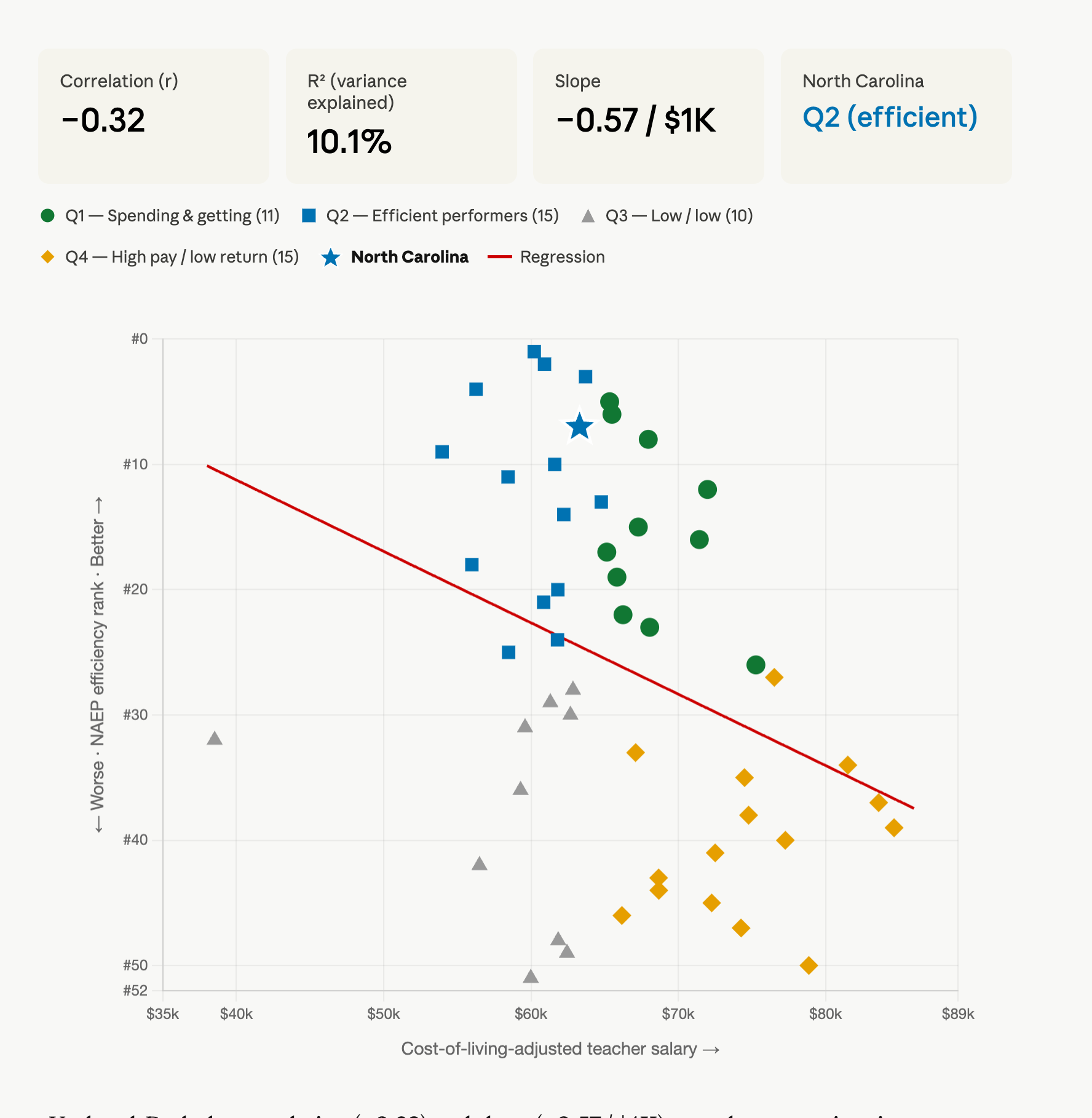
With this in hand, I opted to create a chart to see if there was a correlation between teacher salary and outcome. As before, salary was adjusted to real dollars. When you adjust teacher salaries for cost of living, the rankings shift dramatically:
NC's nominal $60,323 becomes $63,298 in real purchasing power; Wake's COL runs 95.3% of the national average.
California's $104K drops to $74,767 in real terms.
Hawaii's $72K collapses to $38,523, the worst real teacher pay in the country (COL is 187% of national average).
Illinois lands at the top with $84K in real terms; high nominal pay in a low-COL state. This takes Chicago into account.
NC ranks #29 in real teacher pay, ahead of Florida, Idaho, and Utah.
States often cited as "efficient with low pay" (Idaho $60K, Utah $61K, Florida $56K) actually pay roughly the same as NC once you account for local purchasing power.
That produced the chart below showing a negative correlation of -0.32.
Paying teachers more does not produce better educational outcomes per dollar spent. The correlation is weakly negative (r = −0.32), meaning states that pay teachers more in real purchasing power tend to convert dollars to outcomes slightly worse, not better. But the R² of just 10% means teacher pay explains only a tenth of the variation in efficiency. The other 90% lives in curriculum, instruction quality, demographics, class size, and central office overhead. Increased class size increases the overall personnel budget in hiring more teachers. More teachers, sure. More teachers with more pay? No.
What about outliers?
Mississippi went from 49th to 29th in 4th-grade NAEP reading by mandating phonics and the science of reading via the 2013 Literacy-Based Promotion Act. This is the strongest counter to "spend more on teachers." It's also the policy lever NC already pulled with the 2021 Excellent Public Schools Act. North Carolina is actively exercising improvements in curriculum and instruction quality.
Massachusetts is an exception with high pay and high outcomes. But they have a strong curriculum, low poverty, science-of-reading instruction and are not pay-driven.
Utah pays much less per pupil because they run a 22:1 students enrolled per teacher to Carolina's 15:1. It also has a leaner administration. Maybe we pay more for teachers by having fewer?
Idaho's top-ranked efficiency reflects an easier-to-educate population (low poverty, low immigration, and fewer English as Second Language learners. This contributes to its efficiency.
Where does that leave Wake County?
I'm not an expert here, but based on my analysis here are some things I learned. Honestly, demographics is a contributor. Poverty and ESL learners can't be solved overnight.
Stay the course on science-of-reading. This is what moved Mississippi up, with LETRS and phonics-based reading. But NC's 2021 Excellent Public Schools Act mandates this already.
Strengthen curriculum quality, not quantity. Massachusetts has high-rigor content-rich material aligned to clear standards and a strong assessment feedback loop.
Recognize that school building investment eats into education-available dollars. We've been building more schools lately to accommodate growth.
About Ben Wilson
Ben Wilson is the novelist behind Merovex Press, publishing alternate history, military sci-fi, and non-epic fantasy (including the Postal Marines saga and Strand Series). A history buff tuned into human nature and religion, he builds the software he needs to write and publish: Verkilo (offline series writing) and Kindred Quill (reader-facing funnel & author-to-author community hub)—soon available to other authors.