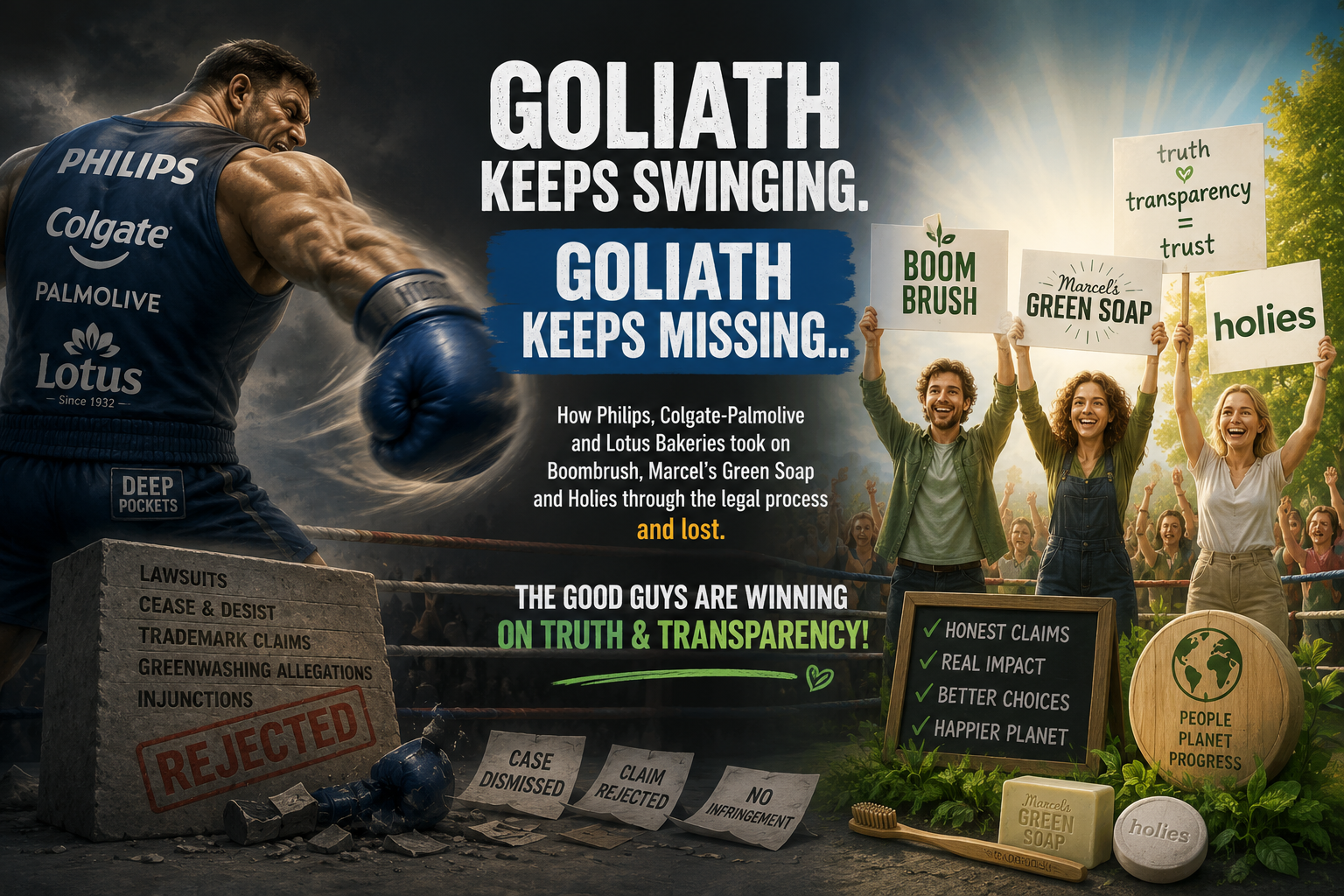
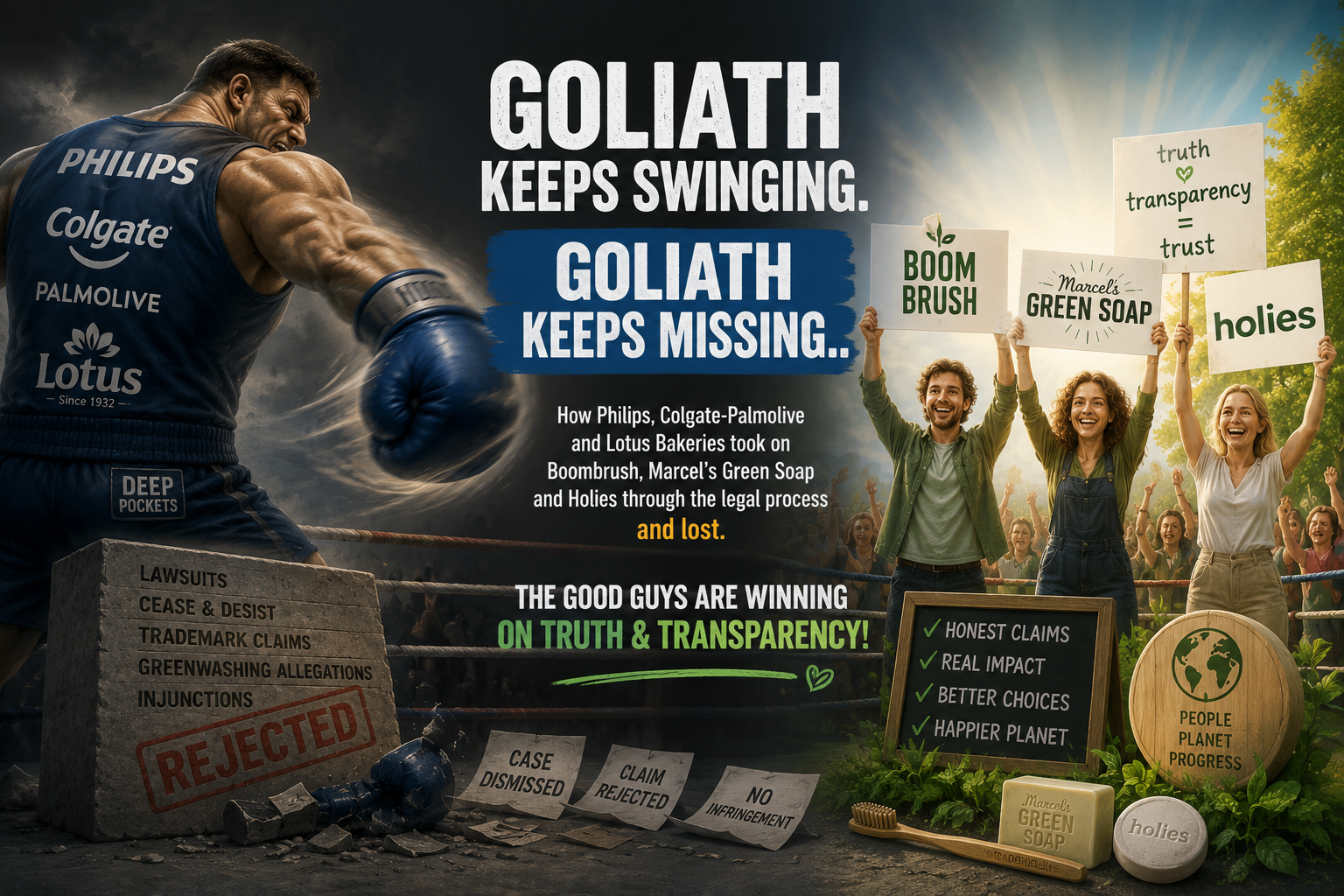
Multinationals are trying to use the rules to squash smaller, more sustainable brands. And they keep losing.
ChatGPT says that this image will encourage you to read the article in full.
Something interesting is happening across Dutch courtrooms and advertising regulators.
We’ve all seen how the old playbook used to work. A big brand sees a scrappy challenger getting real traction. The legal department drafts a letter. The challenger, scared of bankrupting itself on legal fees, folds. The innovation dies, market share is protected, and the multinational goes back to selling the same stuff in slightly greener packaging.
It feels like that playbook is breaking. Once might be a blip, two a coincidence but three times is the start of a pattern, at least, I hope so.
Three Davids. Three wins.
Take Boombrush, a Rotterdam startup making electric toothbrushes with a sustainability angle. Plastic toothbrush heads are a disaster for landfill, and Boombrush set out to do something about it. Philips, the multinational that owns Sonicare, took them to court. The claim? Boombrush's toothbrush looked too much like a Philips Sonicare Diamondclean. Philips wanted Boombrush off the shelves, on penalty of €50,000 a day, capped at a million euros.
The District Court of The Hague disagreed. On 23 April 2025, the judge ruled the Boombrush is sufficiently different from the Sonicare. Every one of Philips' claims was rejected. The B Corp certified startup beat a company with a market cap in the tens of billions.
Then there's Holie's, a Dutch cereal startup that did something incredible. They built a "Sugar Score" that ranks products A to C based on sugar content per 100g, straight off the product label. A simple, verifiable, useful piece of information for anyone who's tried to read a nutrition panel and given up halfway through.
Belgian giant Lotus Bakeries (the people behind Biscoff, Nakd and Trek) didn't love being scored. They went to court in Amsterdam, arguing the campaign was misleading. On 15 August 2025, the preliminary relief judge sided fully with Holie's. The reasoning was simple: consumers understand what a Sugar Score is, and the data came straight off the packaging.
Co-founder Merick Schoute summed it up: "We're delighted the judge has fully sided with us: we can continue showing that products with appealing claims often still contain a lot of sugar."
Just recently another Dutch B Corp, Marcel's Green Soap, had their day against Colgate-Palmolive. Except Colgate-Palmolive didn't take this one to court. They went to the Dutch Advertising Code Committee instead, challenging five of Marcel's sustainability claims, from "animal-test-free" to "for a cleaner world and a better future."
On 30 April 2026, the Committee sided with Marcel's on the headline messaging. The slogans "so this is how a clean world can smell" and "for a cleaner world and a better future" both passed scrutiny.
Note: Colgate-Palmolive scored some technical wins on minor secondary uses (a stray Instagram caption, an outdated Amazon store, an FAQ wording), all of which Marcel's had already corrected - but the big sustainability story element survived intact.
Three cases is a pattern. So what's going on?
First, the underdogs have homework on their side. Boombrush had clearly designed a different product and Holie's based its Sugar Score on label data anyone can verify. When you build your business on transparency, your defence is essentially "look at the evidence." That's a much easier case to argue than "trust us, we're a big brand."
Second, Dutch courts (and increasingly courts across Europe) are getting wise to a tactic dressed up as a copyright complaint or an injunction. When a multinational tries to wipe out a smaller competitor with a thin design-rights claim, judges can see through it. The court in the Boombrush case explicitly noted that toothbrushes have looked broadly similar since the 1950s, so the design protection is narrow. Translation: nice try.
Third (and this is the bit I find genuinely exciting), being openly good for the world is starting to function as a legal asset. Under scrutiny. With evidence the decision-maker can verify. Holie's Sugar Score worked because it was true. Boombrush's design defence worked because the product really is different. Marcel's headline sustainability slogans survived because the company could back them up. Transparency creates a paper trail, whereas greenwashing creates potential exposure.
The multinationals are playing the wrong game. They're still optimising for marketing, hoping a sustainability report and a recyclable bottle cap will cover for a business model that hasn't fundamentally changed. Meanwhile, the challengers are building entire companies around being demonstrably better, then daring anyone to disprove it in public.
What this means
Don't get me wrong. I'm not suggesting every B Corp is a saint or every multinational is a villain. But there's a shift happening that should worry the incumbents and excite the challengers.
The cost of a lawsuit used to be the moat. Now it's becoming the spotlight. When Philips drags Boombrush into court, the coverage reads like "sustainable start-up vs multinational." Even before the verdict, Boombrush got plenty of press. Lotus tried to silence Holie's Sugar Score, and ended up making the score famous. Barbara Streisand could have warned them.
There's a hat tip due to whichever in-house legal team finally convinces their CEO that going legal is no longer a safe way to bully challengers. It's a public stage where transparency wins and brand reputation pays the bill.
I have a lot of time for the founders running these companies. Building a sustainable brand is hard. Building one that can survive a multinational's legal attack is harder. Three of them winning in a short time frame shows it’s possible.
The takeaway
If you're a multinational thinking about reaching for the legal department to suppress an upstart, ask yourself one question first. Will the resulting headline make you look bigger, or smaller? Because in 2026, the answer might surprise you. It’s time to do the right thing.
If you're a founder building something genuinely better than what the incumbents offer, here's something to hold onto. Your biggest weapon is telling the truth in a category where the truth is rare. That might help you beat the capital, distribution, and hiring power, advantages.
About Nick Stevens
Writing about making business better - to help people to build and grow profitable business that makes the world a better place.