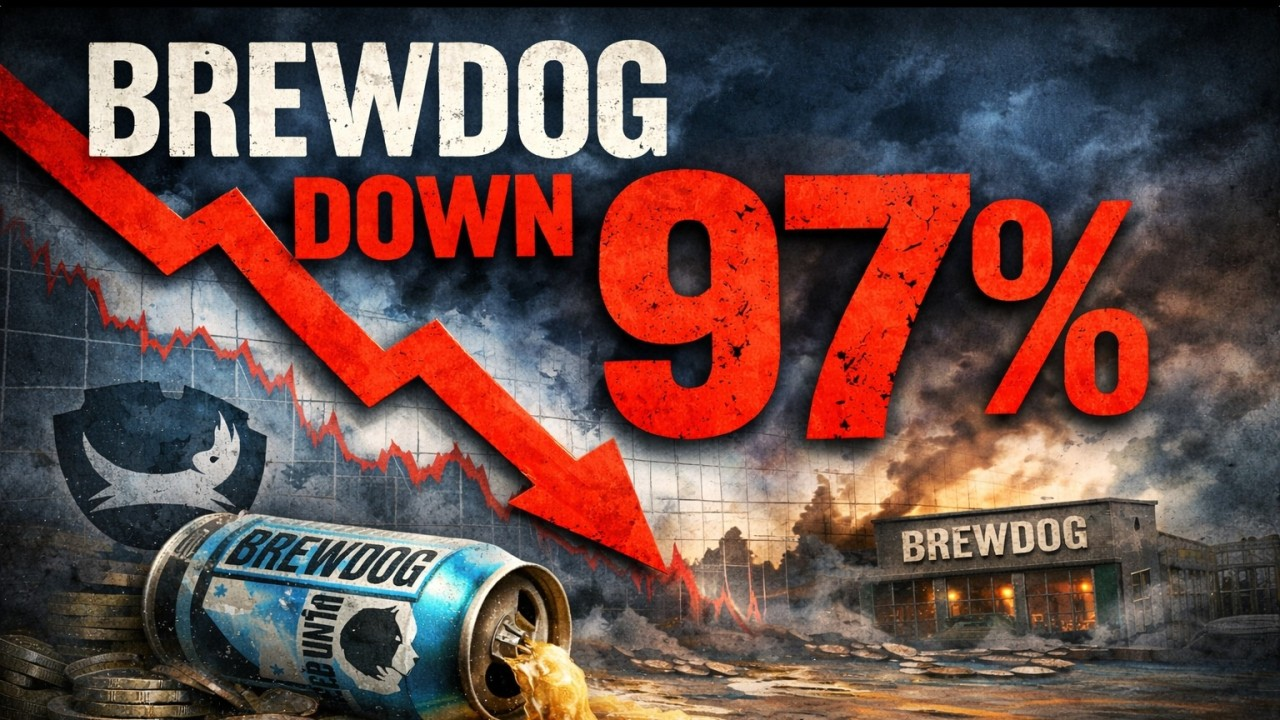
Image created by chatGPT
Some time ago, we passed peak BrewDog.
Today we have the number that shows how far passed.
A whopping 97%.
This is the story of how BrewDog turned £2 Billion Into £33 Million, and left over 200,000 believers with nothing
The News
Yesterday afternoon, BrewDog's UK and Irish assets were sold to Tilray, a US cannabis and drinks company, for £33m. They bought the brand, intellectual property, brewing operations, and just eleven bars.
Thirty-eight bars closed immediately. Nearly 500 jobs gone.
The two founders walked away with life changing money.
And the 200,000-plus "equity punks" who believed in the mission, who put in their money before the institutions did?
They got Zero. Less return than there is alcohol in a can of Brewdog Punk AF.
The road to hell is paved with good intentions
BrewDog set out to make better beer and build a better kind of company. For a while, they succeeded at both.
Beer writers argue about exactly when the turning point was. Matt Curtis, founding editor of drinks magazine Pellicle, puts it at 2021, when a group of former staff published an open letter detailing bullying, a culture of fear, and workers treated like objects. Melissa Cole, the beer and food writer, traces it to 2017, when TSG Consumer Partners paid £213m for a 22.3% stake. Some say the rot set in the moment BrewDog started copyrighting the word "punk."
I think it was on day one. The day they first officially registered the company. What they did that day, set their, totally avoidable, fate. Or rather, the one thing they didn’t do: Legally protect their mission.
To really understand how far they've fallen, you need to understand what made them worth caring about in the first place.
Before the fall
Don't get me wrong: BrewDog was genuinely good once.
BrewDog started in Fraserburgh in 2007. James Watt and Martin Dickie were young, ambitious, and genuinely making good beer.
The premise was a simple reaction against a bland industry. Heineken, ABInBev, the rest of them, had turned beer into a commodity. Shareholder profit the only goal.
Craft brewing was the corrective, and BrewDog were going to do it properly.
Their crowdfunding model was inspired. Rather than institutional money, they invited fans to become "equity punks." Not just shareholders. Fellow believers. You weren't simply buying a financial stake. You were joining a movement. Hundreds of thousands did.
Punky stunts amplified the identity. In 2015, BrewDog threw stuffed toy cats from a helicopter over London. The stunt mocked "fat cat" beer corporations. The crowd loved it. It was exactly what you'd expect from a brewery that had spent eight years making craft beer with attitude, crowdfunding from a generation of drinkers who wanted something that wasn't made in a Dutch factory, and naming itself after its punk ethos. They filmed themselves begging and posing as sex workers to satirise conventional fundraising. Some of it worked, some of it didn't. The Pink IPA, a mock "beer for girls" released on International Women's Day 2018, annoyed more than it amused. But the energy was real.
The tipping point
In 2017, TSG Consumer Partners paid £213m for a 22.3% stake.
The moment that money landed, BrewDog had a new master. Not the equity punks. Not the mission. The margin.
Private equity firms don't invest in countercultures. They invest in growth.
That's the moment Cole marks. "After a private equity company has invested," she said at the time, "can you still go back to the well of your fans?"
No. You cannot. BrewDog tried anyway.
They kept running crowdfunding rounds even after TSG's money landed.
BrewDog kept acting like a movement while operating as a growth-at-all-costs business.
The mission and the margins were now pulling in opposite directions, and the company performed as if they weren't.
That same year, BrewDog threatened a small Leeds pub called Draft Punk with legal action for the crime of using the word punk in its name. Another bar was sued for using Lone Wolf, a name BrewDog wanted for a spirits brand. The irony of a punk brewery copyrighting "punk" was not lost on anyone paying attention.
The Pink IPA, a mock "beer for girls" released on International Women's Day, got the opposite reaction from the one intended.
The unforced errors were manageable. Companies do stupid things. Then it got worse.
Punks with Purpose
In 2021, a group calling themselves Punks with Purpose published an open letter. Former staff. Their claims: bullying, a culture of fear, health and safety corners cut, workers treated like objects. Mental illness. A company that espoused values it did not live by.
For Curtis, this was the definitive moment. "For those who had given them the benefit of the doubt, that was the moment when people thought that they don't deserve to be held up as a paragon of independent beer."
Watt apologised. Then the BBC came knocking with a documentary, and Watt responded not with openness but with private investigators. Hired to gather information on people who had spoken to journalists.
A man who built a brand on speaking truth to power had investigators following the people speaking truth about him.
One more detail surfaced: Watt, self-declared enemy of Big Beer, owned shares in Heineken.
The forest that never could deliver
Nothing illustrates the gap between BrewDog's promises and its reality more cleanly than Kinrara.
In 2020, BrewDog bought a 3,764-hectare estate in the Monadhliath mountains near Aviemore for £8.8m. Kinrara. Big announcement. Millions of trees. A beer called Lost Forest to help fund it. The company would become carbon-negative.
They later admitted the estate was smaller than claimed, the planting area smaller still, and the original CO2 absorption figure of 550,000 tonnes a year would never have been achievable.
The actual CO2 absorption possible, across 100 years if everything worked: 1 million tonnes. Not per year. Total. A different order of magnitude from the original claim.
By this time the trees were reportedly struggling to take root. Buildings were sold off. The carbon-neutrality programme was quietly abandoned.
In October 2025 Kinrara itself was sold to Oxygen Conservation, a company that actually knows what it's doing.
Peak BrewDog by numbers
BrewDog had grown every year since founding, sometimes at extraordinary pace, even through Covid.
2024 ended that streak.
Sales up less than 1% to £357m. Net revenues down slightly. Pre-tax losses of £36.6m. Across two years: nearly £100m in losses. TSG loans carrying interest rates up to 18%. Annual interest payments now at £17.3m.
The company's response was to focus attention on an "adjusted" operating profit of £7.5m: a figure that cheerfully sets aside interest payments, tax, and other inconveniences.
Meanwhile: 2,000 pubs removed BrewDog products from their taps. Ten bars closed, including the Aberdeen flagship on home turf. The distilling operation shut, closing the Lone Wolf spirits brands.
AlixPartners, restructuring consultants, were brought in to oversee a potential sale or breakup of the business.
The new CEO (the third named James since Watt left) pointed investors towards sales volumes shifted at West Ham's London Stadium and Lord's cricket ground.
A BrewDog spokesperson described Lord's cricket ground, spiritual home of English establishment culture since 1814, as "a lodestar of punk culture." Apparently without irony.
Several suitors had shown interest, including the Danish brewer Royal Unibrew and a consortium involving Watt himself, apparently attempting to regain control of the company he'd walked away from less than two years earlier. Neither prevailed.
AlixPartners were upgraded to administrators. Yesterday afternoon (March 3rd 2026), they confirmed the outcome: BrewDog's UK and Irish assets sold to Tilray for just £33m.
"No offer was made at any stage of the sales process, from any prospective bidder, which would have preserved BrewDog in its entirety," AlixPartners said.
What the equity punks lost
Remember the equity punks who backed BrewDog in those early crowdfunding rounds? They weren't venture capitalists running due diligence. They were fans. They bought in because they believed in the mission, the brand, the beer.
AlixPartners confirmed what analysts had long suspected: all 200,000+ equity punk investors will receive nothing. Not a penny. This from a company that once talked about stock market valuations of up to £2bn. The actual sale price: £33m. A ninety-seven percent collapse, give or take.
Unite, the trade union, was direct about what that means in human terms. "Nearly 500 livelihoods have been wiped out while yet another corporate deal is stitched together behind closed doors." And: "A company does not lose 97% of its value in the space of nine years without catastrophic mismanagement."
While those fans lost everything, the founders did not. Watt and Dickie are thought to have made around £100m between them by cashing out shares in 2017 when TSG bought in. That's approximately three times Monday's total sale price.
Incredibly, the collapse wasn't caused by market conditions, or gen Z drinking less, or a sluggish economy. All of that is real, but it's not the story here.
The story is that the company stopped believing in the thing that made it worth believing in, while still using its branding.
"BrewDog has just totally lost its identity," says Melissa Cole. "Whether it was all just smoke and mirrors is kind of irrelevant."
Into that identity vacuum steps Tilray. The new owners made their name as one of the corporate pioneers of legal cannabis in the US and Canada. Their portfolio includes cannabis edibles with names like Chowie Wowie and Bake Sale. They're also one of the largest US craft beer consolidators, having previously snapped up Montauk, Terrapin, Green Flash and Redhook Ale. BrewDog gives them five of the UK's most recognised craft labels, including Punk IPA and Hazy Jane.
Tilray's chief executive said the deal would "refocus BrewDog on the craft beer excellence that made it beloved in the first place." It's a nice line. It is also, essentially, an admission that BrewDog stopped being what it was supposed to be.
Martin Dickie, co-founder, left quietly earlier this year. He had been there from Fraserburgh in 2007. His departure attracted little of the noise that had surrounded Watt's own exit as CEO eighteen months earlier.
Watt has since been using LinkedIn to rail against taxation and publicly mulling whether to delay his wedding to reality TV star Georgia Toffolo in order to minimise his tax bill. He's also launched Social Tip, a platform that pays people to make social media posts about brands.
Pete Brown, a beer writer and author of Tasting Notes: The Art and Science of Pairing Beer and Music, has a slide he shows at talks. On one side: John Lydon (aka Jonny Rotten of the Sex Pistols) doing a commercial for Country Life butter. On the other: James Watt celebrating at Nigel Farage's birthday party.
"It's like the French Revolution," Brown says. "Inevitably the revolutionaries become the reactionaries."
They became exactly what they claimed to hate. The market, the lawyers, the PR disasters, the financials, all of that is symptom. The disease is simpler to understand:
They failed to legally protect the mission, and were eventually tempted by greed.
The punk ate itself.
Note: This post is also available on LinkedIn
Today we have the number that shows how far passed.
A whopping 97%.
This is the story of how BrewDog turned £2 Billion Into £33 Million, and left over 200,000 believers with nothing
The News
Yesterday afternoon, BrewDog's UK and Irish assets were sold to Tilray, a US cannabis and drinks company, for £33m. They bought the brand, intellectual property, brewing operations, and just eleven bars.
Thirty-eight bars closed immediately. Nearly 500 jobs gone.
The two founders walked away with life changing money.
And the 200,000-plus "equity punks" who believed in the mission, who put in their money before the institutions did?
They got Zero. Less return than there is alcohol in a can of Brewdog Punk AF.
The road to hell is paved with good intentions
BrewDog set out to make better beer and build a better kind of company. For a while, they succeeded at both.
Beer writers argue about exactly when the turning point was. Matt Curtis, founding editor of drinks magazine Pellicle, puts it at 2021, when a group of former staff published an open letter detailing bullying, a culture of fear, and workers treated like objects. Melissa Cole, the beer and food writer, traces it to 2017, when TSG Consumer Partners paid £213m for a 22.3% stake. Some say the rot set in the moment BrewDog started copyrighting the word "punk."
I think it was on day one. The day they first officially registered the company. What they did that day, set their, totally avoidable, fate. Or rather, the one thing they didn’t do: Legally protect their mission.
To really understand how far they've fallen, you need to understand what made them worth caring about in the first place.
Before the fall
Don't get me wrong: BrewDog was genuinely good once.
BrewDog started in Fraserburgh in 2007. James Watt and Martin Dickie were young, ambitious, and genuinely making good beer.
The premise was a simple reaction against a bland industry. Heineken, ABInBev, the rest of them, had turned beer into a commodity. Shareholder profit the only goal.
Craft brewing was the corrective, and BrewDog were going to do it properly.
Their crowdfunding model was inspired. Rather than institutional money, they invited fans to become "equity punks." Not just shareholders. Fellow believers. You weren't simply buying a financial stake. You were joining a movement. Hundreds of thousands did.
Punky stunts amplified the identity. In 2015, BrewDog threw stuffed toy cats from a helicopter over London. The stunt mocked "fat cat" beer corporations. The crowd loved it. It was exactly what you'd expect from a brewery that had spent eight years making craft beer with attitude, crowdfunding from a generation of drinkers who wanted something that wasn't made in a Dutch factory, and naming itself after its punk ethos. They filmed themselves begging and posing as sex workers to satirise conventional fundraising. Some of it worked, some of it didn't. The Pink IPA, a mock "beer for girls" released on International Women's Day 2018, annoyed more than it amused. But the energy was real.
The tipping point
In 2017, TSG Consumer Partners paid £213m for a 22.3% stake.
The moment that money landed, BrewDog had a new master. Not the equity punks. Not the mission. The margin.
Private equity firms don't invest in countercultures. They invest in growth.
That's the moment Cole marks. "After a private equity company has invested," she said at the time, "can you still go back to the well of your fans?"
No. You cannot. BrewDog tried anyway.
They kept running crowdfunding rounds even after TSG's money landed.
BrewDog kept acting like a movement while operating as a growth-at-all-costs business.
The mission and the margins were now pulling in opposite directions, and the company performed as if they weren't.
That same year, BrewDog threatened a small Leeds pub called Draft Punk with legal action for the crime of using the word punk in its name. Another bar was sued for using Lone Wolf, a name BrewDog wanted for a spirits brand. The irony of a punk brewery copyrighting "punk" was not lost on anyone paying attention.
The Pink IPA, a mock "beer for girls" released on International Women's Day, got the opposite reaction from the one intended.
The unforced errors were manageable. Companies do stupid things. Then it got worse.
Punks with Purpose
In 2021, a group calling themselves Punks with Purpose published an open letter. Former staff. Their claims: bullying, a culture of fear, health and safety corners cut, workers treated like objects. Mental illness. A company that espoused values it did not live by.
For Curtis, this was the definitive moment. "For those who had given them the benefit of the doubt, that was the moment when people thought that they don't deserve to be held up as a paragon of independent beer."
Watt apologised. Then the BBC came knocking with a documentary, and Watt responded not with openness but with private investigators. Hired to gather information on people who had spoken to journalists.
A man who built a brand on speaking truth to power had investigators following the people speaking truth about him.
One more detail surfaced: Watt, self-declared enemy of Big Beer, owned shares in Heineken.
The forest that never could deliver
Nothing illustrates the gap between BrewDog's promises and its reality more cleanly than Kinrara.
In 2020, BrewDog bought a 3,764-hectare estate in the Monadhliath mountains near Aviemore for £8.8m. Kinrara. Big announcement. Millions of trees. A beer called Lost Forest to help fund it. The company would become carbon-negative.
They later admitted the estate was smaller than claimed, the planting area smaller still, and the original CO2 absorption figure of 550,000 tonnes a year would never have been achievable.
The actual CO2 absorption possible, across 100 years if everything worked: 1 million tonnes. Not per year. Total. A different order of magnitude from the original claim.
By this time the trees were reportedly struggling to take root. Buildings were sold off. The carbon-neutrality programme was quietly abandoned.
In October 2025 Kinrara itself was sold to Oxygen Conservation, a company that actually knows what it's doing.
Peak BrewDog by numbers
BrewDog had grown every year since founding, sometimes at extraordinary pace, even through Covid.
2024 ended that streak.
Sales up less than 1% to £357m. Net revenues down slightly. Pre-tax losses of £36.6m. Across two years: nearly £100m in losses. TSG loans carrying interest rates up to 18%. Annual interest payments now at £17.3m.
The company's response was to focus attention on an "adjusted" operating profit of £7.5m: a figure that cheerfully sets aside interest payments, tax, and other inconveniences.
Meanwhile: 2,000 pubs removed BrewDog products from their taps. Ten bars closed, including the Aberdeen flagship on home turf. The distilling operation shut, closing the Lone Wolf spirits brands.
AlixPartners, restructuring consultants, were brought in to oversee a potential sale or breakup of the business.
The new CEO (the third named James since Watt left) pointed investors towards sales volumes shifted at West Ham's London Stadium and Lord's cricket ground.
A BrewDog spokesperson described Lord's cricket ground, spiritual home of English establishment culture since 1814, as "a lodestar of punk culture." Apparently without irony.
Several suitors had shown interest, including the Danish brewer Royal Unibrew and a consortium involving Watt himself, apparently attempting to regain control of the company he'd walked away from less than two years earlier. Neither prevailed.
AlixPartners were upgraded to administrators. Yesterday afternoon (March 3rd 2026), they confirmed the outcome: BrewDog's UK and Irish assets sold to Tilray for just £33m.
"No offer was made at any stage of the sales process, from any prospective bidder, which would have preserved BrewDog in its entirety," AlixPartners said.
What the equity punks lost
Remember the equity punks who backed BrewDog in those early crowdfunding rounds? They weren't venture capitalists running due diligence. They were fans. They bought in because they believed in the mission, the brand, the beer.
AlixPartners confirmed what analysts had long suspected: all 200,000+ equity punk investors will receive nothing. Not a penny. This from a company that once talked about stock market valuations of up to £2bn. The actual sale price: £33m. A ninety-seven percent collapse, give or take.
Unite, the trade union, was direct about what that means in human terms. "Nearly 500 livelihoods have been wiped out while yet another corporate deal is stitched together behind closed doors." And: "A company does not lose 97% of its value in the space of nine years without catastrophic mismanagement."
While those fans lost everything, the founders did not. Watt and Dickie are thought to have made around £100m between them by cashing out shares in 2017 when TSG bought in. That's approximately three times Monday's total sale price.
Incredibly, the collapse wasn't caused by market conditions, or gen Z drinking less, or a sluggish economy. All of that is real, but it's not the story here.
The story is that the company stopped believing in the thing that made it worth believing in, while still using its branding.
"BrewDog has just totally lost its identity," says Melissa Cole. "Whether it was all just smoke and mirrors is kind of irrelevant."
Into that identity vacuum steps Tilray. The new owners made their name as one of the corporate pioneers of legal cannabis in the US and Canada. Their portfolio includes cannabis edibles with names like Chowie Wowie and Bake Sale. They're also one of the largest US craft beer consolidators, having previously snapped up Montauk, Terrapin, Green Flash and Redhook Ale. BrewDog gives them five of the UK's most recognised craft labels, including Punk IPA and Hazy Jane.
Tilray's chief executive said the deal would "refocus BrewDog on the craft beer excellence that made it beloved in the first place." It's a nice line. It is also, essentially, an admission that BrewDog stopped being what it was supposed to be.
Martin Dickie, co-founder, left quietly earlier this year. He had been there from Fraserburgh in 2007. His departure attracted little of the noise that had surrounded Watt's own exit as CEO eighteen months earlier.
Watt has since been using LinkedIn to rail against taxation and publicly mulling whether to delay his wedding to reality TV star Georgia Toffolo in order to minimise his tax bill. He's also launched Social Tip, a platform that pays people to make social media posts about brands.
Pete Brown, a beer writer and author of Tasting Notes: The Art and Science of Pairing Beer and Music, has a slide he shows at talks. On one side: John Lydon (aka Jonny Rotten of the Sex Pistols) doing a commercial for Country Life butter. On the other: James Watt celebrating at Nigel Farage's birthday party.
"It's like the French Revolution," Brown says. "Inevitably the revolutionaries become the reactionaries."
They became exactly what they claimed to hate. The market, the lawyers, the PR disasters, the financials, all of that is symptom. The disease is simpler to understand:
They failed to legally protect the mission, and were eventually tempted by greed.
The punk ate itself.
Note: This post is also available on LinkedIn