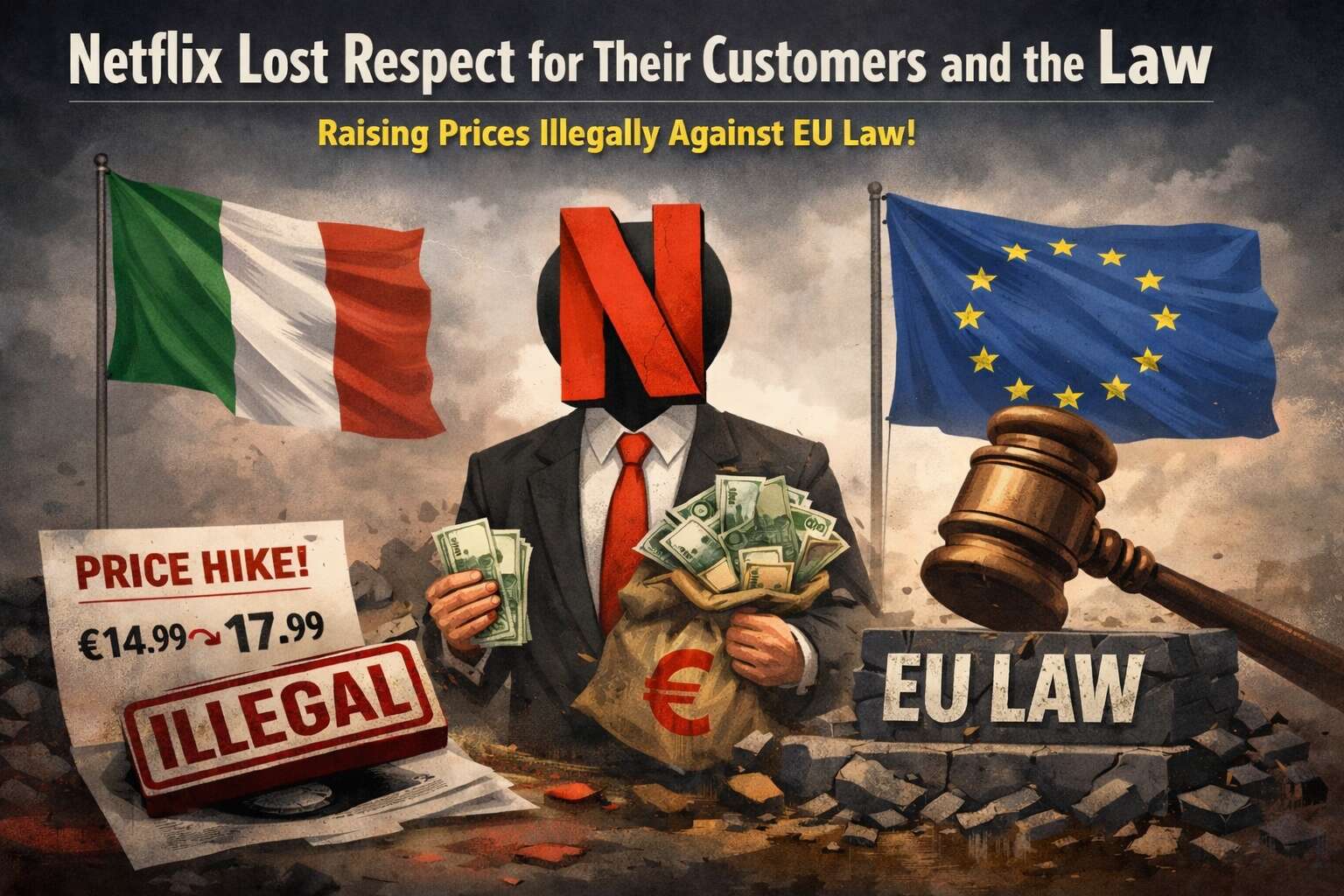
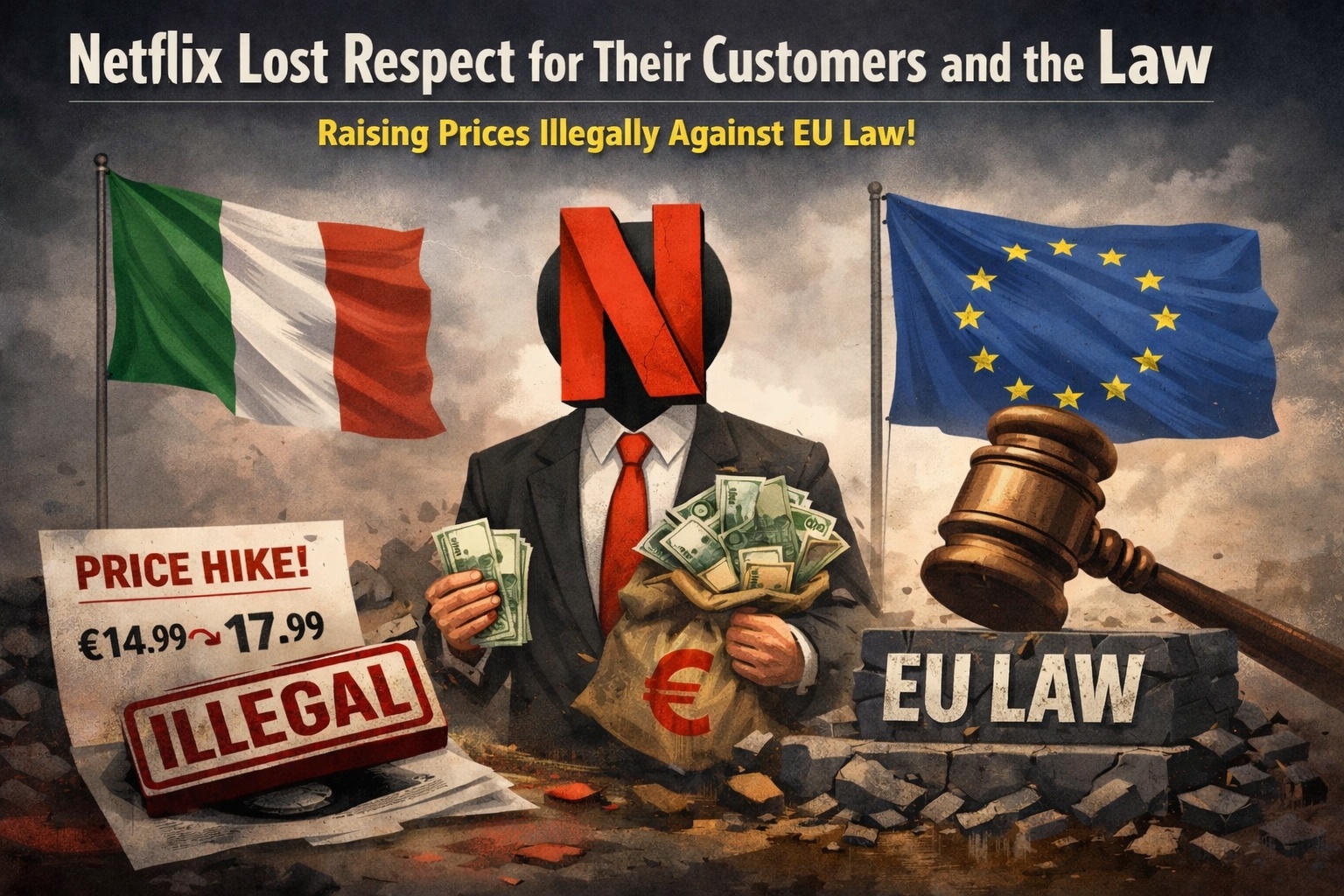
⚖️ Netflix lost respect for their customers and the law.
Netflix ordered to pay millions in refunds thanks to Italian court, but the impact will ripple a long way.
ChatGPT says that this image will encourage you to read the article in full.
Italy just handed every subscription company in Europe a warning shot.
On April 1 a Rome court ruled that Netflix's price increases between 2017 and 2024 were illegal. All four of them. The contract never gave a justified reason for any hike, and under EU Directive 93/13/EEC, "you can cancel if you don't like it" does not count as consent.
Italy has 5.4 million Netflix subscribers. Premium users could be owed up to €500 each. The total exposure runs to hundreds of millions of euros. Netflix says it will appeal.
Good luck with that.
Netflix likely isn’t appealing because of the money they need to pay back, they can surely afford that. Italy is a small country after all. They’re appealing because of the precedent the Rome court has set. What’s valid in Italy, will be applicable across all of Europe.
This behaviour is part of the recipe for a specific way of doing business, that we see in other places.
Netflix's entire growth strategy has been built around the idea that more is always better. More subscribers. More minutes watched. More revenue. The tactics that came with that mindset were, let's say, not always designed with you or me in mind.
Take the autoplay feature. When one episode ends, the next starts after roughly five seconds. On first glance, it seems like a feature of user convenience. In reality the visual countdown bar sweeps across the screen before you've had a moment to think. A University of Chicago study published in late 2024 found that this adds 18 minutes to the average viewing session. Deliberate design. The choice is: “I’m going to start before you've decided."
Then there's what Reed Hastings said in 2017. At a conference in Los Angeles, the Netflix CEO was asked what the company's biggest competition was. He didn't say Disney. Or HBO, nor Amazon. He said sleep. "You get a show or a movie you're really dying to watch and you end up staying up late at night, so we actually compete with sleep," Hastings said. Then he added: "And we're winning."
He was laughing when he said it.
The thing about that quote is it was a boast about capture, not content. The metric was "did we keep you watching?", not "did you enjoy that?" Engagement as extraction.
And while all this was going on, the price kept going up. €11.99 a month in Italy in 2015. Four increases later, €19.99 by 2024. A 67% rise in under a decade. No reason given. No opt-in required. Just a notification, a "you can cancel if you like," and a new charge on your card.
In 2025 a Netflix spokesperson said “Because we continually increase the value we offer our members, we occasionally ask them to pay a little more.”
It worked, for a while. Then Italy read the contract properly.
The EU directive in question has been on the books since 1993. It's not new law. Netflix knew it existed. Every legal team at every subscription company should know it exists. The working assumption was that nobody would bother to actually test it. Now somebody did, and Italy wasn’t alone.
Germany's courts in Berlin and Cologne already ruled the same way. Spain's consumer association FACUA is pursuing an identical case. The Rome decision handed every consumer group in Europe a finished legal template.
I hope every EU country follows. They all have the same consumer protection law and the same pattern of unjustified price increases to point to. I will be happy to receive my refund.
The deeper issue is companies treating contract terms as optional when they're inconvenient, and treating customers as too disorganised, too busy, too resigned to do anything about it. That assumption just got expensive.
The broader implication here goes well beyond Netflix. The entire SaaS and subscription economy has been built on the same foundation. Raise prices, rely on inertia, assume the "cancel if you don't like it" clause covers everything. Spotify, Adobe, gym memberships, telecom bundles: they've all used versions of the same playbook. The Italy ruling says, at least in Europe, that playbook has a legal flaw in it.
The irony is that none of this had to happen. Price your product fairly, explain your increases honestly, give your customers actual reasons rather than a countdown timer and a take-it-or-leave-it email, and you probably don't end up in a Rome courtroom in 2026 being told to pay back seven years of charges.
But surely such honestly is impossible, you might think.
Here's what's already working in the other direction: subscription businesses that treat cancellation as a right, not a betrayal, and price with transparency. Amazing.
Duolingo's freemium model, Zendesk's straightforward tiers, even certain direct-to-consumer brands that let you pause or quit without a maze of dark patterns. These companies aren't bleeding out. They're building sticky relationships because customers feel respected instead of trapped. No autoplay guilt, no surprise hikes, just clear value.
The result? Lower acquisition costs, higher lifetime value, and zero courtroom drama. Maybe evil isn't required for scale.
The data is unambiguous: treating customers, and the planet, with basic respect is not just the decent thing to do; it is the superior business strategy.
Companies that ditch dark patterns and engineered addiction consistently outperform the extraction-first crowd over the long haul.
A recent analysis by the Ethisphere Institute found that companies recognised as among the World's Most Ethical Companies outperformed a broad global benchmark by 8.2 percentage points over five years.
McKinsey's analysis of "triple outperformers” aka companies that beat their peers on growth, profit, and ESG metrics, deliver 2–7 percentage points higher total shareholder returns than pure financial performers.
Consumers are voting with their wallets: PwC's 2024 Voice of the Consumer Survey found 80% willing to pay more, with an average premium of 9.7%.
McKinsey and others show 60%+ in various markets for sustainable options, with premiums often in the 5–10% range depending on category and region.
Netflix genuinely changed how most of us watch television. I have enormous respect for what they built in the early years (I was a customer when it was still a DVD rental company!) But somewhere along the way, the business stopped being about the best possible viewing experience and started being about the most possible viewing. The autoplay timer. The "sleep is our competitor" framing. The quiet price creep. They're the same decision, made over and over again. Netflix lost respect for their customers. Presumably they're not doing so great for the planet either.
As for the ripple effect on subscriptions, I wonder whether this is a one-off incident, or whether regulators and courts will keep pulling at this thread until the entire subscription model for Europe needs rethinking.
My bet? Either way, companies like Interface and Dr Bronner that treat us, and the planet, like adults worth respecting will be the ones still standing in 2035. The rest will keep appealing lost causes while their customers quietly cancel and move to someone who actually values their time, their money, and their future.
About Nick Stevens
Writing about making business better - to help people to build and grow profitable business that makes the world a better place.