I am back from my first ever ACoP under the “Models to Medicines” banner. This conference, is the first conference, where I promised I will show up for X meeting, and ended up being a no-show because of work obligations that came up as a surprise on my calendar .I must say, ACoP is a great place for community driven activities, and this was the first time the conference even planned a Hackathon, where the idea of the hackathon was the following:
- We were provided a short introduction on methods used in the discipline, either as ML methods or as traditional emperical ways of selecting the covariate dataset. - We were provided a synthetic dataset, and were aspired to Find the covariates that drive response, separately for each treatment arm. - if we wanted to go further, we could: Compare traditional covariate models with ML models on the same patients, using metrics that fit the outcome. - I have been a rather unuseful team mate for my team and was not able to contribute, but should you want to to check out the contributions and solve from us where we used Posit solutions, please have a look here.
I think it was an incredible activity, and I have huge apologies for my team mates for being MIA.
The through-line that stuck with me was not “AI is coming” but that it is here, and we as scientists need to learn to ask a sharper question: how do we keep the discipline’s core strengths? There were many discussions and presentations around the use of GenAI frameworks with mechanistic grounding, where many sceintists presented how they can use GenAI to join the prevalidated scripts written by them with GenAI to form multi-agentic frameworks. There were very deep and critical discussions on "are careful inference and use of GenAI enabled methods to gather information from sparse data, to create decision-grade credibility while letting agents accelerate the parts that are still slow and error-prone useful and effective? The ideas have also sparked critical debate on how if agentic systems are not well engineered, can lead to steady-state or convergence of all scientific thoughts and thus is a difficult technology to implement in areas of strong discovery, innovative method explorations and NAMs where sparse, dispersed data is a big topic.
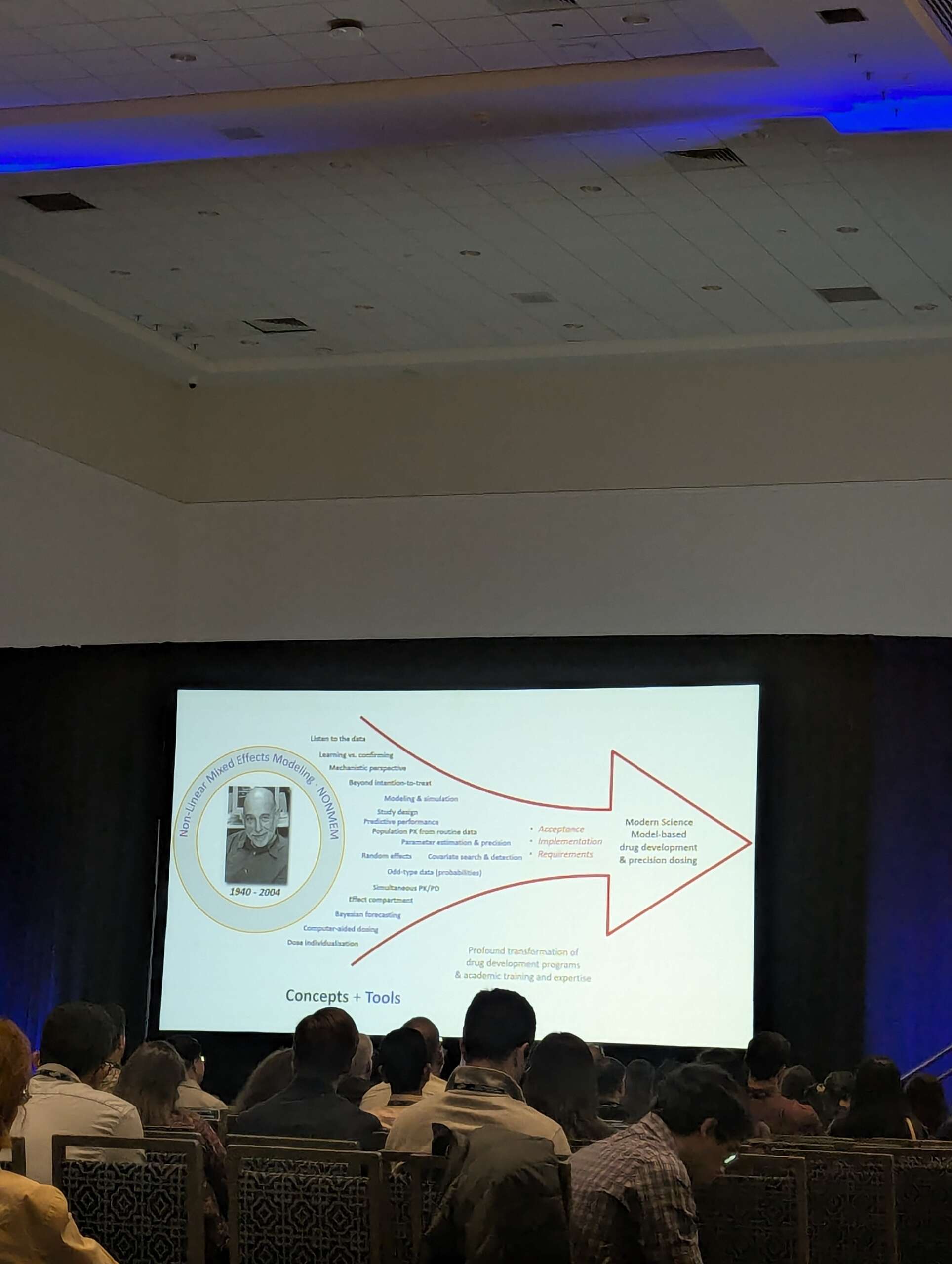
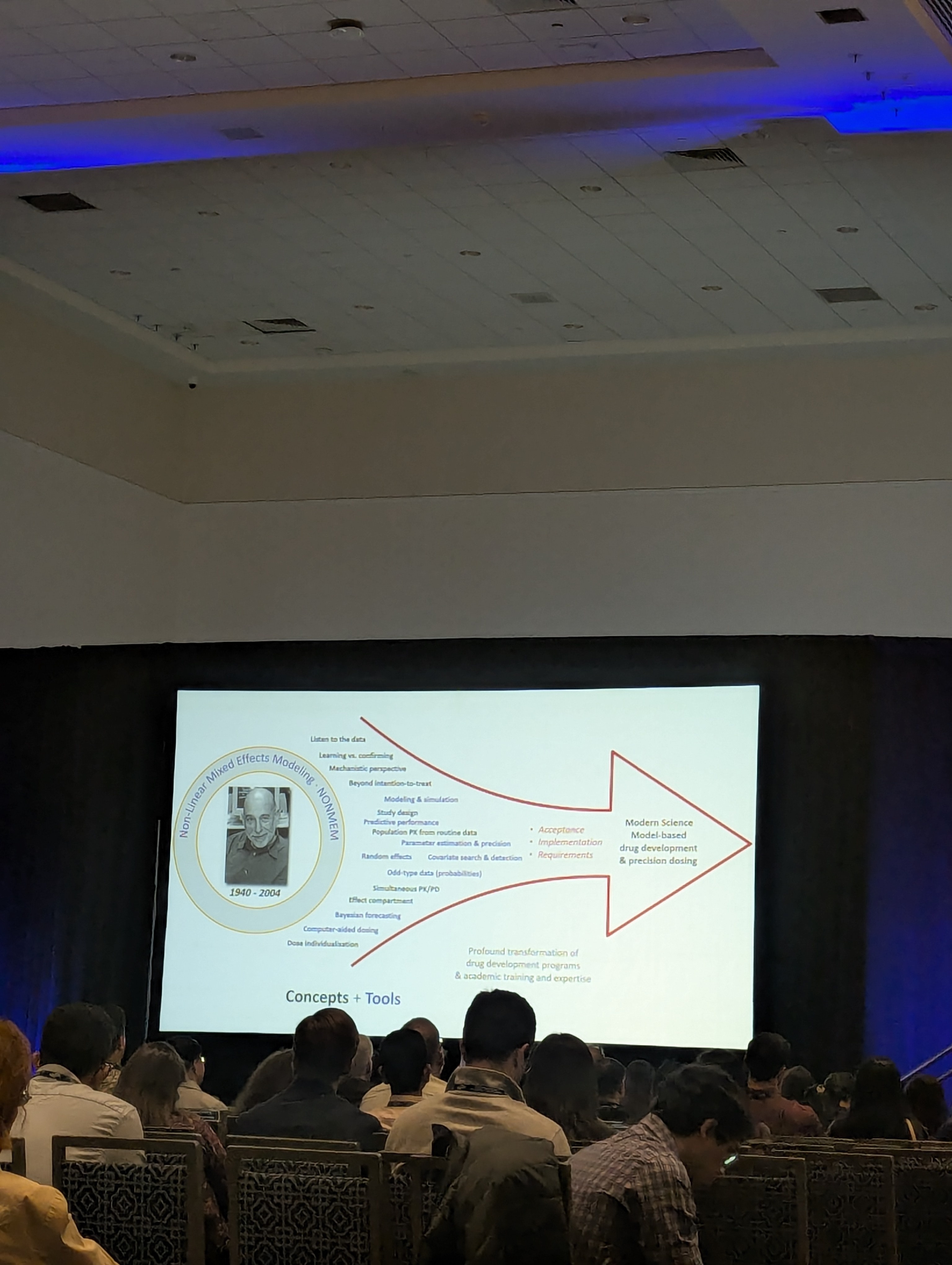
Lewis Sheiner’s legacy was acknowledged on the award lecture where Prof. Inaki shared the NONMEM arc from “listen to the data,” learning versus confirming, random effects, and covariate search all the way to modern model-based development and precision dosing examples of foundational minimal PBPK , minimal QSP models. He emphasized also, as the field progressed, what has changed is the tooling around it- although the methods have not taken much advancements and one could still implement what he had learnt in 80s to the dataset now too.
To me, this sounded like the same population-analysis mindset that extracted signal from theophylline concentrations and peak-flow recovery curves (Holford et al.) is now being asked to operate inside agentic loops.
Genentech showed work on LUCY- LUCAS, a multi-agent framework that takes problem context, PK/PD data, and an intended goal, then iterates through questioning, biological research, model planning, ODE construction, criticism, and validation before producing a mechanistic structure and simulation overlays. The examples (nonlinear PK, TMDD, multi-drug comparisons, more complex cytokine constructs) showed that the value is not just speed; it is the ability to propose, reject, and refine models while keeping the reasoning transparent.
There were session on evaluations and audit trails for trustworthy AI agents made that concrete. I would request every pharmacometrician to contribute to the SIG which has a github here (and truly, we need more of the scientists to contribute to this effort).
Trust rests on three layers: human skills that move us from copilots to engineered multi-agent workflows; agent skills built as unit operations with explicit rules, verification steps, and audit trails; and benchmarks that score outputs against ground truth. The practical pattern is context engineering, an orchestrator plus task agents that share a task library encoding expert consensus (the SKILL.md style: scope, rules, produces, verify). The result is meant to be reviewable, executable, and traceable *without* the agent: scripts that can be re-run, summaries with decision rationales, logs, and scorecards. That is the difference between a helpful suggestion and something you can defend. This is the reason why, this is such a strong group to contribute to as scientific represents from many companies, wether big Pharma, or vendors or even techBio.
I also got a chance from Simulations Plus to represent our work on Agentic QSP. The panelist on our presentation were strong (from FDA, JHU and JnJ). You can have a read at the other topics- one of which was on Structured schemas for provenance-Rich LLM-assisted QSP model calibration and the other one on using diffusion models to create virtual populationsFrom the personal perspective, I was amazed to see around 300 people in the room and later get so many great scientific discussions around "you said what we are thinking" or "you are a pretty intense enthusiast that now I want to talk to you. take it as a compliment". I am really thankful and humbled by all of the people who came to me later, conversed with their thoughts about AI and its impact on our discipline and as a consequence, watered my heart and soul with many take aways and a cup full of vibing. No doubt, ACoP is such a breeding ground for giving growth to people and a strong giving back to the community place.
Liang Zhao’s PBPK SIG talk was also really important. He touched on the obvious, that AI can already speed parts of model building, but it does not change what makes a model credible enough for a regulatory decision. The reality is that the core of PBPK model acceptance remains selective- roughly 30% of recent FDA novel approvals included PBPK, with high acceptance when the use was well-supported (especially CYP3A DDIs) and lower qualification rates at EMA for many proposed uses. AI helps most where its output can be checked against a source, an assay, or a test. ICH M15 and the FDA–EMA guiding principles already give the framework; what the community still needs is shared, PBPK-specific practice for how agents are allowed to operate. For anyone interested in PBPK-AI- SIG contributions!!! Please contact me- I would love to co-coordinate a group on this in ISoP!
What is impressive, is that in this conference, one could see strong convergence of PK/PD methods with mQSP or cross applicaitons in QSP. The hands-on SAEM tutorial showed this: agents helping set up and run population calibration on a mechanistic model, producing typical values, variability, residual error, diagnostics, individual estimates, and a virtual population ready for further simulation.
The same principle appeared in other sessions specifically on the mechanistic modeling for PROTACs moving from in-vitro ADME assays toward clinical translation, and optimal dynamic control approaches for multi-objective therapeutic scenarios such as prostate-cancer drug delivery (balancing castration depth, duration, and recovery).
Interestingly, poster sessions reinforced the theme pattern. One combined QSP with machine learning to predict IGA-based population responses in an atopic-dermatitis model. Another used an LLM to translate natural-language specifications into deterministic code for PBPK-QSP models of bispecific T-cell engagers inside PK-Sim/MoBi, with explicit checks for translation errors and schema compliance. Elsewhere, rich pre-clinical mouse data (full PK in systemic, organ, and tumor compartments plus longitudinal tumor-volume responses across multiple cell lines and dose levels) was being used to inform early clinical development through delayed-damage cascade models. In each case the value came from constraining the AI step so that the mechanistic structure and the statistical diagnostics remained visible and auditable.
The insight I am taking home is that the productive path is not unconstrained generation. It is agents operating inside unit operations that already encode pharmacometric standards: pre-specified candidates, effect-size and plausibility checks, residual diagnostics, virtual-population generation, and explicit human review points. When those constraints are in place, the speed-up is real and the credibility argument stays intact. When they are missing, we risk producing more models that still fail the same regulatory and scientific tests we have always applied.
Another important take home was the NAMs session in ACoP that showed how much as the LLMs get more engaged in modelling, would bring modelling disciplines closer- Pharmacometricians would do PBPK besides miniQSP; PBPK modellers will sit on the breadth of PBPK, QSP and First in Human Pharmacometrics; ClinPharm experts will be able to model and brin in conclusions. Lots of DIY models will be built in the future, where the modellers will gain bigger stakeholdership to be accountable for what is built to explain which hypthesis.
I believe, fatigue as it is that I am experiencing from such implementations- will knock at all our doors.
Across these, the consistent message was that one-shot LLM answers are not enough. The workflows that enforce biological applicability, evidence integrity, unit-level verification, and auditability are the ones that can actually move models toward medicines. ...... Unless The LLM vendors crack open the co-scientist ablilities and let the scientist decide how their harness operates.
I wonder- a lot. So, I write my wonder here. What to expect? The chaos and curiosity that my being brings. As living a human life is not bound by definitions in the macros- the posts here will be spontaneous and identity-less! I like to give and create art. So if you buy an act of creating I will use it for things that I am passionate to give for. Obviously, a little support on my art will make me feel visible.
"Change. Change. Change. Change … change. Change. Chaaange. When you say words a lot they don't mean anything. Or maybe they don't mean anything anyway, and we just think they do."