"You are not a victim of the world. You are a victim of your interpretation of it."
Most of our waking human moments are spent in judgment.
We judge ourselves. We judge our colleagues. We judge our profession.
As a woman, I have come to see this not just as a feeling, but as a pattern. Research suggests that women are statistically more prone to rumination—the loop of repetitive, passive focus on distress.
We build a glass ceiling in our own brains, constructed entirely of these invisible judgment loops.
So, I decided to run an experiment. I stopped asking AI to do my work, and I started asking it to help me cultivate the state of being more often- such that it starts to become second nature itself.
Most of our waking human moments are spent in judgment.
We judge ourselves. We judge our colleagues. We judge our profession.
As a woman, I have come to see this not just as a feeling, but as a pattern. Research suggests that women are statistically more prone to rumination—the loop of repetitive, passive focus on distress.
We build a glass ceiling in our own brains, constructed entirely of these invisible judgment loops.
So, I decided to run an experiment. I stopped asking AI to do my work, and I started asking it to help me cultivate the state of being more often- such that it starts to become second nature itself.
The Experiment: The Philosopher's Agent
I spun up a specific "Claude Skill"—my own digital agentic ally. It isn’t trained on marketing data or code; it is trained on a unique blend of philosophy: Aristotle, Marcus Aurelius, J. Krishnamurti, and Swami Vivekananda.
Every 4 hours, this agent triggers a reflective app on my phone. It doesn't ask for a to-do list. It asks one simple question:
"What are you judging right now?"
The goal is to catch the mind in the act.
As Krishnamurti famously observed:
"The ability to observe without evaluating is the highest form of intelligence."
At the end of the week, the agent analyzes the data to tell me two things:
* The Height of the Ceiling: How much did my internal narrative limit my potential this week?
* The Distance: How successfully did I detach from the judgment to observe it objectively?
I’ve found very few people who can truly hold a mirror to my blind spots without bias. I decided to take a leap of faith and rely on the machine to be that solid partner.
Every 4 hours, this agent triggers a reflective app on my phone. It doesn't ask for a to-do list. It asks one simple question:
"What are you judging right now?"
The goal is to catch the mind in the act.
As Krishnamurti famously observed:
"The ability to observe without evaluating is the highest form of intelligence."
At the end of the week, the agent analyzes the data to tell me two things:
* The Height of the Ceiling: How much did my internal narrative limit my potential this week?
* The Distance: How successfully did I detach from the judgment to observe it objectively?
I’ve found very few people who can truly hold a mirror to my blind spots without bias. I decided to take a leap of faith and rely on the machine to be that solid partner.
The Realization: The Era of "Bespoke Software"
This exercise also got me to think that the AI revolution isn't about buying better software; it's about making your own.
My colleagues and friends- Vlad, Wes, Meeta and Bruni have long argued that the AI revolution will unlock a future where people and companies build their own tools — deeply customized and self-evolving. And they are right.
I also realized: introspection is also a form of software — just internal, not digital.
Maybe we don’t need software that’s better than what others build. Maybe we need software that’s truer — to our patterns, our psychology, our quirks.
My colleagues and friends- Vlad, Wes, Meeta and Bruni have long argued that the AI revolution will unlock a future where people and companies build their own tools — deeply customized and self-evolving. And they are right.
I also realized: introspection is also a form of software — just internal, not digital.
Maybe we don’t need software that’s better than what others build. Maybe we need software that’s truer — to our patterns, our psychology, our quirks.
The Ant Colony & The Agent
This is where the biology of ant colonies meets the psychology of AI.
An individual ant is not particularly smart. But the colony possesses a "Swarm Intelligence"—an emergent property where simple interactions lead to complex, highly effective solutions.
They are "net useful" not because they plan ahead, but because they respond effectively to local signals (stigmergy).
Humans are the opposite. We have high individual intelligence, but our "judgment loops" create noise.
We get in our own way. We fear the layoff because we fear we are becoming useless.
AI is the signal that organizes the colony.
By using my "Philosopher Agent," I am using AI to dampen the noise of my judgment and amplify the signal of my utility.
* It catches me when I am petty.
* It reminds me of Marcus Aurelius ("Remove the judgement, and you have removed the thought 'I am hurt'") when I am angry.
* It reminds me of Vivekananda when I am fearful.
It turns me into a "net useful" node in the network of the world.
An individual ant is not particularly smart. But the colony possesses a "Swarm Intelligence"—an emergent property where simple interactions lead to complex, highly effective solutions.
They are "net useful" not because they plan ahead, but because they respond effectively to local signals (stigmergy).
Humans are the opposite. We have high individual intelligence, but our "judgment loops" create noise.
We get in our own way. We fear the layoff because we fear we are becoming useless.
AI is the signal that organizes the colony.
By using my "Philosopher Agent," I am using AI to dampen the noise of my judgment and amplify the signal of my utility.
* It catches me when I am petty.
* It reminds me of Marcus Aurelius ("Remove the judgement, and you have removed the thought 'I am hurt'") when I am angry.
* It reminds me of Vivekananda when I am fearful.
It turns me into a "net useful" node in the network of the world.
The Leap
So I’m letting this experiment run for a month.
Let’s see if wisdom can be simulated — or at least, scaffolded — by AI. Let’s see if awareness, when augmented, can free us from the ceiling of judgment.
Let’s see if wisdom can be simulated — or at least, scaffolded — by AI. Let’s see if awareness, when augmented, can free us from the ceiling of judgment.
"What if some visitor from Mars had come a billion years ago to judge the fate of earthly life from watching clumps of cells that hadn't even learned to crawl? In the same way, we cannot grasp the range of what machines may do in the future from seeing what's on view right now."
Marvin Minsky in his book, The Society of Mind (1986)
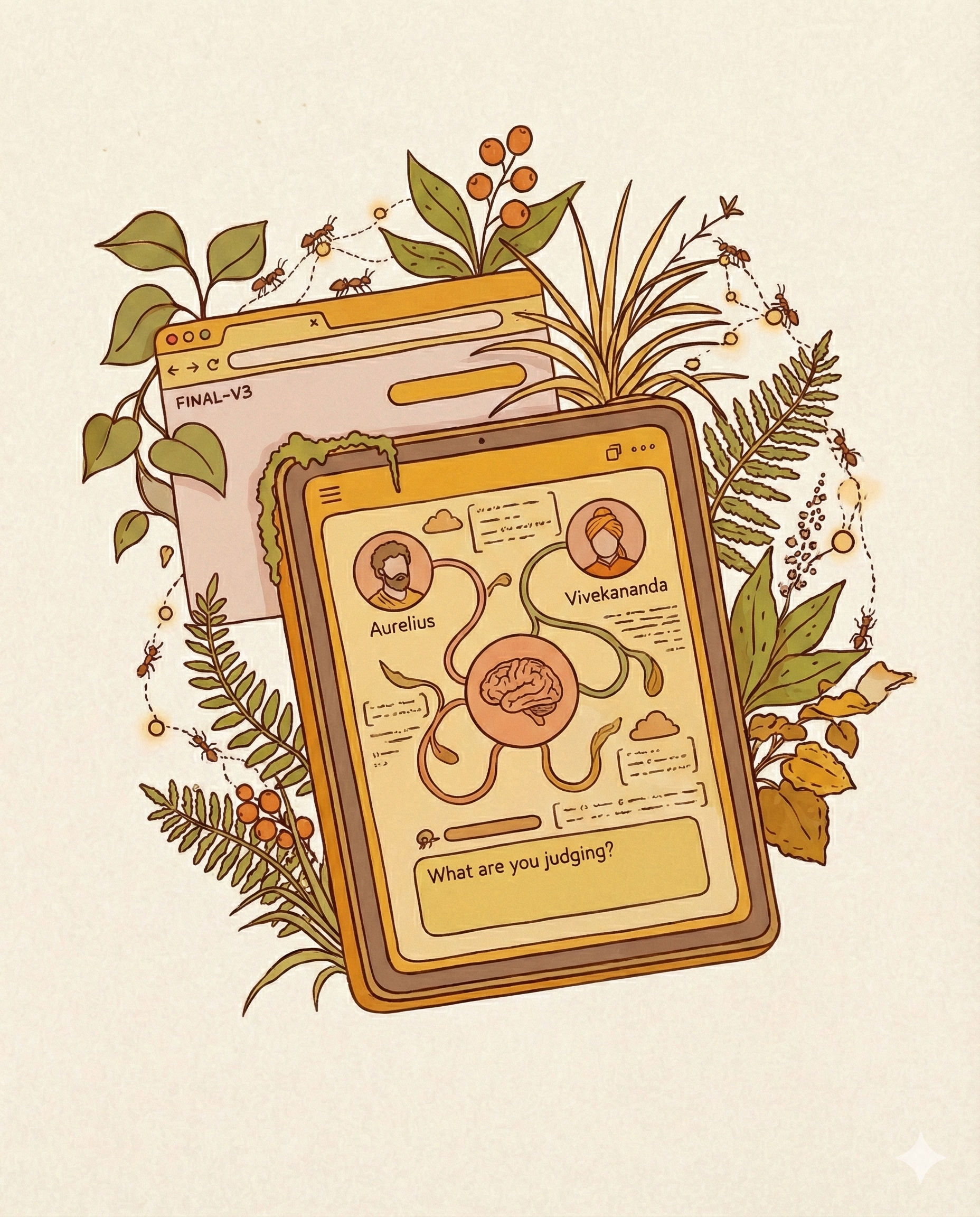
Image: Sketched, and then edited with Nano Banana