As the Eurotox gets closer, I have the nostalgia of not being able to be present there this year. I may consider to take some days off from work to visit Eurotox and immerse in science as currently that seems to be the last thing on my job.
I would like to care and delve into science as a whole. Not the science that one company does and then roots into it.
Eitherways the topic of NAMs has taken considerable and heavy bend from so many of the people in either industry, or academics or the world of AI. I will cover all these in 2 parts because I can and I want to. 😊✨
In June and July 2026, a wave of peer-reviewed papers prove the shift of NAMs is real and directional, offering concrete examples of human-relevant, animal-sparing methods moving from research into real-world application.
Among them, a notable contribution from the FDA’s Center for Drug Evaluation and Research (CDER) stands out, alongside advances in developmental neurotoxicity, endocrine disruption screening, vaccine safety, and environmental risk assessment.
These publications arrive at a pivotal moment. With the FDA’s 2025 Roadmap to Reducing Animal Testing still guiding agency priorities, the European Commission’s June 2026 Roadmap toward phasing out animal testing for chemical safety, and growing industry investment in organ-on-chip, in silico, and 3D cell models, the science is catching up to the policy ambition.
The CDER Perspective: Experience, Gaps, and a Path Forward
One of the most closely watched pieces by me is the CDER/OND editorial “FDA/CDER/OND Experience With New Approach Methodologies (NAMs)” by Jia Yao and colleagues, published in issue of International Journal of Toxicology (epub late 2025). Drawing on years of reviewer experience, the authors detail how NAMs have already been incorporated into standard nonclinical assessments, highlight specific tests that achieved international acceptance as alternatives to animal studies, and share anonymized insights into NAM data submitted to support drug applications.93 % of NAM packages were either in silico (49 %) or conventional in vitro (44 %). Organ-on-chip and microphysiological systems remain rare. Stem-cell and sandwich-culture models appear more often than complex 3-D platforms.Regulatory reality still favors methods that are cheap, scalable, and already familiar to reviewers. The gap between laboratory excitement (MPS, multi-organ chips) and dossier content is large. What makes this paper particularly valuable is it's exposure after the directional bend of FDA on NAMs.
Vaccines: moving non-clinical safety off the animal default
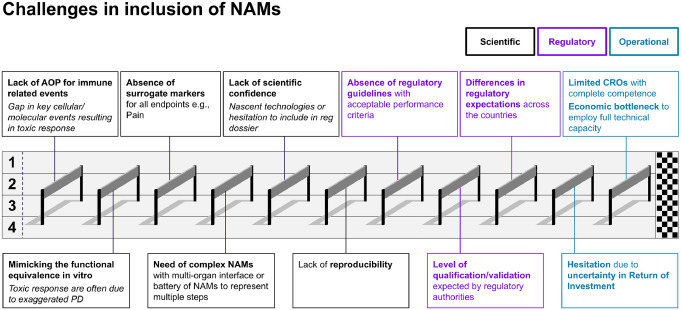
It's a great review of NAMs (in vitro, in silico, omics, microphysiological systems, etc.) for vaccine non-clinical safety; covers regulatory frameworks (EMA/FDA), sequential transition strategies (reduce then replace animal use), and positioning of NAMs across development stages. Unlike drugs, where pharmacokinetic exposure predictions can link preclinical formulations to human administration, vaccine formulations require additional time for producing and characterizing clinically representative samples. What is really powerful in this publication is the review on roadblocks:
The high-altitude scientific roadmap
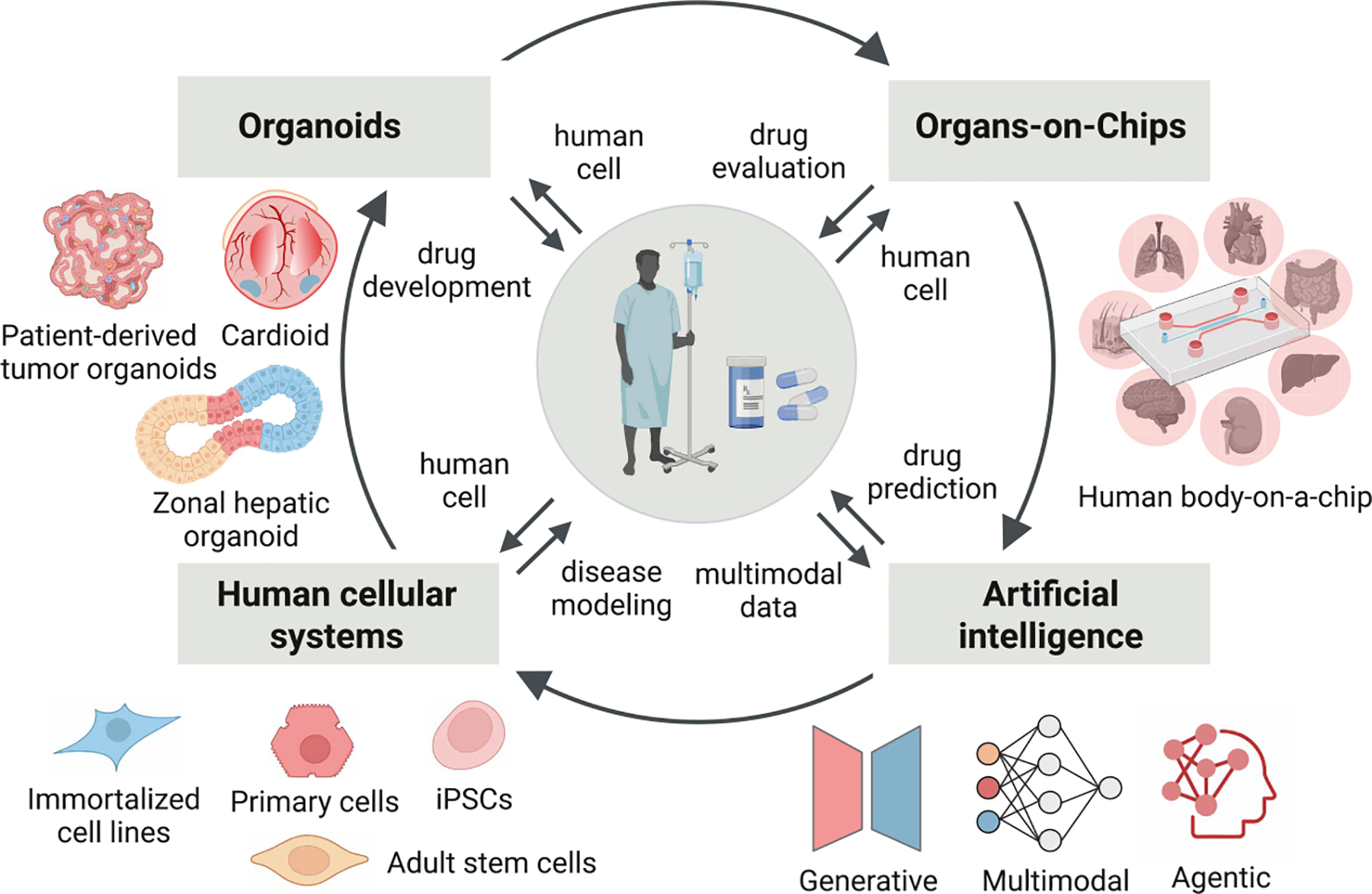
This paper in Science sets real high expectations of translation of NAMs in drug development. The authors frame NAMs as the response to the chronic failure of animal models to predict human outcomes. They integrate three layers — human cellular systems, microphysiological platforms, and AI — and place them inside a regulatory and ethical roadmap. The paper is less about any single assay and more about an infrastructure shift: from interspecies extrapolation to human-relevant prediction by design. This paper has explicit linkage to FDA Modernization Act 3.0 language makes it the citation magnet for strategic discussions in 2026.
Defining the term itself — “What’s in a NAM?”
The authors propose a crisp definition: **NAMs are species-specific methodologies that do not use living animals and prioritize the target species (usually human) in some form**. The point is to reduce ambiguity that has allowed the term to drift. Clarity of definition is itself a regulatory enabler; without it, “NAM” becomes marketing rather than a decision-grade category.
Systems thinking for the transition — the CHANGE project
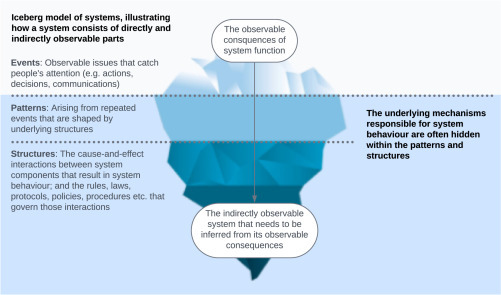
They talk about the systems level thinking of changing the way we do tox for good. For inclusion of NAMs and they say that technical validation alone is insufficient. The authors map six system components — infrastructure, processes, culture, technology, goals, and actors — and identify leverage points where small interventions can accelerate uptake. This is the NIH/NICEATM-aligned answer to the question:
“why are good NAMs still slow to enter decisions?”
One of the most controversial but true sentence in this publication is:
The second system-based explanation is that the system favours short-term reassurance, procedural and market certainty even while recognising the potential value of making greater use of NAMs.
Pros of NAMs (ethics, mechanism, human relevance, speed) sit against the real cons (validation burden, limited historical data, investment needs). This CHANGE paper argues that system-level design, not more assays, is what tips the balance for the NAMs to find momentum.
Singapore goes into food safety NAMs scoping review
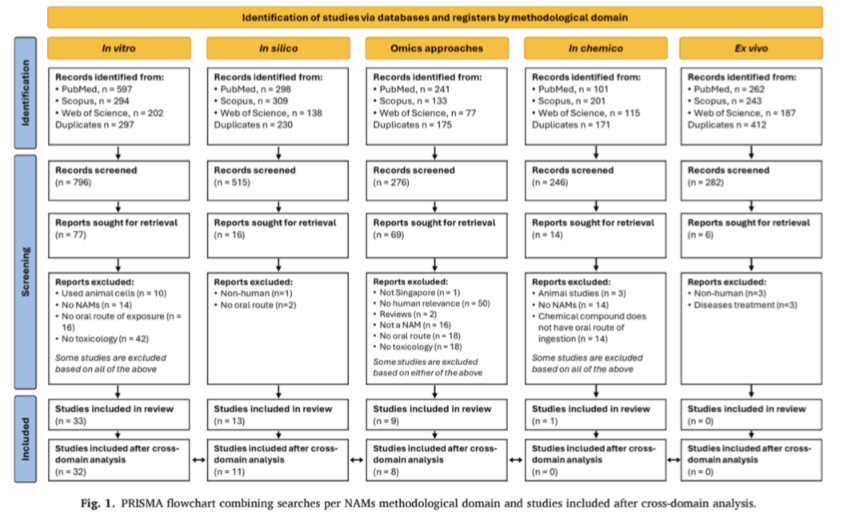
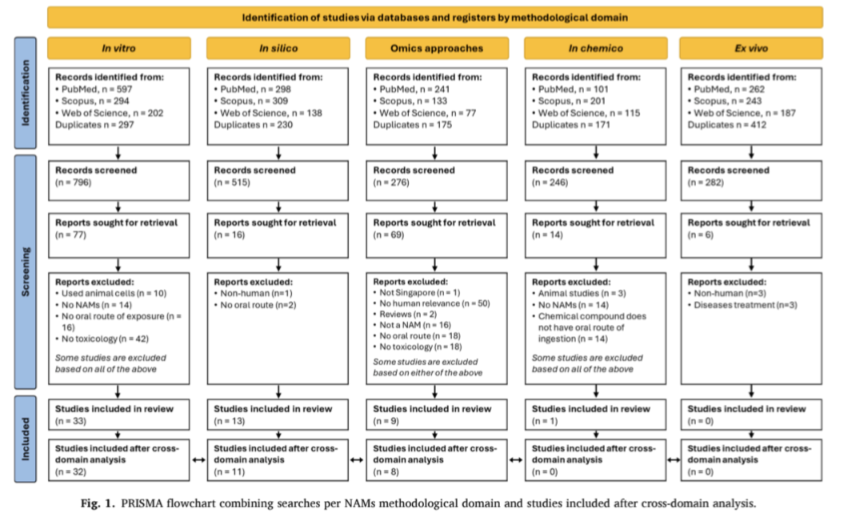
I would say the scoping review is by far the most thorough review I have noticed for NAMs from policy makers. It's worth a clear read for food chemistry. 51 food safety NAMs studies clearly scoped and reviewed. They also talk about mixtures and how little evidence there is around that in submissions. They clearly define what percentage of studies were transferable NAMs from one sector to another with oral relevance.
The Canadian friendliness for the environment
This paper taught me more than I thought. They talk about how NAMs can be added to whole-effluent toxicity (WET) - a term I was not even aware of. Were you?
They make the case that the current tools used to measure WET in Canadian regulations can be optimized with NAMs. So what is effluent exactly? As the first few lines of the paper states:
Effluent is the liquid waste generated from agriculture, industry, and municipalities (domestic and stormwater) and it poses a significant ecological risk. Effluent discharge enters receiving environments, acting as a vector of many chemicals that can collectively affect organism reproduction, growth, and survival and alter ecosystem composition.
They are mostly comprised of complex mixtures with having elements like copper, lead etc in the mixtures. They talk about various methods that replace whole animal testing in specific light to fishes. And that there is an endeavor for EcoToxChip. Lots of new things to learn from the Canadians ♥️.
Definition hygiene
What's in a NAM is a fun paper to read where the authors propose a crisp definition: NAMs are species-specific methodologies that do not use living animals and prioritize the target species (usually human) in some form. The point is to reduce ambiguity that has allowed the term to drift. Clarity of definition is itself a regulatory enabler; without it, “NAM” becomes marketing rather than a decision-grade category.
The publications of mid-2026 do not claim that animal testing is finished. They claim something more useful: the criteria for replacing it are becoming explicit, the submission patterns are measurable, and the remaining barriers are increasingly organizational rather than purely scientific.
Looking forward to sharing the rest. As of now good night from my end.
I wonder- a lot. So, I write my wonder here. What to expect? The chaos and curiosity that my being brings. As living a human life is not bound by definitions in the macros- the posts here will be spontaneous and identity-less! I like to give and create art. So if you buy an act of creating I will use it for things that I am passionate to give for. Obviously, a little support on my art will make me feel visible.
"Change. Change. Change. Change … change. Change. Chaaange. When you say words a lot they don't mean anything. Or maybe they don't mean anything anyway, and we just think they do."