Yesterday, I turned another year older. It was a day for "Friday Afternoon" thinking that 10% of time on the the "big questions." I looked at my career as a scientist and my future as a leader, and I realized that the friction I’ve felt isn't just bad luck. It’s a mathematical certainty of the systems I’ve been living in.
1. The Audibility gap of women in leadership
In continuous signaling systems, small errors at one stage compound and distort the signal at the next. The same dynamic plays out in leadership hierarchies. When a woman’s idea is ignored or misattributed, that initial error amplifies upward: by the time it reaches the top, credit often shifts to a man and the original insight is lost.
Most leaders operate like fragile analog amplifiers. They are overwhelmed by egos, interpersonal conflicts, and the need to protect their own position. Instead of strengthening valuable signals, they resist or suppress them.
The result is the “echo effect”: a thoughtful proposal from a woman lands in silence, only for a man to repeat the same idea moments later and receive enthusiastic praise. This isn’t mere oversight, it’s indic tion of systemic bias. People instinctively route ideas toward those they already expect to be the “idea people.”
Consequently, many leaders function as lids rather than ladders. They prioritize self-protection over enabling others to rise. True leadership: flexible, service-oriented, and designed to launch stronger signals from the team is rare.
2. The Power of "No" and the Filtering of Standards
To fix your life, you have to stop being a continuous signal that tries to please everyone. You have to become discrete.
I’ve learned that the most important tool for a high-standard life is the word "No."
By saying "No" to the status games, "No" to the toxic networking of ego-driven science, and "No" to rooms where I am passively accepted but not respected, I am finally seeing the quality of my own ideas.
If you don't say "No," you are just noise. When you say "No," you filter for the fundamentals. You force the "likely" to make way for the "desirable."
I’ve learned that the most important tool for a high-standard life is the word "No."
By saying "No" to the status games, "No" to the toxic networking of ego-driven science, and "No" to rooms where I am passively accepted but not respected, I am finally seeing the quality of my own ideas.
If you don't say "No," you are just noise. When you say "No," you filter for the fundamentals. You force the "likely" to make way for the "desirable."
3. Learning to Learn (and Learning to Leave)
In the laboratories of my past, I was often the only one with a firm grasp of the "new."
I had to learn enough numerical analysis, social science, and technology just to cope. But as a scientist, I realized that if you don't keep learning the fundamentals of new fields, you get left behind.
My pivot to anew position is an admission that while technology evolves rapidly, human institutions- especially the rigid hierarchies of the scientific community- evolve with agonizing slowness.
I am choosing not to wait for the "slow evolution of the human animal." I am moving to where I can handle the "great possibilities" of the future through individual choice.
I had to learn enough numerical analysis, social science, and technology just to cope. But as a scientist, I realized that if you don't keep learning the fundamentals of new fields, you get left behind.
My pivot to anew position is an admission that while technology evolves rapidly, human institutions- especially the rigid hierarchies of the scientific community- evolve with agonizing slowness.
I am choosing not to wait for the "slow evolution of the human animal." I am moving to where I can handle the "great possibilities" of the future through individual choice.
4. The Science of being in the Network Graph
I’ve spent a long time in the scientific community, a group I respect deeply but which I now see as one of the most ego-driven ecosystems on Earth. We talk about merit, but in reality, science survives on network effects.
The compounding effect of relationships in a scientific career is more powerful than almost any other field. If you are a brilliant scientist but cannot "sell" your ideas or "bang on doors," you get stuck in the "foam"- the surface-level noise where high potential goes to die.
If you can't communicate, you don't exist. But I’ve found that if I want to do all these same things, then I want to perform on a stage larger than a peer-reviewed journal. I want to create actual, tangible value.
The compounding effect of relationships in a scientific career is more powerful than almost any other field. If you are a brilliant scientist but cannot "sell" your ideas or "bang on doors," you get stuck in the "foam"- the surface-level noise where high potential goes to die.
If you can't communicate, you don't exist. But I’ve found that if I want to do all these same things, then I want to perform on a stage larger than a peer-reviewed journal. I want to create actual, tangible value.
5. Breaking the Barrier: Finding the "Hidden Rooms"
I’ve learned that the Status Ladder is a ghost. It doesn't actually lead to the people you want to work with. The truly talented people, the highly critical thinkers who ask the right questions, are rarely found in the "standard" rooms of a corporate or academic hierarchy.
To find them, you have to break the barriers of the status game. You have to stop trying to climb a ladder that leads to a crowded, stagnant floor and instead seek out the rooms that enable you. I am looking for the people who push me to my boundaries, not those who ask me to shrink to fit theirs.
To find them, you have to break the barriers of the status game. You have to stop trying to climb a ladder that leads to a crowded, stagnant floor and instead seek out the rooms that enable you. I am looking for the people who push me to my boundaries, not those who ask me to shrink to fit theirs.
6. The Three Questions: Possible, Likely, Desirable
In planning my upcoming years, I am distinguishing between three questions:
1. What is possible? (Innovation)
2. What is likely? (The same old status games and leadership ceilings)
3. What is desirable?(A life of value and presence)
For a long time, I chased the "likely." I climbed the ladder because that’s what "good scientists" do. But the "desirable" was always entrepreneurship. It’s the ability to work with the "hidden" people...the critical thinkers who ask the right questions but are never found in the "standard" rooms. These people don't care about your place on the network graph; they care about the strength of your signal. And you would find them in rooms and situations you least imagine to put yourself into.
1. What is possible? (Innovation)
2. What is likely? (The same old status games and leadership ceilings)
3. What is desirable?(A life of value and presence)
For a long time, I chased the "likely." I climbed the ladder because that’s what "good scientists" do. But the "desirable" was always entrepreneurship. It’s the ability to work with the "hidden" people...the critical thinkers who ask the right questions but are never found in the "standard" rooms. These people don't care about your place on the network graph; they care about the strength of your signal. And you would find them in rooms and situations you least imagine to put yourself into.
6. Fun as 100% Presence
I am redefining "Fun" as the ultimate state of 100% presence.
Computers have the advantage of speed and freedom from boredom, but they lack the ability to want a specific future. Humans have that advantage.
I no longer want to be a scientist who just "understands and translates." I want to be the entrepreneur who creates. My upcoming years are about getting what I want from life, not just from a job or a negotiation. I am quitting the game where the rules are designed to make me fail, and I am starting a new one where the only metric is the value I bring and the presence I maintain.
As I rise, I am taking many great philosopers advice: I am concentrating on the fundamentals of being human, learning the truths of those around me, and ensuring that my signal is never again lost in someone else’s noise.
Computers have the advantage of speed and freedom from boredom, but they lack the ability to want a specific future. Humans have that advantage.
I no longer want to be a scientist who just "understands and translates." I want to be the entrepreneur who creates. My upcoming years are about getting what I want from life, not just from a job or a negotiation. I am quitting the game where the rules are designed to make me fail, and I am starting a new one where the only metric is the value I bring and the presence I maintain.
As I rise, I am taking many great philosopers advice: I am concentrating on the fundamentals of being human, learning the truths of those around me, and ensuring that my signal is never again lost in someone else’s noise.
Richard Hamming noted that "No vision, not much of a future." This trip around the sun would be about leaning into the vision of the future I want to hold for myself. Either personally or professionally.
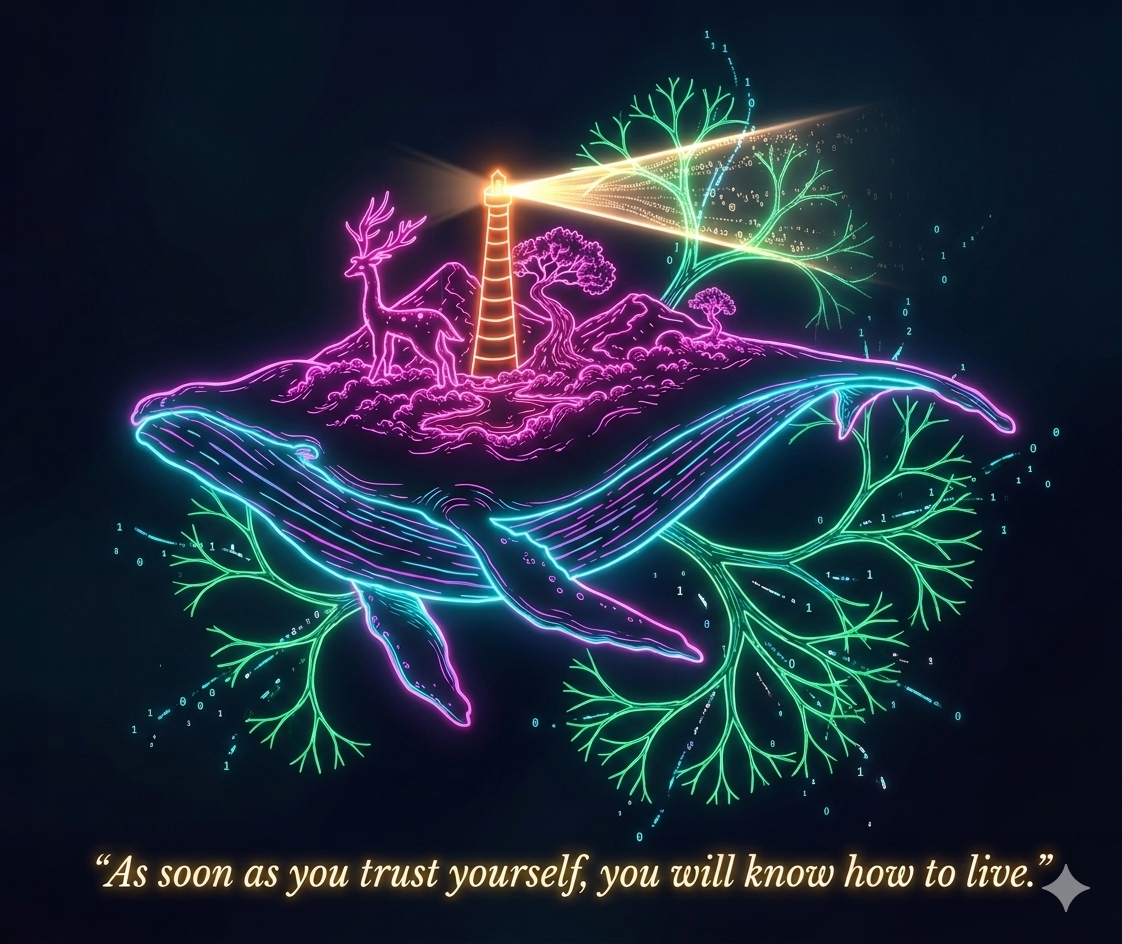
quote was shared by my friend Sips and Norgard. I just got compelled to it.