Today I will share some learnings I have gathered from consistent exposure to some mild form of discriminatory comments on my authenticity in professional circles. I think many of us women face it and decide to be quiet about it- or are made to believe the feeling that this is just normal of what they face. I think it is important to learn tools on how to manage such instances and people, and most importantly to develop a mindset that knows how to ignore the comments, not useful for our professional presence or that shrink us in another persons perspective.
A while ago, someone decided to explain professionalism to me- outside professional hours.They told me, that my approach to visibility (at that time enjoying walking bare foot- which is by the way very much backed by science itself for its numerous benefits), to presence, to self-presentation will prevent me from getting contracts, from being taken seriously, from "proceeding." They invoked concepts like "business value" and "business ethics". I remember listening and realising that it is a critique of my non-conformity. And it is delivered with the authority of someone who has conflated their own survival with the truth.
The first thing
The first thing worth saying is this:
A lot of people do not give feedback to improve your work. They give feedback to reduce their own discomfort. That distinction matters.
The first thing worth saying is this:
A lot of people do not give feedback to improve your work. They give feedback to reduce their own discomfort. That distinction matters.
Because if someone is reacting to your tattoos, your tone, your posture, your visibility, your comfort of being barefoot at instances (with professional communication/permission) is your refusal to perform the exact version of “professional” that helped them survive then it is a projection bias that you are facing. It is a critique of your freedom. And freedom is the one thing the status-anxious cannot tolerate.
Why this happens in science so much?
This dynamic shows up in many fields, but science gives it unusually fertile ground. Its interesting to see it here because you expect scientists to hold better standards or at least be more critical and self aware of their speech and political judgements.
However, over the course of time, I have developed mental model and theories for these instances- and this is my first and most strong standing hypothesis. Whether it is true is a matter of how much it stands the test of time to the new data points that would add to it- in areas of science like that of mine, the work is technically hard and socially opaque. The models are complex. The questions are multi-layered. The timelines are long. You can be doing excellent work for years before the broader system knows what to do with it.
And once someone has spent years building an identity around those games, they can become deeply threatened by a person who seems to create value without obeying all the same rituals.
In cases like this, one thing is simple:
Most people don't build glass ceilings to keep others out. They build them to keep themselves in.
How to navigate unsolicited feedback
There is a skill that is rarely taught, and yet determines more of your trajectory than almost anything else: the ability to ignore feedback that is not useful in your context. Not all feedback. Not constructive criticism from people who understand your work. But the ambient noise of people projecting their own anxieties, their own status games, their own unlived lives onto you.
Most people don't build glass ceilings to keep others out. They build them to keep themselves in.
How to navigate unsolicited feedback
There is a skill that is rarely taught, and yet determines more of your trajectory than almost anything else: the ability to ignore feedback that is not useful in your context. Not all feedback. Not constructive criticism from people who understand your work. But the ambient noise of people projecting their own anxieties, their own status games, their own unlived lives onto you.
When someone gives you feedback, ask two questions.
- Do they understand my actual work well enough to evaluate it?
- Do they want me to succeed, or do they want me to conform?
If they don’t understand your work, their opinion may still tell you something about perception, but it should not be allowed to rewrite your direction. If they mainly want conformity, then the feedback is not guidance. It is boundary enforcement.
another great rule to exercise is: don’t take criticism from someone you wouldn’t ask advice from.
There is also a useful distinction one can make between criticism and insult - criticism points to a discrepancy between actual and desired; insult adds judgment and character attack.
That framework is powerful in navigating glass ceilings that are served as feedback or advice from people around you.
for example:
“Your assumption about hepatic clearance may not be supported by the dataset” is criticism. “You’re too informal to be taken seriously” is usually not. One addresses the work. The other tries to control the person.
another great rule to exercise is: don’t take criticism from someone you wouldn’t ask advice from.
There is also a useful distinction one can make between criticism and insult - criticism points to a discrepancy between actual and desired; insult adds judgment and character attack.
That framework is powerful in navigating glass ceilings that are served as feedback or advice from people around you.
for example:
“Your assumption about hepatic clearance may not be supported by the dataset” is criticism. “You’re too informal to be taken seriously” is usually not. One addresses the work. The other tries to control the person.
The other idea that belongs here is that many times even badly delivered feedback can still contain information, and even inaccurate feedback can reveal a perception worth understanding. That does not mean all feedback deserves obedience. It means some feedback deserves extraction: take the data, discard the drama.
That is a much stronger skill than either blind defensiveness or blind compliance.
The volume principle
An important concept to keep in mind is actually from my favourite song: If, hearing your call, nobody comes - nevertheless, walk alone!
figure out what you want, ignore the opinions of others, and do so much volume that it becomes unreasonable for you to fail. In science, that does not mean frantic busyness. It means sustained, compounding output.
Write the post. Build the model. Refine the framework. Publish the thought. Improve the analysis. Keep showing your work. Keep becoming easier to find. Keep getting better at the thing that actually matters.
An important concept to keep in mind is actually from my favourite song: If, hearing your call, nobody comes - nevertheless, walk alone!
figure out what you want, ignore the opinions of others, and do so much volume that it becomes unreasonable for you to fail. In science, that does not mean frantic busyness. It means sustained, compounding output.
Write the post. Build the model. Refine the framework. Publish the thought. Improve the analysis. Keep showing your work. Keep becoming easier to find. Keep getting better at the thing that actually matters.
A lot of unhelpful criticism loses power when your body of work becomes undeniable.
Not because the critics become wiser. Usually they don’t. But because volume creates signal, and signal eventually outruns gossip.
The people who don’t build ceilings
But this is not only about the people who narrow the room.
It is also about the women who widened it for me.
Some people have advocated for my work in rooms I wasn’t in. Some have amplified what I wrote simply because they found it useful. Some have represented me generously without asking for anything in return.
That kind of support is never small.
The people who do this understand something that insecure professionals often miss: good work is not a zero-sum game. Promoting good thinking does not reduce your own value. It increases the quality of the field. This is why I almost have a very plain and strong bias toward promoting others and refusing to waste energy tearing people down.
Secure people amplify. Insecure people police.
That may be the cleanest heuristic of all.
The real skill
So I think one of the highest skills in modern work is this:
To become selective about what enters your mind.
Not closed. Not arrogant. Not unreachable.
Selective.
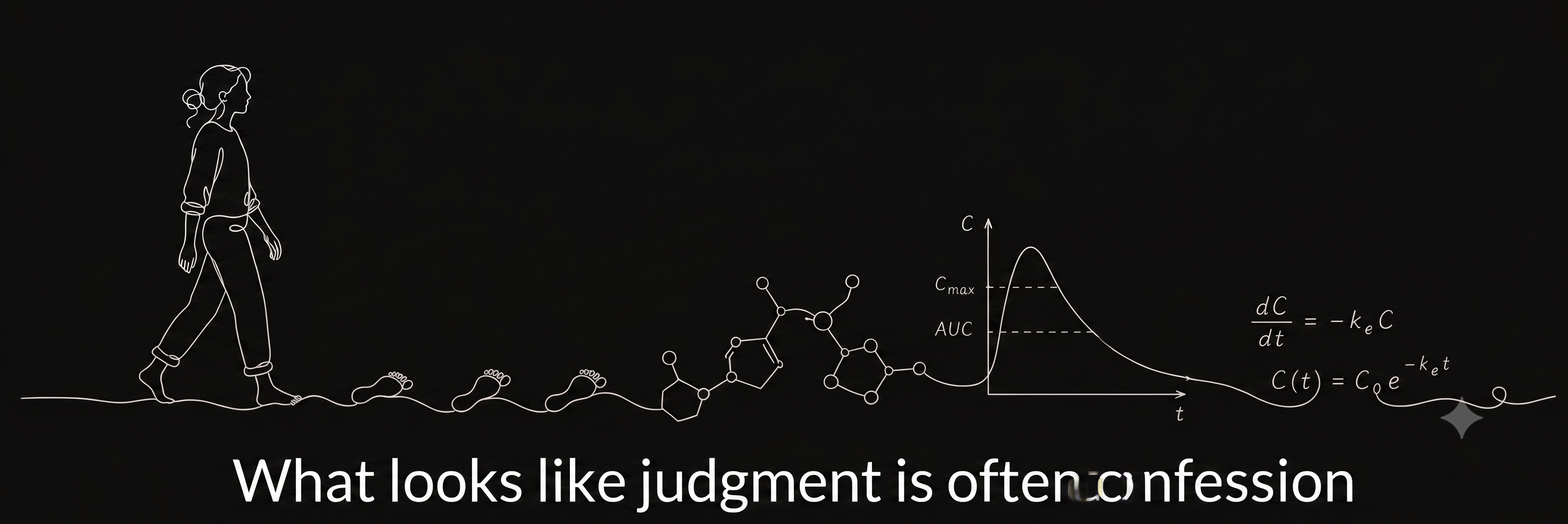
P.S. more of you should walk barefoot- and this was a ton of fun with GLM 5.2