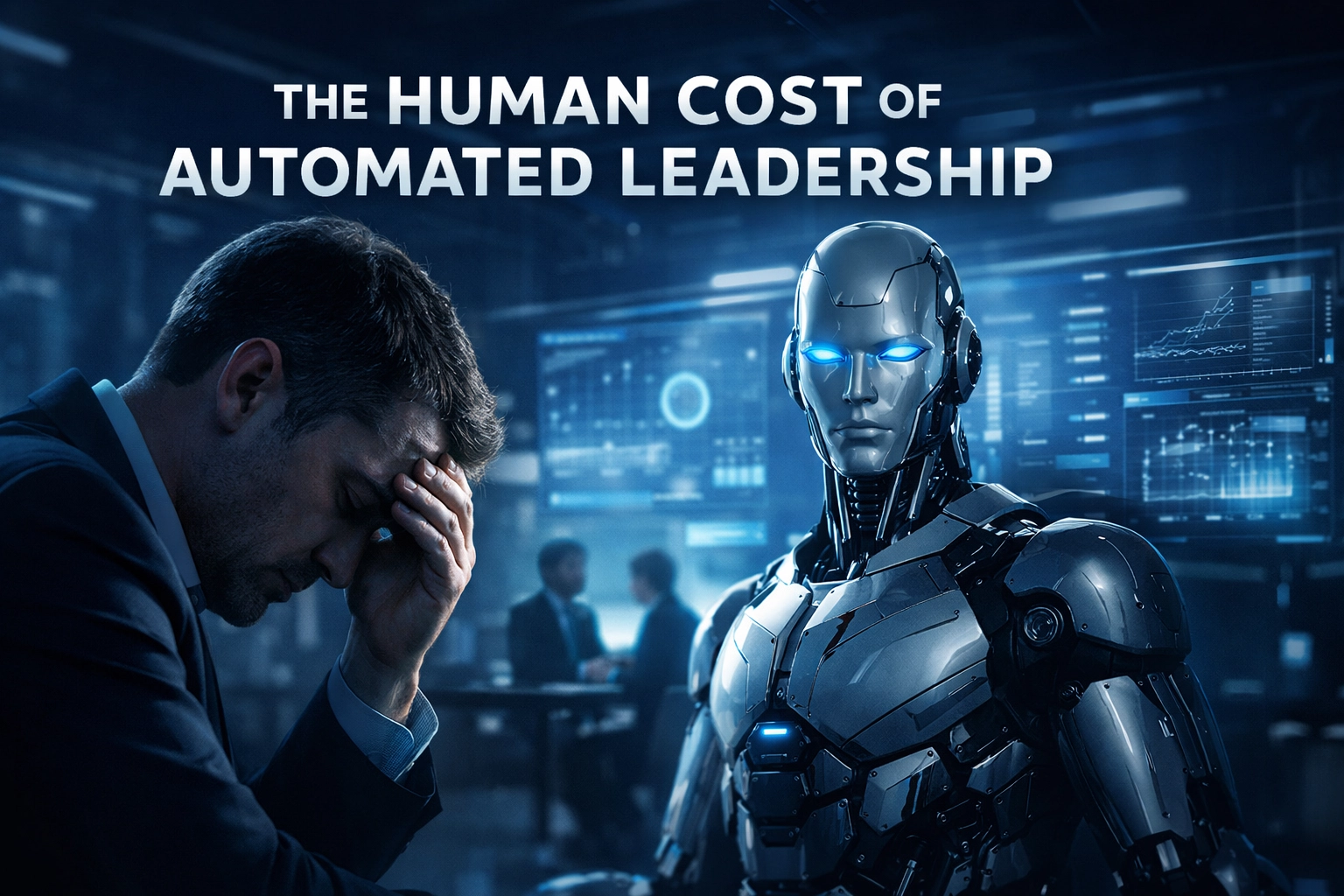
I've been in this business for over twenty years, and I've watched the pendulum swing from gut-driven decisions to data-driven everything. We went from executives making calls based on experience and instinct to boards demanding dashboards for every breath the company takes.
Don't get me wrong, I love good data, and I recommend systems that make it easier to capture, visualize, and act on it. Data keeps us honest. It surfaces problems we might miss. And AI has taken that to a whole new level, it can spot patterns faster than any human team, flag risks earlier, and give leaders a massive advantage when the stakes are high. But somewhere along the way, a lot of organizations started treating metrics like they were the entire story instead of just one chapter.
And that shift has a cost most people don't see coming, not because the technology is “bad,” but because we’re asking it to lead without a pilot.
The Dashboard Obsession, Great Tools, Risky Autopilot
Walk into any modern office, and you'll see them everywhere. Real-time analytics. Performance metrics. KPI dashboards glowing on every screen. We've built entire platforms to track, measure, and visualize every possible data point about our teams, our customers, and our operations.
The promise was simple: automate the mundane, free up leaders to focus on strategy, and let the data guide the decisions. And in theory, that sounds perfect.
In practice, the problem is not the dashboards. The problem is what happens when leaders outsource judgment to them. When the system becomes the decision-maker rather than the decision support, you end up with leaders who stop trusting their own experience, teams that feel they're being managed by algorithms rather than humans, and organizations that can measure everything but understand nothing.
Data should inform the gut, not silence it.

When the Algorithm Starts Driving
Here's what I see happening on the ground. Managers get access to AI-generated performance insights, automated feedback tools, and predictive analytics about their teams. The software tells them who's underperforming, who's at risk of leaving, and what interventions to make.
Used well, those are powerful, budget-friendly, scalable, and efficient tools for spotting patterns early and reducing guesswork. Used poorly, they become a substitute for leadership.
And slowly, the human element disappears.
Employees start to notice. They feel it. One client told me their team described it perfectly, "I don't feel like I'm being led by a person anymore. I feel like I'm being managed by an algorithm that my boss just reads from."
That's the human cost nobody talks about. Not that the technology exists, but that leaders let it drive without a pilot. When leadership becomes overly automated, people stop feeling seen, heard, or understood by the humans supposedly leading them.
Trust doesn't come from a dashboard, and you can't automate your way into the kind of loyalty that keeps great people around during tough times.
The Paradox Nobody Expected, Better Tools, Higher Leadership Bar
Here's the thing that really gets me. All this automation was supposed to make leadership easier. Take repetitive tasks off leaders' plates so they can focus on high-value work.
Instead, it raised the bar for leadership.
Why? Because when you remove all the simple, straightforward tasks, what's left are the messy, complicated, deeply human problems that no algorithm can solve. And if you haven't been developing your judgment, your intuition, your ability to read a room or sense when something's off, you're in trouble.
Automation doesn't hide weak leadership. It exposes it.
Poor communication becomes glaring when there's no busy work to hide behind. Lack of clarity stands out. Avoiding difficult conversations becomes impossible when the data keeps surfacing the same problems over and over.
That is exactly why I’m pro-technology and pro-leadership at the same time. Advanced tools are most effective when they amplify a capable leader, not when they attempt to replace one.

And here's the kicker, the same tools that were supposed to reduce the burden are now creating new pressures. Teams have more questions about what should be automated. There's more uncertainty about the future. Higher expectations that leaders should be operating at the cutting edge of AI while also providing stability and reassurance.
It's exhausting.
Where Human Judgment Still Wins
After two decades in this industry, I can tell you exactly where data falls short.
During crisis moments. When something breaks at 2 AM, and you need to make a call with incomplete information, no dashboard is going to save you. You need judgment, experience, and the confidence to make a decision knowing you might be wrong.
In managing change. You can measure productivity, retention, and engagement scores all day long. But understanding why your best engineer is suddenly disengaged? That takes a conversation. Human intuition. The ability to read between the lines.
When navigating politics and relationships. Every organization has invisible dynamics. Unspoken tensions. Historical context that never makes it into the CRM. Data can show you what's happening, but it takes human wisdom to understand why and what to do about it.
In hiring and building teams. I've seen companies try to automate candidate screening to the point where they're basically hiring based on keyword matches and algorithm scores. And then they wonder why their culture feels off or why great people don't stick around. Because hiring isn't just about skills on paper. It's about chemistry, potential, and intangibles you can only assess face-to-face.

The Skills We're Losing
One of the scariest trends I'm seeing is the degradation of critical thinking in leadership.
When you can just ask an AI for the answer, when the dashboard tells you what to do, when every decision comes with a recommendation from the system, you stop developing your own decision-making muscles.
Leaders start defaulting to the algorithm. They stop questioning assumptions. They trust the data without assessing whether it actually measures what matters or whether the context has changed.
And their teams notice. Trust in leadership drops because people can tell when someone is just reading from a script the software wrote.
The irony is brutal. We adopted all this technology to make better decisions, and instead, we're creating a generation of leaders who struggle to make any decision unless the computer first validates it.
The fix is not less technology. The fix is better leadership around the technology, clear ownership, clear intent, and the confidence to treat analytics as input, not authority.
Finding the Balance, Data Informs, Leaders Decide
So what's the answer? Because I'm not suggesting we throw out the dashboards and go back to gut-feel-only leadership.
The sweet spot is treating data as exactly what it is: a tool. Not the boss. Not the strategy. A tool. The goal is balance, use data to inform the gut, not silence it.
Here's what that looks like in practice:
Use data to surface questions, not to provide all the answers. When the metrics show something unusual, that's your cue to dig deeper. Talk to people. Understand context. Don't just accept the number at face value.
Preserve space for human connection. If your calendar is wall-to-wall meetings staring at dashboards, you're doing it wrong. Build in time to walk the floor, have coffee with your team, and check in without an agenda.
Develop your judgment intentionally. Make predictions before you look at the data. Notice when your gut was right and when it was wrong. Learn from both. Your intuition is a muscle; use it or lose it.
Question the automation. Just because you can automate something doesn't mean you should. Some conversations need to happen human-to-human, even if they're inefficient.
Remember what you're optimizing for. Metrics can show you efficiency, productivity, and speed. But are those actually the most important things? Sometimes the messy, slow, human approach builds something that data can't measure: trust, loyalty, and innovation.
If you want a straightforward way to sanity-check your approach, use this quick checklist:
- Clear decision owner, a human who is accountable for the call
- Data quality confirmed, you know what the metric actually measures
- Context captured, you talked to the people behind the number
- Automation boundaries set, what the system can recommend, and what it cannot decide
- Human follow-up required, especially for performance, change, and conflict

The 20-Year Perspective, Technology Needs Leadership
I've been through enough technology cycles to know how this plays out. AI and modern analytics are not recycled ideas, they are real innovations that are changing what’s possible in operations, security, customer experience, and decision speed. And even with all that power, the fundamentals of leadership stay the same.
People want to be led by humans who understand them, challenge them, support them, and occasionally make decisions that don't perfectly align with what the spreadsheet says.
The best leaders I work with use data constantly. They're not afraid of analytics. But they also trust their experience. They know when to override the algorithm. They understand that leadership is as much art as science.
That’s also how I approach my work: I can help you select advanced, budget-friendly, scalable, and efficient tools, and just as importantly, I help leaders implement them with the right guardrails so the technology enhances human intuition rather than competing with it.
They've learned that empathy doesn't show up in quarterly metrics, but it does in retention rates three years later. That having the hard conversation nobody wants to have is often the right move, even when it temporarily hurts the engagement scores.
That wisdom earned over decades in the field is worth something. Even in 2026.
What This Means for You
If you're leading a team right now, here's my challenge. Look at how you're making decisions. Are you using data to inform your judgment, or are you letting it replace your judgment?
Are your people feeling led by a human or managed by an algorithm?
Because the human cost of getting this wrong isn't the technology. It's the leadership mistake of letting tech drive without a pilot. And that cost isn't just measured in productivity metrics or employee satisfaction scores. It shows up in the talent that quietly leaves, the innovation that never happens, the trust that slowly erodes until one day you realize your best people don't really trust you anymore.
The machines are getting smarter every day. But they're not getting more human. That's still our job.
And after twenty years of watching technology change everything about how we work, I can tell you this much: the leaders who win aren't the ones with the best dashboards.
They're the ones who know when to trust the data and when to trust themselves.
Ray Zoller is President of Zoller Consulting LLC in the Denver, Colorado Metropolitan Area. He helps businesses find vendor-neutral technology solutions, and also helps people build residual income through his partnership with OTG Consulting.