This list of things computers can do probably won't surprise you:
- Learn what you tell them.
- Apply instructions when needed.
- Remember and read numbers.
- Add, subtract, multiply, divide, and round off.
- Look at a result and make a choice.
- Do long chains of these operations.
- Write out an answer.
- Make sure the answer is right.
- Know that one problem is finished and return to another.
- Determine most of their own instructions.
- Work unattended.
They do these things much better than you or I. They are fast, reliable, and powerful. They are able to solve problems that have baffled us for many years, as they think in ways never open to us before.
But you may be surprised in learning that the paragraph above is paraphrased from a 1949 book called "Giant Brains" by Edmund Berkeley. And a year before that, Alan Turing produced the "Intelligent Machinery" report, regarded as the first manifesto of Artificial Intelligence. The term itself was coined in 1956 by John McCarthy for the Dartmouth College summer AI conference.
AI has come and gone in history several times. Better technology and improved processes are usually not given enough credit for how much better Artificial Intelligence seems to be when each wave comes to the shore. And now more than ever, it seems that AI can stand on its own as if we don't need to understand the tech or rethink how to work with it. But we know that history rhymes, even when it doesn't repeat itself.
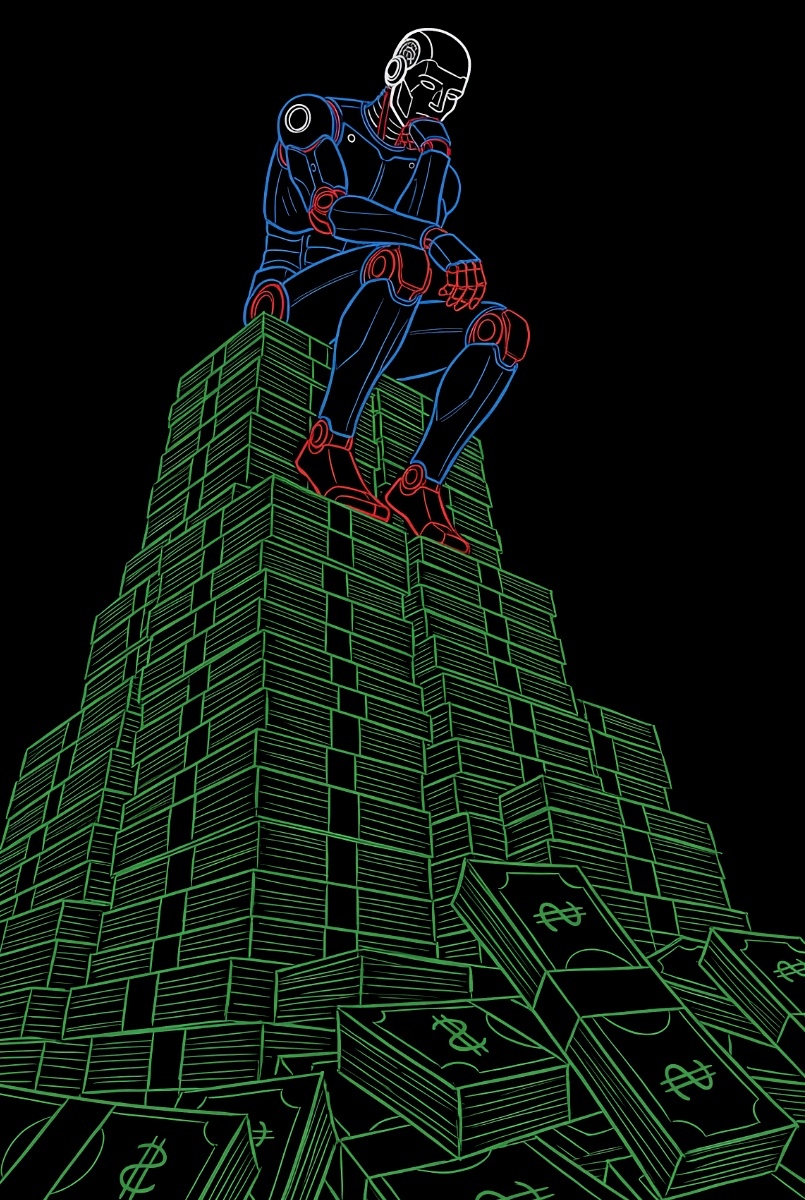
Long-lasting success is still to be found underneath the surface for those who recognise all the pillars holding AI up. There are many layers in this cake where AI is the cherry on top.
But what about long-lasting failure? In a recent book by Eliezer Yudkowsky and Nate Soares, they make a scary prediction:
"If any company or group, anywhere on the planet, builds an artificial superintelligence using anything remotely like current techniques, based on anything remotely like the present understanding of AI, then everyone, everywhere on Earth, will die."
How sure can we be that this form of intelligence may soon be teaching itself to become so superior that it will end humanity as we know it? Is that the primary threat as AI drives forward or are humans still very much in the loop? How big is the problem of AI alignment in comparison with human alignment?
We know at least that current machine learning technology can already accelerate a lot of dangerous human behaviours:
- engineered pandemics
- widespread disinformation
- large-scale manipulation of individuals, including children
- national and international security concerns
- mass unemployment
- systematic human rights violations
This list comes from a "Global Call for AI Red Lines" signed in the 80th session of the United Nations General Assembly. If we follow the news, we already know that not only are some of these already happening, but also that the list is incomplete. We can find real cases of AI being employed for automatic price fixing, refusing insurance claims, optimising war crimes, or degrading customer support and content moderation.
It should be clear to everyone (but for those that profit otherwise) how AI can be an opportunity if we keep our hands on the wheel, or a problem if we let it drive to wherever the owners of each road want to take us. On top of that, we can make predictions about some impending human extinction, but maybe that potential risk should take a backseat to the actual risks harming people right now.
AI isn't a magical isolated entity that's so unlike all the other tech that blame can't possibly be put on anyone. It's like the opposite of cryptography since large language models mathematically can't be trusted, but as we've learned from gambling, the house always wins. As AI can't stand on its own, responsibility for its actions should be assigned to those holding its puppet strings made of probabilities.