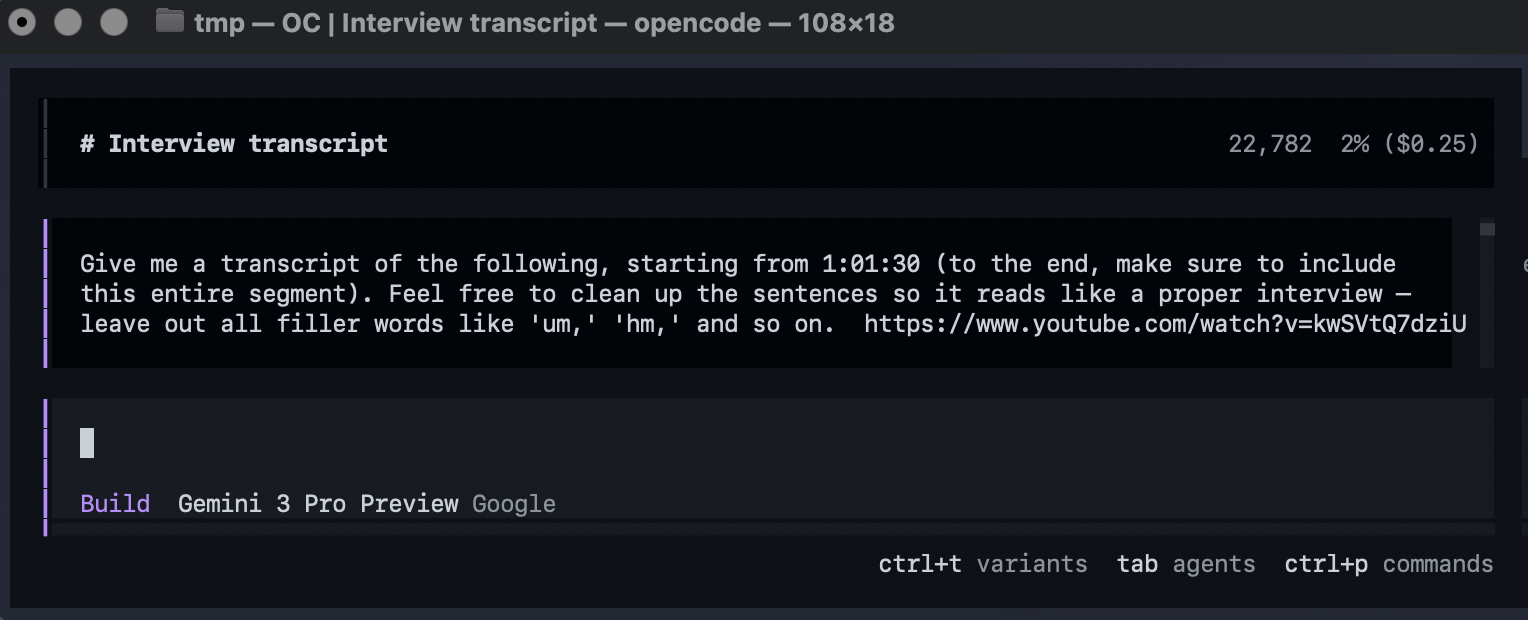
I just listened to this No Priors podcast with Andrej Karpathy and there are a few interesting things mentioned about the future of education. I used my OpenCode agent with Gemini 3 Pro to get the transcript (slightly paraphrased). It was cool that it managed to figure it out very quickly.
Here is the transcript for the part where they talked about the future of education. I highlighted the part I found most interesting.
Interviewer: I want to talk about a tiny side project you have before we end. Tell me about microGPT.
Andrej Karpathy: Oh, yeah. So, microGPT. I have this running obsession spanning maybe a decade or two of simplifying and boiling down LLMs to their bare essence. I've had a number of projects along these lines, like nanoGPT, makemore, and micrograd. I feel microGPT is now the state-of-the-art of me trying to boil it down to just the essence.
The thing is, training neural nets and LLMs specifically involves a huge amount of code, but all of that code is actually complexity from efficiency. It's just because you need it to go fast. If you don't need it to go fast and you just care about the algorithm, then that algorithm is actually 200 lines of Python. It's very simple to read, and this includes comments and everything.
You just have your dataset, which is text, and your neural network architecture, which is about 50 lines. You need to do your forward pass, and then you have to do your backward pass to calculate the gradients. A little autograd engine to calculate those gradients is 100 lines. Then you need an optimizer; Adam, for example, which is a state-of-the-art optimizer, is really just 10 lines. Putting everything together in a training loop is about 200 lines.
Normally—maybe a year ago or more—if I had come up with microGPT, I would be tempted to explain it to people. I'd have a video stepping through it or create a little guide. I actually tried to make that video and a guide, but I realized it wasn't really adding too much. Because it's already so simple at 200 lines, anyone could ask their AI agent to explain it in various ways. I'm not explaining to people anymore; I'm explaining it to agents. If you can explain it to agents, then agents can act as the router. They can target the explanation to the human in their own language with infinite patience, tailored to their exact capability.
Interviewer: Right. If I don't understand a particular function, I can ask the agent to explain it to me three different ways, and I'm not going to get that from you.
Andrej Karpathy: Exactly. So I feel like, what is education? It used to be guides, lectures, and other similar things. Now I'm explaining things to agents more, and maybe I'm coming up with "skills." A skill is just a way to instruct the agent on how to teach a concept. I could have a skill for microGPT outlining the progression I imagine the agent should take you through if you're interested in understanding the codebase. It provides hints to the model, like, "First start off with this, and then proceed with that." I could just script the curriculum a little bit as a skill.
I feel there's going to be less explaining things directly to people, and it's going to be more about whether the agent gets it. If the agent gets it, they'll do the explanation. We're not fully there yet; I still think I can probably explain things a little bit better than the agents, but the models are improving so rapidly that it feels like a losing battle to some extent.
Education is going to be reshuffled by this quite substantially. It's almost the end of teaching each other things directly. If I have a library of code, it used to be that you'd write documentation for human users. But you shouldn't do that anymore; instead of HTML documents for humans, you have Markdown documents for agents. If agents get it, they can explain all the different parts. It's this redirection through agents, and I think we're going to see a lot more of that playing out.
Interviewer: We'll see if the great teachers learn to develop intuition for how to explain things to agents differently.
Andrej Karpathy: Ultimately, yes. For example, with microGPT, I actually tried to get an agent to write it. I told it to boil down neural networking to the absolute simplest thing, and it couldn't do it. MicroGPT is the culmination of my obsession. It's those exact 200 lines. I thought about this for a long time; this is the solution, and trust me, it can't get simpler. That is my value add. Everything else, the agent gets.
It just couldn't come up with it from scratch, but it totally gets it and understands why it's done in a certain way. My contribution is these few specific bits, but everything else in terms of the education that follows is not my domain anymore. Education changes in those ways; you have to infuse the few bits that you feel strongly about regarding the curriculum or the best way of explaining it. The things agents can't do is your job now. The things agents can do, they can probably do better than you—or very soon will be able to. So you should be strategic about what you're actually spending time on.
Interviewer: Well, we appreciate those few things. Thank you, Andrej.
Andrej Karpathy: Okay.
Outro: Find us on Twitter at NoPriorsPod. Subscribe to our YouTube channel if you want to see our faces. Follow the show on Apple Podcasts, Spotify, or wherever you listen so you get a new episode every week. And sign up for emails or find transcripts for every episode at no-priors.com.