There is a bet running through the markets right now. You can see it in the share prices — data centres, cloud, semiconductors, and increasingly software, all moving on a logic that has stopped being about earnings and started being about faith.
The bet is simple to state: this innovation will deliver a productivity increase large enough to absorb the extraordinary rise in public debt being used to finance it.
That is the whole argument. Everything else is detail.
The numbers we are betting against
Global GDP is around $126 trillion, of which roughly $30 trillion is the United States. Global public debt sits near $115 trillion and is forecast to cross the size of the world economy itself.
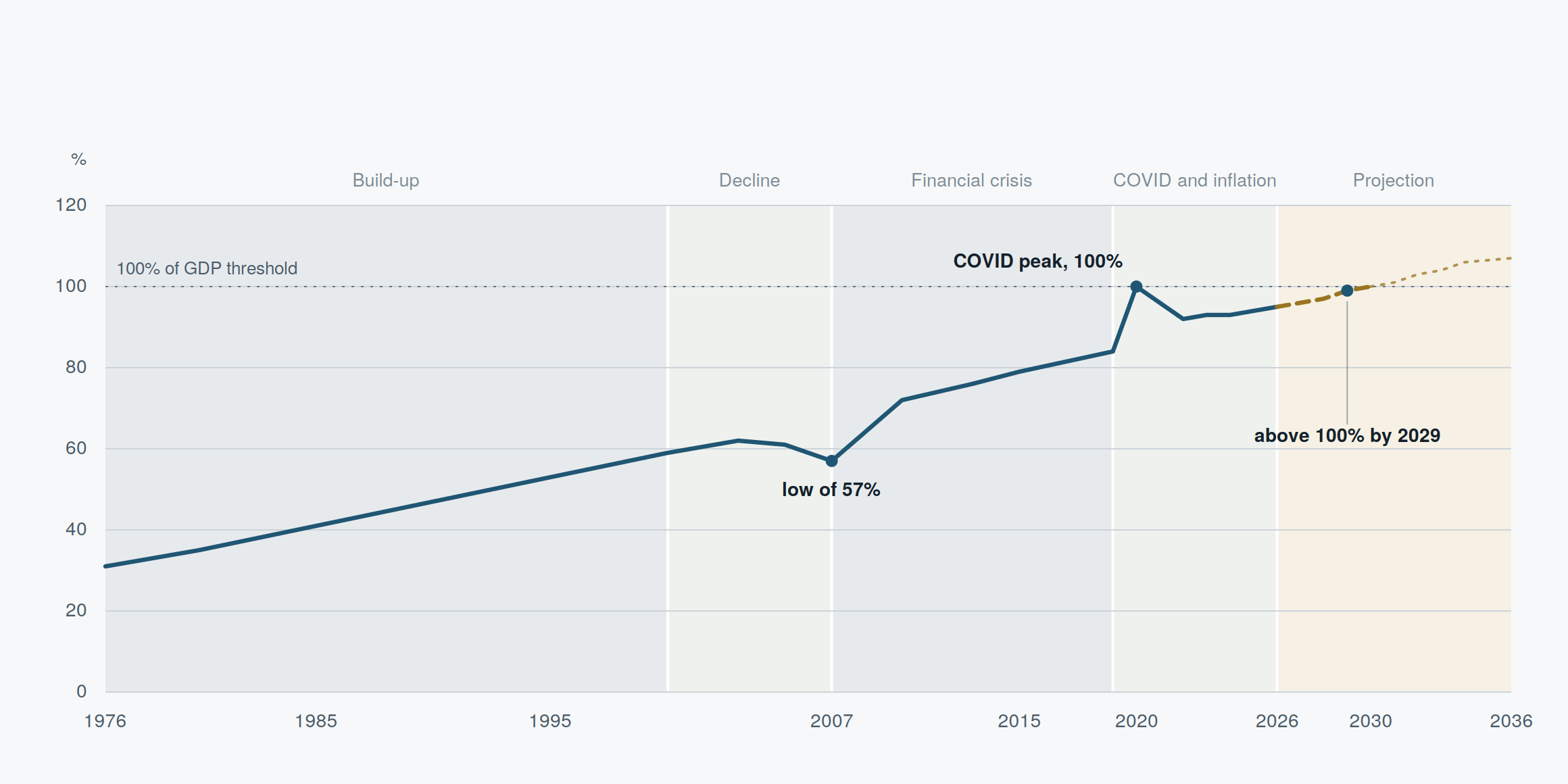
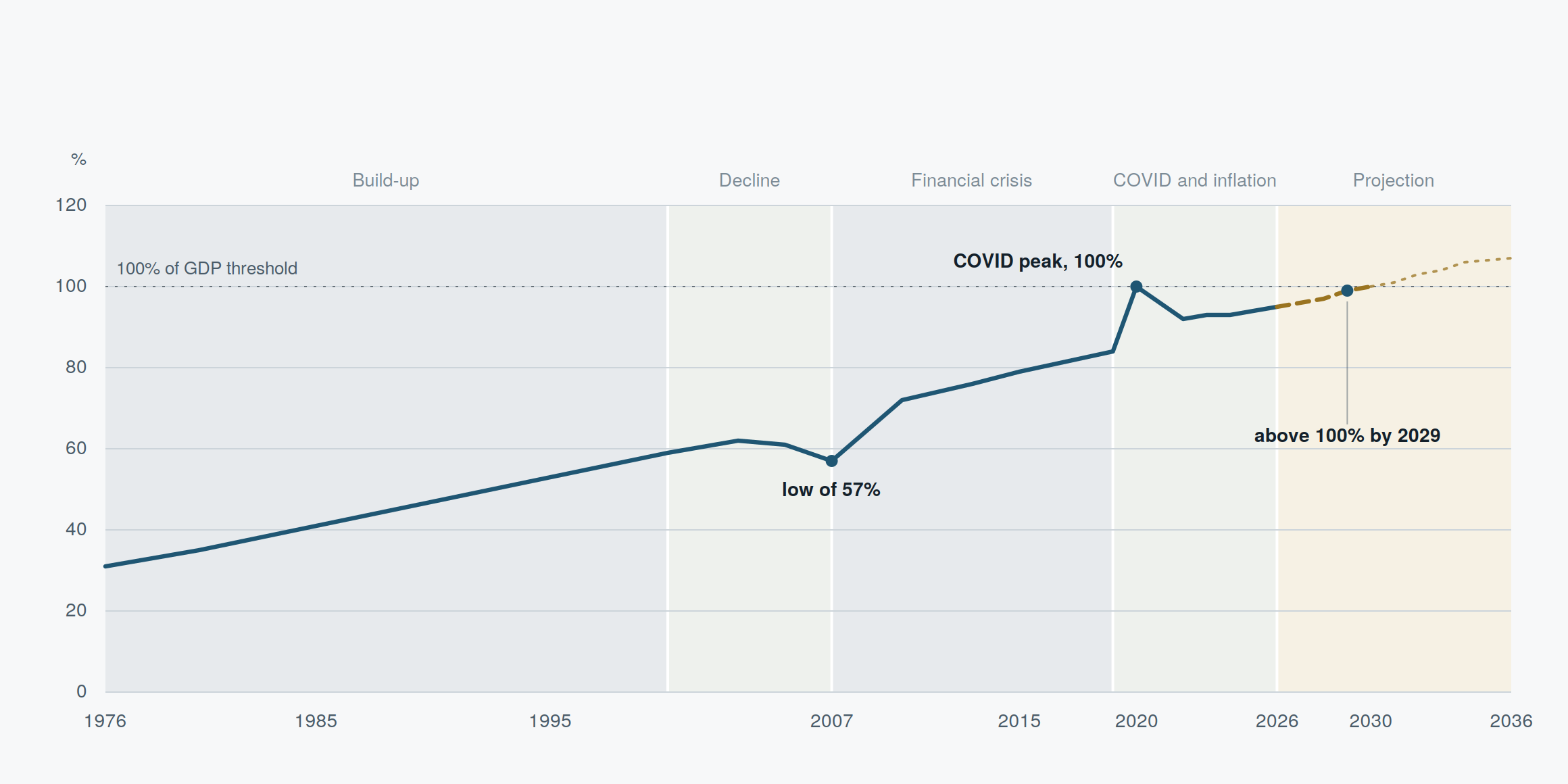
The US is further along than most. Debt-to-GDP is around 125% today, with credible paths to 140% or 160%. GDP is growing between 2% and 3%, but the deficit for this year is running at 6% — which means the debt is compounding faster than the economy that has to service it. That is not a cyclical problem. That is a structural one.
The cost is already visible. Net interest for fiscal 2026 is projected at roughly $1 trillion. Interest now consumes about 14% of federal spending. The average rate on the debt is 3.4%, but new issuance is priced at today's market: Treasuries near 4.8%, with the 10-year plausibly heading above 5%.
That gap between 3.4% and 5% is the whole refinancing problem in one number.
The logic of the bet
Debt sustainability comes down to one relationship: the real interest rate versus real growth.
The real rate is what you pay for money minus inflation. If a country grows faster than that, the debt-to-GDP ratio can reabsorb itself — it shrinks without anyone having to cut anything. This is how the post-war generation dealt with debt levels higher than today's.
AI fits neatly into that frame. Raise productivity and you raise GDP against the same invested capital. More output, same capital, better ratio. Problem solved.
Why it is harder than that
The flaw is that the real rate and growth are not independent variables.
The moment productivity rises, the expected return on capital rises with it — and interest rates follow. We are watching this happen in real time. One of the reasons Treasury yields are climbing is precisely that tech equity is delivering extraordinary returns and extraordinary profits. The market simply repriced what it expects to earn everywhere else.
So the honest question is not "will AI grow the economy?" It is: **will growth accelerate faster than rates rise?** That is a much narrower bet, and a much less comfortable one.
Two studies worth reading
Yale Budget Lab (May 2026) and a Brookings/Fed paper (July 2026) both modelled this, and both surface findings that are genuinely counterintuitive.
Labour displacement cancels the fiscal gain. Higher productivity produces a fiscal surplus — but if it also produces job losses, the government response determines the outcome. And the response should be support: that is what a state owes a population it has displaced. Which means the fiscal gain gets spent before it lands.
Longevity is a fiscal cost. This is the one that took me longest to accept. AI is already transforming healthcare, and that impact will extend healthspan and lifespan both. That is unambiguously good. It is also unambiguously expensive: a longer life is more retired years, and an average American retiree costs the state around $42,000 per year. The health dividend eats the growth dividend.
Two of the most attractive consequences of the technology quietly work against the fiscal case for it.
What I actually think
The productivity gain is real. I see it in my own work, and the mechanism is straightforward: you get more done in a year.
But it does what every technology shift does — it moves cost rather than removing it. You work differently, you move faster, you deploy capital and people in a different shape than before. Costs migrate into areas that were marginal or did not exist at all. We saw exactly this with the web. We are seeing it again.
On employment, I am more optimistic than most. I do not believe this leads to lower employment rates, at least not now. It certainly is not happening yet — the US has rarely seen employment conditions as tight as these.
So my expectation is: productivity rises, and costs rise alongside it.
Which puts the weight back where it always was — on fiscal policy. And that is the part that worries me, because the fundamentals are not on the table for most governments. Cutting public spending remains politically untouchable. So does any serious reconsideration of healthcare, or of what the state provides its population. The conversation that would actually resolve this is the one nobody wants to have.
The bet, stated plainly
Look at the 6% US deficit for 2026. The bet is that it gets absorbed by rising productivity — higher tax revenue, a higher-quality workforce, all of it against a population that is ageing.
That is a hell of a bet.
I hope it works, because the alternatives have not. Tariffs did nothing: the deficit stayed exactly as wide as you like. Which means the US, and frankly the rest of the world pulled along with it, is all-in on AI and on this single wager.
We are not hedging. We are just hoping the productivity arrives faster than the interest bill.