Growth, Demography, and the Silent Crisis Behind the Numbers
Yesterday I was reading a great article on FT about birth rates decline. And I learned something I really didn't know.
Why am I interested in birth rates? Because I’m interested in growth. And there is probably no macroeconomic variable more important than demographics when trying to forecast the future trajectory of countries and economies.
GDP growth, consumption, housing demand, pension sustainability, labor markets, innovation capacity, military strength, healthcare systems — everything ultimately rests on people. On how many are born, how many work, how many age, and how societies evolve across generations.
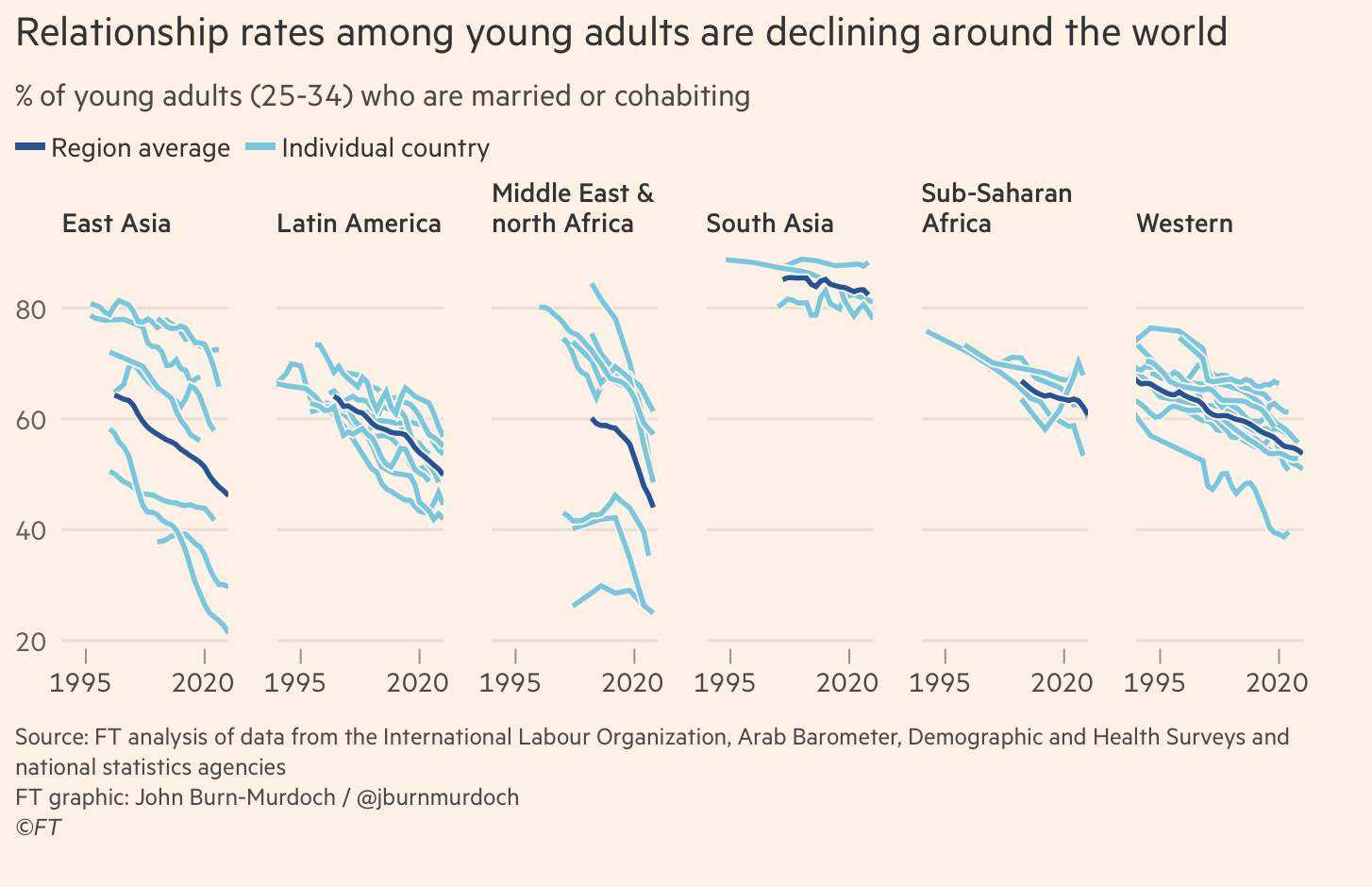
For years, many assumed declining fertility was mainly a Western (and Chinese) problem. A phenomenon linked to wealthy countries becoming more individualistic and less family-oriented. But the reality is much bigger and much more global.
Birth rates are collapsing almost everywhere. And I was shocked when I read it!
Let's see why.
Countries across Asia, Latin America, Europe, and even parts of the Middle East are now far below the replacement rate of 2.1 children per woman needed to maintain population stability. In some countries the decline has become dramatic. Mexico, for example, now has fertility rates below the United States. East Asia is facing an even steeper demographic cliff.
And this is where the topic becomes fascinating — and also deeply concerning.
Because the explanation is not simply “economic difficulty.”
If that were the case, richer countries would have more children once prosperity increased. Yet many wealthy societies continue to see fertility collapse despite higher living standards than previous generations ever experienced.
What seems to be changing is something deeper: the relationship between humans, time, ambition, relationships, and digital life.
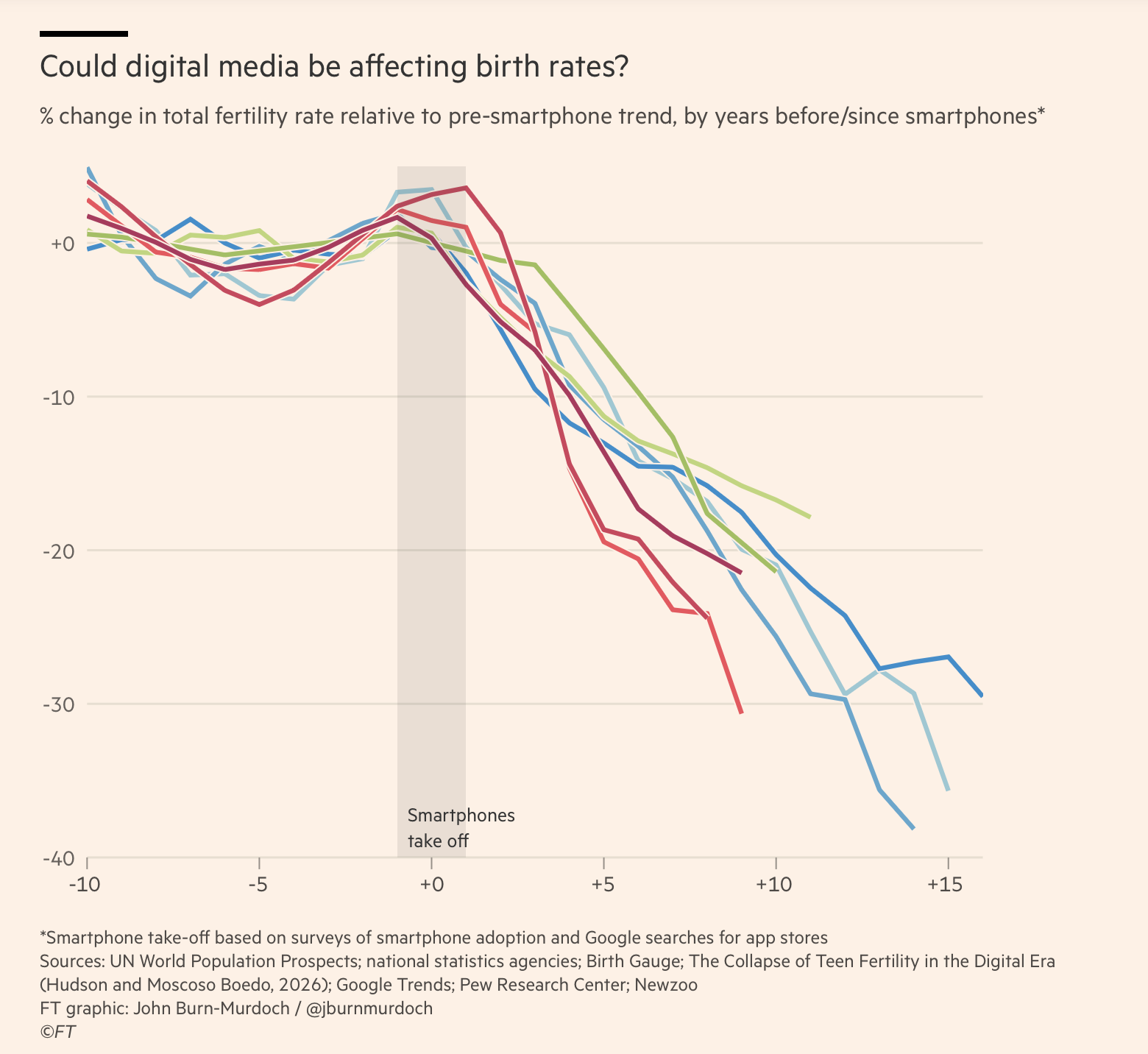
One of the most interesting observations I found is the correlation between the explosion of digital consumption — especially after the spread of 4G and social media platforms — and the acceleration of fertility decline globally.
Many say that young people don't interact anymore, face to face and the article is focusing on it as well. I don't completely agree. Young people interact even too much. Social interaction did not disappear. It migrated online. And it's MASSIVE. What changed are the ambitions and expectations.
They become artificially amplified. Everyone is constantly exposed to unrealistic standards of beauty, success, wealth, lifestyle, and personal achievement. Commitment starts to feel like limitation. Stability feels like giving up optionality. What in my opinion block young people to engage in a relationship is the FOMO, the Fear of Missing Out opportunities. The sliding doors.
And family creation inherently requires the opposite mindset
commitment,
sacrifice,
acceptance of imperfection,
long-term thinking,
and the a choice!
People postpone decisions because they fear closing doors. But life itself only progresses through the courage to close some doors in order to fully open others.
Ironically, this pursuit of unlimited possibilities often generates the opposite outcome: paralysis, loneliness, and dissatisfaction.
There is also another dimension we rarely discuss enough: time scarcity.
Modern professionals constantly feel overwhelmed. Work, notifications, social pressure, self-improvement, performance anxiety, endless digital stimulation. Many people simply feel they do not have the emotional or cognitive space to build a family.
This is where AI creates an interesting paradox.
Artificial intelligence and automation could eventually free humanity from enormous amounts of repetitive work. They may give us back time — which is perhaps the scarcest resource of our era.
If extra time simply becomes more passive digital consumption, more comparison, more isolation, and more immersion in synthetic realities, the problem may worsen.
But if technology helps us reconnect with what is real — health, nature, relationships, family, community, meaning — then perhaps AI could unexpectedly help rebalance society rather than fragment it further.
Maybe the future competitive advantage of countries will not only depend on AI infrastructure, energy, or productivity. Maybe it will also depend on whether societies can preserve human connection, trust, and the desire to build the next generation.