I Never Understood Stablecoins. Until Now. And Wow.
I'll be honest. Every time someone mentioned USDT, Tether or stablecoins, my brain switched off. I grouped it with Bitcoin, crypto, speculation. I thought: if you want dollars, just hold dollars. What's the point of a digital copy?
Then I started digging. The trigger was a remarkable interview that Guido Maria Brera and Silvia Berzoni did on Black Box (a fantastic Italian podcast about finance by Chora Media), with the CEO of Tether — a deep, honest conversation that finally made the whole thing click. From there I fell down the rabbit hole: more interviews on YouTube, articles, data. Worth noting on the Chora angle: Tether holds a ~30% stake in Be Water, the holding company that controls Chora Media, and both Tether's founders are personal shareholders alongside Brera. Make of that what you will — but the interview stands on its own merits.
What it led me to was the story of two Italians who launched the stablecoin and turned it into arguably the most profitable company per employee on the planet. Giancarlo Devasini, a former plastic surgeon from Turin who is now the richest person in Italy, and Paolo Ardoino, a computer scientist from Savona who leads the company as CEO. Between them, they built something that generated over $13 billion in profit in 2024 alone, with fewer than 200 employees — roughly $85 million per person, dwarfing Goldman Sachs, Apple, and Nvidia. That question — how? — is what finally made me understand what Tether actually is.
It also revealed my blind spot. I was thinking like someone who lives in Singapore, with a multi-currency bank account, great financial infrastructure, and the freedom to hold whatever currency I want. Most of the world doesn't have that.
The problem Tether (and stable coins) actually solves
Imagine you're in Argentina, Nigeria, or Turkey... Your salary comes in local currency. That currency is losing value — 20%, 40%, 80% against the dollar in just a few years. You want to protect yourself by converting to dollars.
In Argentina and Nigeria, you often simply can't. Capital controls block it, or the official rate is so punishing that the black market becomes your only real option — and the black market takes its commission. In Turkey, the government spent years engineering financial incentives to actively steer citizens away from holding foreign currency, while inflation ran above 80% at its peak. You can technically open a dollar account, but the system was built to discourage it.
Ardoino cited the numbers: the Turkish lira lost over 81% of its value against the dollar in five years, the Venezuelan bolivar 99.8%, the Argentine peso 94.5%. The lira has continued sliding into 2026.
That's the real problem. And Tether is the solution.
You convert your lira, your pesos, your naira into USDT — a token pegged 1:1 to the US dollar — through a local exchange or even a corner shop. Instantly, your savings are denominated in the world's reserve currency. No bank account in USD required. No Western Union. No waiting. No permission from your government.
One of Tether's team members landed in Bolivia, walked into a random shop, and found all the prices on the shelves denominated in USDT. Not dollars. Not the local boliviano. USDT. The President of Bolivia's Central Bank later confirmed it: USDT had quietly become the country's de facto legal tender.
That's not a crypto story. That's a financial infrastructure story.
What people actually use it for
When I started going deeper, one thing that kept surprising me was how many different problems USDT solves — and how unrelated most of them are to crypto trading.
1. The savings account you were never offered
In Argentina, USDT is not your spending account — the peso still handles daily life. USDT is your savings account. The place you park value so it doesn't evaporate. A digital mattress that actually holds its shape. No bank appointment, no paperwork, no government permission. You convert, and you're protected.
2. Remittances: the most human use case
If you work in the US and send money home to the Philippines, Nigeria, or Mexico, Western Union or MoneyGram take between 6% and 26% of what you send. One day of your working week, gone, to a middleman. With USDT the fee is effectively zero. The money arrives in seconds. This alone is already revolutionary for hundreds of millions of families — and Tether's user base is growing by 30 million people per quarter.
3. Where the banking system stopped working
Commodity traders moving oil, gas, and food into countries like Bolivia, El Salvador, Honduras — countries where the banking system no longer moves dollars. Where a SWIFT wire from Europe simply doesn't arrive. These traders switched to USDT years ago because it was the only thing that worked. Nobody sold it to them. They just showed up.
4. The tech frontier: AI agents
If you have billions of AI agents transacting autonomously, they can't have a JP Morgan account or a credit card. They need programmable money. Money that moves like code. USDT is already that — and the demand hasn't even started yet.
The business model is almost offensively simple
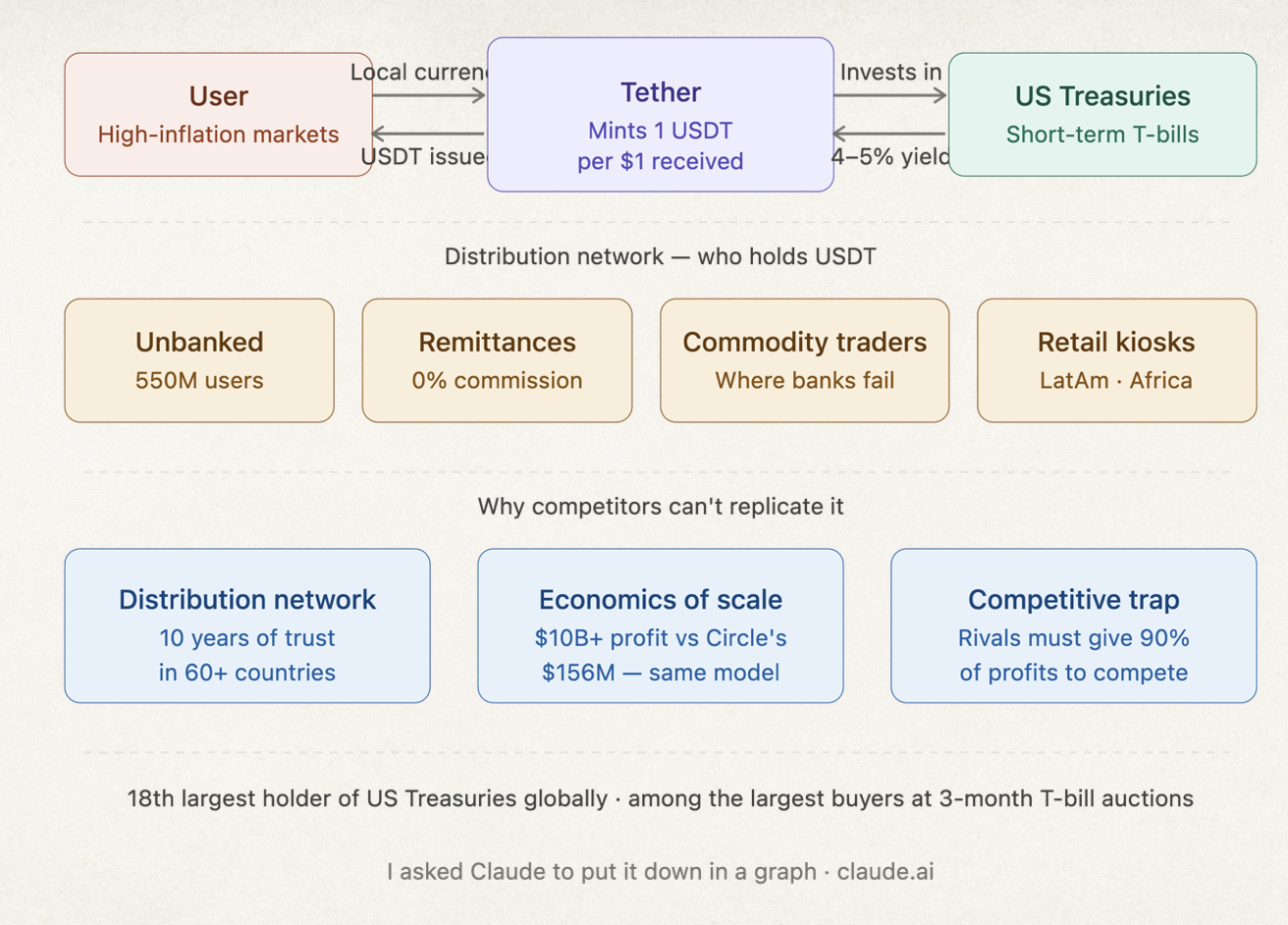
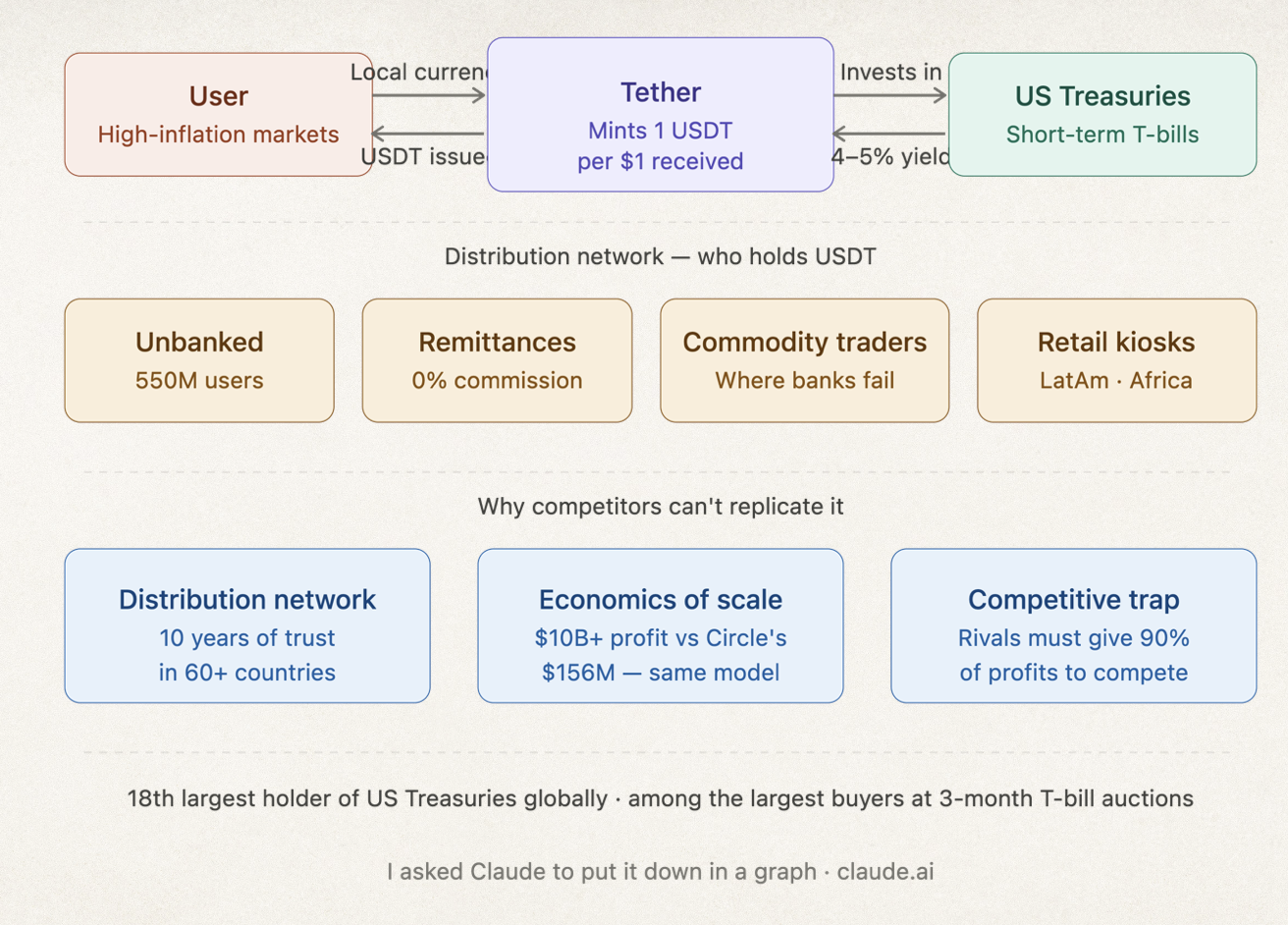
Here's where it gets genuinely beautiful. When someone gives Tether $1 to mint 1 USDT, Tether takes that dollar and invests it in short-term US Treasury bills — with total exposure now exceeding $141 billion. These are among the safest instruments on earth, and have been yielding between 4% and 5% annually in recent years. The liability is the USDT issued. The user gets their dollar-equivalent token. Tether keeps the interest.
The numbers are extraordinary. $13 billion in profit in 2024. $5.7 billion in just the first half of 2025. Over $10 billion for the full year 2025. Fewer than 200 employees. No credit risk. No loan defaults. The only scenario that breaks the model is a US government default.
For comparison: Circle, the second-largest stablecoin issuer, made $156 million in net profit for the entire year 2024. Less than five days of profit at Tether's pace. Same model, same assets. The difference isn't the product. It's the distribution network.
Why it's nearly impossible to copy
To compete with Tether on user acquisition, rivals must hand over the bulk of their economics to distribution partners. Circle's own S-1 filing revealed it paid Coinbase $908 million in distribution fees in 2024 alone — on total revenue of $1.7 billion. More than half of everything earned, gone before the lights are on. You'd kill your economics before you even got started.
Tether's moat is the network they've spent over a decade building: 550 million users across 60+ countries, tens of thousands of point-of-sale locations across Latin America, kiosks in African villages, and commodity traders using USDT to pay suppliers in countries where dollar wire transfers simply don't arrive anymore. Global commodities settled in Tether because the traditional banking system has effectively stopped working in certain corridors.
They didn't just create a token. They built the most extensive dollar distribution network in history, reaching people JP Morgan has no interest in serving, in places where the formal financial system gave up.
Tether is now the 18th largest holder of US Treasuries in the world, and among the largest buyers at 3-month T-bill auctions — paradoxically one of the most important buyers of US government debt, purchasing what China and others are selling.
The audit question — finally moving
For years, Tether's most persistent vulnerability was the lack of a full independent audit. In March 2026, that changed. A Big Four accounting firm has been formally engaged for the first full financial statement audit in the company's history. The firm hasn't been named, the work isn't complete. But there's no way out now — the US GENIUS Act, signed in July 2025, mandates annual audits for stablecoin issuers above $50 billion in circulation. At $186 billion, Tether has no choice. The audit is happening.
What I keep coming back to
I started this as someone who changed the subject every time stablecoins came up. I end it convinced that Tether is one of the most important financial stories of our time — hiding in plain sight behind a name that sounds weird and a product most people confuse with Bitcoin.
The US dollar is America's most powerful export. Not its military, not its technology. The dollar. And two Italians built the most effective system ever created to distribute it to the 550 million people who need it most. People that banks don't want. People in places finance forgot.
This is not crypto. This is infrastructure. It's about financial inclusivity — and it's built around the jewel in the crown of the US economy: the 💵.