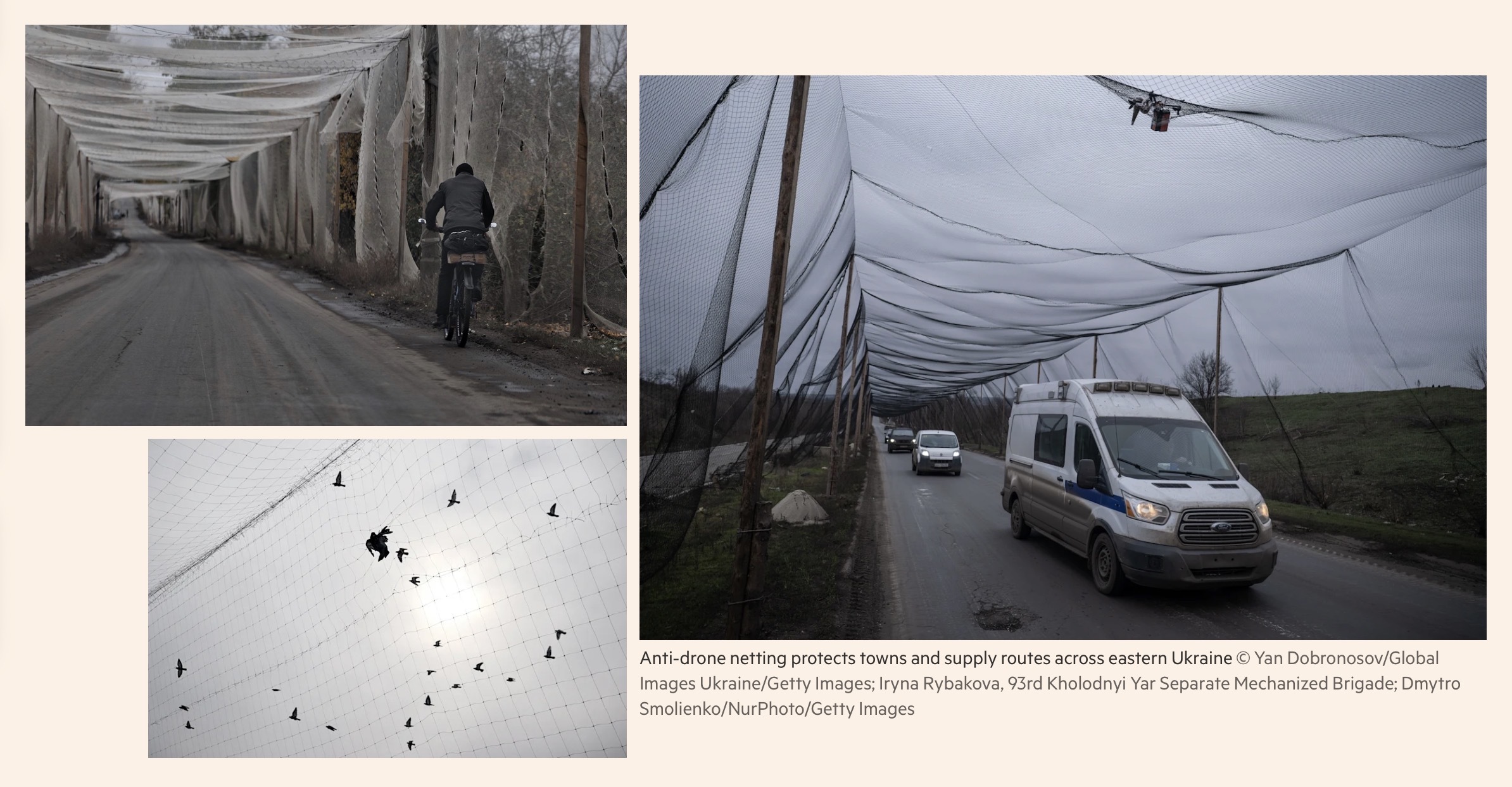
The Financial Times report on the “kill zone” in Ukraine is deeply impressive. It describes a battle fought to protect oneself from drones — by attacking with drones.
Who would have imagined that flying objects originally designed to take photos would end up replacing jets, marines, and tanks?
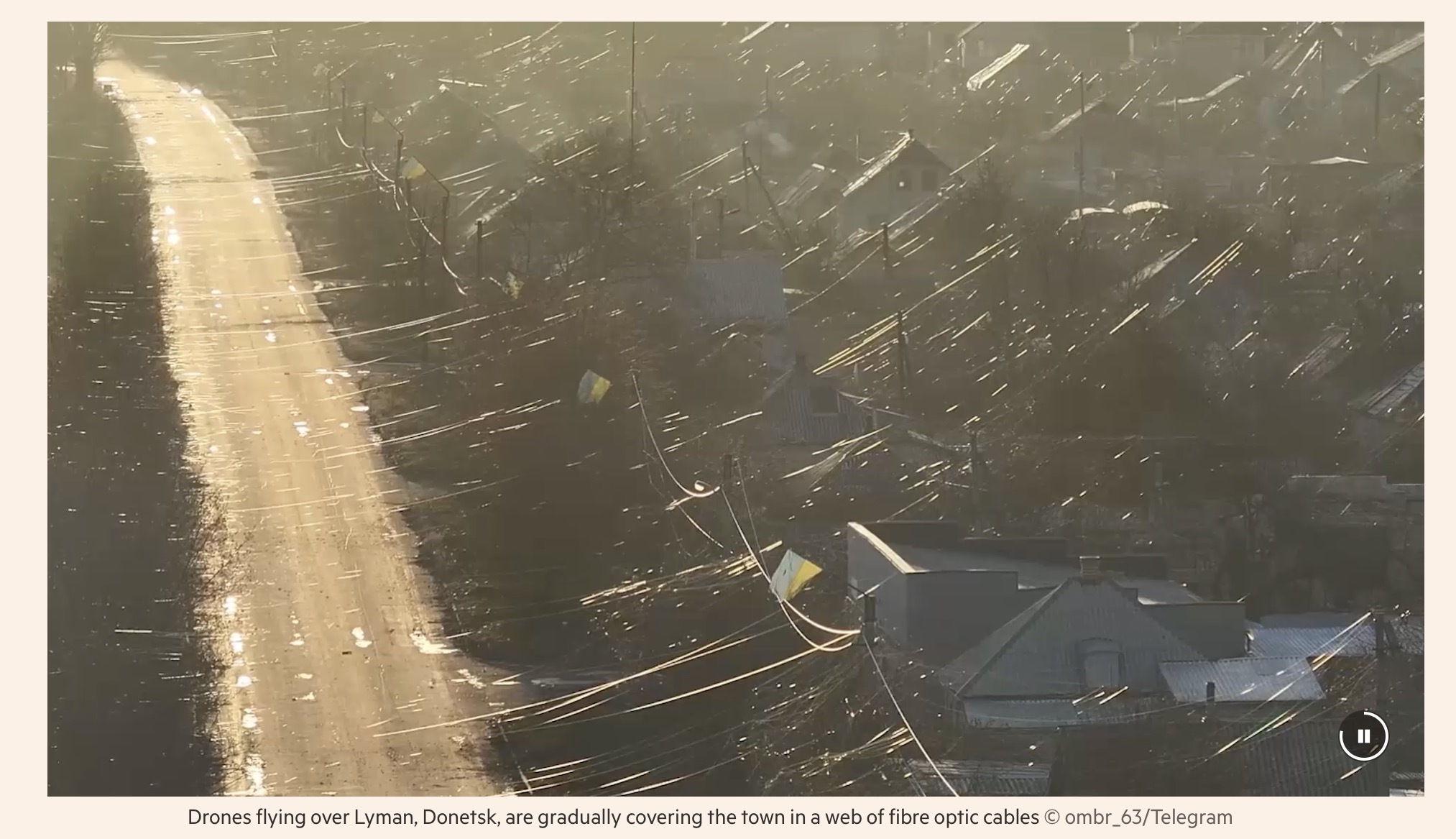
What strikes me most is the massive use of rudimentary protection systems, such as the nets covering entire areas in Kherson. At the same time, to avoid radio interference and jamming, drones are increasingly connected to kilometers of fiber optic cable. Wired drones. Entire cities slowly becoming covered in strands of fiber left behind by their flight paths.
This is warfare driven entirely by data — and by immediate response to data.
Drones monitor the movement of people and vehicles from above. If something moves, ground-based drones — positioned like modern dynamic mines — or high-speed FPV drones launched from rear positions attack almost instantly. The result is chilling: at the front, nobody moves freely anymore. Movement happens meter by meter.
The OODA loop — observe, orient, decide, act — has collapsed into seconds.
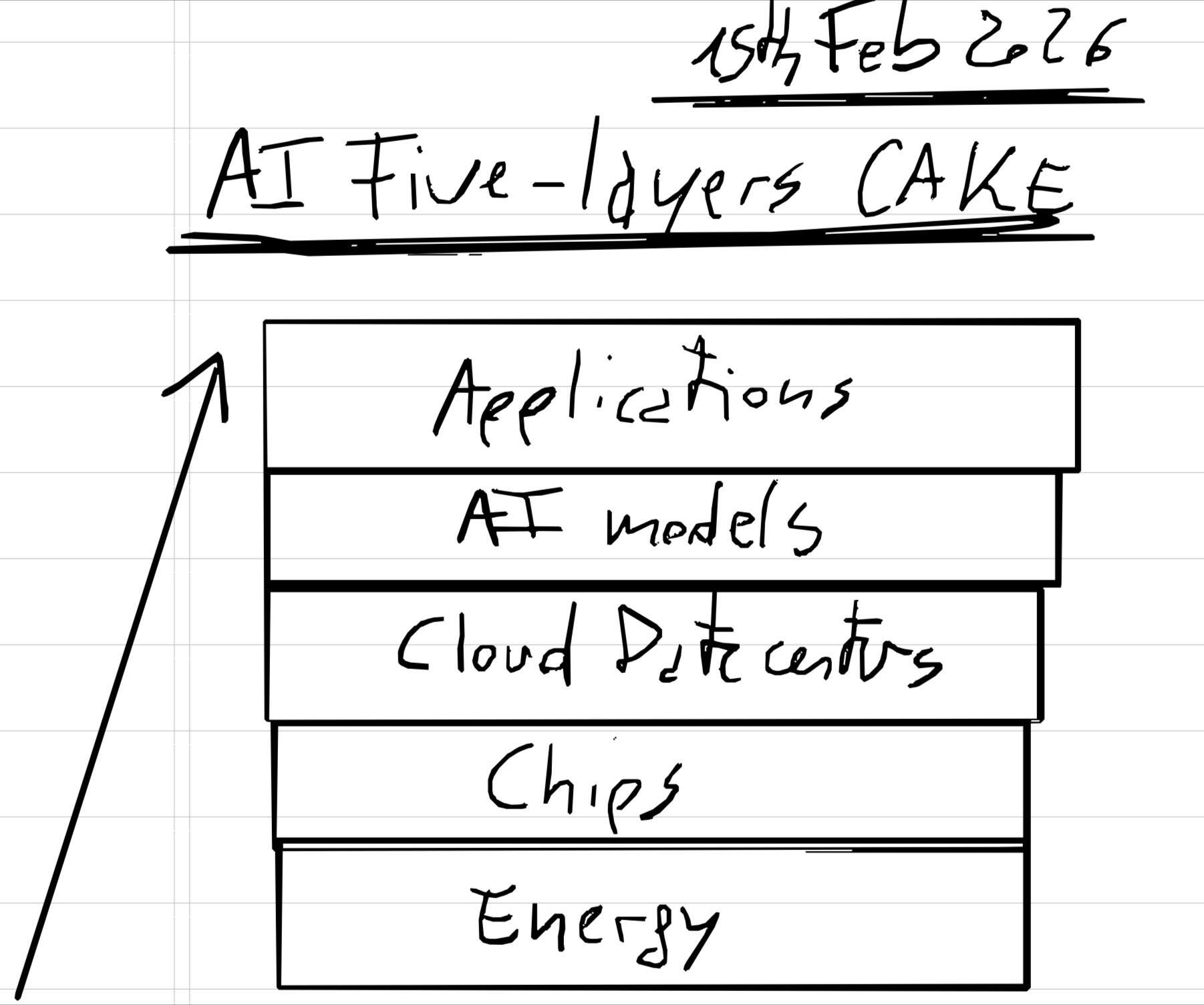
In Davos, Jensen Huang, CEO of NVIDIA, described AI as a five-layer cake: energy, chips, cloud data centers, AI models, and finally applications.
The real value, he said, is not in the first four layers. It is in the fifth — applications.
And here is the uncomfortable truth: many of the most impactful AI applications will serve military purposes.
Speed in provisioning data, processing it, generating feedback, analyzing it, and acting on it makes a difference everywhere — but in war, it makes the difference between survival and destruction.
This is not simply a question of whether there is an AI bubble.
It is a matter of life or death.
As of February 2026, the total value of signed but not yet deliverable contracts between AI application companies and cloud computing vendors such as NVIDIA, Microsoft, and Amazon stands at around $1.6 trillion (Bloomberg). An enormous and growing backlog.
This backlog exists for two structural reasons.
Either vendors do not yet have the capacity to deliver additional volume — which explains the massive global investments in data centers, energy infrastructure, and advanced cooling systems — or clients do not yet have sufficient demand today, but are securing capacity because they expect to need it tomorrow.
In 2026, only a fraction of this backlog will actually be fulfilled.
Many observers call it a bubble. Perhaps part of it is. Infrastructure cycles often overshoot.
But to truly understand whether this is excess or inevitability, we must understand where the defense industry is heading — and how AI applications will serve it.
Modern warfare is sensor-driven, data-driven, model-driven. It rewards whoever compresses the decision cycle the most. In such a world, compute capacity is not a luxury. It is strategic infrastructure.
This is not the most comfortable side of technological progress to contemplate. But it is reality.
At least we are in a position to discuss it — instead of living under a wired net.