People keep asking me how Asia is holding up. How are businesses reacting to the closure of the Strait of Hormuz? What are the effects on the ground?
My honest answer, for now, is: it is quiet. Almost suspiciously quiet.
But having spent the past weeks traveling in the region from Singapore to HK, Japan, Indonesia, Vietnam, and reading this week's Economist cover piece on the arithmetic of the crisis, I can say with growing confidence that this is not calm — it is the calm before the storm.
The Numbers Don't Lie
Let us start with the fundamentals, because the math here is both simple and brutal.
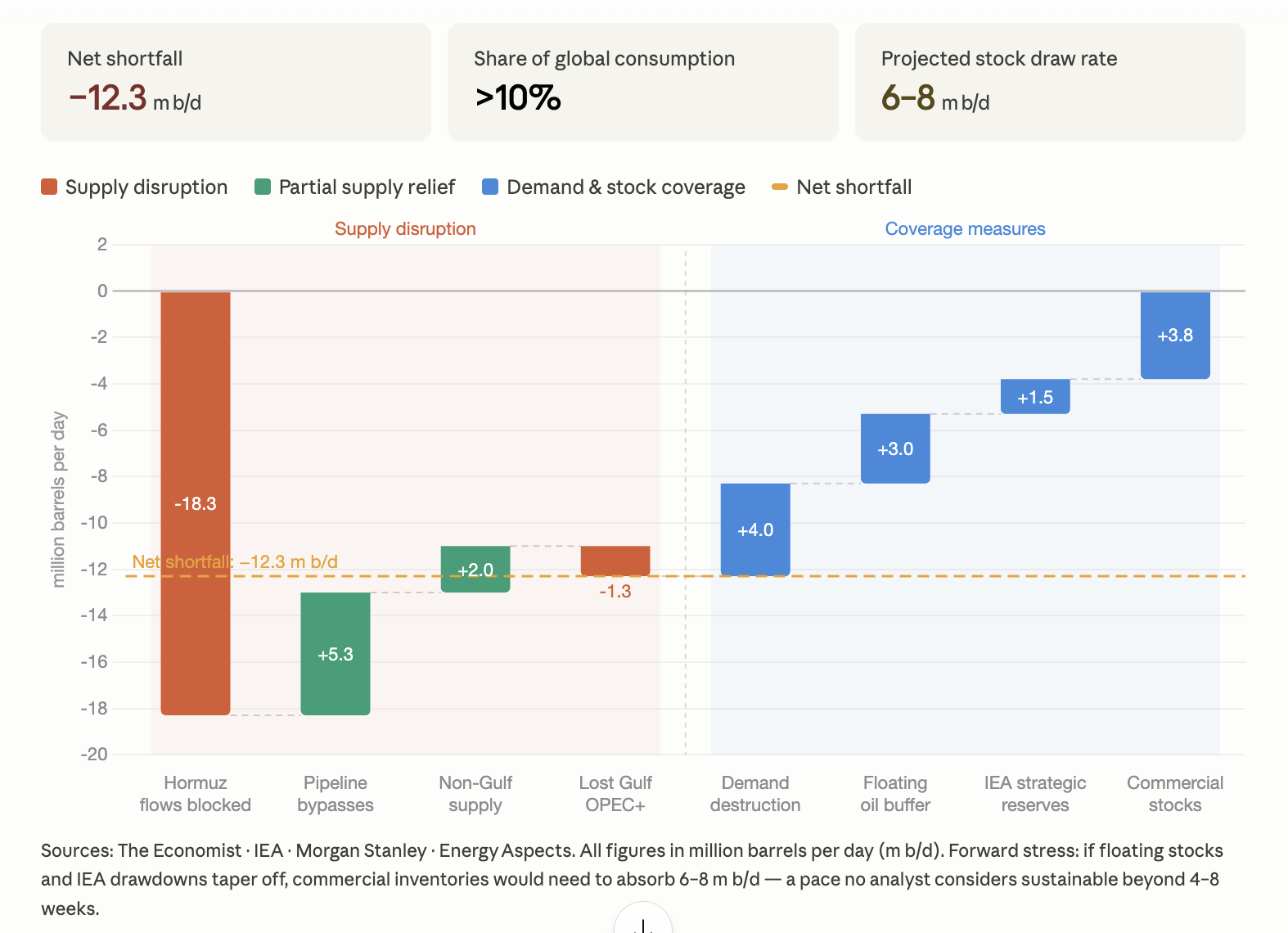
The Strait of Hormuz carries roughly 18.3 million barrels per day of crude and refined products — around 18% of global supply. When you account for two bypass pipelines running through the UAE and Saudi Arabia, and for the fact that the Gulf economies themselves are now half-frozen and consuming less, you can chip away at that number. But even after all adjustments, the net shortfall from the blockade sits at approximately 12.3 million barrels per day. That is more than 10% of total global consumption, gone from the market overnight.
To put that in perspective of the beautiful Economist article: the world has never engineered a supply interruption of this scale outside of a world war.
I asked Claude to create a waterfall graph to see the crude numbers visually:
How Markets Are Holding — For Now
The market is not collapsing today because three temporary buffers are filling the gap (see blue in my graph)
First, demand destruction. Factories across Asia — particularly in petrochemicals — have sharply reduced output. Asian plants that process naphtha into plastics are running at 60 to 75% capacity. Some have shut entirely. Airlines in the Middle East have cut traffic by two-thirds. This reduces demand by an estimated 3 to 5 million barrels per day, and every barrel not consumed is a barrel not needed.
Second, the floating oil buffer. Gulf producers, sensing the coming storm, had ramped up exports in the weeks before the conflict. Large volumes of Iranian and Russian crude were also caught on tankers due to tightening Western sanctions, since partly loosened. This seaborne reservoir has been providing an estimated 3 million barrels per day since early March.
Third, strategic reserves. The International Energy Agency coordinated the largest emergency drawdown in its history — 400 million barrels from member states' strategic stores, equivalent to one-third of their total reserves.
Together, these three mechanisms are covering much of the 12.3 million barrel shortfall. On paper, the market balances. In practice, the situation is far more fragile than the surface quiet suggests.
You Cannot Substitute a Flow with a Stock
This is the sentence that matters. This is the structural problem that financial markets, in their enthusiasm, tend to underestimate.
Stocks are finite. Flows are continuous. The moment you start drawing down strategic reserves, floating buffers, and commercial inventories to replace a disrupted flow, you are running a countdown clock — not solving a problem.
And the clock is ticking faster than most people realise. When the floating buffer depletes and IEA members grow reluctant to drain reserves that were built for weeks-long crises, not indefinite blockades, the burden shifts entirely onto commercial inventories. At that point, commercial stocks would need to absorb somewhere between 6 and 8 million barrels per day — roughly three times the most extreme drawdown recorded even at the height of the post-Covid recovery. No analyst considers that sustainable for more than a few weeks.
The Economist estimates that shortages will begin materialising in most regions within 4 to 8 weeks. I think that is right.
Two Scenarios, Neither of Them Easy
The optimistic scenario: The strait reopens within weeks. Markets rally. Stocks surge. Executives call it a close call and move on.
But even here, do not be deceived by the initial euphoria. Rebuilding depleted inventories takes time. Restarting petrochemical plants that have been idled or running at partial capacity takes time. Reconstructing supply chains that have spent months rerouting crude from America and West Africa around the Cape of Good Hope takes time. In the most optimistic reading, we are looking at 3 to 6 months before supply chains normalise — which means a complicated second half of 2026 regardless. Slower growth. Inflationary pressure. Knock-on effects on currencies in import-dependent economies.
The pessimistic scenario: The closure continues past summer. Then we are in genuinely uncharted territory. Countries like Indonesia, the Philippines, Pakistan, and Myanmar — which have already seen pump prices rise between 50% and 100% — risk not just economic pain but real shortages of diesel, gasoline, and kerosene. These are not inconveniences. In economies where diesel powers agriculture, logistics, and electricity generation, a supply crunch is a social and political event.
This Is Not Covid. It Is Worse in One Key Way.
The Covid shock was a demand shock. Demand collapsed, and governments could respond with stimulus, liquidity, and subsidies to cushion the fall. The policy toolkit for demand shocks is well understood.
This is a supply shock. You cannot stimulate your way out of a missing 12 million barrels per day. You cannot print oil. Supply shocks are inherently inflationary — they push prices up precisely when economic activity is slowing — and they are politically far harder to manage because the pain is visible at every petrol station, every freight invoice, every factory electricity bill.
The geopolitical complexity adds another layer. Governments across Southeast Asia have every incentive to suppress visible panic for as long as possible. The quiet we are seeing is partly real — buffers are still working — and partly managed. When it breaks, it will break quickly.
- SL