I've written about dementia before. On The C-Athlete, a while back, I tried to understand Alzheimer's from the inside out — what actually forms it. I'd just finished a wonderful book on the subject, The End of Alzheimer's of Dale E. Bredesen, and what stayed with me was this: it's not really a disease that arrives from outside. It's an immune response our own body builds, quietly, over decades. Here I want to focus more on demographic numbers and the easy mistakes we can do with them.
A roboant title
The Economist ran a piece this week titled "How dementia is being defeated — incidence among the elderly is falling fast." Bold claim. And not entirely wrong — a lot of the risk factors are now well understood, and as I wrote before, a large share of them can be slowed or prevented, especially if you know you're carrying a genetic predisposition. But that's not actually what pulled me in this time. What pulled me in was a number, and how a number can be true and still mislead you.
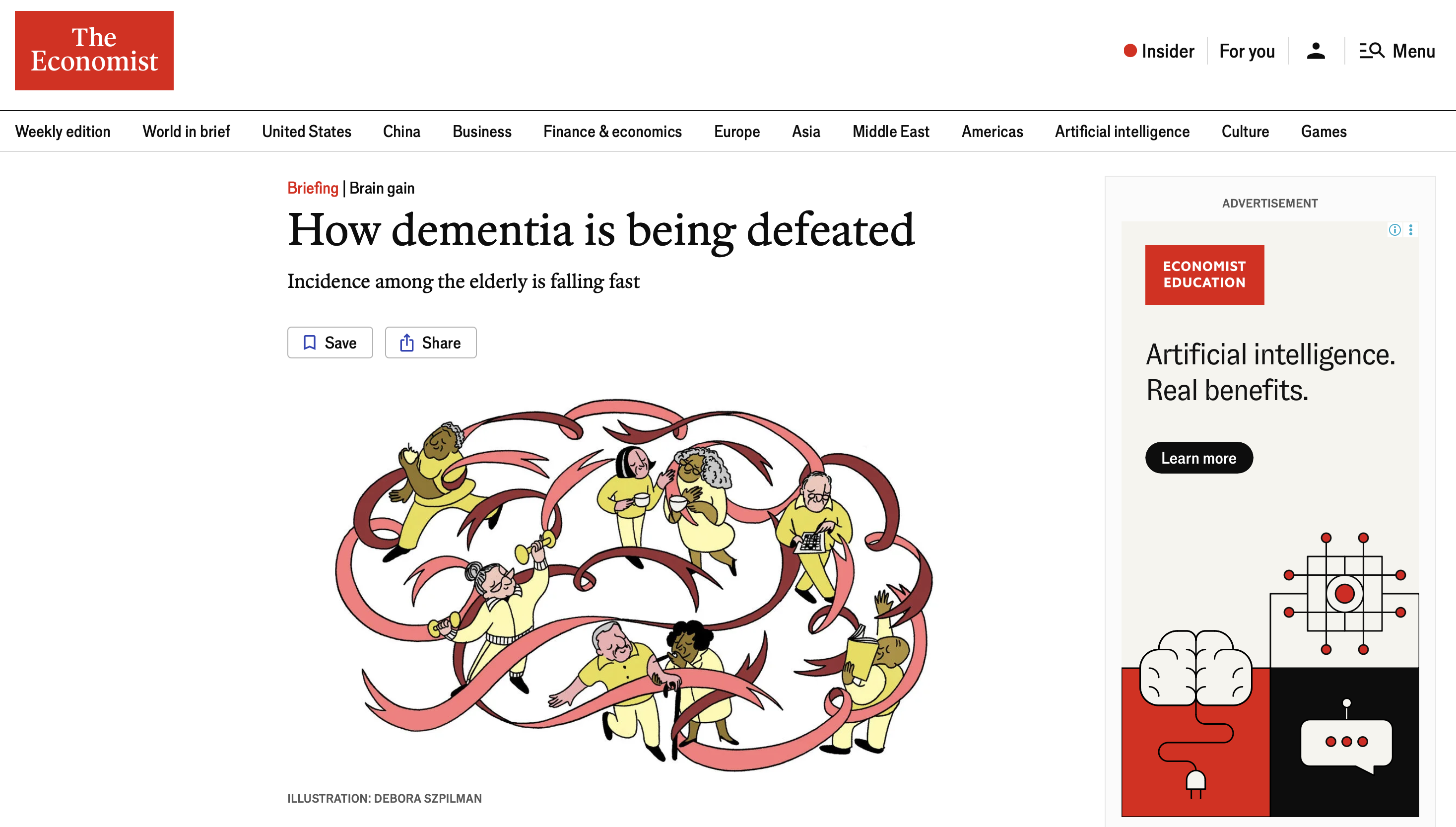
The Economist's own reporting was built on a genuinely excellent piece of science: Changing Story of the Dementia Epidemic, published in JAMA by Eric Stallard and two colleagues at Duke. And the core finding is real, and striking.
The cohort effect
We already know dementia rises steeply with age — almost nothing at 65, then climbing hard after 85. That part isn't news. What Stallard's team shows is something else: if you follow specific birth cohorts — not just "people who are 85 today" but "people born in a specific five-year window" — the percentage of them who develop dementia at a given age has been falling, generation after generation.
We already know dementia rises steeply with age — almost nothing at 65, then climbing hard after 85. That part isn't news. What Stallard's team shows is something else: if you follow specific birth cohorts — not just "people who are 85 today" but "people born in a specific five-year window" — the percentage of them who develop dementia at a given age has been falling, generation after generation.
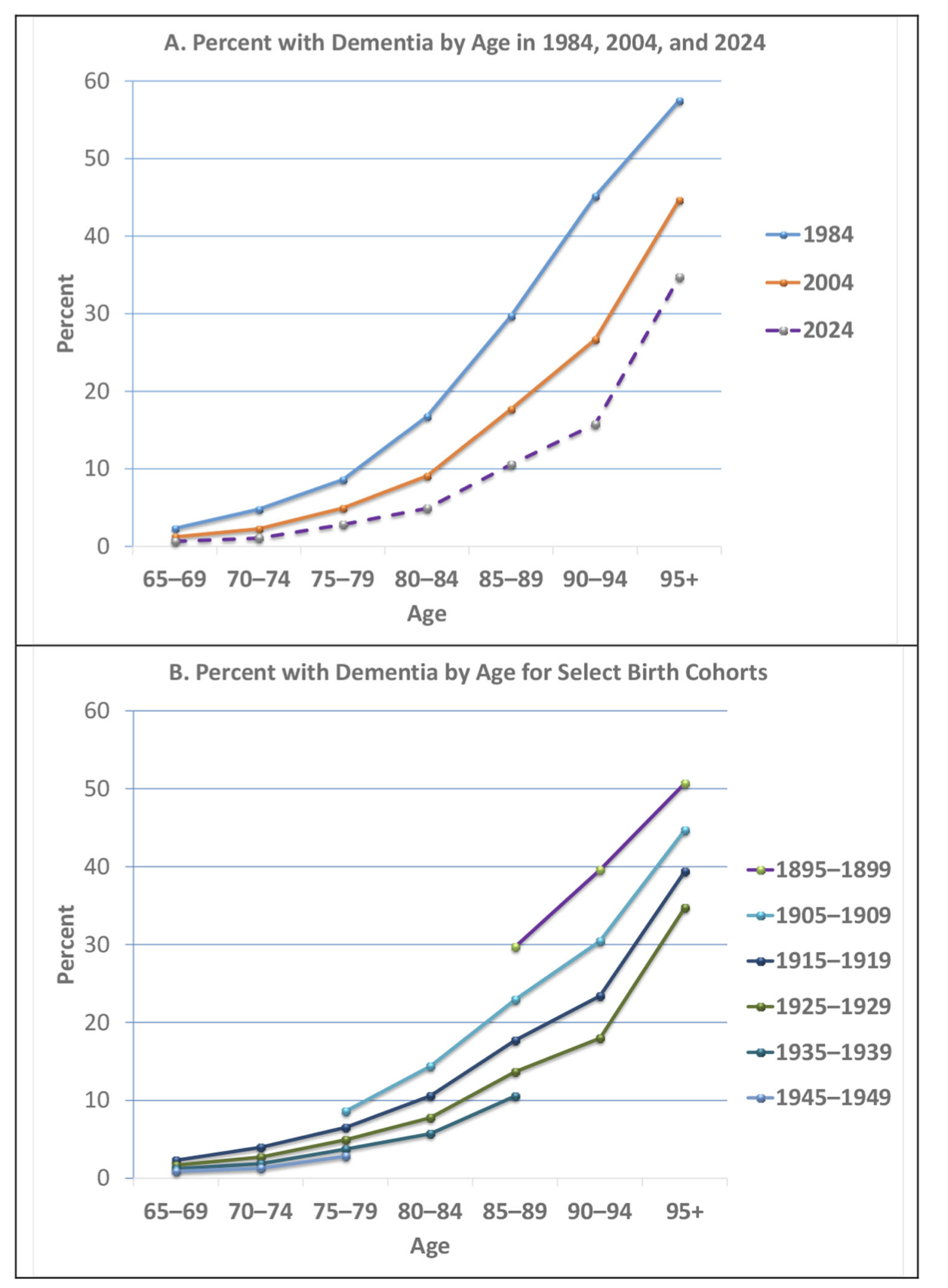
People born between 1895 and 1899 had roughly a 30% dementia rate by their late 80s. People born just forty years later, 1935–1939, hit the same age with a rate closer to 10%. The chart below — from the study itself — shows this cohort-by-cohort decline, alongside the same story told a second way: the period trend, comparing what an 85-year-old's odds looked like in 1984 versus 2004 versus 2024. Both views say the same thing. Whatever birth year or calendar year you slice it by, the line keeps dropping.
Read a chart like that, and the Economist's headline writes itself. Dementia: defeated.
Except it isn't
The reality, and the reason I'm writing this and not just re-sharing the headline, is that the epidemic is still coming — a real tsunami — despite the falling percentages, and despite the fact that we now understand the risk factors better than ever.
The reality, and the reason I'm writing this and not just re-sharing the headline, is that the epidemic is still coming — a real tsunami — despite the falling percentages, and despite the fact that we now understand the risk factors better than ever.
The percentage is only half the equation. The other half is the size of the population it's being applied to. And that population — people over 80 — is not shrinking. It's exploding. The baby boom generation, the huge cohort born 1946 through 1964, is now arriving at exactly the ages where dementia risk is highest, in numbers no previous generation has come close to. Even if the individual risk keeps falling as it has been, the raw count of people living with dementia is still expected to rise — some projections put it at around 25% more cases by 2050.
It's the same trap I saw many times working with data — mistaking a rate for a volume. A shrinking default rate on a loan book that's tripled in size is not the same thing as fewer defaults. A smaller slice of a much bigger pie can still be a bigger slice. The percentage tells you about risk per person. The tsunami is about how many people. Both are true simultaneously, and a headline that only reports one of them is telling you half the story, in the most flattering light available.
What you can actually do about it
The part of the JAMA piece I found most useful wasn't the demographic argument at all — it was the reminder of how much of this is still in our hands, and when in life it matters most. The Lancet Commission's 2024 report, which the Economist also drew its "mind map" from, lays out the modifiable risk factors and — critically — tags each one to the life stage where it does the most damage: early life, midlife, or late life.
The part of the JAMA piece I found most useful wasn't the demographic argument at all — it was the reminder of how much of this is still in our hands, and when in life it matters most. The Lancet Commission's 2024 report, which the Economist also drew its "mind map" from, lays out the modifiable risk factors and — critically — tags each one to the life stage where it does the most damage: early life, midlife, or late life.
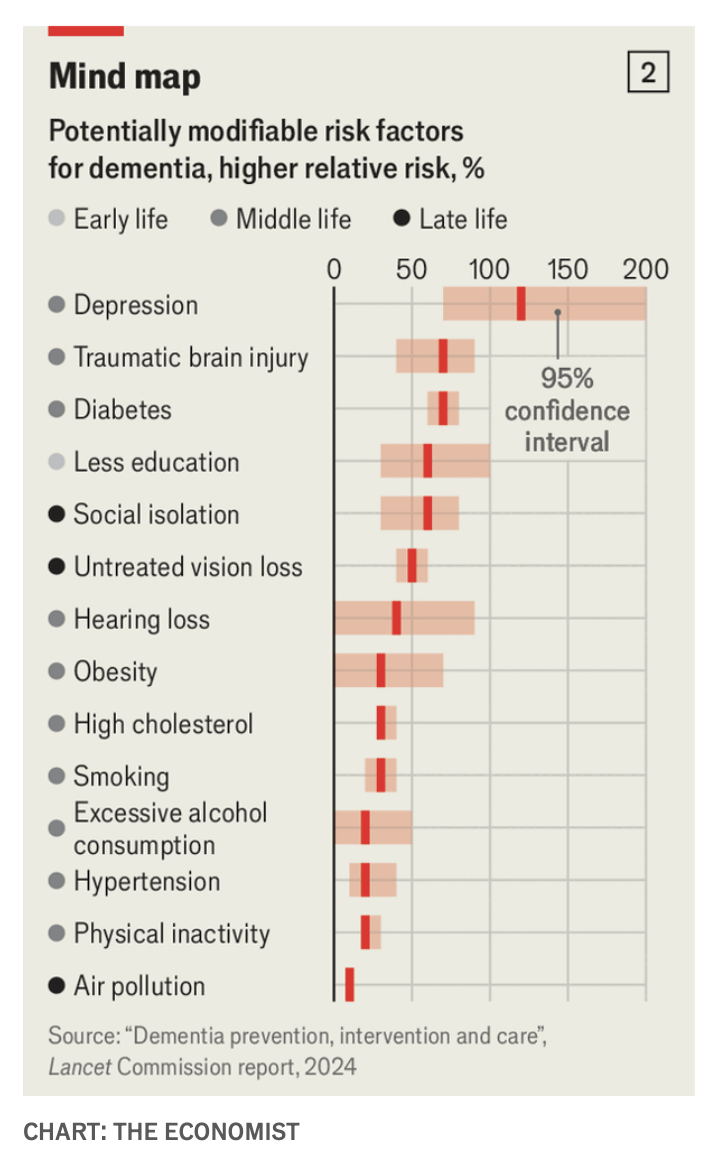
Depression carries the single largest relative risk on that chart, by a wide margin. Hearing loss and obesity aren't far behind — and both are things I already train around, one way or another. Physical inactivity sits lower on relative risk than I expected, but it's also one of the few factors that touches almost every other one on the list: sleep, weight, cardiovascular health, mood. It's the lever behind the other levers.
And then there's the piece that isn't modifiable at all: genetics. The gene most associated with late-onset risk, ApoE4, roughly doubles or triples your risk with a single copy. Around 2–3% of people carry two copies — for them, the risk runs 10 to 15 times higher than average. Worth knowing early, not as fatalism, but as a reason to work the modifiable 40% harder.
Sitting with it
What I keep coming back to is not the medicine, it's the epistemics. A well-constructed statistic, reported honestly, can still produce a completely misleading headline — not through dishonesty, but through omission. The Economist wasn't wrong about the rate. It just forgot to multiply by the population (or they did it but down the article, instead on the title;-)). And I think that's the more interesting lesson to carry out of this than anything about neurons or genes: growth in a number is not always growth in incidence. Sometimes the pie just got bigger. It's worth asking, every time, which one you're actually looking at.
The rate is falling. The wave is still coming.
- SL
Sources: P.J. Eric Stallard, Svetlana V. Ukraintseva, P. Murali Doraiswamy, "Changing Story of the Dementia Epidemic," JAMA, March 2025 (Duke University, Biodemography of Aging Research Unit). "Dementia prevention, intervention, and care," Lancet Commission report, 2024. The Economist.