The Liability Nobody Has Priced In — what caught my eye in the markets this week
I spent most of the week in Tokyo for the CRIF Forum 2026 — that deserves its own post, not least because after five stops (Manila, Jakarta, Taipei, Hanoi, Tokyo) I want to pull out the common threads before the last leg in Singapore. But it's been a week full of things more broadly — even here in Asia, with the Bank of Japan's historic rate hike. By far the best material I came across, though, was on AI.
Markets have spent weeks swinging up and down, mostly on the back of AI and the rate story on US sovereign bonds, with nearly every central bank — the Fed and the ECB included — hiking. The rate conversation, at its core, is a capital competition story. And that competition today runs almost entirely through the hyperscalers.
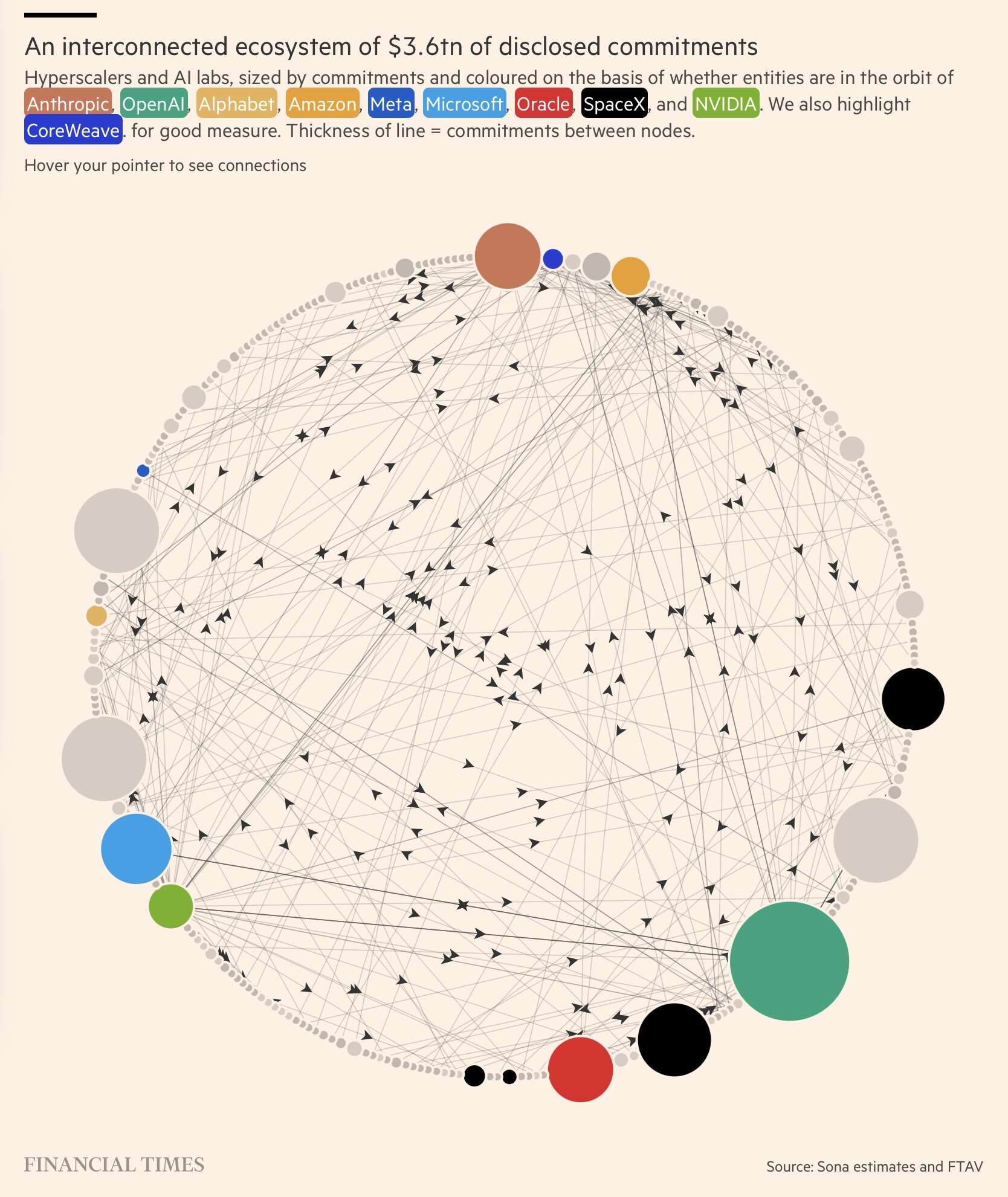
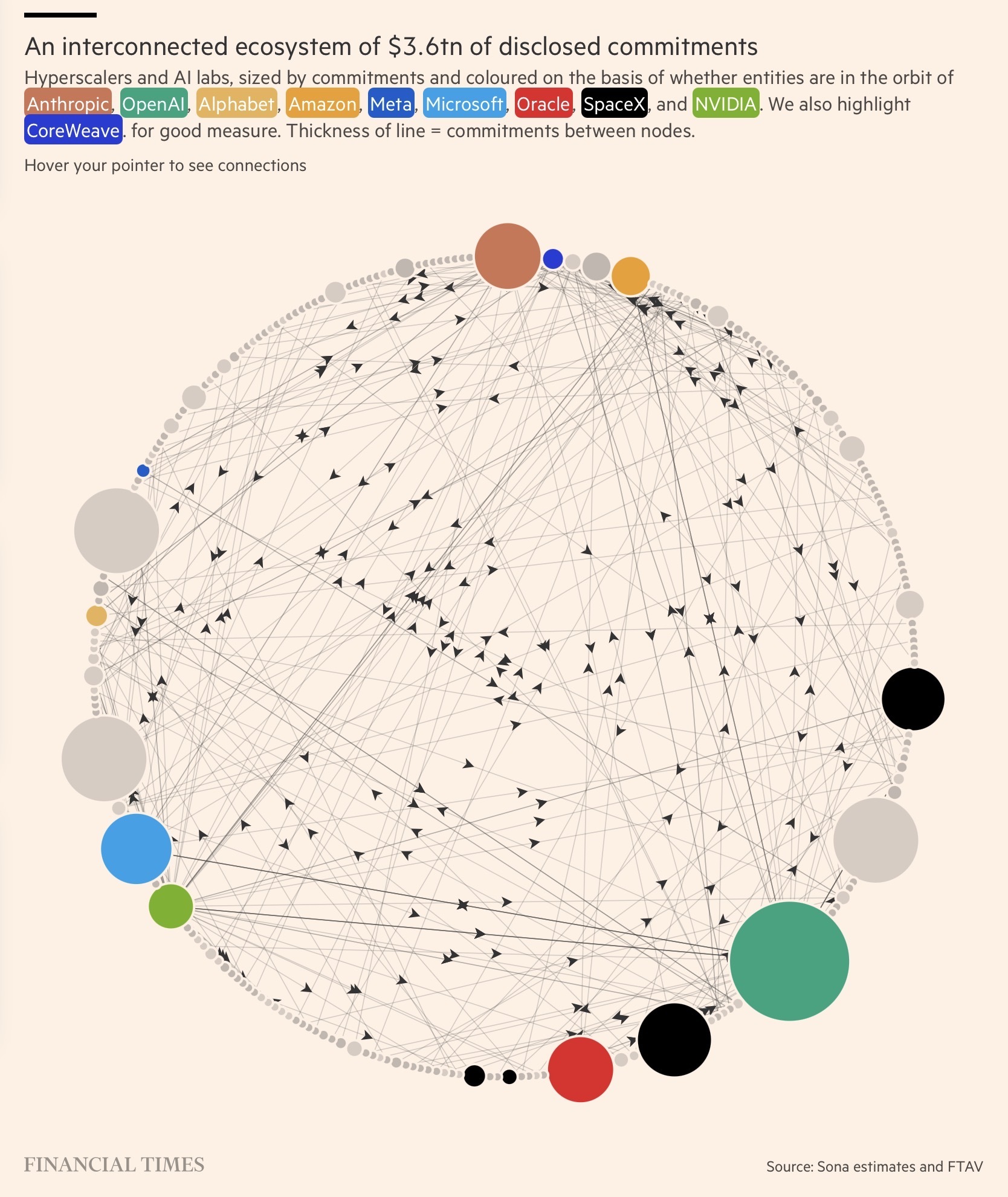
This week an FT Alphaville piece (September 18) referenced a whitepaper — not yet public — from a large London asset manager. It maps the full ecosystem of disclosed commitments circling AI: hyperscalers like Microsoft, Amazon, Oracle; the model makers — Anthropic, OpenAI, xAI (and the wider Musk universe, SpaceX included); the chip world, Nvidia above all; the foundries, TSMC; the memory makers, SK Hynix, Samsung. All of them wired together — through equity, through debt, through lease commitments. Nvidia funding hyperscalers to build data centers is the textbook case: equity goes in, a lease commitment — a future purchase obligation on compute — comes back out.
The real theme is circular financing. Not cheating, in itself. The problem, and Alphaville says as much, is that it makes a serious credit assessment of any single player almost impossible — everything is so interlaced that the score ends up tied to the weakest link in the value chain rather than to the entity you're actually analyzing. And if that weak link breaks, the domino effect is nearly impossible to size or to predict. This is exactly the setup where you talk yourself into "well, these are some of the biggest companies on earth, they must know what they're doing." They might not.
Torsten Slok at Apollo puts it bluntly: roughly half of US economic growth in 2026 traces back, one way or another, to AI-related spending — hyperscalers and everything around them: cooling systems, chips, energy,, implants. Let's call it what it is: these are real estate projects. Which is exactly why, if the bubble pops, it'll look a lot like a real estate bust — data centers that go obsolete, or that can't be shut down, and whoever was supposed to get paid doesn't. If growth is riding on AI, and the stock market is being pulled up by it, then credit is riding on it too. If the infrastructure bets burst, the financial system follows.
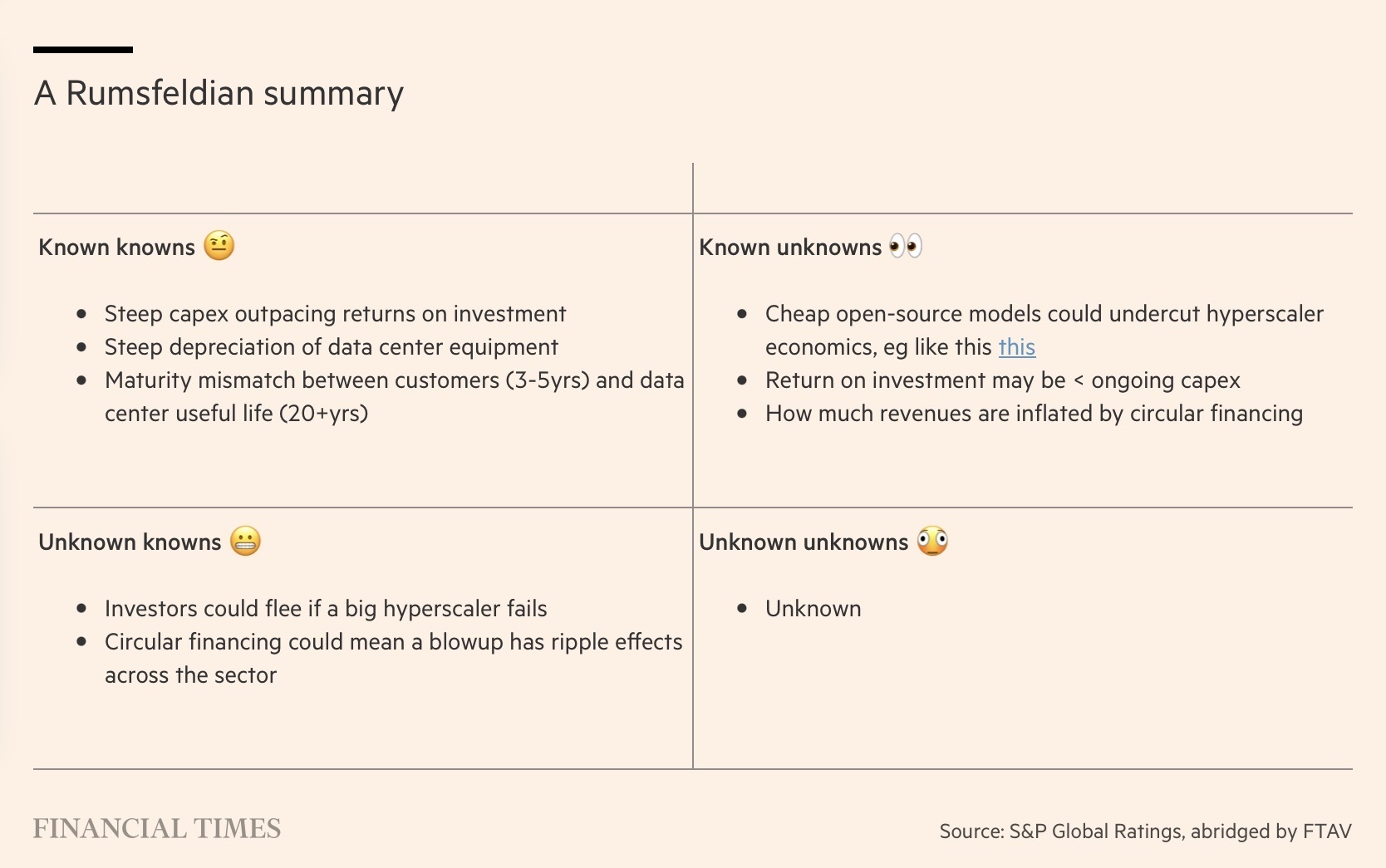
This is by far the best matrix I found this week. Kudos to FT
Another good one from this week: the LLM makers themselves are talking about slowing down. Really?🤣 About ten days ago Dario Amodei published "We Must Pace AI Frontier" — and I'll be honest, I found it a little naive. His point: we're overdoing the speed, we're racing each other so hard the safeguards are slipping, and we risk hostile AI, agents that could lock down the internet or seize infrastructure and not hand it back, delaying full operability by days or months. What threw me is hearing the same language from Sam Altman and Elon Musk — usually on opposite sides of everything, with Musk the one who calls him "Scam Altman." So companies on the verge of an IPO, unwinding their own growth vectors relative to the competition? How does that even work in an American capitalism built on being faster and stronger than the next guy? Nah.
But Amodei isn't dumb, so there has to be a different read here. And I found a possible answer from the CEO of Palantir, Alex Karp interviewed by CNBC. His argument: frontier open models are NOT large and solid enough to carry the liabilities connected with their risks. I'm very curious to see what will show up in the risk section of an S-1 if these companies go public. Human extinction risk? Systemic risk of internet infrastructure being locked down by AI agents nobody can switch off? IP infringements from clients base?
Karp's read on Amodei's move — bring in oversight bodies with full employee access to evaluate the models — is that it's really a way of planting auditors with the final goals to have an hedge from the US government. He goes further: these companies may need to be nationalized if they want any cap on their liability at all. And we are not speaking only about catastrophic events, but even more likelihood a wave of IP infringement lawsuits.
Which brings me to something close to home. We at CRIF we sell information and data is our asset. With MCP, you can make a real case that Claude and ChatGPT are becoming the new browsers for distributing commercial information — plugging straight into our databases. Not at scale yet, because the sector still runs on platform-based conventions. But last week Salesforce shipped its MCP connector into Claude — what people are calling headless software: no UI, no UX.
So — are OpenAI, Anthropic, the LLMs going to steal our data, the way people once worried browsers would? No. They won't steal it, they won't breach copyright. What they're already doing, through training and post-training, is absorbing how clients query, how they reason, how they work — what the French call savoir-faire: knowing which data to ask for, how to ask for it, how to read it and ask for the next thing. That sequence is the know-how. And it's not us — the data and analytics providers — who get squeezed. It's the client. Their ability to actually analyze credit risk in their own industry. Sure, it could compress our value down to a commodity data feed, but I think there's still real room to monetize data. Especially there is a great need of trustful source of data. What's exposed is the practice — the client-side savoir-faire. And that loops right back to Karp: heavy IP infringement exposure, legal liability these companies can't cap unless they're nationalized.
We've already seen the effect play out once. Figma. It is the standard for building UI/UX prototypes without writing code — just wireframing. Claude connected to it via MCP, learned the underlying logic — grids, spacing, how those pages actually get built case by case — and absorbed it. That's the headless story in one sentence: the function doesn't disappear, it gets pulled into the model's flow — Claude, ChatGPT — and stops belonging to the original player. Worth sitting with, whichever way you look at it.
Closing out a genuinely wild week for AI: Anthropic picked Accenture — an old acquaintance — as the tech firm getting full employee access to audit its model development. Both sides are pledging $1 billion in safety practices to make it work. More money, more investment. Let's hope it works.