Reflections from CRIF Forum Manila and CRIF Forum Taipei, June–July 2026
I walked into two CRIF Forums a few weeks apart carrying the same four numbers in my head: Philippines Q1 GDP growth of +2.8%, Taiwan's eye-popping +14.5%; Philippine inflation running at 6.4%, Taiwan's at a comparatively sleepy 2.6%. On paper, these looked like two economies moving in opposite directions — one growing modestly but overheating on prices, the other booming while somehow keeping a lid on costs. I had my own working theories walking in. Both turned out to be wrong, or at least incomplete — and the reason why says more about how to read economic data than about either economy specifically.
Lesson One, Manila: I blamed energy. It was rice.
My instinct on Philippine inflation was straightforward: energy costs, driven by the Iran/Strait of Hormuz tensions, must be the culprit. It's the obvious geopolitical story, and oil had moved — Brent was sitting around $80/barrel versus a pre-conflict $67, roughly a 19% jump.
RCBC's chief economist framed it differently at the forum: the dominant, "sticky" driver of Philippine inflation was El Niño, not oil. Really? Checking the actual CPI architecture afterward, the numbers back him up decisively:
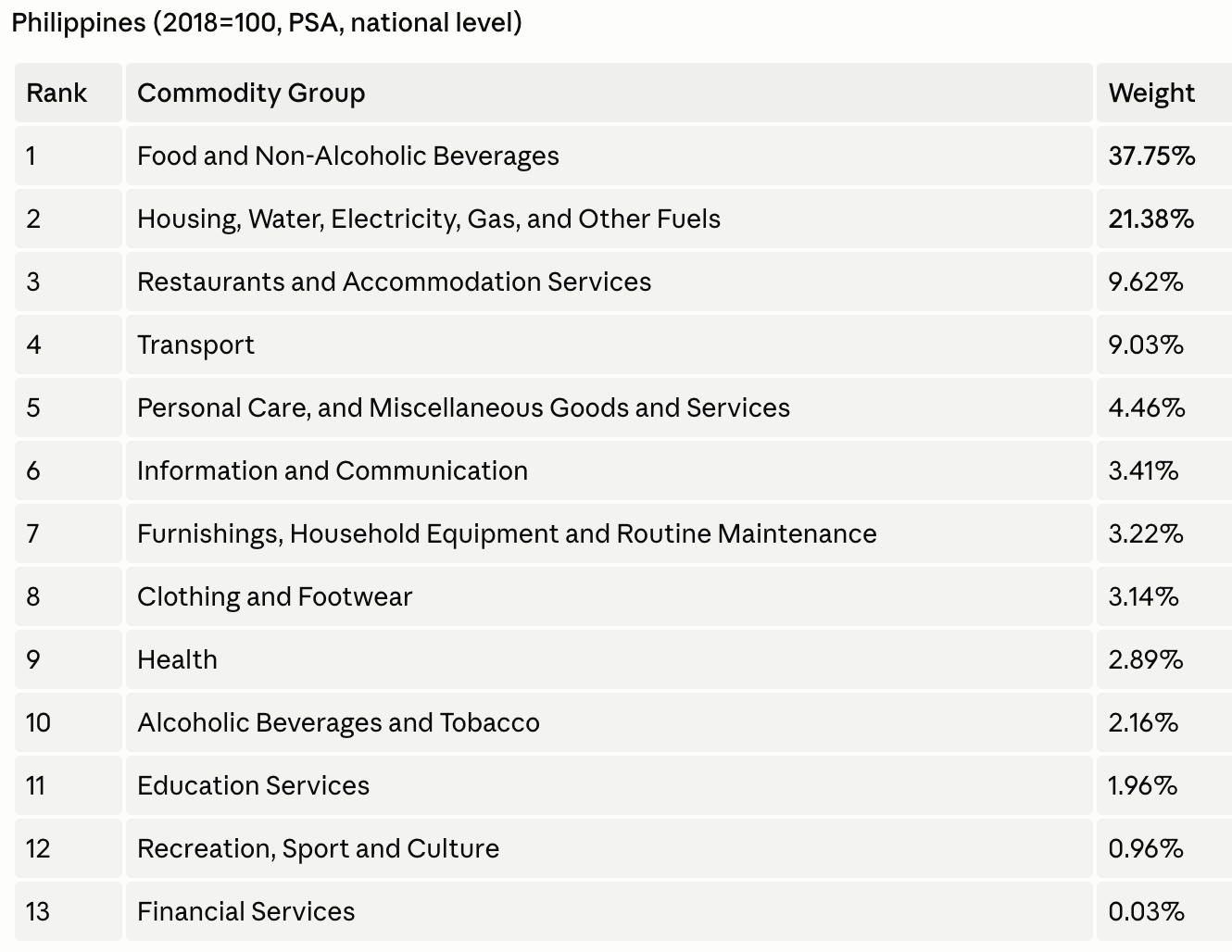
- Food and Non-Alcoholic Beverages carries 37.75% of the entire Philippine CPI basket — by far the single largest division. Cereals alone (rice, corn, flour) are officially weighted at 9.4%.
- Electricity, by contrast, is a real but much smaller line item — about 4.6% of the basket, priced through Meralco's deregulated, fuel-cost-adjusted tariffs.
- The oil shock itself was moderate by historical standards — a 19% move is a fraction of the 2022 Ukraine-driven spike, and it was already easing by the time of the forum, with a US-Iran deal reportedly under discussion.
- El Niño, meanwhile, is structural and ongoing — projected to persist until early 2027 — and it hits the single heaviest-weighted item in the entire basket directly.
Run the arithmetic and it's not close: a moderating, 19%-scale energy shock landing on a 4.6%-weight item simply cannot outmuscle a structural, multi-year supply shock landing on a 37.75%-weight item, even before you account for how directly rice prices pass through to headline inflation. I had the mechanism right (geopolitics matters) and the object wrong (it's agriculture, not energy, that dominates the Philippine basket).
Lesson Two, Taipei: the energy shock was real — it just never reached the register
Taiwan looked like the harder puzzle, because unlike the Philippines, Taiwan has essentially zero energy independence — it's fully exposed to global LNG markets, including the Qatar-linked supply tightness that pushed import costs up sharply. I expected that exposure to show up loudly in headline CPI. It didn't, and the reason isn't one thing — it's two things stacking on top of each other.
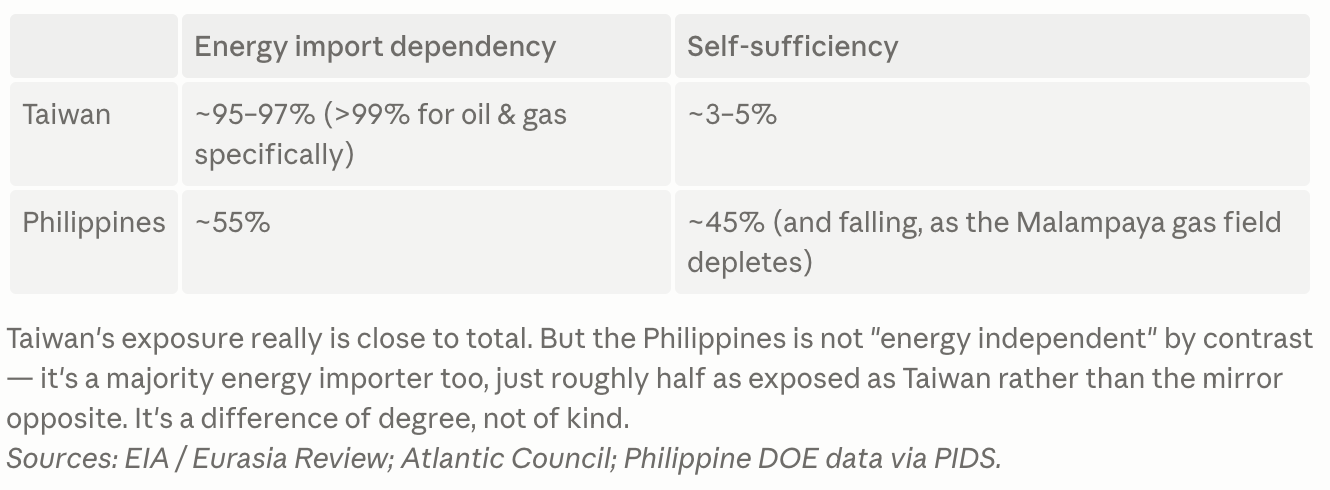
First, the price never actually moved for consumers. Taipower, the state utility, froze the household electricity tariff at NT$3.78/kWh even as its own LNG input costs surged over 140%. Instead of passing that through, Taipower absorbed it — accumulating roughly NT$418 billion (~US$13 billion) in losses by mid-2025. The cost didn't disappear; it moved off the CPI and onto the state's books. As one Taiwanese energy specialist put it, in market terms it would be "political suicide" to charge consumers the real price.
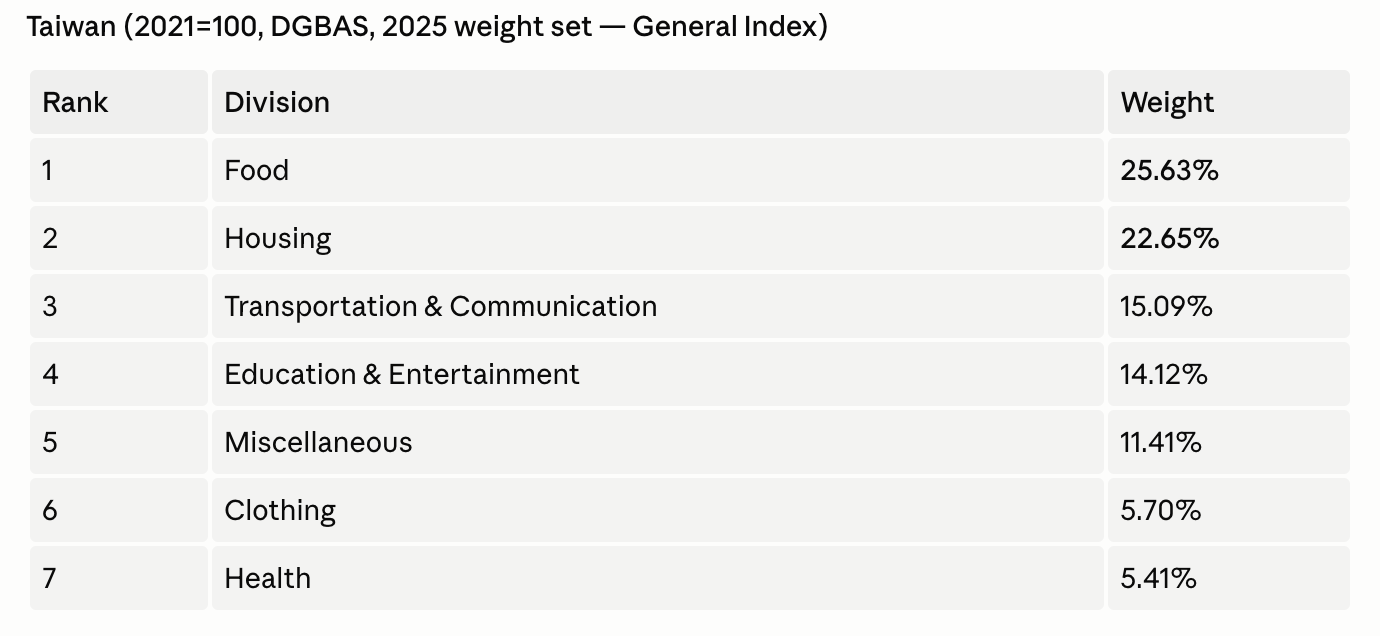
Second, even if that price had moved, its ceiling on headline CPI is structurally low. Pulling the actual DGBAS basket weights: household electricity is just 1.15% of Taiwan's entire CPI, gas another 0.3%, vehicle fuel about 2.4% — roughly 3.9% direct energy exposure in total, versus Food at 25.6% and Housing at 22.65%. Compare that to the Philippines' 4.6% electricity weight alone, and you can see Taiwan's basket was always going to be less energy-reactive by design, on top of being price-suppressed by administration.
That's the mechanical half of the answer. But it doesn't explain the growth side of the paradox — how do you post +14.5% GDP growth and still have almost nothing show up in consumer prices? This is where the forum conversations added the piece I was missing.
The real story: growth without diffusion
+14.5% GDP growth should, in any conventional model, generate some demand-pull inflation — more income chasing goods, upward wage pressure, price pass-through. It didn't, because the growth itself never reaches a broad enough base of the population to generate that demand pressure. Taiwan's headline number is overwhelmingly a TSMC-and-AI-supply-chain story: capital-intensive, export-oriented, concentrated in a narrow set of firms and a relatively small, highly specialized workforce. The revenue is real and enormous — but it accrues to shareholders, to a concentrated pool of high-skill engineers, and to foreign customers' balance sheets far more than it does to the wages and discretionary spending of the median Taiwanese household. Money that never reaches the median household's wallet can't bid up the price of groceries or rent.
Put the two mechanisms together and Taiwan's 2.6% inflation stops looking like a policy success and starts looking like two forms of absorption happening simultaneously: the state absorbing the true cost of imported energy onto its own balance sheet, and the corporate sector absorbing the gains of an unprecedented growth cycle without redistributing enough of it into consumer demand for that demand to bid up prices. Low inflation, in this reading, isn't evidence that "everything is fine" — it's evidence that both the cost side and the growth side are being kept, deliberately or structurally, away from the ordinary consumer.
Why this matters beyond curiosity
Both forums were nominally about something else — Manila's was framed around trusted data and business resilience, Taipei's around stablecoins and UBO transparency — but I left both with the same meta-lesson, which is really about how to read a macro headline at all: a GDP or CPI print is a weighted average, and the weights are where the real story lives. You cannot know whether 6.4% inflation is an energy story or a food story without opening the basket. You cannot know whether 14.5% growth is broad-based prosperity or a narrow supercycle without asking who actually captures the revenue. The number alone tells you the what; only the composition tells you the why — and the why is what actually matters for policy, for credit risk, and for anyone trying to forecast what happens next.
It's the same discipline, incidentally, that came up constantly in both forums under a different name: "trust but verify." Analysts kept repeating it about AI-assisted credit decisions and UBO look-through — don't take the surface data point at face value, look underneath it for what's actually driving the number. Turns out the same discipline applies to reading a country's inflation print over coffee between panel sessions.
- SL
CPI Basket Composition
Sources
- PSA OpenSTAT — Weights by Commodity Group for CPI, 2018-based
- PSA — Summary Inflation Report, Consumer Price Index (2018=100): June 2026
- DGBAS — Consumer Price Index (Base Year 2021) by Item Weight, 2025 weights
- Eurasia Review — Taiwan Energy Profile: Imports Over 90% Of Its Energy Demand
- Atlantic Council — The Iran war tests Taiwan's energy resilience
- PIDS — How Energy Secure is the Philippines?
- ChinaTalk — Taiwan's War on Renewables