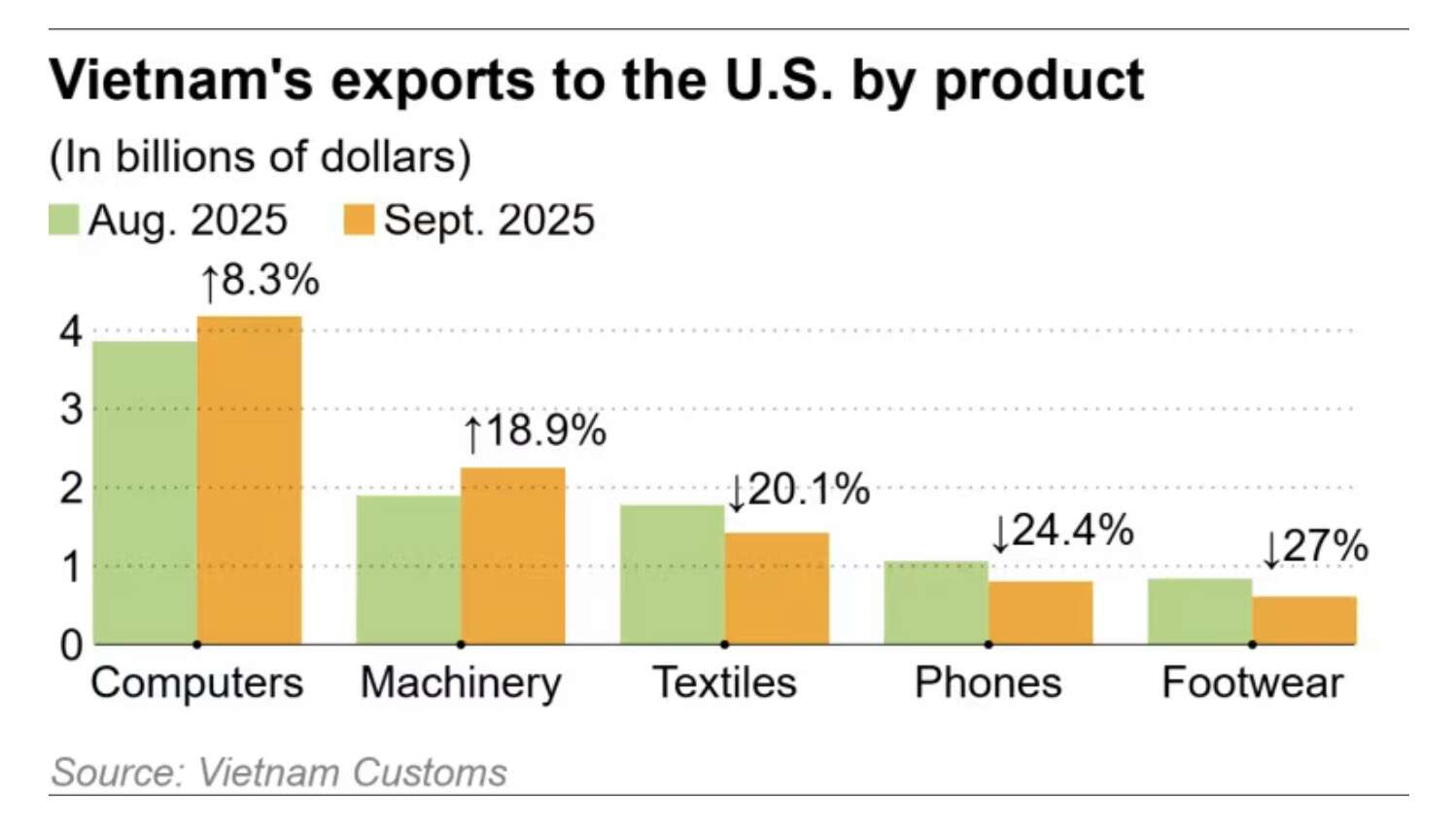
I had the confirmation on my thoughts: Vietnam is gaining momentum thanks to tariffs. They are shifting from low labour cost production to tech high margin powered by China and US driven investments.
In the past, both China and the U.S. invested in low-cost, low-margin manufacturing — textiles, sportswear, footwear. Today, we’re witnessing a clear shift toward high-margin, technology-driven production.
Vietnam is emerging as one of the biggest winners in the tariff war. Despite a 20% duty on exports to the U.S., it remains advantageous for Chinese companies to invest there — not merely for trans-shipment (which would trigger 40% tariffs) but to relocate full manufacturing operations and serve global markets directly from Vietnam rather than from China.
Export data confirms this shift. Apple, Samsung, and even companies like Coherent, a leader in optical materials, are ramping up production investments in Vietnam.
“The days are gone when a Chinese company would say, ‘I’ll set up one assembly unit in Vietnam, screw everything together, and keep my profits in China.’ Today, when companies decide to leave China, they move their entire footprint — that’s why the projects are getting larger,” said Bruno Jaspaert, General Director at DEEP C Vietnam.
“Before, China was the factory of the world. Today, China is supplying the machines for all the factories in the world,” Jaspaert told Nikkei Asia.
China is evolving from being the factory of the world to becoming the owner of the world’s factories. Once the world’s largest buyer of machinery, it is now one of its main suppliers.
Since 2018, Chinese machinery exports have increased 2.5× — reaching $29 billion in 2024, and by September 2025 already hitting $25 billion