Hello hello! Welcome to this week's edition of Sunday Chillin'! A blustery week in the 100-acre-wood here but I have Survived. Hope everyone has been staying warm and healthy!
Dark Sky
I've been thinking about pollution a lot recently, but not the pollution you might be imagining. I'm talking about light pollution, which is the brightening of the night sky due to man-made lighting.
Light pollution is what prevents those of us in cities from seeing basically any stars at all. If you had looked up at the night sky in the year 1000, it would've felt like you were on a completely different planet. In the darkest areas of the world (designated as Bortle Class 1 Dark Sky locations), on a clear night you can still see upwards of 9000 stars. Compare that to cities that are designated Class 8 or 9 (looking at you, NYC and Beijing) and even on a clear night, you can only see <10 stars. Only the brightest stars and planets remain visible in these sorts of environments. [1]
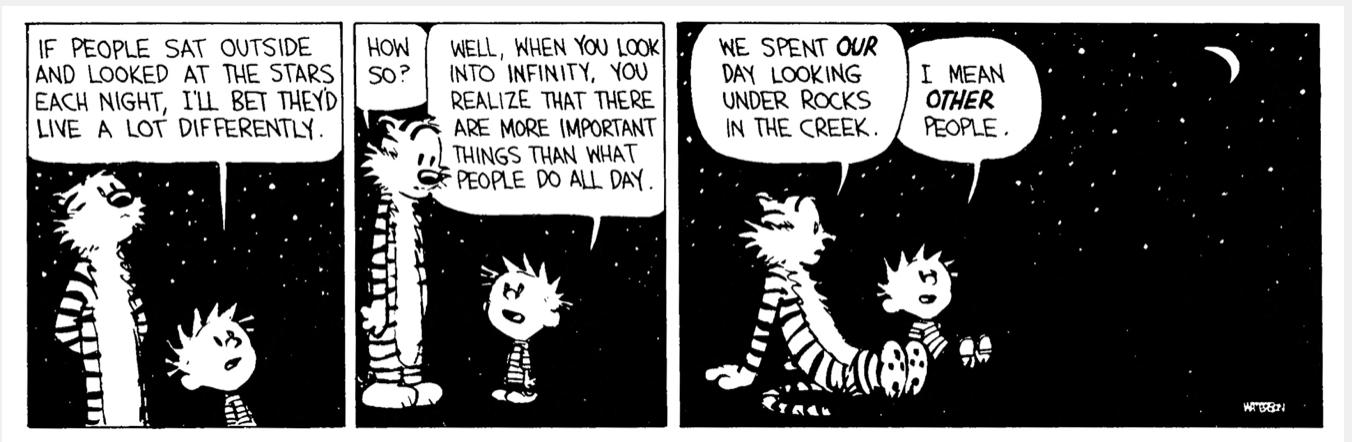
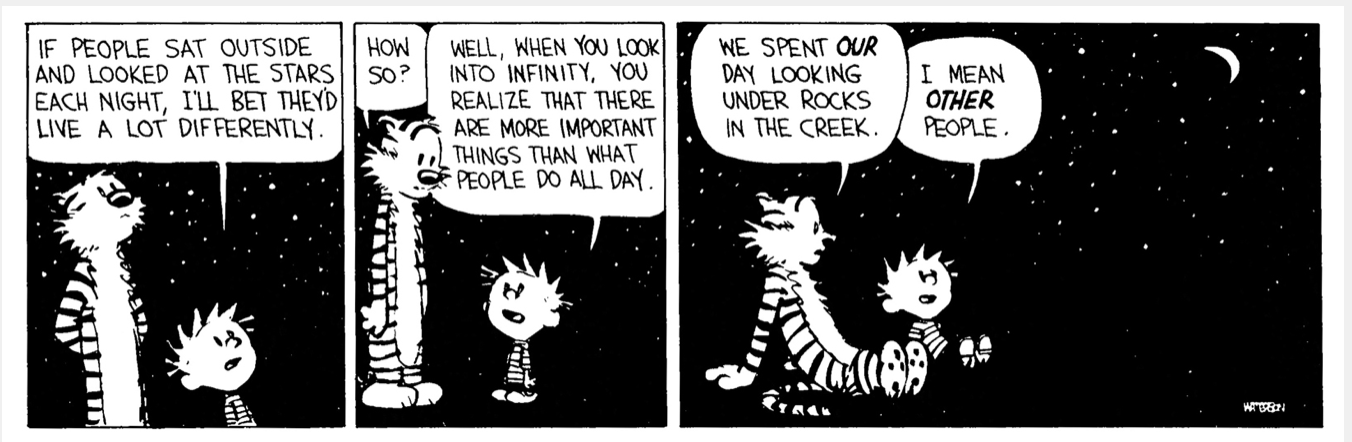
This inability to view the stars probably contributes in no small part to our general disconnect from nature. If people could gaze at a sea of stars every night, maybe they'd have a different view of humanity's place in the universe. Normally I'd put this in a footnote, but Bill Watterson has a really wonderful comic about this exact thing, please give it a look. [2]
But light pollution now affects more than just our enjoyment of nature; it also impacts our health. Human beings follow an internal "clock" of sorts called the Circadian Rhythm, and this is what dictates our mood and energy variations throughout a day. [3] It's now being shown that our usage of bright LED lighting in almost every circumstance is throwing off this natural rhythm.
In the past, humans would feel sleepy at night because our bodies associated the setting of the sun with rest. After all, if all you could carry was a torch (at best), then you'd probably call it a day circa 7pm. Nowadays though, you can just turn on your Feit Electric® 100-Watt Bright White (2700K) T3 R7 Short Base Dimmable Halogen Light Bulb (2-pack) and illuminate the surrounding areas with ease. [4]
Or maybe you've experienced the extreme brightness of new car headlights when you've been driving at night. Car headlights (and every other light) just keep getting brighter and brighter, which I find dubious, even from a safety standpoint. Sure, now I can see 200 feet in front of me on a dark and lonely road on a cloudless night while I hear the baying of wolves in the distance as I travel to my ailing grandmother's house to bring her a basket of blueberries, which she needs immediately. But in more practical scenarios, I'm also blinding and distracting every incoming driver for like half a mile.
All of these things contribute to our irregular melatonin levels and the rise in sleeping-related disorders in the general population. There's a lot more to write about this topic though, and I don't want to bore you with all the details today. But maybe in this case, brighter does not equal better, and we should spend more time appreciating the darkness. [5]
I plan on visiting a Class-1 location sometime this year, and I invite you all to do the same. Go see the stars, and marvel at the fact that you're seeing the same sights that people saw thousands of years ago. What a cool thing to be able to experience. ·͜·
Some Tunes For You This week's songs are just songs that I think would be nice to listen to under a clear sky while lying on the hood of your car (or something equally heartwarming). At first I was going to try to tie them together some way musically, but I decided to share a few types of songs instead. Different strokes for different folks after all, but I hope you find something you like!
That's all for this week folks, hope to bump into you while wandering through a dark sky location (we won't be able to see each other because of the lack of light, hopefully).
See you all next Sunday!
suhaas ———————————————————————————— If you'd like to share this newsletter with your friends, please direct them to this link. Here are Spotify and YouTube playlists with all the songs so far.
[1] One of my most controversial opinions is that Times Square is actually pretty cool. A true monument to capitalism and one of the few places in where you can experience the brightness of daytime 24/7! On your next visit there, be sure to take a book with you and read under the glare of the giant LCD screens that illuminate the area. If you do it just right, you can be in everyone's way simultaneously, which is the most Times Square-y thing you could do. Btw, for those of you that live in suburban areas, I regret to inform you that that's still around Class-6 or 7, so you're not Living It Up either.
[2] I absolutely adore Bill Watterson and am of the opinion that there's a Calvin and Hobbes comic for every situation. We have the entire C&H collection at home and I try to read through it once a year. It's a hefty set (10 years of comics!) but always worth it. More comics sure to follow.
[3] This is why so many people feel sleepy around 2-4pm, and probably also what led to the "siesta." I don't know the exact evolutionary reason for this lethargy, but if I had to guess, it's because that's the hottest period of the day and we evolved to conserve our energy then. Although the sun reaches its highest point in the sky at around noon, it takes a little bit of time for all the air and ground to heat up, hence the delay. Of course, if you happen to pound 4-6 cups of coffee per day, I suppose your body's natural rhythms are of little concern.
[4] I know what you're thinking: "but Suhaas, lightbulbs have been roughly the same power (60 watts) and hence the same lumens (roughly 800) for the last 30+ years!" Turns out that although that is true, we've started to shift our lightbulbs to be more and more blue. The regulatory processes for labeling lightbulb brightness intensities use light meters that measure the strict lumen output of bulbs. But the human eye is much more sensitive to blue light than it is to, say, red light. So as we modify our bulbs to be more blue, they actually appear much brighter in our field of vision. This is also part of what is contributing to the blue-light disruption of our sleep. I'm unlikely to stop watching YouTube videos late into the night anyway though, what's done is Done.
[5] Of course, the big caveat here is that bright lighting does make the world much safer. I'm not advocating for darkening all of our cities as this would greatly endanger many women and marginalized people. That would be like telling the ancient hunter-gatherer to put out his campfire while hungry ocelots and rabid giraffes gather round. That's not an ancient self-help book I could sell with a good conscience.