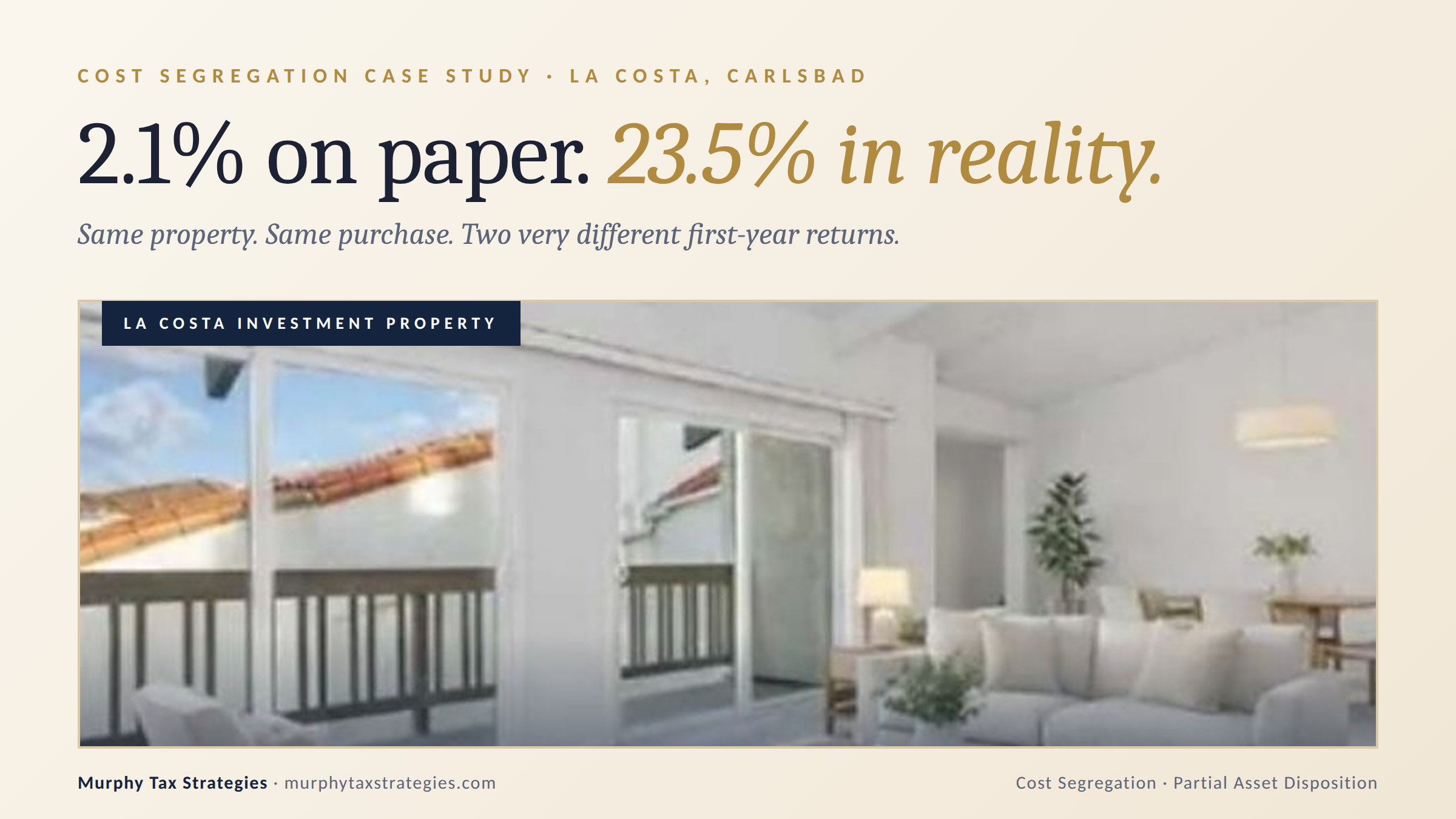
Same property | Same purchase | Two very different first-year returns.
2.1% on Paper, 23.5% in Reality: A Cost Segregation Case Study on a La Costa Investment Property
Most investors judge a rental by cash-on-cash return. In coastal Southern California, that number is often thin enough to kill the deal. It also leaves out what the tax code can add in year one. This case study is an engineering-based cost segregation study we recently completed on a remodeled investment property in La Costa. It shows how large that gap can be.
The Deal
The investor bought the condo, completed a full interior remodel, and placed it in service as a long-term rental in January 2026.
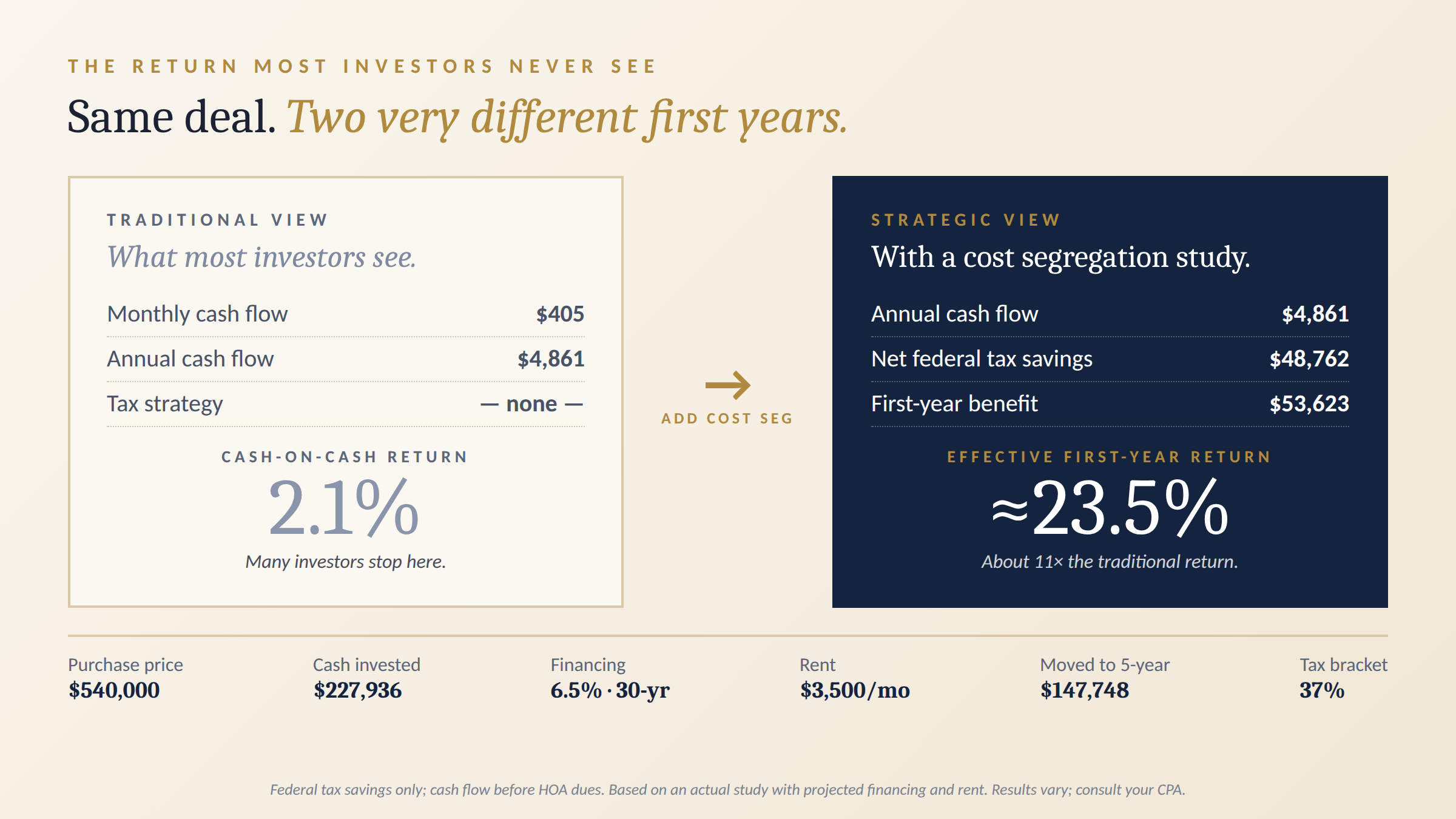
Purchase price: $540,000
Down payment (25%): $135,000
Remodel and improvements: $92,936
Total cash invested: about $227,936
Financing: $405,000 at 6.5%, 30-year fixed
Monthly payment (PITI): about $3,095
Monthly rent: $3,500
Investor's federal tax bracket: 37%
The Traditional View
Rent of $3,500 against a $3,095 payment leaves about $405 a month, or $4,861 a year, before HOA dues and other operating costs. Against $227,936 of cash invested, that is a cash-on-cash return of about 2.1%.
Many investors stop here and decide the deal doesn't work.
The View With Cost Segregation
The engineering study broke the property's $622,936 depreciable basis (building plus remodel) into its actual components:
Class lifeClassificationCost basis5-year | §1245 personal property (cabinetry, millwork, flooring, appliances, specialty electrical and plumbing, and more) | $147,748 27.5-year | Residential rental building and structural components | $475,188
Nearly a quarter of the depreciable basis moved into the 5-year category. Because 100% bonus depreciation now applies permanently to qualifying property acquired after January 19, 2025, that entire 5-year portion can be deducted in the first year.
The result:
Additional first-year depreciation: $142,599
Estimated federal tax savings at 37%: $52,762
Study fee: $4,000
Net tax savings after the fee: $48,762
Add the $4,861 of cash flow, and the first-year economic benefit is about $53,623, or roughly 23.5% of the cash invested. That is about 11 times the traditional return.
Put another way, what looked like $405 a month in cash flow is worth the equivalent of about $4,470 a month in year one.
Where the Deduction Came From
The main 5-year components were:
Cabinetry and millwork: kitchen cabinets, countertops, shelving and moldings
Flooring: carpet, vinyl tile and the new wood plank flooring from the remodel
Specialty plumbing and electrical: the sink and appliance connections serving specific equipment, not the building
Appliances, window treatments, accent lighting and data wiring
This is why remodeled properties often produce strong studies. Much of what goes into a kitchen-and-flooring renovation is short-life property, not part of the building.
What Is Cost Segregation?
The IRS normally depreciates a residential rental as one asset over 27.5 years. A property is really hundreds of components, and many of them have much shorter recovery periods.
A cost segregation study is an engineering-based analysis that identifies those components, prices them with recognized construction cost data, and assigns each one its correct class life. The total depreciation over the life of the property doesn't change. What changes is how much you can take now.
What Is Partial Asset Disposition?
Partial Asset Disposition (PAD) applies later in ownership. When you replace a component, such as flooring, a water heater or an HVAC unit, PAD lets you write off the remaining undepreciated value of the part you removed. Without a study, that old value stays on the books even though it's gone.
A study done at purchase gives you the cost figures you need to claim PAD on future renovations.
Before You Count on It
Passive activity rules. Long-term rental losses are generally passive. A high-income investor usually can't use them against W-2 income unless they qualify as a real estate professional. Otherwise the losses offset other passive income or carry forward until they can be used or the property is sold.
California doesn't follow federal bonus depreciation. The savings here are federal. For state tax, California depreciates on its own schedule.
Recapture. When you sell, the accelerated depreciation is generally taxed back. A 1031 exchange can defer it. Plan for your exit when you plan the study.
For Real Estate Agents
Most agents show investor clients cash-on-cash return. Showing them the full first-year picture sets you apart as an advisor, and money freed up in year one often funds the client's next purchase. Sometimes the best way to grow sales is to help current clients buy again.
Who Should Consider a Study
Investors in the 32%–37% federal brackets
Owners of properties placed in service after January 19, 2025
Investors who have remodeled or plan to remodel
Real estate professionals who can use the losses now
Owners who never ran a study on a property bought in prior years. A look-back study can catch up the missed depreciation without amending returns.
Engineering-Based Studies and IRS Compliance
This study followed the approach laid out in the IRS Cost Segregation Audit Techniques Guide. That included a site visit, R.S. Means cost data, engineering take-offs, and a reconciliation of every allocated dollar back to total cost. That level of documentation is what holds up if the study is examined.
Every Property Is Different
The land allocation, the share that qualifies as short-life property, your bracket, and whether you can use the losses all affect the outcome. This property's results reflect its remodel and its facts. Yours will reflect your own.
Frequently Asked Questions
Is cost segregation worth it on a single condo? It can be. On this property, a $4,000 study produced about $48,800 in net first-year federal tax savings. Remodeled units and higher-bracket investors tend to see the strongest results.
Is bonus depreciation still 100% in 2026? Yes. Under the 2025 tax law, 100% bonus depreciation is permanent for qualifying property acquired after January 19, 2025.
Do remodel costs qualify? Partly. On a residential rental, items like cabinetry, countertops, flooring and appliances are usually 5-year property and qualify for bonus depreciation. Structural work like electrical, HVAC and painting stays on the 27.5-year schedule.
Can I use these losses against my salary? Usually only if you qualify as a real estate professional. Otherwise they offset passive income and carry forward.
What happens when I sell? The depreciation is subject to recapture. A 1031 exchange can defer it.
If you own or are buying an investment property and want to see what a study would show, I'm happy to run the numbers.
Results based on an actual cost segregation study, with financing and rent shown as projected. Individual results vary with property, financing and tax situation. Consult your CPA or tax advisor about your own circumstances.
Topic: La Costa investment property (long-term rental). Written a day early in place of the scheduled Friday post. Fact-check the tax figures with your CPA before publishing.