Buy It, Improve It: How Two Cost Segregation Studies Produced an Estimated $18.6M in Tax Savings
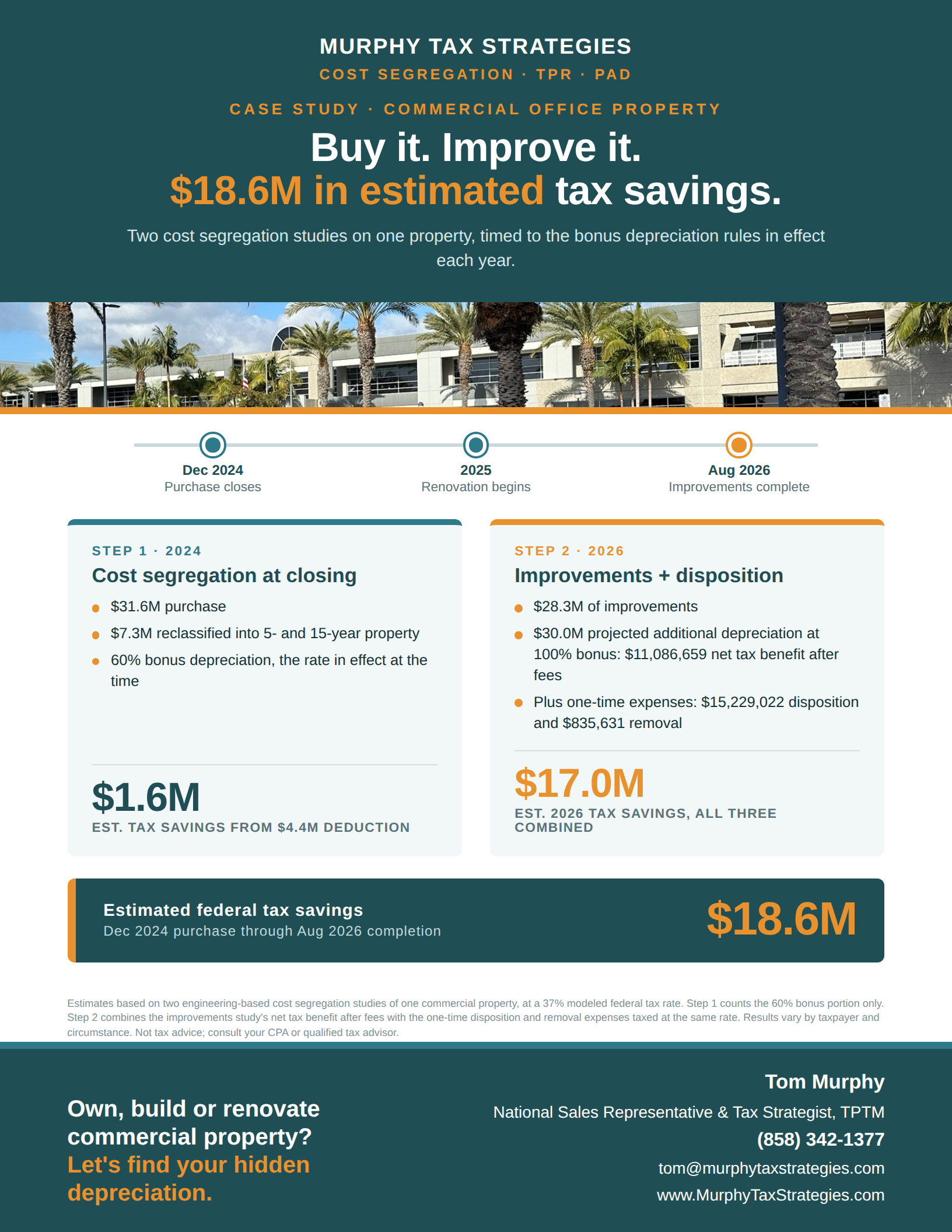
Cost segregation isn't a one-time event. Timing it to the bonus depreciation rules in effect each year can change the result dramatically.
Most commercial property owners think of cost segregation as something you do once, at purchase. A recent engagement on a commercial office property shows why that undersells it. Two engineering-based studies, done at two different points in the asset's life, each captured a different opportunity.
(Details that could identify the owner or the property have been left out at the client's request. The figures come from the final studies.)
Step 1: Cost segregation at closing (December 2024)
The owner closed on the property in December 2024 at a cost basis of $31.6 million. Rather than depreciating the whole building over 39 years, the engineering analysis separated out components that qualify for shorter recovery periods:
- $3.1 million classified as 5-year personal property
- $4.2 million classified as 15-year land improvements
- $24.3 million remaining as 39-year structure
That moved about $7.3 million onto accelerated schedules. At the time, bonus depreciation was 60%, which produced roughly a $4.4 million deduction and an estimated $1.6 million in federal tax savings.
Step 2: Improvements and disposition (2025 to 2026)
Renovation began in 2025 and finished in August 2026. The second study covered about $28.3 million of improvements and applied the Tangible Property Regulations to everything removed along the way. Under the current rules, qualifying improvements are eligible for 100% bonus depreciation.
- $30.0 million of projected additional depreciation at 100% bonus, worth $11.09 million in net tax benefit after fees, including $19.3 million of non-structural interior work classified as 15-year Qualified Improvement Property
- $15.2 million of original building components were removed or replaced, so their remaining basis could be written off through a Partial Asset Disposition instead of depreciated for decades
- $0.8 million of removal costs were expensed rather than capitalized
The disposition and removal are a one-time deduction in 2026. Taxed at the same rate, the $16.1 million of one-time expense adds about $5.9 million to the $11.09 million from the improvements, for an estimated $17.0 million in federal tax savings in 2026.
The bottom line
Deduction Est. federal tax savings
- Step 1: Closing, Dec 2024 (60% bonus) | $4.4M | $1.6M
- Step 2: Improvements complete, Aug 2026 (100% bonus) | $46.1M | $17.0M
- Total | $50.4M | $18.6M
Estimates use a 37% modeled federal rate and count only the bonus portion of the Step 1 deduction. Individual results vary.
Three lessons for property owners
1. Revisit the building after every major improvement, and watch the bonus depreciation rate. The same kind of study can produce a very different result depending on the year it lands in.
2. Don't forget what you tore out. Without a Partial Asset Disposition election, the remaining basis in a removed roof, HVAC system or interior buildout keeps depreciating as though it were still there. Writing it off is often one of the largest line items.
3. Get the Tangible Property Regulations right first. The TPRs are mandatory, and any depreciation schedule has to be scrubbed under them before a cost segregation study can be layered on.
Is your property a candidate?
If you own, develop or renovate commercial or non-owner-occupied residential property, including office, multifamily, hospitality, senior living and rentals, there is a good chance a study, or a second look at an earlier one, would surface savings.
Reach out for a free assessment: (858) 342-1377, tom@murphytaxstrategies.com, or use the savings calculator at murphytaxstrategies.com.
Tom Murphy is National Sales Representative and Tax Strategist at TPTM (Tangible Property Tax Methods).
This post is for general information and illustrates results from a specific prior engagement. Tax outcomes depend on individual circumstances. Please consult your CPA or qualified tax advisor about your situation.